
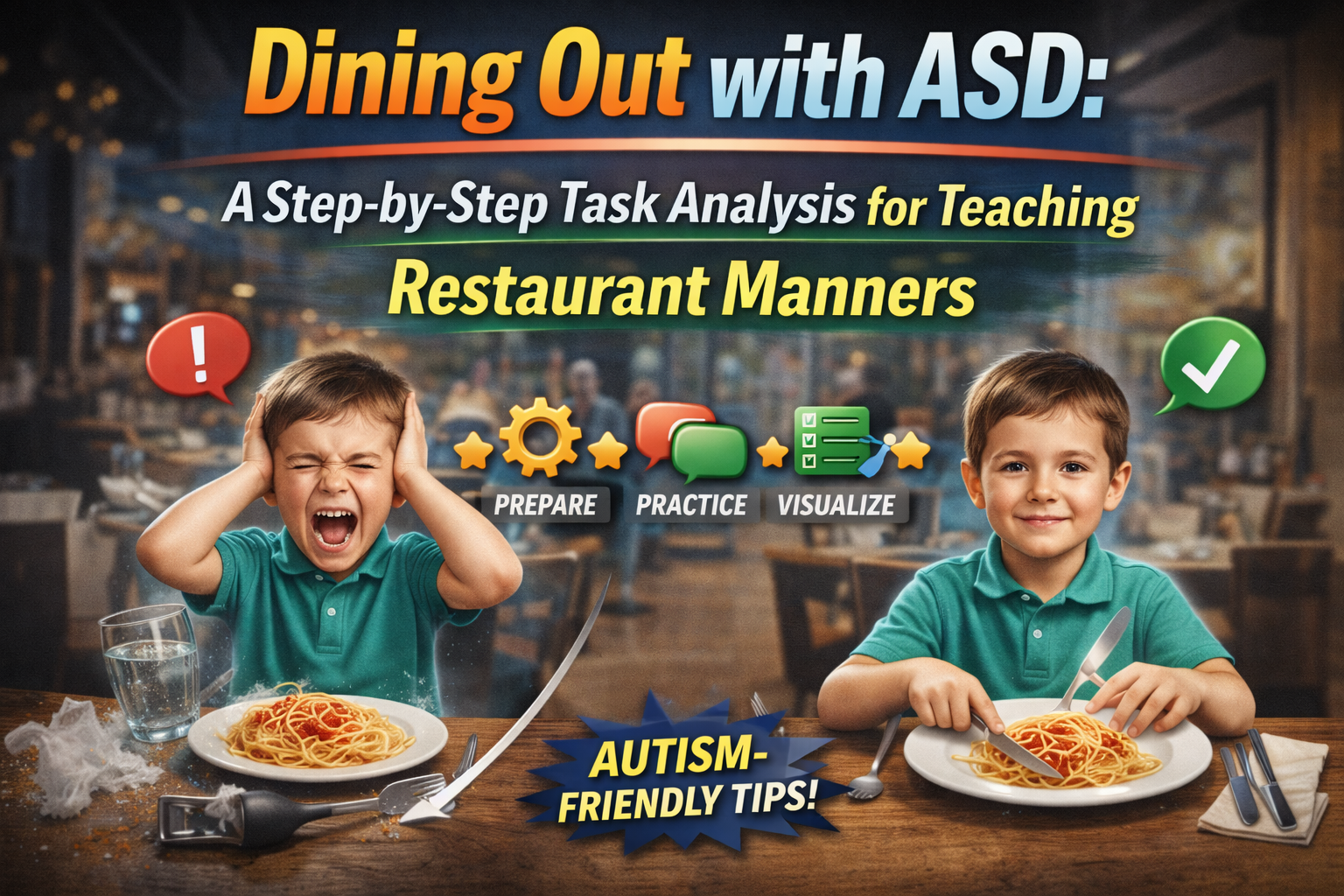
Dining Out with ASD: A Step‑by‑Step Task Analysis for Teaching Restaurant Manners

ABA Clinic
task analysis for autism

For many families raising children with autism spectrum disorder (ASD), a simple meal at a restaurant can feel overwhelming. Sensory overload, unpredictable routines, and social expectations make dining out with autism a uniquely challenging experience. Yet for your child to participate in everyday life — from family celebrations to school outings — mastering restaurant manners for kids with ASD is essential.

In this blog, we’ll walk through a complete task analysis for dining out, offering clear, teachable steps to support your child’s success. Drawing on practical strategies and clinical insight, this guide helps parents turn each restaurant experience into a meaningful learning opportunity.

Why a Task Analysis Matters

task analysis in autism breaks a complex activity — like eating at a restaurant — into small, teachable parts. Rather than expecting your child to “just know” how to behave, you teach each step explicitly, monitor progress, and reinforce success. This approach is especially effective for children with ASD because it provides structure and clarity.

Using a well‑designed task analysis supports skill development in:

  • Social communication in public
  • Self‑regulation in new environments
  • Adaptive behavior in family and community settings
  • Executive functioning — planning, sequencing, and problem solving

With repetition and reinforcement, these skills spill over into other areas of life, helping your child feel more confident and capable in social settings.

Step 1: Prepare Before You Go

Preparation is the foundation of success. Children with ASD thrive when they know what to expect.

Create a Social Story

Before your restaurant visit, share a social story describing:

  • Where you’re going
  • What you’ll do when you get there
  • Expected behaviors (sitting in a chair, using an inside voice)
  • How long you’ll stay
  • What happens next (dessert? home? playtime?)

Use visuals and simple language tailored to your child’s communication level.

Step 2: Practice at Home

Before stepping into a real restaurant, rehearse at home.

Role‑Playing

Set up a pretend restaurant with:

  • A table and chairs
  • A menu (even if it’s homemade)
  • A “server” (parent or sibling)

Practice:

  • Waiting to be seated
  • Asking for a menu
  • Ordering politely
  • Using please and thank you
  • Paying the bill (even play money)

This builds familiarity and decreases anxiety the first time you try it in a real setting.

Step 3: Sensory Planning

Autism sensory challenges are a major factor in dining success. Think ahead:

  • Choose a restaurant with low noise, minimal crowds, and comfortable lighting.
  • Pack sensory supports like noise‑canceling headphones, fidget toys, or weighted lap pads.
  • Arrive early to avoid peak crowds and give your child time to settle in.

Remember: avoiding environments that trigger sensory overload is a valid strategy — not a cop‑out.

Step 4: The Arrival Routine

When you arrive, approach the restaurant step by step:

  1. Wait in line or stand by the host station.
  2. Look at the menu posted outside (if available).
  3. Say your name or “table for [number].”
  4. Follow the host to your seat.

Teach and practice phrases like:

  • “We would like a table, please.”
  • “Thank you.”

These small scripts help your child learn social cues and build confidence.

Step 5: Seating and Settling In

Once seated:

  • Help your child get comfortable in the chair.
  • Use visual cues (picture schedules) to show what comes next — e.g., “Sit → Look at Menu → Wait for Server.”

Show your child how to:

  • Place a folded napkin on their lap
  • Turn off or silence electronic devices
  • Keep hands on the table while waiting

Step 6: Ordering

Ordering food involves communication, patience, and turn taking — all areas where children with ASD may need support.

Strategies to Teach Ordering

  • Practice choosing from a simplified menu.
  • Use picture choices if needed.
  • Prompt your child to make a choice before the server arrives.

Example script:

“I would like the chicken tenders, please.”

Teach phrases incrementally — first practicing at home, then in quiet settings, and then at progressively busier restaurants.

Step 7: Waiting for Food

Waiting can be one of the hardest parts.

Support Strategies

  • Use visual timers to show how long the wait will be.
  • Provide quiet activities — coloring, puzzles, or sensory objects.
  • Practice waiting behaviors at home, reinforcing calm sitting.

If your child becomes restless:

  • Gently redirect back to the table activities
  • Offer praise for each moment of positive behavior

Step 8: Eating and Table Manners

Once the food arrives, the focus shifts to restaurant manners for kids with ASD.

Table Skill Goals

Teach your child to:

  • Eat with utensils or fingers depending on the food
  • Chew with mouth closed
  • Use napkins appropriately
  • Ask for help when needed

You might need to break these down into smaller steps. For example:

  • Step 8.1: Hold fork
  • Step 8.2: Bring fork to mouth
  • Step 8.3: Chew and swallow before speaking

Use praise and positive reinforcement for each mastered step.

Step 9: Handling Challenges

Not every outing will be smooth — and that’s okay.

Common Restaurant Challenges

  • Sensory overload
  • Difficulty waiting
  • Refusing to sit
  • Refusal of food
  • Emotional outbursts

Effective Responses

Instead of reacting emotionally:

  • Acknowledge feelings: “I see you’re frustrated.”
  • Redirect: “Let’s take a deep breath.”
  • Offer choices: “You can sit here or here.”
  • Take a brief break if needed

These behavior strategies for autism help your child learn coping skills rather than simply suppressing behavior.

Step 10: Paying and Leaving

The final steps are often overlooked but very important.

Paying the Bill

  • Teach your child how to say “check, please”
  • Practice handing over money or card
  • Thank the server

This is a critical social skill and boosts independence.

Leaving the Restaurant

Closure is part of routine. Say goodbye, gather belongings, and acknowledge good behavior.

Example scripts:

  • “Thank you for the food.”
  • “We had a nice time.”

Positive reinforcement at the end solidifies learning.

Tips for Success

Use Visual Supports

Visual schedules, choice boards, and flashcards make abstract expectations concrete.

Reinforce Small Wins

Every step your child masters gets them closer to independence. Celebrate progress consistently.

Be Patient and Flexible

Some days will be easier than others. Adjust expectations based on your child’s needs.

Collaborate with Professionals

Occupational therapists, speech therapists, and behavior analysts can tailor strategies to your child’s unique profile.

Conclusion

Dining out with ASD doesn’t have to be stressful or avoided entirely. With a thoughtful task analysis for autism, clear modeling, and compassionate practice, your child can learn the skills needed to navigate restaurants with confidence.

Each step — from preparation to paying the bill — builds not just restaurant manners for kids with ASD, but broader life skills in communication, self‑regulation, and social participation.

Remember: progress is incremental, not instantaneous. With patience, planning, and consistent reinforcement, what once felt impossible can become an enjoyable part of family life.

Contact us at 972–310–4991 or visit https://radiantspectrumtherapy.com/ to learn more.

Share This :