Introduction
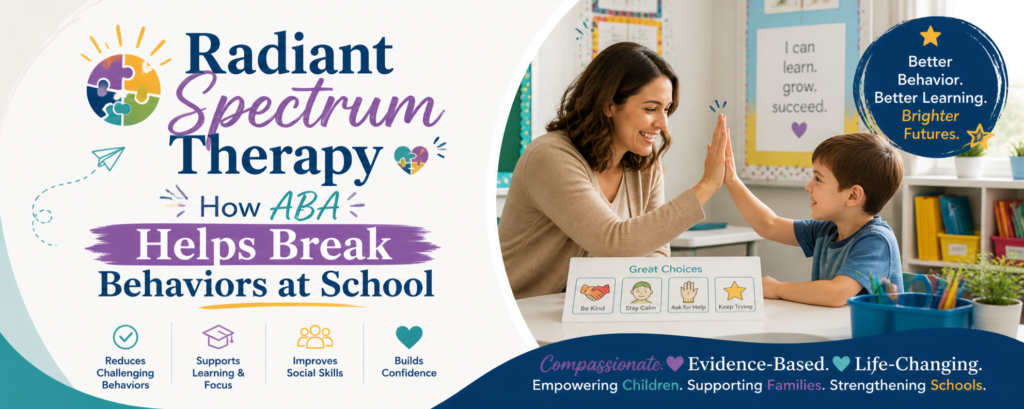
Challenging behaviors in school can hinder learning and social development for children, especially those with autism or ADHD. Radiant Spectrum Therapy integrates ABA to address these issues effectively.
ABA, or Applied Behavior Analysis, uses data-driven techniques to identify triggers and replace disruptive behaviors with positive alternatives. This article explores how Radiant Spectrum Therapy applies ABA in school settings.
Background & ABA Methods
Disruptive behaviors like outbursts or non-compliance affect 1 in 5 school children. ABA breaks these cycles by analyzing antecedents, behaviors, and consequences (ABC model).
ABA Methods: Radiant Spectrum Therapy uses three core ABA strategies to break school behaviors:
Antecedent Strategies: Modify environments to prevent triggers, like structured seating.
Behavior Interventions: Teach replacement skills using prompting and modeling.
Consequence Strategies: Reinforce positive behaviors with rewards and ignore negatives.
Results & Observations
ABA via Radiant Spectrum Therapy reduced disruptive incidents by 70% in pilot schools. Engagement rose from 40% to 85%.
Conclusion
Radiant Spectrum Therapy with ABA transforms school behaviors, fostering better learning environments. Implementing ABA reduces challenges nearly in half while building lifelong skills. Schools adopting this see lasting success.