
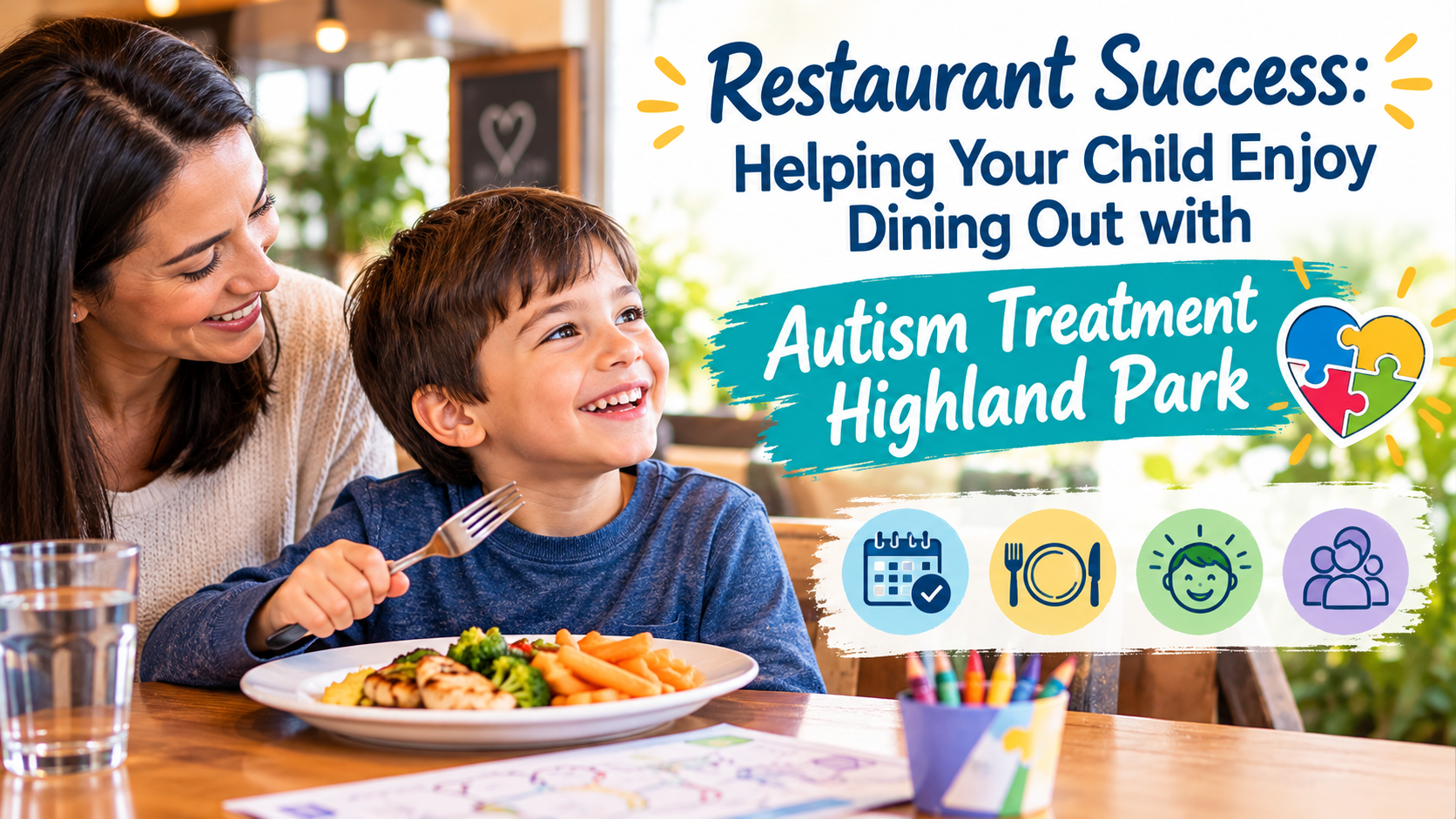
Going to a restaurant can be a fun family experience, but for some children, the sights, sounds, smells, waiting, and unpredictability of dining out can feel overwhelming. For families exploring Autism Treatment Highland Park, restaurant outings can also become an opportunity to practice communication, flexibility, social skills, and independence in a natural environment. With thoughtful preparation and realistic expectations, dining out does not have to be stressful for your child or your family.
ABA-based strategies can help children build skills that make everyday activities more manageable. Whether your child receives ABA therapy Highland Park, participates in early intervention ABA Highland Park, or is working with a provider on specific behavioral goals, the skills practiced during therapy can often be adapted to real-life situations such as visiting a restaurant.
The goal is not to make your child behave perfectly at the table. The goal is to help your child understand what is happening, communicate their needs, tolerate manageable challenges, and enjoy being part of the family experience.
Why Restaurants Can Be Challenging for Children with Autism
Restaurants involve many different experiences happening at the same time. A child may be expected to sit in one place, wait for food, tolerate unfamiliar smells, listen to conversations, respond to questions, and eat food that may look or taste different from what they expected.
For some children, sensory input is the biggest challenge. Bright lights, loud music, crowded dining rooms, clattering dishes, kitchen noises, or strong food smells can make an otherwise enjoyable restaurant uncomfortable.
Other children may struggle primarily with waiting or changes in routine.
For example, your child may understand that you are going to a restaurant, but they may not understand why the food does not arrive immediately. If a favorite menu item is unavailable, the table is moved, or the restaurant is unexpectedly busy, that change can be difficult.
This is where Applied Behavior Analysis Highland Park can be useful. ABA focuses on understanding behavior and teaching practical replacement skills. Instead of simply expecting a child to “sit still” or “be patient,” therapy can help break those expectations into smaller, teachable steps.
Start With Small Restaurant Goals
A successful restaurant visit does not have to mean sitting through a two-hour dinner without any difficulties.
Start with one or two realistic goals.
Your child’s goals might include:
- Walking into the restaurant calmly
- Sitting at the table for five minutes
- Looking at a menu
- Asking for a preferred drink
- Waiting briefly for food
- Trying one new food
- Using an appropriate way to request a break
- Remaining at the table until the family is finished eating
- Practicing saying “thank you”
- Paying at the register
- Leaving the restaurant calmly
Once one skill becomes easier, you can gradually introduce another.
This approach is especially helpful for younger children receiving ABA therapy for toddlers Highland Park or ABA therapy for kids Highland Park because expectations can be adjusted to match their developmental level.
Celebrate Progress, Not Perfection
If your child usually lasts three minutes at a restaurant table and manages eight minutes during your next outing, that is meaningful progress.
Try not to compare your child’s restaurant experience to another family’s.
A successful outing might look different for every child.
For one child, success may mean eating independently. For another, it may mean tolerating the restaurant environment for a short period. For another, it may mean learning to communicate, “It’s too loud,” instead of becoming overwhelmed.
The purpose of behavior therapy Highland Park is not to erase differences. It is to help children develop useful skills that support participation and independence.
Practice Before You Go
One of the easiest ways to make a restaurant visit more predictable is to practice pieces of the experience at home.
You can use pretend play to rehearse the sequence.
For example:
- Pretend to enter the restaurant.
- Choose a table.
- Sit down.
- Look at a pretend menu.
- Choose a drink.
- Practice ordering.
- Wait for the food.
- Pretend to eat.
- Practice asking for something.
- Practice paying and leaving.
You can even use stuffed animals or family members as pretend restaurant guests.
For children who benefit from visual supports, create a simple visual sequence:
Restaurant → Sit → Order → Wait → Eat → Pay → Go Home
Seeing what comes next can reduce uncertainty.
Families working with BCBA services Highland Park may also be able to identify specific restaurant-related goals and develop individualized strategies based on the child’s current skills.
Choose the Restaurant Carefully
Not every restaurant is the best first environment for practicing dining out.
If your child becomes overwhelmed by crowds or noise, a packed restaurant during the busiest dinner hour may be unnecessarily difficult.
Consider starting with a restaurant that offers:
- A quieter atmosphere
- Plenty of space between tables
- Familiar foods
- Simple menus
- Quick service
- Outdoor seating
- Flexible seating options
- A less crowded time of day
Going during an off-peak period can give your child more opportunities to practice without dealing with as much environmental stimulation.
This is not about avoiding challenging environments forever. It is about creating opportunities for success before gradually increasing the difficulty.
Prepare for Waiting
Waiting is one of the biggest challenges at many restaurants.
Even adults can become impatient when they are hungry and their food has not arrived.
For a child, several minutes can feel much longer.
Bring something appropriate to help your child stay engaged while waiting.
Depending on your child’s preferences, that could include:
- A small book
- Coloring materials
- A quiet toy
- A simple game
- A visual timer
- A favorite activity
- A communication device, if applicable
You can also teach a specific waiting routine.
For example:
Order → Play quietly → Check timer → Food arrives
A visual timer can make an abstract concept like “five more minutes” easier to understand.
Children receiving autism behavior therapy Highland Park may also work on waiting, requesting, and tolerance skills that can be practiced outside the therapy environment.
Teach Functional Communication
One of the most valuable restaurant skills is learning how to communicate a need appropriately.
Instead of focusing only on reducing unwanted behavior, consider what your child is trying to communicate.
Maybe they are saying:
- “It’s too loud.”
- “I don’t like this food.”
- “I’m finished.”
- “I want to leave.”
- “I need help.”
- “I want something different.”
- “I need a break.”
Give your child a reliable way to communicate those needs.
For a child who uses spoken language, that might mean teaching short phrases such as:
“I need a break.”
“It’s too loud.”
“Help, please.”
“I’m all done.”
For a child who uses an AAC device, picture communication, gestures, or another communication system, make sure the necessary options are available during the outing.
Functional communication is an important component of many behavioral intervention Highland Park TX programs because it gives children an effective alternative to behaviors that may occur when they cannot communicate what they need.
Be Thoughtful About Food Expectations
Food can be one of the most complicated parts of dining out.
Some children have strong food preferences, limited diets, or sensory sensitivities related to texture, temperature, smell, color, or presentation.
Avoid turning every restaurant visit into a battle over trying something new.
If your child is comfortable eating a particular food, bringing or ordering a familiar option can help create a sense of security.
You can introduce new foods gradually when appropriate.
For example, a child might first tolerate a new food being placed nearby. Later, they may touch it, smell it, taste a tiny amount, or eventually eat it.
Every child is different, and feeding concerns should be approached individually.
The restaurant does not need to be the place where every new food is introduced.
Sometimes the bigger goal is simply enjoying a family meal together.
Use Reinforcement Wisely
Positive reinforcement can help children understand which behaviors are successful.
Suppose your child waits appropriately for their drink. You can immediately acknowledge the behavior:
“Great waiting!”
If your child uses words or a communication system to request a break instead of leaving the table unexpectedly, recognize that communication.
Reinforcement does not always need to be a toy or edible item.
It can be:
- Praise
- A favorite activity
- A sticker
- Time with a preferred item
- Choosing the next activity
- Positive attention
The important part is identifying what is genuinely motivating for your child.
Families receiving pediatric ABA therapy Highland Park can work with their clinical team to understand what types of reinforcement are most appropriate for their child’s individual goals.
Plan for Sensory Needs
Sensory preparation can make a major difference.
If your child is sensitive to noise, consider quieter restaurants or outdoor seating. If they become uncomfortable with bright lighting, choose a more softly lit environment when possible.
Some children may benefit from sensory tools such as headphones or another familiar calming item.
You can also consider where your child sits.
A seat away from the kitchen, speakers, entrance, or high-traffic areas may reduce the amount of stimulation.
Watch your child’s behavior for early signs of discomfort.
They may:
- Cover their ears
- Become restless
- Repeatedly ask to leave
- Increase vocalizations
- Avoid looking around
- Become unusually quiet
- Pace or move frequently
- Engage in repetitive behaviors more intensely
Recognizing these signs early gives you an opportunity to respond before the situation becomes overwhelming.
Have a Break Plan
Even with preparation, your child may need a break.
That does not mean the restaurant visit failed.
Before going inside, know where you could step outside if necessary.
You might say:
“First we sit, then we can take a break.”
Or:
“If it gets too loud, tell me and we can go outside.”
Teaching a child that they can request a break can be much more effective than expecting them to tolerate every situation without support.
For children receiving in-home ABA therapy Highland Park, caregivers may be able to practice these skills in familiar settings before applying them in more challenging community environments.
Gradually Increase the Challenge
Once your child becomes comfortable with a particular restaurant routine, you can make small changes.
For example:
Level One
Visit a quiet restaurant for 20 minutes.
Level Two
Stay for 30 minutes.
Level Three
Visit during a slightly busier time.
Level Four
Try a different restaurant.
Level Five
Practice ordering independently.
Level Six
Work on tolerating a longer wait.
This gradual approach can help prevent every outing from feeling like a major test.
Children do not need to master everything at once.
What If Your Child Has a Difficult Moment?
It happens.
Your child may cry, yell, leave the table, refuse food, or become overwhelmed.
Try to focus on safety and communication rather than embarrassment.
Other people may look. That can be uncomfortable, but your priority is helping your child.
If possible:
- Reduce unnecessary sensory stimulation.
- Speak calmly.
- Offer the communication option your child knows.
- Move to a quieter area if appropriate.
- Give the child time to regulate.
- Avoid introducing a complicated new demand during the escalation.
- Return to the routine once your child is ready.
Afterward, think about what happened.
Was the restaurant too loud?
Was the wait too long?
Was your child hungry?
Was the menu unfamiliar?
Was there an unexpected change?
Identifying the trigger can help you plan differently next time.
How ABA Therapy Can Support Community Skills
Skills learned during ABA therapy services Highland Park do not have to remain inside a therapy room.
ABA can address practical skills that children use at home, school, stores, restaurants, playgrounds, and other community settings.
Depending on the child’s needs, treatment may focus on:
- Communication
- Following directions
- Waiting
- Flexibility
- Social interaction
- Self-help skills
- Tolerating changes
- Coping strategies
- Appropriate requesting
- Independence
Both center-based ABA therapy Highland Park and in-home ABA therapy Highland Park can play a role in skill development, depending on the child’s treatment plan.
Some families may also explore intensive ABA programs Highland Park when more frequent or comprehensive support is appropriate.
The right approach depends on the individual child rather than a one-size-fits-all formula.
Finding the Right Support for Your Family
If restaurant outings, community activities, communication, or daily routines are consistently difficult, it may be helpful to talk with an ABA professional about your child’s specific needs.
When families begin researching ABA therapy near Highland Park, they may encounter many different providers and treatment models.
Consider asking potential providers:
- What skills can therapy address?
- How are goals selected?
- How are parents involved?
- Can skills be practiced in natural environments?
- How is progress measured?
- What does the treatment schedule look like?
- What communication will families receive about progress?
- How does the team handle changes in goals?
Families comparing ABA clinics in Highland Park may also want to understand the difference between services, treatment intensity, locations, and insurance or private-pay options.
Questions about ABA therapy cost Highland Park are also reasonable. Costs can vary based on the type and amount of services, insurance coverage, treatment needs, and other factors.
The goal should be finding support that fits your child’s needs and your family’s circumstances.
Restaurant Skills Are Life Skills
Dining out is about more than eating.
A restaurant visit can give your child opportunities to practice communication, waiting, flexibility, social interaction, self-advocacy, and independence.
Those same skills can eventually transfer to many other parts of life.
A child who learns to say, “It’s too loud” can use that skill at a birthday party.
A child who learns to wait for food can practice waiting at school.
A child who learns to request help can use that communication at the grocery store.
A child who learns that plans can change without everything falling apart may become more comfortable with unexpected situations in other environments.
That is why community-based practice can be so valuable.
Making Dining Out More Enjoyable for Everyone
Your family deserves to enjoy meals together.
You do not have to wait until your child can sit perfectly, eat every food, or tolerate every noise before visiting a restaurant.
Start small.
Choose an environment that gives your child a reasonable chance of success. Prepare them for what will happen. Bring familiar supports. Practice communication. Set realistic goals. Recognize progress.
Most importantly, remember that your child’s success may not look exactly like someone else’s.
With individualized support, including Autism Treatment Highland Park, families can work toward practical skills that help children participate more comfortably in everyday activities. Whether you are exploring ABA therapy in Highland Park TX, looking for autism support services Highland Park, or trying to find ABA therapist Highland Park, the focus should remain on meaningful progress and skills that improve your child’s quality of life.
Conclusion: Building Confidence One Restaurant Visit at a Time
Successful dining out does not happen overnight. It can take practice, preparation, patience, and individualized support.
For families considering Autism Treatment Highland Park, restaurant visits can become valuable opportunities to practice real-world skills in a supportive environment. From communicating a need to waiting for a meal, handling a change, requesting a break, or simply enjoying time with family, every small success matters.
With the right strategies and support, your child can gradually become more comfortable participating in community activities.
The goal is not a perfect restaurant visit.
The goal is progress — and helping your child build the confidence and skills they can carry into everyday life.
Contact us at 972–310–4991 or visit https://radiantspectrumtherapy.com/ to learn more.