
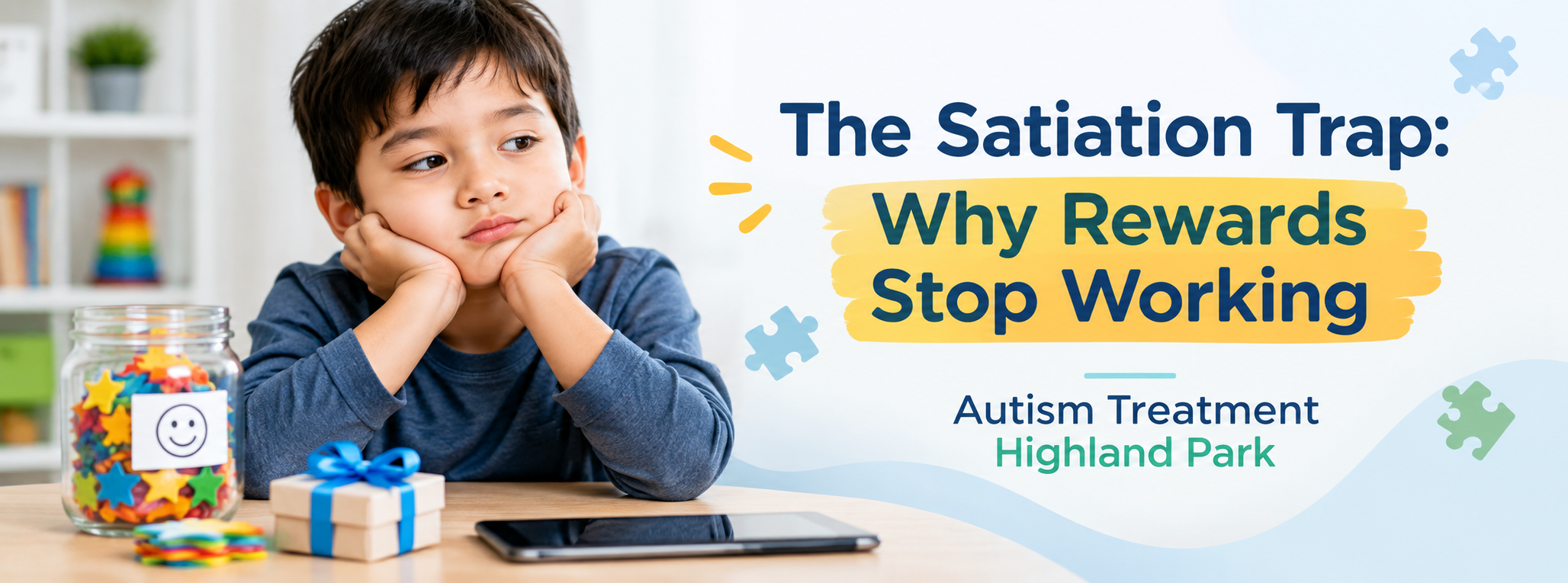
If you’ve ever found yourself thinking, “This reward worked perfectly last week — what happened?” you’re not alone. One of the most common frustrations for families and clinicians involved in Autism Treatment Highland Park is watching a once-powerful reward suddenly lose its magic.
Maybe your child used to eagerly brush their teeth for five minutes of an iPad game. Then one day, they shrug. The same game, the same routine, and suddenly there’s no motivation. Or perhaps a favorite snack that once inspired cooperation now gets pushed aside without a second glance.
This doesn’t necessarily mean your child has become “stubborn,” that the reward system failed, or that ABA therapy Highland Park isn’t working. In many cases, it’s something behavior analysts expect: satiation.
Understanding why rewards lose their effectiveness — and how to prevent it — can make everyday routines smoother and reduce power struggles. In Applied Behavior Analysis Highland Park, clinicians use the concepts of Motivating Operations, including satiation and deprivation, to keep reinforcement meaningful and individualized.
Let’s explore why this happens and how a simple Reinforcer Rotation Schedule can help keep motivation fresh.
Why Rewards Suddenly Stop Working
Imagine eating your favorite dessert every single meal for two weeks.
Eventually, even your favorite treat starts feeling less exciting.
The same principle applies to reinforcement. When someone has repeated access to the same rewarding item or activity, its value temporarily decreases.
This is called satiation.
In ABA therapy for autism Highland Park, therapists don’t assume that a reinforcer will stay effective forever. Instead, they regularly observe how motivation changes and adjust reinforcement accordingly.
Common reinforcers that may lose value include:
- iPad games
- Favorite YouTube videos
- Stickers
- Small toys
- Candy or snacks
- Bubbles
- Sensory toys
- Music
The goal isn’t to remove things someone enjoys. It’s to recognize when “favorite” becomes “ordinary.”
Understanding Motivating Operations
One of the most useful concepts in behavior therapy Highland Park is the idea of Motivating Operations (MOs).
Motivating Operations temporarily change how valuable a reinforcer feels.
There are two primary types that matter most for families.
Satiation
Satiation happens when someone has had enough of something.
The reward becomes less motivating.
Examples include:
- Unlimited tablet time makes earning five extra minutes less exciting.
- Eating several cookies reduces interest in another cookie.
- Playing with the same toy all afternoon makes it less appealing during therapy.
Deprivation
Deprivation is the opposite.
When access has been limited appropriately and naturally, the reward becomes more valuable.
Examples include:
- A favorite game feels exciting after a short break.
- A swing becomes highly motivating after spending time indoors.
- Bubbles become special when they’re saved for teaching moments.
In behavioral intervention Highland Park TX, therapists carefully balance access without creating unnecessary frustration.
The goal is never deprivation through distress.
Instead, it’s about preserving excitement.
Why This Matters in Daily Life
Parents often notice this pattern during routines like:
- Getting dressed
- Homework
- Bedtime
- Tooth brushing
- Transitions
- Mealtime
A reward that worked beautifully for two weeks suddenly stops producing the same cooperation.
Without understanding satiation, it’s easy to assume:
- “They’re ignoring me.”
- “They’re testing limits.”
- “We need bigger rewards.”
Often, neither is true.
The reinforcer simply needs refreshing.
Whether families receive in-home ABA therapy Highland Park or center-based ABA therapy Highland Park, recognizing these patterns helps everyone respond more effectively.
Signs Your Reinforcer Is Losing Its Power
How can you tell whether a reward is becoming less effective?
Watch for these clues.
Delayed Responses
The child hesitates before completing the task.
Negotiating More Often
They begin asking for something different.
Ignoring the Reward
The item no longer captures attention.
Faster Boredom
They lose interest almost immediately.
Increased Escape Behaviors
Instead of working toward the reward, they avoid the task entirely.
These observations help BCBAs adjust reinforcement before frustration grows.
The Reinforcer Rotation Schedule
One of the simplest ways to prevent satiation is creating a Reinforcer Rotation Schedule.
Instead of relying on one “magic reward,” build a menu of options.
Think of it like rotating meals instead of eating the same dinner every night.
Step 1: Build a Reinforcer Menu
Start by brainstorming several categories.
Edible Options
- Pretzels
- Fruit snacks
- Apple slices
- Crackers
Sensory Activities
- Bubbles
- Play-Doh
- Kinetic sand
- Water play
Movement Activities
- Jumping
- Swinging
- Dancing
- Mini obstacle course
Technology
- Educational games
- Music videos
- Drawing apps
Creative Choices
- Stickers
- Coloring
- LEGO building
- Magnets
In pediatric ABA therapy Highland Park, therapists often maintain multiple reinforcer categories because preferences naturally shift.
Step 2: Observe Current Favorites
Don’t assume yesterday’s favorite is today’s favorite.
Instead, watch what your child chooses during free time.
Ask questions like:
- What do they pick first?
- What keeps their attention longest?
- What do they ask for independently?
These observations provide valuable clues.
Step 3: Rotate Instead of Repeating
Rather than using the same reward every session, rotate options.
Example schedule:

The exact schedule doesn’t matter as much as avoiding constant repetition.
Step 4: Save Special Rewards for Special Moments
Some reinforcers work best when they’re reserved.
Instead of unlimited access throughout the day:
- Save bubbles for practicing communication.
- Save a favorite game for completing routines.
- Save a special toy for therapy sessions.
This naturally maintains motivation without creating conflict.
What Is a Preference Assessment?
In BCBA services Highland Park, therapists don’t simply guess what motivates someone.
They conduct preference assessments.
These are structured ways of discovering what someone currently enjoys.
Informal Preference Assessments
These happen naturally.
Examples include:
- Watching what someone chooses first.
- Offering two toys and seeing which they pick.
- Observing favorite activities during free play.
Formal Preference Assessments
Therapists may systematically present multiple options and record choices.
These assessments help identify:
- High-value reinforcers
- Medium-value reinforcers
- Emerging interests
Because preferences change frequently, assessments happen regularly — not just once.
Why Bigger Rewards Aren’t Always Better
When motivation drops, many adults instinctively increase rewards.
More candy.
More screen time.
Bigger prizes.
Sometimes this works briefly.
Sometimes it actually speeds up satiation.
Instead, ABA therapy services Highland Park focuses on maintaining the quality of reinforcement rather than constantly increasing the quantity.
Often, variety beats size.
Using Choice to Increase Motivation
One of the easiest ways to strengthen reinforcement is offering choices.
Instead of saying:
“You get stickers.”
Try:
“Would you like stickers or bubbles?”
Choice provides:
- Greater autonomy
- Increased engagement
- Reduced resistance
- More individualized motivation
For many children receiving ABA therapy for kids Highland Park, simply choosing their reward increases participation.
Matching Rewards to Energy Levels
Not every reward works in every situation.
A child who’s already energetic may not benefit most from jumping as a reward.
Instead, match reinforcement to current needs.
Examples:

Matching reinforcement thoughtfully can improve success across routines.
Avoiding Power Struggles
One misconception is that limiting access always creates conflict.
It doesn’t have to.
Instead of saying:
“No iPad.”
Try:
“We’ll save the iPad for after you finish brushing your teeth.”
The difference matters.
You’re not taking away something enjoyable.
You’re preserving its motivating value.
This approach often reduces arguments because expectations remain predictable.
How Therapists Keep Reinforcement Effective
In top-rated ABA therapists Highland Park programs, reinforcement plans are constantly evolving.
A BCBA may:
- Monitor engagement.
- Collect data on responses.
- Notice declining motivation.
- Introduce new reinforcers.
- Rotate activities.
- Conduct new preference assessments.
This flexibility helps prevent reinforcement systems from becoming stale.
Ideas for Creating a Reinforcer Rotation at Home
You don’t need an elaborate system.
A simple “reward menu” can work beautifully.
Create Three Categories
Quick Rewards (1–2 minutes)
- High five
- Bubbles
- Funny video
Medium Rewards (5 minutes)
- LEGO
- Drawing
- Music
Special Rewards (10–15 minutes)
- Favorite game
- Sensory activity
- Outdoor play
Rotate through these categories instead of repeating one favorite every time.
When a Favorite Stops Working Completely
Sometimes a child appears to lose interest entirely.
Don’t panic.
Interests naturally change.
Instead:
- Observe new interests.
- Introduce fresh options.
- Rotate old favorites out temporarily.
- Revisit them later.
Often, a previously ignored reinforcer becomes exciting again after a break.
This is a normal part of how motivation works.
Supporting Motivation Without Pressure
The ultimate goal of Autism Treatment Highland Park isn’t to make children work harder for rewards.
It’s to understand what genuinely motivates them.
Effective reinforcement should feel:
- Respectful
- Flexible
- Individualized
- Positive
When adults recognize the role of satiation and motivating operations, routines become less about constant negotiation and more about creating opportunities for success.
Whether your family is exploring ABA therapy near Highland Park, private ABA therapy Highland Park, or developmental therapy Highland Park, understanding how reinforcement changes over time can make everyday strategies more effective.
Conclusion
If a reward suddenly stops working, it doesn’t automatically mean your child has become less cooperative or that your reinforcement system has failed. More often, it’s a sign that the reinforcer has lost some of its value through satiation, a completely normal behavioral process recognized in Applied Behavior Analysis Highland Park.
By building a Reinforcer Rotation Schedule, offering meaningful choices, conducting regular preference checks, and preserving the novelty of favorite activities, families can keep motivation strong without relying on larger rewards or unnecessary power struggles.
At Radiant Spectrum Therapy, our BCBA services Highland Park are built around individualized, compassionate care. Whether your child benefits most from in-home ABA therapy Highland Park or center-based ABA therapy Highland Park, we help families create practical reinforcement strategies that evolve with their child’s changing interests and needs.
When reinforcement stays meaningful, learning becomes more enjoyable, routines become smoother, and progress becomes more sustainable — one motivating moment at a time.
Contact us at 972–310–4991 or visit https://radiantspectrumtherapy.com/ to learn more.