
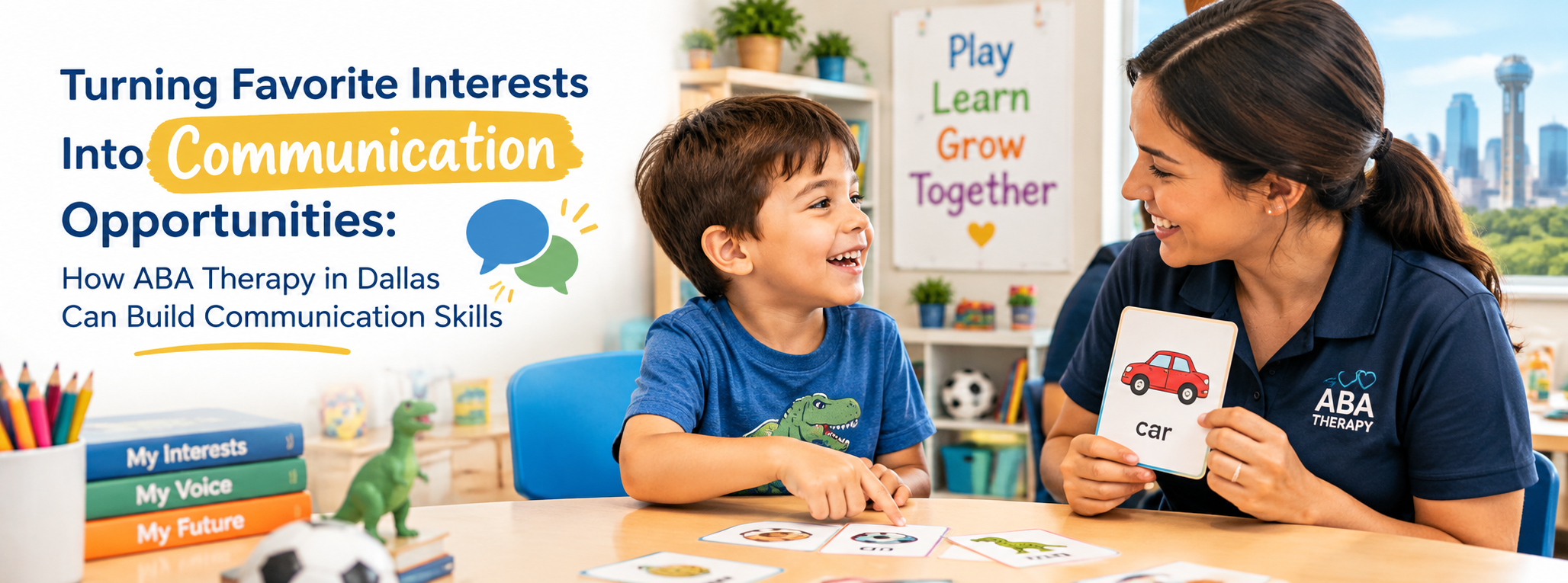
Children naturally gravitate toward the things they enjoy most. It might be dinosaurs, trains, music, bubbles, animals, drawing, video games, or even something as simple as watching the same short video over and over. These favorite interests are more than just sources of entertainment. They can become meaningful opportunities for learning, connection, and communication. For families exploring ABA Therapy in Dallas, understanding how a child’s interests can be incorporated into everyday learning can be an important part of supporting communication development.
When a child is highly interested in something, they are often more motivated to engage with it. That motivation can create natural opportunities to practice requesting, commenting, answering questions, taking turns, following directions, and interacting with other people.
Rather than trying to pull a child away from what they love, caregivers and therapists can sometimes use those interests as a bridge toward new communication skills.
Why Favorite Interests Matter in Communication
Communication is not limited to speaking in complete sentences. Children communicate in many different ways, including gestures, facial expressions, sounds, pointing, pictures, signs, communication devices, and spoken words.
For some children, communicating with another person can feel less naturally rewarding than interacting with a preferred object or activity. A favorite interest can help make social interaction more meaningful.
For example, a child who loves trains may not initially be interested in answering general questions about their day. However, they may become much more engaged when someone brings a train set into the conversation.
A therapist might use that interest to encourage the child to:
- Request a specific train
- Ask for help connecting tracks
- Identify colors or shapes
- Choose between two trains
- Describe what the train is doing
- Take turns pushing the train
- Answer simple questions
- Comment when the train reaches a station
- Practice waiting for another person
- Share the activity with a parent or sibling
The favorite interest becomes the setting in which communication has a purpose.
Communication Is More Than Asking for Things
One of the first communication skills children may practice is requesting. A child might learn to ask for a favorite toy, snack, activity, or assistance.
Requesting is important, but communication development does not stop there.
Children also benefit from learning how to:
Make Comments
Commenting helps children share experiences with other people.
Instead of only saying, “Car,” a child might eventually learn to say or communicate:
- “The car is fast.”
- “I see a red car.”
- “The car crashed.”
- “That one is mine.”
- “Look at this!”
A favorite interest gives children something concrete to talk about.
Answer Questions
Favorite interests can also make questions easier to understand and answer.
If a child loves animals, a caregiver might ask:
“What animal is this?”
“Where does the lion live?”
“What sound does the cow make?”
“Which animal do you like?”
Questions can gradually become more complex as the child’s communication skills develop.
Take Turns
Communication is also about learning that interactions go both ways.
During a favorite activity, a child may practice taking turns choosing a song, rolling a ball, adding a puzzle piece, or moving a toy.
These small exchanges help introduce the idea that communication involves another person.
Following a Child’s Motivation
Motivation is an important consideration when teaching new skills. When children are interested in an activity, they may be more willing to participate and communicate.
This does not mean every favorite interest needs to become a structured lesson.
Sometimes the best opportunity is simply following the child’s lead.
Imagine a child sitting on the floor playing with a collection of dinosaurs. Instead of immediately changing the activity, a parent could sit nearby and become part of the play.
The parent might say:
“That’s a T-Rex.”
Then pause.
The child may look toward the dinosaur.
The parent could continue:
“The T-Rex is walking.”
Then pause again.
Those pauses give the child opportunities to respond, imitate, gesture, point, or use words.
The interaction becomes a conversation built around something the child already enjoys.
Creating Communication Opportunities Instead of Giving Everything Immediately
One useful strategy is creating small opportunities for a child to communicate.
For example, suppose a child loves bubbles.
Instead of placing the bubbles directly in front of the child and immediately blowing them, a caregiver could hold the bubbles and wait.
The child might:
- Reach toward the bubbles
- Point
- Make a sound
- Say “bubbles”
- Use a communication device
- Gesture for more
- Look between the bubbles and the caregiver
Each of these responses can provide an opportunity to acknowledge and encourage communication.
The goal is not to make a child struggle unnecessarily. The goal is to create natural moments where communication has a purpose.
Using Choices to Encourage Communication
Offering choices can be another simple way to encourage communication.
Suppose a child loves snacks. Instead of asking a broad question such as, “What do you want?” a caregiver could hold up two options.
“Cracker or apple?”
The child can point, reach, gesture, use words, or use an alternative communication system to make a choice.
The same strategy can be used with favorite activities.
“Puzzle or blocks?”
“Blue car or red car?”
“Music or bubbles?”
Choices can help children practice expressing preferences while also giving them a meaningful reason to communicate.
Expanding a Child’s Interests
A favorite interest can also become a starting point for expanding language.
Consider a child who loves cars.
At first, the child may simply say:
“Car.”
An adult can model slightly more advanced language:
“Red car.”
Later:
“The red car is fast.”
Eventually:
“The red car is going to the garage.”
The adult is not necessarily requiring the child to repeat every sentence. Instead, they are providing language that fits naturally into the activity.
This approach can help children hear how words can be combined and expanded.
Follow the Child’s Current Level
Language should generally be appropriate to the child’s current communication abilities.
If a child is primarily communicating with single words, jumping immediately to long sentences may create frustration.
Instead, small expansions can be more practical.
For example:
Child: “Ball.”
Adult: “Big ball.”
Or:
Child: “Train.”
Adult: “Blue train.”
The exact level of support will vary from child to child.
Turning Repetition Into Learning
Many children enjoy repeating the same activity. Adults sometimes worry that repetition means the child is not learning anything new.
However, repetition can provide valuable opportunities to practice.
A child who repeatedly watches the same part of a favorite show may already know the sequence extremely well. That familiarity can potentially be used to introduce communication opportunities.
A caregiver might pause before a familiar part and wait for the child to respond.
For example, if a favorite song has a predictable line, the caregiver could pause and give the child an opportunity to vocalize, gesture, or communicate what comes next.
The familiar routine provides predictability, while the pause creates an opportunity for participation.
Moving From Favorite Interests to Broader Communication
A child’s favorite interest does not have to remain the only subject they discuss.
It can serve as a bridge toward broader topics.
For example, a child who loves dinosaurs might begin by identifying different dinosaurs. Over time, the conversation could expand to:
- Where dinosaurs lived
- What they ate
- How big they were
- Which animals live today
- Favorite books
- Museum visits
- Outdoor activities
- Questions about nature
The goal is not to eliminate the child’s interest. Instead, the interest can provide a comfortable starting point for exploring new ideas.
Using Interests During Everyday Activities
Communication opportunities do not have to happen only during therapy sessions.
Parents and caregivers can incorporate a child’s interests into ordinary routines.
Mealtime
If a child loves a particular character, food item, or theme, caregivers can use that interest during meals to encourage requesting, choosing, labeling, and commenting.
Bath Time
A child who loves water play might practice naming toys, requesting more water, choosing which toy to use, or describing what is happening.
Getting Dressed
Favorite characters or colors can become opportunities to practice choosing between clothing options.
“Blue shirt or green shirt?”
Car Rides
If a child loves vehicles, caregivers can talk about buses, trucks, motorcycles, traffic lights, and other things they see outside.
Playtime
Favorite toys can naturally encourage turn-taking, imitation, requesting, commenting, and pretend play.
These moments can be brief. Communication practice does not always need to feel like a formal lesson.
How ABA Therapy Can Support Communication Development
Families seeking ABA therapy in Dallas may work with professionals who use individualized strategies to help children develop communication, social, adaptive, and other functional skills.
Applied Behavior Analysis can involve identifying what motivates a child and using that information when developing individualized learning opportunities.
For example, a child’s strong interest in music may become part of activities designed to practice requesting or turn-taking. A child’s interest in puzzles might be incorporated into activities involving following directions, problem-solving, or requesting assistance.
The specific goals and strategies depend on the individual child.
For families considering ABA therapy for autism Dallas, it is important to remember that there is no single communication strategy that works for every child. A qualified team can look at the child’s current abilities, preferences, communication style, and goals when determining appropriate supports.
In-Home ABA Therapy Can Bring Learning Into Everyday Routines
For some families, in-home ABA therapy Dallas can provide opportunities to work on communication skills in familiar surroundings.
The home naturally contains situations where communication matters.
A child may need to ask for a favorite toy, request help opening a container, choose a snack, indicate that they are finished, or communicate where they want to go.
These everyday situations can make communication functional and meaningful.
Because the child is practicing within familiar routines, caregivers may also have opportunities to learn strategies they can continue using between sessions.
Center-Based Therapy Can Offer Different Learning Opportunities
Some families choose center-based ABA therapy Dallas because a structured clinical environment can provide different opportunities for learning and social interaction.
A center may allow children to practice communication with therapists and peers while working on individualized goals.
For example, children may practice:
- Requesting items
- Sharing materials
- Taking turns
- Following group directions
- Answering questions
- Participating in structured activities
- Transitioning between activities
- Communicating with different people
The appropriate setting depends on the child’s individual needs, family circumstances, treatment goals, and recommendations from the care team.
Supporting Alternative Forms of Communication
Not every child communicates primarily through speech.
Some children may use gestures, picture systems, sign language, or augmentative and alternative communication (AAC) devices.
These forms of communication can be incorporated into favorite activities too.
For example, a child who loves bubbles might use a communication system to request “more,” “bubbles,” “stop,” or “all done.”
A child who loves books might use pictures to select which book they want.
The important part is giving the child meaningful ways to express themselves.
Communication should not be limited to spoken language.
What Parents Can Try at Home
Parents do not need to turn every activity into a therapy session. A few simple changes can create more opportunities for interaction.
Try:
- Following your child’s interests. Join an activity they already enjoy.
- Pausing. Give your child time to respond instead of immediately filling the silence.
- Offering choices. Provide two or more meaningful options.
- Modeling language. Use simple language that fits the activity.
- Expanding communication. Add one or two words to what your child already communicates.
- Celebrating attempts. Acknowledge gestures, sounds, words, pictures, and other communication efforts.
- Taking turns. Create predictable back-and-forth interactions.
- Keeping it natural. Communication opportunities can happen during play, meals, errands, and routines.
Small moments can add up.
When a Favorite Interest Becomes a Bridge
A child’s favorite interest can tell adults a lot about what captures their attention and motivates them.
Instead of viewing that interest as something that needs to be interrupted, parents and professionals can sometimes use it as a starting point.
A train can become a reason to request.
A favorite song can become a reason to take turns.
A dinosaur can become a reason to answer a question.
A puzzle can become a reason to ask for help.
A favorite character can become a reason to make a choice.
These moments turn something familiar and enjoyable into an opportunity for connection.
Finding the Right Support for Your Child
Every child develops communication skills differently. Some children may need support with requesting and expressing basic needs, while others may be working on conversation, social communication, or communicating across different environments.
Families researching ABA therapy in Dallas can look for providers who take time to understand the individual child rather than relying on a one-size-fits-all approach.
Questions families may consider asking include:
- How are communication goals identified?
- How are a child’s interests incorporated into therapy?
- How are parents involved?
- What communication methods are supported?
- How is progress monitored?
- Can therapy take place at home, in a center, or across different environments?
- How does the BCBA collaborate with the family and other professionals?
These questions can help families better understand what services may look like and whether a particular approach fits their child’s needs.
Communication Starts With Connection
A favorite interest may seem small from an adult’s perspective, but to a child, it can be the doorway into a much larger world of communication.
When adults join children in activities they already enjoy, they can create opportunities to request, comment, choose, respond, take turns, and connect.
For families exploring ABA Therapy in Dallas, incorporating a child’s interests into individualized communication goals can make learning opportunities feel more meaningful and relevant to everyday life. Whether communication happens through spoken language, gestures, pictures, or an AAC system, the goal is to help each child have effective ways to express themselves and participate in the world around them.
Sometimes, the best place to begin building communication is not by introducing something completely new. It is by looking at what a child already loves — and finding a way to turn that interest into a conversation.
Contact us at 972–310–4991 or visit https://radiantspectrumtherapy.com/ to learn more.