
Children learn language in different ways. Some begin speaking with individual words, while others communicate through short phrases, gestures, or sentences they have heard from parents, teachers, television shows, or other people. If your child frequently repeats words or entire phrases, you may wonder whether they understand what they are saying or whether repetition is simply a habit. This behavior is often called echolalia, and it can play an important role in communication and language development. For families exploring ABA Therapy in Dallas, understanding echolalia can provide valuable insight into how children express themselves, process language, and develop meaningful communication skills.
Echolalia is commonly observed in autistic children, but it is not necessarily meaningless repetition. A child may repeat a question because they are processing it, use a familiar phrase to request something, or repeat words to express excitement, frustration, or another emotion. Recognizing the purpose behind these repetitions helps parents and caregivers respond more effectively.
Through individualized ABA therapy Dallas families can explore, children can build on their existing communication abilities while developing new ways to express their needs, thoughts, and feelings.
What Is Echolalia and How Does It Relate to ABA Therapy in Dallas?
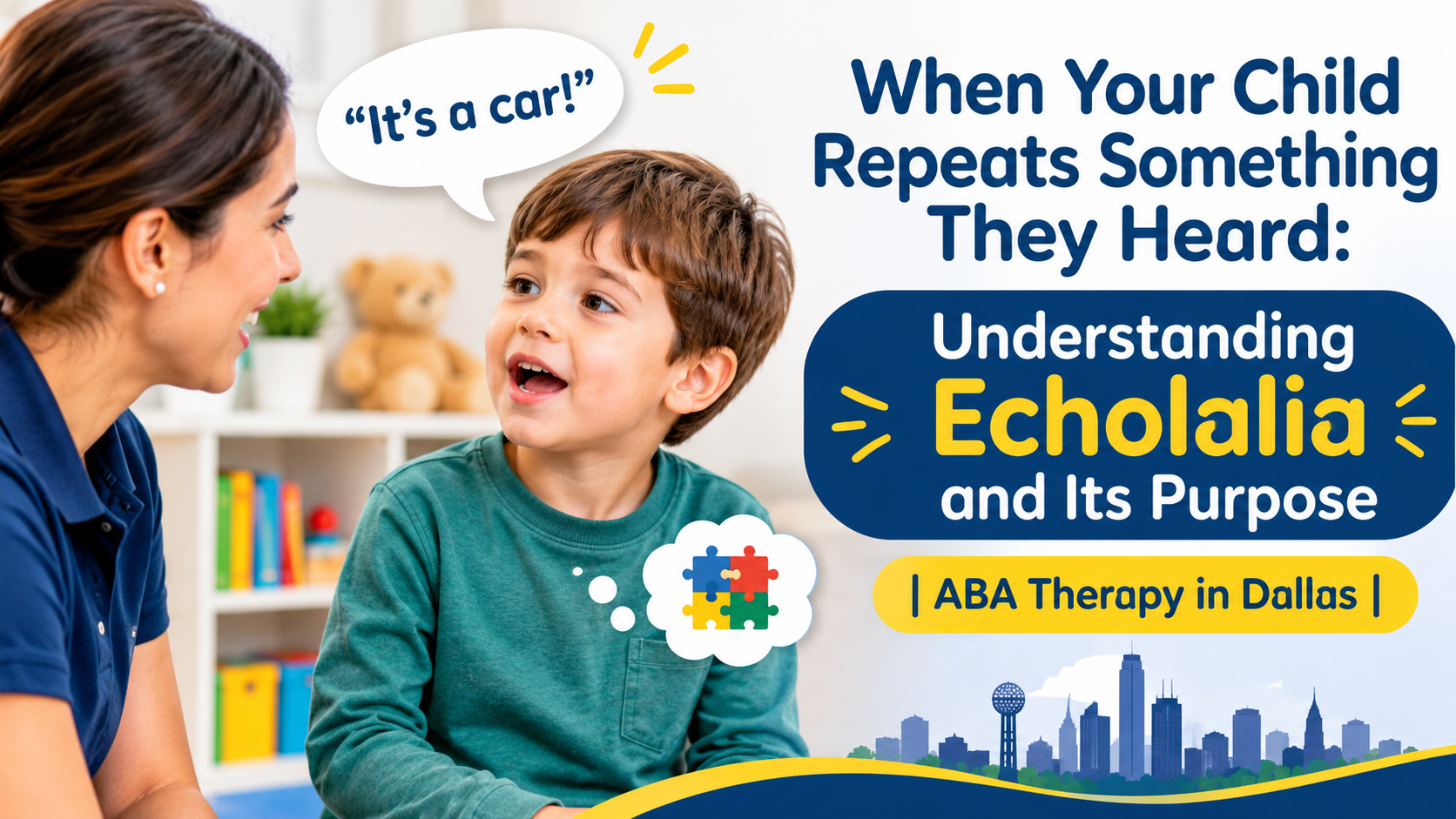
Echolalia refers to the repetition of words, phrases, or sentences that a child has previously heard. The repeated language may come from everyday conversations, favorite television programs, songs, books, or interactions with family members.
For example, a parent might ask, “Do you want something to drink?” Instead of answering yes or no, the child repeats, “Do you want something to drink?”
Although the response may not sound like a typical answer, the child may be attempting to communicate or process the question.
Echolalia is frequently associated with autism, but it can also appear during typical language development. Young children often repeat words as they learn vocabulary, sentence patterns, and conversational skills.
For families researching ABA therapy services Dallas, understanding the difference between repetition and purposeful communication is an important starting point. Applied Behavior Analysis Dallas professionals can help families explore communication patterns and identify meaningful opportunities to build new skills.
Immediate and Delayed Echolalia
Echolalia generally falls into two categories.
Immediate echolalia happens when a child repeats something shortly after hearing it.
Examples include:
- Repeating a parent’s question instead of answering it.
- Repeating instructions given by a teacher.
- Repeating a word or phrase immediately after another person says it.
- Echoing a sentence during an everyday conversation.
Delayed echolalia occurs when a child repeats language they heard earlier. The repetition may happen hours, days, weeks, or even months after the original experience.
Examples include:
- Repeating dialogue from a favorite cartoon.
- Using a familiar sentence from a previous conversation.
- Repeating a phrase from a song when experiencing a particular emotion.
- Using a memorized expression during a situation that reminds the child of an earlier experience.
Both forms can serve different purposes. Instead of automatically discouraging repetition, caregivers can look at the situation, the child’s behavior, and what may have prompted the language.
Why Do Children Repeat Words and Phrases?
Children may repeat language for several reasons. Sometimes repetition helps them understand information. Other times, it gives them a way to communicate when they do not yet have the words to express an original thought.
For parents exploring ABA therapy for autism Dallas, understanding these possible functions can help them recognize communication opportunities throughout the day. Families looking into autism therapy Dallas TX can also benefit from learning how repeated language may support their child’s development.
1. Processing Language and Information
Understanding spoken language requires several skills. Children must recognize words, interpret their meaning, understand the question or instruction, and determine how to respond.
Some children repeat what they hear as they process the information.
For instance, when someone says, “Let’s put your shoes on,” a child might repeat, “Put your shoes on” before beginning the task.
The repetition may give the child additional time to understand what is being communicated.
Parents can support this process by:
- Speaking in clear, manageable sentences.
- Allowing additional time for responses.
- Avoiding repeated questioning.
- Pairing spoken instructions with gestures or visual cues.
- Recognizing attempts to respond, even when the words are repeated.
2. Communicating Wants and Needs
Echolalia can also function as a form of communication.
Imagine a child who frequently hears the phrase, “Do you want to go outside?” When the child wants to play outdoors, they may repeat the same question.
Although the wording sounds like a question, the child’s intention may actually be to request outdoor time.
This is an important distinction. The child may already be using language purposefully, even if the communication does not look like a typical conversation.
Through individualized behavioral intervention Dallas TX families may explore, therapists can help identify what a child’s repeated phrases communicate and build on those existing skills.
3. Expressing Feelings and Emotions
Sometimes children repeat familiar words because those phrases are connected to emotional experiences.
A child might repeat a favorite song lyric when excited, use a familiar phrase when feeling overwhelmed, or repeat something a parent previously said when seeking reassurance.
These expressions may help children communicate feelings they cannot yet describe independently.
Parents can respond by acknowledging the possible emotion and providing simple language.
For example:
- Child: “It’s okay, it’s okay.”
- Parent: “You want to feel safe. I’m right here.”
This approach validates the child’s communication while introducing additional language that may become useful over time.
4. Finding Comfort in Familiar Language
Familiar phrases can provide predictability. Repeating a sentence or expression may help a child feel more comfortable during unfamiliar situations or changes in routine.
For example, a child might repeat a phrase from a favorite show while entering a new classroom or preparing for an unfamiliar activity.
Rather than assuming the repetition should stop, caregivers can consider whether the child is using familiar language to manage the experience.
Supporting emotional regulation and communication together can be an important part of developmental therapy Dallas families seek.
Is Echolalia a Sign That a Child Understands Language?
One of the most common questions parents ask is whether a child understands the words they repeat.
The answer depends on the individual child and the situation.
Some children repeat phrases with a clear understanding of their meaning. Others may recognize certain words or expressions but have difficulty interpreting the entire sentence.
A child may also understand more than they can independently express.
For example, a child who repeats “Time to clean up” might understand that an activity is ending and that toys need to be put away. However, they may not yet be able to independently say, “I’m finished playing.”
This is why evaluating communication requires looking beyond spoken words.
Parents and professionals may consider:
- Whether the child responds appropriately to familiar instructions.
- Whether repeated phrases occur in predictable situations.
- Whether the child uses certain expressions to request specific things.
- Whether gestures, facial expressions, or body movements accompany speech.
- Whether the child demonstrates understanding through actions.
An individualized assessment can help identify receptive language skills, expressive communication abilities, and areas where additional support may be beneficial.
When Should Parents Seek Additional Support?
Echolalia does not automatically mean a child has a communication disorder or requires intensive intervention. However, parents may benefit from professional guidance when repeated language is accompanied by communication difficulties that affect everyday activities.
Consider seeking an evaluation if your child:
- Has difficulty communicating basic wants and needs.
- Frequently repeats questions without appearing to understand them.
- Struggles to participate in back-and-forth conversations.
- Has difficulty expressing discomfort, frustration, or other emotions.
- Relies heavily on memorized phrases and has difficulty communicating new ideas.
- Experiences challenges communicating across different environments.
An evaluation can help determine whether speech-language services, autism support services Dallas families can access, or other developmental supports may be appropriate.
Families can also explore pediatric ABA therapy Dallas providers offer when they want individualized support for communication, social interaction, and daily living skills.
Parents of younger children may also want to learn about ABA therapy for toddlers Dallas programs and whether early developmental support is appropriate for their child’s needs.
It is important to remember that children develop at different rates. The goal should not be to eliminate every repeated phrase but to understand what the child is communicating and identify opportunities to expand their abilities.
How ABA Therapy Can Support Children Who Use Echolalia
Applied Behavior Analysis focuses on understanding behavior, identifying meaningful learning opportunities, and teaching skills that support everyday life.
When echolalia is part of a child’s communication, ABA therapy can help identify the purpose of repeated language and encourage more flexible ways to communicate.
For families researching autism behavior therapy Dallas, individualized treatment should begin with understanding the child’s current communication abilities rather than assuming that all repetition serves the same purpose.
Identifying the Function of Repeated Language
Before introducing new communication goals, a therapist may observe when, where, and why a child repeats particular phrases.
For example:
- Does the child repeat phrases when requesting something?
- Does repetition happen more frequently during transitions?
- Does the child use familiar dialogue when excited?
- Does the child repeat questions when processing information?
- Does the child use certain phrases when seeking attention or comfort?
Understanding these patterns helps therapists develop meaningful strategies.
A BCBA may use observations, caregiver interviews, and individualized assessments to understand how communication occurs across different environments.
Families looking into BCBA services Dallas providers offer should look for professionals who recognize the importance of functional communication and respect each child’s individual learning style.
Building Functional Communication
One goal of communication-focused intervention is helping children express what they want, need, and feel in ways that other people can understand.
For example, if a child repeats “Do you want a snack?” whenever they are hungry, a therapist might gradually introduce alternative expressions such as:
- “I want a snack.”
- “Can I have food?”
- “I’m hungry.”
The goal is not to remove the child’s original phrase immediately. Instead, the therapist can acknowledge its meaning and introduce additional ways to communicate the same message.
This allows children to build on language they already use.
Encouraging Spontaneous Language
Some children rely heavily on familiar expressions because creating original sentences is challenging.
Therapists can introduce learning opportunities that encourage children to use language more independently.
For instance, during play, a therapist might pause before giving a favorite toy and create an opportunity for the child to request it.
Depending on the child’s abilities, the therapist may support communication through:
- Spoken words.
- Short phrases.
- Gestures.
- Visual communication.
- Augmentative and alternative communication (AAC), when appropriate.
These strategies can be incorporated into ABA therapy for kids Dallas families explore, with goals based on each child’s communication profile.
Supporting Social Communication
Communication involves more than requesting objects or answering questions. Children also need opportunities to participate in shared activities, respond to others, and express their interests.
A therapist may work on:
- Taking turns during conversations.
- Responding to simple questions.
- Initiating interactions.
- Sharing interests.
- Participating in play.
- Recognizing opportunities to communicate with others.
These goals can help children develop more meaningful interactions with family members, classmates, and peers.
For children who benefit from structured support, center-based ABA therapy Dallas programs may offer opportunities to practice communication and social skills in a learning environment. Meanwhile, in-home ABA therapy Dallas services can help children practice skills within familiar routines and everyday family interactions.
The most appropriate setting depends on the child’s needs, family priorities, treatment goals, and available services.
How Parents Can Respond to Echolalia at Home
Parents play an important role in supporting communication development. Everyday activities provide opportunities to model language, encourage interaction, and help children discover new ways to express themselves.
You do not need to turn every conversation into a lesson. Small, consistent interactions can make a meaningful difference.
1. Acknowledge What Your Child Says
When your child repeats a phrase, avoid immediately telling them to stop or insisting that they say something differently.
Instead, consider what the phrase might mean.
If your child says, “Are you ready to go?” while standing near the door, they may be communicating that they want to leave.
You can respond, “Yes, let’s go outside!”
This acknowledges the possible intention behind the words and keeps the interaction positive.
2. Model Simple Alternative Phrases
If your child frequently repeats long sentences, introduce shorter expressions that communicate the same idea.
For example:
- Instead of repeating, “Do you want some water?” model “I want water.”
- Instead of repeating, “It’s time to play,” model “Let’s play.”
- Instead of repeating, “Are you okay?” model “I need help.”
Keep language natural and connected to what is happening.
3. Give Your Child Time to Respond
Some children need more processing time before responding to a question or instruction.
After speaking, pause instead of immediately repeating the question.
For example, ask, “Which toy would you like?” Then give your child time to respond through speech, gestures, pointing, or another communication method.
This can reduce pressure and create more opportunities for independent communication.
4. Follow Your Child’s Interests
Children are often more motivated to communicate when an activity involves something they enjoy.
If your child loves building blocks, playing with toy animals, or watching a favorite show, use those interests to create opportunities for interaction.
You might introduce simple phrases such as:
- “Build a tower.”
- “My turn.”
- “More blocks.”
- “The animal is sleeping.”
Following your child’s interests can make communication more natural and enjoyable.
5. Avoid Making Speech the Only Way to Communicate
Not every child communicates most effectively through spoken language.
Gestures, pictures, signs, and AAC tools can also support meaningful communication.
These approaches do not need to be viewed as replacements for speech. They can provide additional ways for children to express themselves while their communication abilities continue developing.
If you are unsure which strategies are appropriate, discuss them with your child’s treatment team.
Choosing the Right ABA Support for Your Child
Finding appropriate support can feel overwhelming, particularly when parents are learning about autism, communication development, and different treatment approaches.
Families searching for ABA therapy near Dallas may encounter several providers offering different treatment settings, schedules, and services.
When comparing options, consider the following:
Individualized treatment plans: Your child’s goals should reflect their communication abilities, developmental needs, interests, and family priorities.
Qualified professionals: Ask about the qualifications and supervision of the professionals responsible for developing and implementing the treatment plan.
Family involvement: Caregiver collaboration helps children practice communication skills outside therapy sessions.
Communication-focused goals: Ask how the provider approaches echolalia, functional communication, spontaneous language, and alternative communication methods.
Flexible treatment settings: Consider whether home-based services, clinic-based services, or a combination would best support your child’s goals.
When comparing the best ABA therapy providers Dallas has available, remember that the best choice is not necessarily the provider offering the most hours. It is important to find a team that understands your child, communicates clearly with your family, and develops meaningful goals.
Some families search for affordable ABA therapy Dallas TX options, while others investigate private ABA therapy Dallas providers. Treatment availability, insurance acceptance, and out-of-pocket expenses can vary.
Parents may also compare intensive ABA programs Dallas providers offer. Before choosing a schedule, consider your child’s individual needs, the treatment team’s recommendations, and your family’s ability to participate.
Families looking for ABA clinics in Dallas should ask about treatment environments, staff qualifications, communication goals, and opportunities for caregiver involvement.
If you are trying to find ABA therapist Dallas families can work with, ask whether the provider offers an initial consultation and how the team determines whether its services are appropriate.
Understanding ABA Therapy Options in Dallas
Parents researching autism services often encounter many different treatment descriptions. Understanding what each service offers can make the decision-making process easier.
ABA therapy in Dallas TX may be available through different settings and treatment arrangements, depending on provider availability and a child’s needs.
For example:
- In-home services: Provide opportunities to practice communication during meals, playtime, transitions, and other familiar routines.
- Center-based services: Offer structured learning opportunities and supervised practice in a clinic environment.
- Early intervention: Supports younger children who may benefit from individualized developmental and communication goals.
- Parent training: Helps caregivers understand strategies they can incorporate into everyday interactions.
Families may also search for Dallas autism services to learn about developmental evaluations, therapy options, and resources for children with autism.
Some parents explore ABA therapy near me Dallas searches to locate providers close to home, while others compare available programs based on their child’s treatment needs.
When researching the best ABA therapy in Dallas, look beyond advertising claims. Ask about individualized goals, communication approaches, caregiver participation, and how progress is evaluated.
Families can also compare top-rated ABA therapists Dallas providers advertise, but ratings should be only one consideration when selecting a treatment team.
Parents interested in ABA therapy cost Dallas should request information about insurance acceptance, authorization requirements, copayments, scheduling, and any additional expenses before beginning services.
Understanding how ABA therapy works Dallas providers explain it can also help parents make informed decisions. A reputable provider should be willing to discuss its assessment process, treatment methods, supervision practices, and family collaboration.
How Radiant Spectrum Therapy Supports Children’s Development
At Radiant Spectrum Therapy, we believe every child deserves opportunities to communicate, connect, and develop skills in ways that respect their individual strengths and needs.
Our approach recognizes that communication does not look the same for every child. Some children communicate through complete sentences, while others use gestures, familiar phrases, pictures, or repeated language.
Rather than focusing only on what a child is not yet doing, meaningful support begins by understanding what the child can already communicate.
Our services are designed to help families explore individualized ABA support through both in-home and in-clinic options in the Dallas and Highland Park areas.
Whether a child is learning to express basic needs, participate in conversations, develop social skills, or become more independent during everyday activities, treatment goals should be meaningful to the child and their family.
We also recognize that parents are essential members of the developmental journey. Collaboration, practical guidance, and consistent communication help families understand their child’s progress and identify ways to support learning beyond therapy sessions.
Contact us at 972–310–4991 or visit https://radiantspectrumtherapy.com/ to learn more.