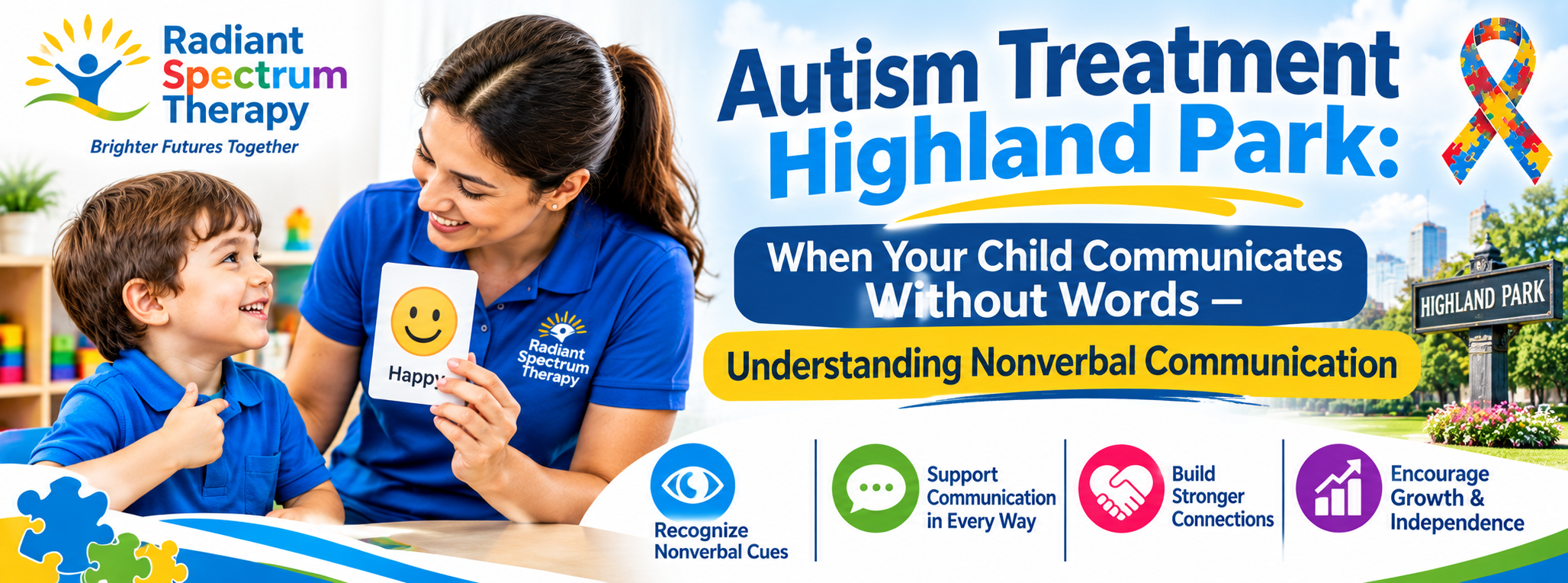
Communication is about much more than speaking. Children express their thoughts, feelings, preferences, and needs in many different ways, even when they do not use spoken words. For families exploring Autism Treatment Highland Park, understanding these forms of communication can be an important step toward helping their children connect with others and participate more comfortably in everyday life. A gesture, facial expression, movement, or picture can communicate something meaningful, and recognizing these signals can help parents and caregivers better understand what a child is trying to express.
For children on the autism spectrum, communication may look different from what adults typically expect. Some children use a few spoken words, while others communicate primarily through gestures, body language, visual supports, or alternative communication systems. Some may understand much more than they can express verbally. Others may communicate differently depending on the environment, activity, or people around them.
The goal should never be to force every child to communicate in the same way. Instead, families can learn to recognize each child’s communication style and provide opportunities for meaningful interaction. With the right support, children can develop ways to express themselves, make choices, build relationships, and become more independent.
At Radiant Spectrum Therapy, we believe every child deserves to be heard, understood, and supported. Through individualized care and compassionate guidance, families can discover communication strategies that respect their child’s strengths and developmental needs.
What Does Nonverbal Communication Mean in Autism?
Nonverbal communication refers to the ways people share information without relying on spoken language. It includes facial expressions, gestures, eye gaze, body movements, pointing, pictures, and other visual or physical signals.
For autistic children, these communication methods can be especially important. A child who does not regularly speak may still have many ways to express what they want, what they enjoy, or when something feels uncomfortable.
For example, a child might:
- Point toward a favorite snack when they are hungry.
- Bring a toy to a parent to request help or invite interaction.
- Push an object away to communicate that they do not want it.
- Reach toward someone when asking to be picked up.
- Use facial expressions to show excitement, frustration, or discomfort.
- Lead a caregiver toward a preferred activity.
- Use pictures or symbols to communicate choices.
These actions are not simply behaviors that need to be corrected. They can carry meaningful messages that adults should learn to recognize.
Families seeking ABA therapy Highland Park or ABA therapy services Highland Park may benefit from learning how different communication styles affect their child’s daily experiences. Understanding what a child is already communicating provides a foundation for developing additional communication skills.
Understanding the Different Ways Children Communicate Without Words
Every child has an individual communication style. Some children rely on several methods, while others consistently use one or two approaches. Recognizing these differences helps caregivers respond more effectively.
1. Gestures and Hand Movements
Gestures are among the most recognizable forms of nonverbal communication. Children may use their hands and arms to express requests, preferences, and emotions.
Common examples include:
- Pointing toward something they want.
- Waving to greet or say goodbye.
- Reaching for an object or person.
- Shaking their head to indicate no.
- Nodding to communicate agreement.
- Giving an object to someone to request assistance.
Some autistic children may develop their own gestures that are meaningful to their families. A child might tap a particular object when requesting it or repeatedly extend their hand toward a cabinet to indicate that they want something inside.
Parents should pay attention to these patterns rather than assuming a gesture must look a certain way to be meaningful.
2. Facial Expressions
Facial expressions can provide important information about a child’s emotional experience. Smiling, frowning, widening the eyes, or changing facial tension may communicate excitement, uncertainty, discomfort, or frustration.
However, autistic children may express emotions differently. Some may have subtle facial expressions, while others may not consistently display emotions in ways that adults expect.
For instance, a child might appear calm while feeling overwhelmed or smile when experiencing excitement or nervousness. Facial expressions should be understood alongside the child’s environment, actions, and other communication signals.
Parents exploring Applied Behavior Analysis Highland Park can learn how to observe these signals within everyday situations and respond in ways that support their child’s emotional and communication needs.
3. Body Language and Movement
Body movements can communicate information that spoken language does not capture. A child’s posture, movement, and physical responses may help caregivers understand their preferences and experiences.
Examples include:
- Moving closer to a trusted caregiver for comfort.
- Turning away from an activity they do not enjoy.
- Covering their ears when sounds become overwhelming.
- Jumping or moving excitedly when anticipating something enjoyable.
- Moving toward a preferred toy or activity.
- Pulling away when they need additional personal space.
Some movements may also be related to sensory regulation. For example, rocking, hand movements, or repetitive motions may help a child manage sensory input or emotions.
These movements should not automatically be interpreted as communication attempts or problems. Context matters, and repetitive movements can serve important self-regulation purposes.
4. Eye Gaze and Visual Attention
Children may also communicate through where they look or how they direct their attention. Looking toward an object, alternating attention between an item and a caregiver, or watching someone demonstrate an activity can provide useful information.
However, eye contact is not a requirement for meaningful communication. Some autistic children find direct eye contact uncomfortable or distracting.
Instead of insisting that a child look directly at someone, adults can focus on whether the child is engaging, responding, sharing attention, or communicating through other methods.
The priority is meaningful connection, not forcing a particular social behavior.
Why Recognizing Nonverbal Communication Matters
When children cannot easily communicate their needs, everyday situations can become frustrating. A child may struggle to request assistance, express discomfort, or explain what they want.
When adults overlook these communication attempts, misunderstandings can happen.
For example, a child who pushes away a plate may be communicating that they are finished eating. A child who covers their ears may be responding to uncomfortable noise. A child who brings a puzzle to an adult may be asking for help.
Recognizing these signals can help families:
- Respond to needs before frustration increases.
- Reduce communication-related misunderstandings.
- Support emotional expression.
- Encourage independence and decision-making.
- Build stronger relationships.
- Create more positive daily routines.
For families considering ABA therapy for autism Highland Park or autism therapy Highland Park TX, understanding nonverbal communication can be an important part of identifying meaningful developmental goals.
The objective is not to eliminate a child’s existing communication style. It is to acknowledge what the child can already express and help them develop additional ways to communicate when needed.
Alternative and Augmentative Communication Methods
Some children benefit from additional communication tools that make it easier to express themselves. Augmentative and Alternative Communication (AAC) refers to methods and tools that support communication beyond spoken language.
AAC can be used by children who are nonspeaking, minimally speaking, or who benefit from additional ways to communicate.
Picture Exchange and Visual Communication
Picture-based communication allows children to express needs by selecting or exchanging images.
For example, a child may use pictures representing:
- Food and drinks.
- Favorite toys.
- Activities.
- People.
- Places.
- Feelings.
- Everyday routines.
A child might select a picture of a snack to request something to eat or choose a picture representing an outdoor activity.
Visual communication can be particularly helpful because it provides a concrete way to understand choices and express preferences.
Communication Boards
Communication boards display pictures, symbols, or words that children can point to or select.
A simple board might include options such as:
- Help.
- More.
- Stop.
- Finished.
- Yes.
- No.
- Break.
- Drink.
These boards can be customized to match a child’s vocabulary, abilities, and everyday environment.
Speech-Generating Devices
Some children use electronic devices or tablet-based applications that produce spoken words when a picture, symbol, or word is selected.
These devices can help children communicate more independently in different environments.
For example, a child might select an image of water, and the device will produce the corresponding spoken message.
AAC does not prevent children from developing spoken language. It can provide another communication pathway while supporting their ability to express themselves.
Visual Schedules and Routine Supports
Visual schedules use pictures or symbols to show what activities are coming next.
They can help children understand daily routines, prepare for transitions, and communicate preferences.
A morning schedule might include pictures showing:
- Wake up.
- Get dressed.
- Eat breakfast.
- Brush teeth.
- Get ready for school.
Visual schedules can make routines more predictable and reduce uncertainty.
How ABA Therapy Can Support Nonverbal Communication
Applied Behavior Analysis (ABA) is an individualized approach that can help children develop practical skills, including communication, social interaction, daily living, and independence.
For children who communicate without spoken words, ABA programs may focus on identifying existing communication abilities and building additional functional communication skills.
When families explore in-home ABA therapy Highland Park, center-based ABA therapy Highland Park, or early intervention ABA Highland Park, they should look for individualized programs that respect their child’s current communication methods.
Depending on the child’s needs, a program may focus on:
- Requesting preferred items and activities.
- Communicating yes and no.
- Asking for help.
- Expressing discomfort.
- Making independent choices.
- Understanding visual instructions.
- Responding to everyday communication.
- Using gestures, pictures, or AAC devices.
- Developing social interaction skills.
A qualified Board Certified Behavior Analyst (BCBA) can assess a child’s current skills and help establish appropriate goals.
Individualized Communication Goals
No two children have exactly the same communication needs. One child may benefit from learning to point toward preferred objects, while another may already use a communication device and need support using it in different settings.
An individualized plan considers:
- The child’s developmental abilities.
- Existing communication methods.
- Personal interests and preferences.
- Sensory needs.
- Family priorities.
- Everyday challenges and opportunities.
The goal is to help children communicate more effectively in ways that are useful and meaningful to them.
Encouraging Communication Through Everyday Activities
Communication opportunities do not have to happen only during structured learning sessions.
Parents and caregivers can encourage communication throughout the day.
For example:
- During meals, offer choices between two preferred foods.
- During playtime, pause occasionally to allow the child to request more.
- During dressing, provide opportunities to choose between clothing options.
- During storytime, encourage the child to point toward pictures.
- During outdoor activities, use gestures and visual supports to identify objects.
These everyday interactions provide natural opportunities for children to practice expressing themselves.
Supporting Nonverbal Communication at Home
Parents play an important role in helping children feel understood. Small changes in everyday interactions can make communication more comfortable and accessible.
Give Your Child Time to Respond
Children may need additional time to process information and communicate a response. Avoid immediately repeating instructions or answering on their behalf.
Pause, observe, and allow your child an opportunity to respond using their preferred communication method.
Offer Choices
Giving children choices encourages independent communication.
Instead of asking an open-ended question such as, “What do you want to eat?” try showing two options.
You can hold up an apple and a banana or display pictures of both foods. Your child can point, reach, gesture, or use an AAC device to make a selection.
Acknowledge Every Communication Attempt
If your child points toward a toy, recognize the gesture and respond appropriately. If they bring you a cup, consider whether they are requesting a drink or asking for help.
Responding to communication attempts teaches children that their actions can help them connect with others.
Use Simple and Consistent Language
Pairing simple spoken words with gestures, pictures, or demonstrations can make communication easier to understand.
For example, when offering a toy, you might say “Ball” while showing the object.
Consistency across family members and caregivers can also help children understand familiar words and routines.
Avoid Forcing Eye Contact or Speech
Children should not have to make eye contact or speak verbally to demonstrate that they understand or are engaged.
Respecting a child’s communication preferences creates a more supportive environment and allows them to participate without unnecessary pressure.
When Should Parents Consider Professional Communication Support?
Every child’s development is different. Some children begin communicating through gestures early, while others need additional support to develop reliable communication methods.
Parents may consider a professional evaluation when a child:
- Has difficulty expressing basic needs.
- Rarely uses gestures to communicate.
- Experiences frequent frustration related to communication.
- Has difficulty making choices or requesting assistance.
- Does not consistently respond to familiar communication.
- Relies on adults to interpret most of their needs.
- Has lost previously developed communication skills.
A developmental evaluation can help families better understand their child’s strengths and areas where additional support may be beneficial.
For children who have lost previously acquired communication skills, parents should seek prompt medical and developmental evaluation.
Families exploring pediatric ABA therapy Highland Park, ABA therapy for toddlers Highland Park, or ABA therapy for kids Highland Park can discuss their concerns with qualified professionals to determine what types of support may be appropriate.
Choosing the Right ABA Support in Highland Park
Finding appropriate developmental support involves more than choosing a nearby provider. Families should look for a team that understands their child’s individual communication needs and prioritizes meaningful progress.
When comparing best ABA therapy providers Highland Park, consider the following questions:
- Are services individualized for each child?
- Are communication goals based on the child’s needs and preferences?
- Are BCBAs involved in assessment and treatment planning?
- Does the provider support AAC and other communication methods?
- Are parents included in the learning process?
- Are progress and treatment goals regularly reviewed?
- Does the team prioritize functional communication and independence?
Families may encounter different options, including private ABA therapy Highland Park, intensive ABA programs Highland Park, and other forms of behavior therapy Highland Park.
It is important to understand what each program offers and whether its approach aligns with the child’s developmental needs.
A provider offering autism behavior therapy Highland Park or behavioral intervention Highland Park TX should be able to explain how communication goals are developed, measured, and adjusted over time.
Families may also compare BCBA services Highland Park, autism support services Highland Park, developmental therapy Highland Park, and special needs therapy Highland Park to understand the range of available resources.
Understanding ABA Therapy Costs and Available Options
Cost is another important consideration when researching services. Families searching for affordable ABA therapy Highland Park TX or ABA therapy cost Highland Park may find that pricing varies depending on several factors.
These may include:
- The number of therapy hours recommended.
- Whether services are provided at home or in a clinic.
- The child’s individualized treatment needs.
- Insurance coverage and eligibility.
- Assessment and supervision requirements.
Some families prefer in-home ABA therapy Highland Park because learning can take place within familiar routines and environments. Others may consider center-based ABA therapy Highland Park when a structured clinical setting better supports their child’s goals.
There is no single service arrangement that works for every family. Discussing treatment recommendations, insurance benefits, scheduling, and costs directly with providers can help parents make informed decisions.
Finding the Right Communication Support Near Highland Park
Searching for ABA therapy near Highland Park, ABA therapy in Highland Park TX, or Highland Park autism services can help families identify local developmental resources.
Parents may also search for ABA clinics in Highland Park, ABA therapy near me Highland Park, best ABA therapy in Highland Park, or top-rated ABA therapists Highland Park when comparing providers.
However, proximity and online ratings should not be the only factors influencing a decision. A provider’s clinical approach, staff qualifications, communication practices, family involvement, and ability to accommodate individual needs are equally important.
If you are trying to find ABA therapist Highland Park, consider scheduling a conversation to learn how the provider approaches communication development and individualized care.
The right team should be willing to listen to your concerns, answer your questions, and explain how its services can support your child’s progress.
Every Child Deserves to Be Heard, Understood, and Supported
Communication does not have to involve spoken words to be meaningful. A gesture, a picture, a movement, or a communication device can help a child share their needs, express preferences, and build connections with the people around them.
For families exploring Autism Treatment Highland Park, recognizing these communication methods is an important part of understanding how children interact with their environment. With patience, individualized support, and consistent opportunities to communicate, children can develop skills that make everyday experiences more accessible and rewarding.
At Radiant Spectrum Therapy, we believe progress begins with understanding each child’s unique strengths. Our compassionate approach to ABA therapy focuses on meaningful developmental goals, functional communication, and helping children build confidence and independence.
Whether your family is exploring early intervention, in-home services, or additional developmental support, your child’s communication journey deserves individualized attention.
Every child has a voice. Our goal is to help them find the ways to share it.
Contact us at 972–310–4991 or visit https://radiantspectrumtherapy.com/our-locations-highland-park/ to learn more.