
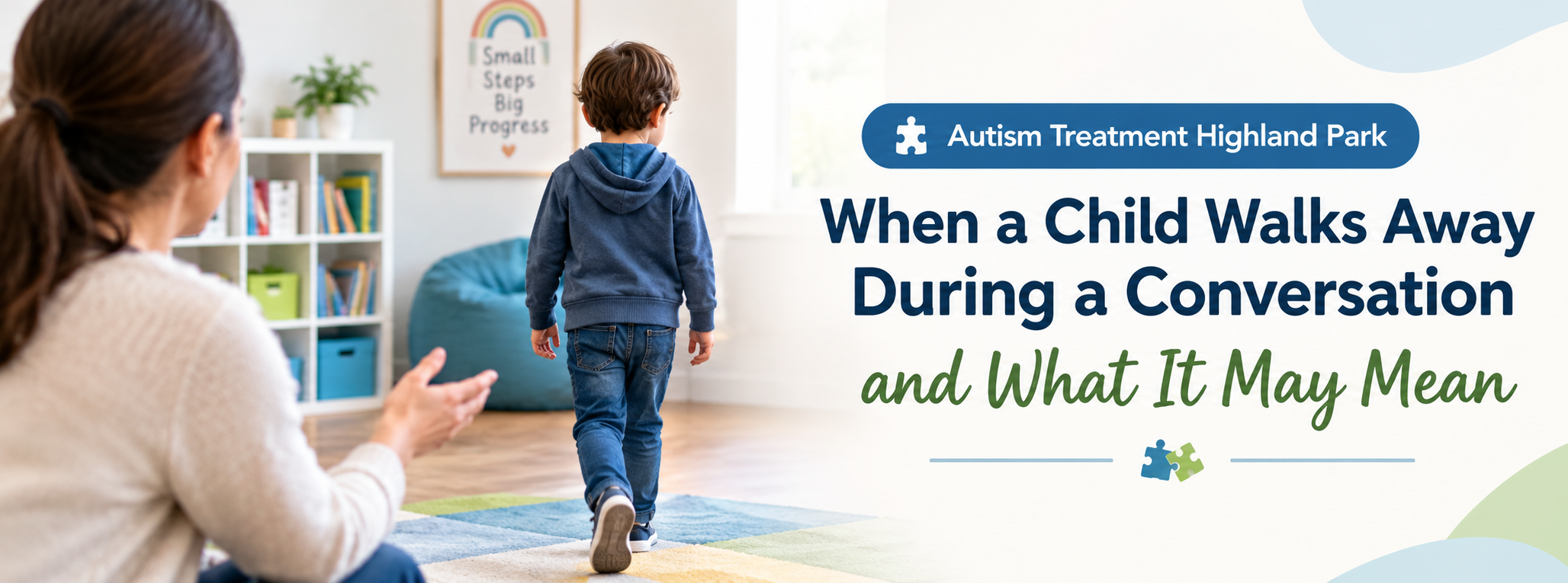
When a child walks away during a conversation, it can be difficult for parents and caregivers to understand what the child is communicating. The child may need a break, feel overwhelmed, lose interest in the activity, or struggle to express that they are ready to move on. Understanding these moments is an important part of Autism Treatment Highland Park, where supporting communication, independence, and meaningful social connections can help children participate more comfortably in everyday interactions.
For some autistic children, walking away is not necessarily a sign of defiance or disrespect. It may be a practical way to communicate a need when spoken language, gestures, or other communication skills are still developing. Other children may walk away because a conversation is too demanding, the environment is uncomfortable, or they need more time to process what someone has said.
Instead of immediately viewing the behavior as something that needs to be stopped, adults can look at what happened before the child walked away, what the child might be communicating, and how to respond in a supportive way.
At Radiant Spectrum Therapy, compassionate, individualized ABA therapy can help children develop practical communication skills while respecting their preferences, boundaries, and individual needs. The goal is not to require children to remain in every conversation. It is to help them communicate when they need space, understand social situations, and reconnect when they are ready.
Why Might a Child Walk Away During a Conversation?
Children communicate through words, gestures, facial expressions, body movements, and behavior. Walking away is one action that can have several different meanings depending on the situation.
Understanding the context is essential because the same behavior may serve different purposes at different times.
The Child May Need a Break
Conversations require attention, listening, processing information, and sometimes responding quickly. For a child who finds these demands challenging, even a short interaction can become tiring.
A child might walk away after answering several questions, participating in a group activity, or spending time in a busy environment. The movement may indicate a need to rest or take a break from social demands.
Rather than insisting that the child finish the conversation, adults can acknowledge the possibility that the interaction has become too demanding.
A simple response might be, “You need a break. That’s okay. We can talk again later.”
This approach communicates that the child’s needs matter while introducing language that can eventually replace the need to walk away without warning.
The Conversation May Feel Overwhelming
Environmental and sensory factors can influence how comfortable a child feels during an interaction. Background noise, bright lights, multiple people speaking, or frequent interruptions may make it difficult to concentrate.
Some children also need additional processing time to understand questions and formulate responses. When adults speak quickly or ask several questions in succession, the child may feel pressured.
In these situations, walking away may be an attempt to reduce the demands of the environment.
Caregivers can help by reducing unnecessary noise, slowing the pace of conversation, allowing pauses, and offering a quieter place to talk.
These adjustments can be especially helpful for children receiving autism therapy Highland Park TX, where individualized support can address communication needs alongside environmental and sensory considerations.
The Child May Want to Change Activities
Children have different interests, energy levels, and preferences. A conversation about an unfamiliar subject may be less engaging than an activity the child enjoys.
For example, a child might leave a conversation about getting dressed because they want to play with building blocks. Another child may walk away during a discussion about school because they are ready to move to a different activity.
The child may not yet know how to say, “I’m finished talking,” “Can we do something else?” or “I want to play now.”
Adults can teach these phrases naturally during everyday routines. Offering choices, such as “Would you like to finish this conversation or talk about it after playtime?” can help children practice expressing preferences.
The Child May Not Know How to Respond
Social conversations involve more than understanding individual words. Children must often recognize when someone expects a response, decide what to say, and determine when an interaction is finished.
These expectations may not be obvious to every child.
A child who does not know how to answer a question or enter a conversation may walk away because leaving feels easier than navigating an uncertain situation.
In this case, practical communication support can include teaching simple responses, modeling ways to ask for clarification, and providing opportunities to practice without pressure.
Why Observing Context Matters Before Responding
One of the most helpful things adults can do is observe what happens before, during, and after a child walks away.
The purpose is not to assume that every action has one fixed explanation. Instead, observation helps caregivers identify patterns and make informed decisions about the support a child may need.
Look at What Happened Before the Child Left
Consider the circumstances surrounding the interaction.
Ask yourself:
- Was the conversation taking place in a noisy or crowded environment?
- Had the child already participated in several conversations?
- Were adults asking repeated questions or expecting immediate answers?
- Was the child engaged in an activity they wanted to continue?
- Did the conversation involve an unfamiliar person or topic?
- Did the child show signs of discomfort, frustration, or fatigue?
These details can help identify situations in which the child may need more processing time, a quieter environment, or an opportunity to communicate a preference.
For example, if a child regularly walks away when several adults speak at once, reducing the number of people participating may be more helpful than repeatedly prompting the child to stay.
Notice What Happens Afterward
It can also be useful to observe what the child does after leaving.
Does the child move to a quiet corner? Return to a preferred activity? Seek movement? Cover their ears? Rejoin the conversation independently after a few minutes?
These observations can provide clues about the child’s needs, although no single action proves a particular reason.
If the pattern is unclear or the behavior creates significant safety concerns, a qualified professional can help caregivers examine the circumstances and develop an individualized support plan.
Avoid Making Assumptions About Intent
Walking away does not automatically mean a child is ignoring someone, refusing to cooperate, or trying to be disruptive.
Assuming negative intent can lead adults to respond with repeated demands, criticism, or unnecessary consequences. These reactions may increase stress without teaching the communication skills the child needs.
A more productive approach is to remain curious, recognize the child’s perspective, and consider what would make the interaction easier.
Families exploring Applied Behavior Analysis Highland Park can discuss these patterns with a qualified behavior analyst who understands the importance of individualized assessment and respectful, functional communication support.
Respecting a Child’s Communication and Boundaries
Helping a child develop social communication skills does not mean requiring them to remain available to others at all times.
Children have the right to communicate discomfort, decline an interaction when appropriate, and ask for space. Respecting these boundaries can help build trust and make future interactions feel more manageable.
Teach That Communication Can Take Different Forms
Spoken language is only one way to communicate.
A child may express a need through gestures, pictures, communication cards, a speech-generating device, or other augmentative and alternative communication (AAC) methods.
For example, a child who is not yet comfortable saying “I need a break” might point to a break card or select the phrase on a communication device.
Adults should recognize these communication attempts and respond consistently. A communication method is useful only when the child has meaningful opportunities to use it.
This is an important consideration for families seeking ABA therapy services Highland Park, particularly when their child benefits from individualized communication strategies.
Avoid Forcing Eye Contact or Conversation
Looking directly at another person is not necessary for every meaningful interaction. Some children listen more comfortably while looking elsewhere, moving around, or engaging with an object.
Similarly, a child does not always need to answer every question immediately or participate in every social exchange.
Instead of focusing exclusively on outward signs of attention, adults can consider whether the child understands the information, communicates their needs, and participates in ways that work for them.
Respecting these differences supports more authentic social interaction rather than teaching children to hide discomfort simply to meet an expectation.
Acknowledge the Need for Space
When a child walks away, adults can respond calmly and avoid turning the moment into a confrontation.
Depending on the circumstances, a response might be:
- “You can take a break.”
- “Would you like some quiet time?”
- “You can tell me when you’re ready.”
- “Let’s pause and come back to this later.”
These statements acknowledge the child’s needs while modeling language that can support future communication.
If immediate safety is a concern, adults should prioritize safety and provide appropriate supervision without treating the child’s need for space as wrongdoing.
Teaching Practical Ways to Request a Pause
Children can learn alternative ways to communicate that they are finished, need space, or want to change activities. These skills are most useful when they are easy to understand, practical to use, and consistently respected.
The aim is not to eliminate a child’s ability to leave an uncomfortable interaction. It is to expand the child’s communication options.
Start With Simple, Functional Phrases
Choose language that matches the child’s current communication abilities.
Examples include:
- “Break, please.”
- “I’m finished.”
- “Not now.”
- “I need space.”
- “Can we talk later?”
- “Help me, please.”
Some children may begin with one word, a gesture, or a picture. Others may be ready for complete sentences.
Adults should avoid expecting a child to master a complicated phrase before honoring a clear request for a break.
Practice During Calm Moments
It is easier to learn a new skill when the child is comfortable than when they are already overwhelmed.
Parents can practice during familiar activities, such as playing a game, preparing a snack, or talking about a favorite subject.
For example, a parent might say, “If you want to stop playing, you can tell me ‘all done.’”
The child can then practice the phrase, gesture, or communication symbol. When the child communicates that they are finished, the adult should respond appropriately.
Repeated, low-pressure practice helps make the communication skill more familiar.
Use Visual Supports When Helpful
Visual supports can make communication more accessible for children who benefit from seeing information rather than relying entirely on spoken instructions.
A small set of picture cards might include:
- Break
- Finished
- Help
- Quiet space
- Different activity
- Talk later
These supports can be placed in areas where the child frequently interacts with others.
The symbols should be meaningful to the individual child, and adults should model how to use them without demanding that the child communicate in only one way.
For families exploring early intervention ABA Highland Park, visual communication strategies may be considered as part of a broader, individualized plan when appropriate for the child’s developmental and communication needs.
Respect the Request When Possible
Teaching a child to request a break is most effective when the request leads to a meaningful response.
If the child says “break” but adults repeatedly insist on finishing the conversation first, the child may learn that communicating their needs does not help.
Whenever possible, honor the request promptly. If an important task cannot be stopped immediately, explain the situation in simple language and offer a realistic alternative.
For example, “We need to finish putting the scissors away, then you can take a break.”
Safety, essential care, and other necessary responsibilities may require adult guidance, but those situations should be handled thoughtfully rather than used to dismiss the child’s communication.
How ABA Therapy Can Support Communication Skills
Applied Behavior Analysis (ABA) is an approach that can be used to understand behavior, teach useful skills, and support meaningful participation in everyday life.
When a child frequently walks away during conversations, individualized support may help identify patterns, understand the child’s communication needs, and develop practical alternatives.
The goal should be to increase the child’s ability to communicate and make choices, not simply to make the child remain in a conversation.
Individualized Assessment and Goal Setting
A qualified Board Certified Behavior Analyst (BCBA) may work with a family to understand when walking away occurs and what support might help.
This may include reviewing the child’s communication abilities, observing relevant situations, discussing caregiver concerns, and considering environmental factors.
Goals should reflect the child’s individual needs. One child may benefit from learning to request a break. Another may need support understanding conversational cues, communicating discomfort, or returning to an interaction when they choose.
Families looking for BCBA services Highland Park should ask how a provider develops goals, involves caregivers, measures meaningful progress, and respects a child’s autonomy.
Practicing Skills in Everyday Situations
Communication skills are more useful when children can apply them outside a therapy session.
Depending on the child’s needs, practice may involve asking for a break during play, requesting help with a difficult task, or telling a family member that they are finished talking.
Caregivers can learn to use consistent language, recognize communication attempts, and create opportunities for the child to practice in familiar environments.
Some families may consider in-home ABA therapy Highland Park because practicing skills within everyday routines can make it easier to address situations that naturally occur at home.
Other families may explore center-based ABA therapy Highland Park, depending on their child’s goals, preferences, service availability, and clinical recommendations.
The appropriate setting should be determined by the individual child’s needs rather than assuming that one model is best for every family.
Building Flexible and Meaningful Social Participation
Social communication involves many interconnected skills. Children may benefit from learning how to initiate interactions, express preferences, recognize when someone is speaking to them, and communicate when they are ready to stop.
However, progress does not have to mean longer conversations or more frequent eye contact.
Meaningful progress might include a child independently requesting a break, experiencing less distress during difficult interactions, communicating preferences more clearly, or choosing to rejoin a conversation after resting.
These outcomes focus on communication, comfort, and independence rather than compliance alone.
Supporting Communication at Home, School, and in the Community
Consistency can help children use communication skills across different environments. Parents, teachers, caregivers, and therapists can work together to make sure the child’s requests are understood.
At Home
During family conversations, allow the child time to respond. Avoid asking several questions in quick succession, and notice when the child appears ready to stop.
If the child walks away, calmly acknowledge the movement and consider whether a break or a change in the interaction would help.
Parents can also model their own boundaries by saying things such as, “I need a quiet minute,” or “Let’s finish talking after dinner.” This demonstrates that requesting space is a normal part of communication.
At School
Teachers can support communication by providing predictable routines, clear instructions, and appropriate opportunities for breaks.
If a child regularly leaves group discussions, it may help to examine the length of the activity, noise levels, difficulty of the material, and expectations for participation.
A collaborative plan can identify how the child may request assistance or a pause while maintaining appropriate supervision and access to learning.
In Public and Social Settings
Community settings can introduce unfamiliar people, unexpected changes, and sensory demands.
Before an outing, caregivers can explain what to expect, identify a quiet place if available, and make sure the child has a practical way to request a break.
It may also help to prepare other adults to respond calmly when the child needs space rather than interpreting the behavior as impolite.
These adjustments can support participation without requiring the child to ignore discomfort.
Choosing Autism Support That Respects Your Child
Families considering autism behavior therapy Highland Park may encounter providers who describe their approaches differently. Asking specific questions can help parents determine whether a program aligns with their child’s needs and family priorities.
Consider asking:
- How do you determine why a child walks away during conversations?
- How do you teach children to request breaks and communicate boundaries?
- How do you incorporate AAC or other communication methods?
- How are goals individualized to the child’s strengths and preferences?
- How do you involve parents and caregivers?
- How do you measure progress beyond simply reducing a behavior?
- How do you respond when a child communicates that they do not want to participate?
A thoughtful provider should be able to explain how assessment, teaching strategies, and progress monitoring work together.
Families researching Highland Park autism services may also want to understand which service settings are available, what caregiver involvement looks like, and whether the provider can accommodate the child’s communication and support needs.
When comparing ABA clinics in Highland Park, ask about the qualifications of the clinical team, the approach to individualized treatment, and the process for reviewing goals as the child develops.
It is also reasonable to discuss practical considerations, including insurance coverage, scheduling, and potential out-of-pocket expenses.
Understanding ABA Therapy Options and Costs in Highland Park
Finding an appropriate provider involves more than identifying a nearby clinic. Families may want to compare treatment approaches, available settings, qualifications, and financial considerations before making a decision.
Searches for ABA therapy cost Highland Park may produce different estimates because costs can depend on the provider, service model, number of hours, insurance benefits, and individual treatment plan.
Families considering affordable ABA therapy Highland Park TX should contact providers and their insurance company to clarify coverage, deductibles, copayments, authorization requirements, and any services that may not be covered.
Some parents may prefer private ABA therapy Highland Park, while others may prioritize home-based support, clinic-based sessions, or a combination of services when clinically appropriate and available.
There is no single program that is automatically the best choice for every child. Families looking for the best ABA therapy in Highland Park or top-rated ABA therapists Highland Park should look beyond rankings and consider whether the provider’s approach fits their child’s needs.
Understanding how ABA therapy works Highland Park can also help families evaluate whether a proposed plan emphasizes practical skills, individualized assessment, meaningful outcomes, and collaboration with caregivers.
If you are ready to find ABA therapist Highland Park, consider asking for an initial conversation about your concerns, your child’s communication strengths, and the goals that matter most to your family.
Depending on your child’s age and needs, you may also encounter providers offering pediatric ABA therapy Highland Park, ABA therapy for toddlers Highland Park, ABA therapy for kids Highland Park, or special needs therapy Highland Park. These descriptions can help you explore options, but the specific services and qualifications should always be verified directly with each provider.
Families may also compare developmental therapy Highland Park, behavior therapy Highland Park, and other support services based on their child’s goals. Children can have different needs, and coordinated care may be appropriate when recommended by qualified professionals.
Compassionate Support From Radiant Spectrum Therapy
At Radiant Spectrum Therapy, we believe children deserve support that recognizes their individuality, communication preferences, and potential for growth.
When a child walks away during a conversation, the most helpful response begins with curiosity. The movement may communicate a need for rest, space, a different activity, or help navigating an interaction. By observing the situation, respecting boundaries, and teaching practical ways to request a pause, adults can help children build communication skills that are useful in everyday life.
Families exploring ABA therapy Highland Park can look for individualized support that values both skill development and the child’s comfort. Whether the priority is requesting breaks, expressing preferences, participating in conversations, or developing independence, goals should be meaningful to the child and family.
Radiant Spectrum Therapy provides compassionate ABA therapy focused on helping children connect, grow, and shine. Our approach centers on practical skills, family collaboration, and individualized support that meets children where they are.
If you are exploring Autism Treatment Highland Park, we invite you to learn more about our services and discuss your family’s goals. Together, we can explore supportive strategies that help your child communicate their needs, navigate social situations, and participate in everyday experiences in ways that feel safe and meaningful.
Every child deserves to have their communication recognized. Sometimes, understanding what a child needs begins with listening to what their movement may be telling us.
Contact us at 972–310–4991 or visit https://radiantspectrumtherapy.com/our-locations-highland-park/ to learn more.