
Making mistakes is a normal part of childhood. Kids spill drinks, forget instructions, say something they did not mean, lose a game, break something by accident, or choose a behavior that does not work out the way they expected. For some children, however, the mistake itself may feel much bigger than the situation.
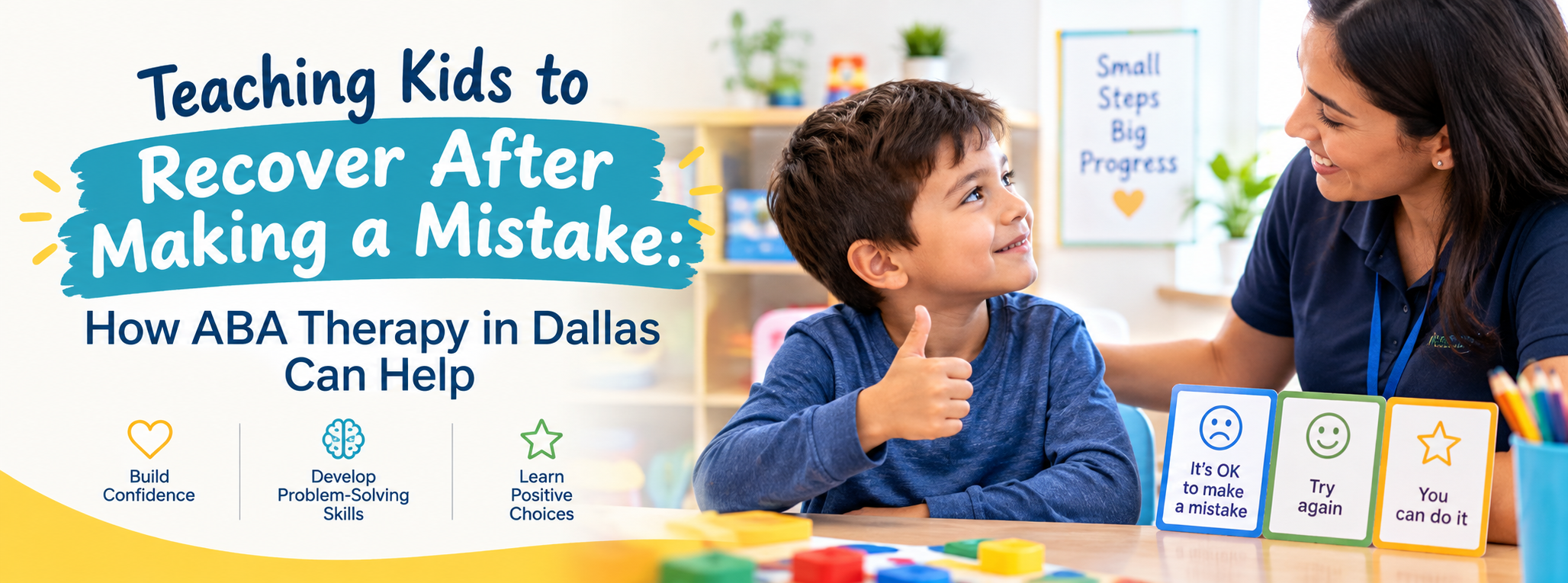
A child may become frustrated, cry, shut down, refuse to continue, or have difficulty moving forward after something goes wrong. Learning how to recover from mistakes is an important life skill, and ABA Therapy in Dallas can help children practice the skills they need to handle these moments more successfully.
The goal is not to teach children that mistakes do not matter. Instead, children can learn that mistakes are something they can work through. With individualized support, they can learn to pause, communicate, problem-solve, try again, and move forward.
Why Recovering From Mistakes Can Be Difficult
Adults often understand that making a mistake is temporary. A child may not see it the same way.
For some children, especially children who have difficulty with emotional regulation, communication, flexibility, or coping with unexpected changes, a mistake can quickly become overwhelming.
For example, imagine a child who is building a tower with blocks. The tower falls just before they finish it. One child might simply rebuild it. Another child may become extremely upset and refuse to touch the blocks again.
The difference is not necessarily about whether the child wants to succeed. The child may simply need more practice with the skills involved in recovering.
Some children may struggle with:
- Accepting that something did not go as planned
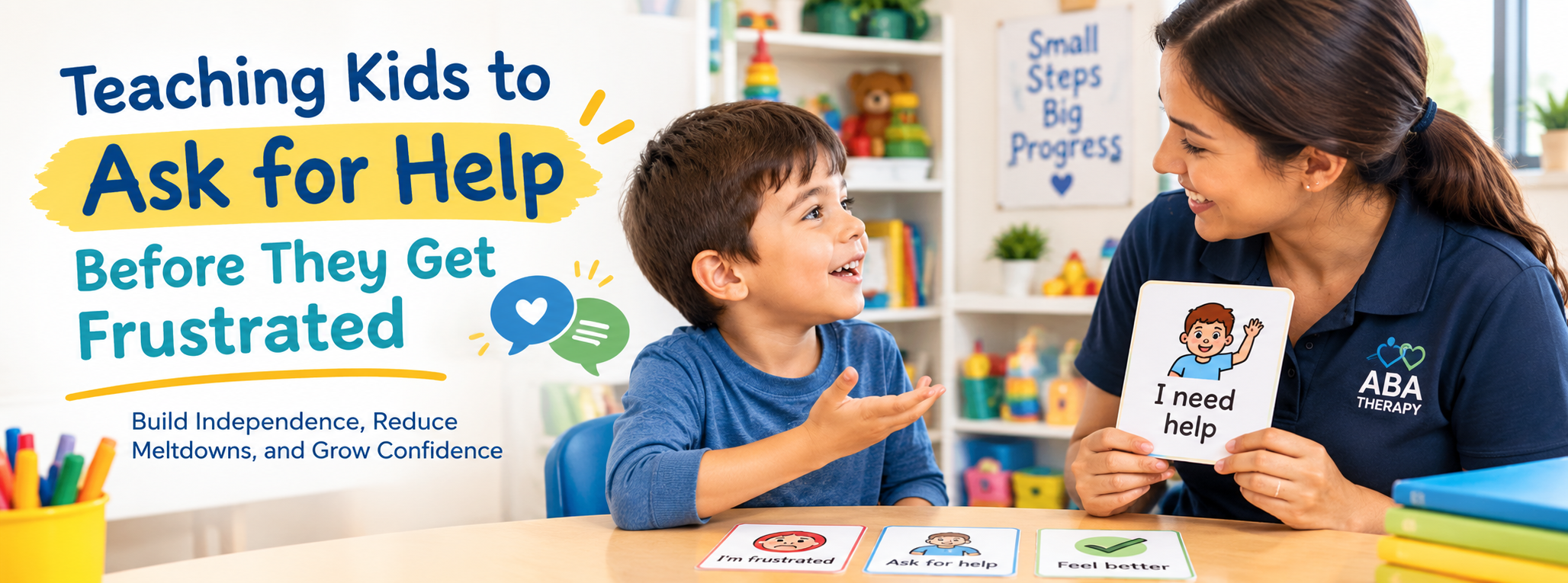
- Asking for help after making a mistake
- Trying again after an unsuccessful attempt
- Managing frustration
- Communicating disappointment appropriately
- Understanding that one mistake does not mean they failed completely
- Moving on after an embarrassing moment
- Accepting correction from an adult
- Changing their approach when something does not work
These are skills that can be taught and practiced.
Mistakes Are Learning Opportunities
One of the most important messages adults can give children is that a mistake does not have to end the activity.
Instead of immediately fixing the problem for the child, parents, teachers, and therapists can help the child learn what to do next.
A simple sequence might look like:
Mistake → Pause → Communicate → Problem-solve → Try again
Over time, this sequence can become more familiar.
For example, if a child accidentally spills their drink, an adult might calmly say, “That’s okay. What can we do now?”
The child may learn to respond with, “I need a towel.”
The focus shifts from the mistake itself to the recovery process.
That distinction can make a significant difference.
How ABA Therapy Can Support Recovery Skills
ABA therapy in Dallas can be individualized around a child’s specific needs, including communication, social skills, adaptive skills, and behavior. When appropriate, therapists can incorporate mistake-recovery skills into everyday activities rather than treating them as an isolated lesson.
A therapist might intentionally create small, manageable opportunities for a child to experience something not going exactly as expected.
For example, during a game, the child may lose a turn. During a puzzle, a piece may not fit. During a learning activity, the child may select an incorrect answer.
The therapist can then support the child through the recovery process.
The purpose is not to frustrate the child unnecessarily. Instead, activities can be adjusted so the child has opportunities to practice coping skills at a level that is appropriate for them.
Building Tolerance for Small Mistakes
Children do not have to start with major challenges.
A therapist may begin with small situations where the outcome is slightly different from what the child expected.
For example:
- Choosing the wrong puzzle piece
- Getting an answer incorrect
- Losing a simple game
- Making a small change to a familiar activity
- Having to correct an incomplete task
The child can then practice responding appropriately.
As these situations become easier, the skills can be generalized to other environments and activities.
Teaching Children What to Do After a Mistake
Telling a child, “Don’t get upset,” does not necessarily teach them what they should do instead.
Children often benefit from having a specific replacement behavior.
For example, rather than simply saying:
“Don’t cry because you got it wrong.”
An adult might teach:
“If you’re not sure, you can say, ‘Can you help me?’”
Instead of:
“Stop getting frustrated.”
A child could be taught:
“Take a breath, tell me what’s wrong, and we can figure it out.”
The more concrete the replacement behavior is, the easier it can be for a child to understand what is expected.
Teaching a Simple Recovery Routine
A predictable routine can make mistakes feel less overwhelming.
Depending on the child’s developmental level and needs, a recovery routine could include four or five simple steps.
1. Stop and Pause
The first step is learning to pause before reacting.
This could involve taking a breath, putting down an item, counting slowly, or using another calming strategy that works for the child.
2. Identify What Happened
The child can practice communicating what went wrong.
For example:
“I got it wrong.”
“My tower fell.”
“I don’t know what to do.”
“I need help.”
This gives the child a way to communicate instead of immediately reacting through challenging behavior.
3. Choose a Solution
Next, the child can learn to ask:
“What can I do now?”
Maybe the answer is to clean up the spill, rebuild the tower, ask for clarification, or try a different strategy.
4. Try Again
The child practices returning to the activity instead of abandoning it completely.
Trying again does not always mean doing exactly the same thing. It can mean changing the approach.
5. Move Forward
Finally, the child learns that the mistake is over.
The goal is to return to the activity, continue the day, and understand that one difficult moment does not have to determine what happens next.
Encouraging Communication Instead of Frustration
Communication can play a major role in mistake recovery.
A child who cannot easily explain what they need may rely on other ways to communicate frustration.
This is why ABA therapy services Dallas families seek may include goals related to functional communication and expressing needs appropriately.
A child might learn phrases such as:
- “Help me, please.”
- “I need a break.”
- “Can I try again?”
- “I don’t understand.”
- “That’s not what I wanted.”
- “Can you show me?”
- “I made a mistake.”
- “I’m ready to try again.”
These phrases give children practical tools they can use when something goes wrong.
For children who use alternative or augmentative communication, their communication system can also be incorporated into these situations.
Helping Children Separate a Mistake From Their Identity
A child may sometimes make a mistake and immediately say something like, “I’m bad,” “I can’t do anything,” or “I’m stupid.”
Adults can help separate the action from the child’s identity.
Instead of allowing the mistake to become a statement about who the child is, adults can focus on what happened and what can happen next.
For example:
“You got that answer wrong. Let’s figure it out together.”
“You knocked it over. Accidents happen. Let’s clean it up.”
“That didn’t work this time. What could we try differently?”
This teaches an important concept: making a mistake is something you did, not something that defines who you are.
Practicing When the Child Is Calm
It is much easier to teach coping skills when a child is already calm.
Trying to introduce a brand-new strategy in the middle of an intense emotional reaction may not be effective.
Instead, parents and therapists can practice recovery skills during everyday activities when the child is comfortable.
Games, puzzles, crafts, cooking, schoolwork, and play can all create natural opportunities.
For example, while playing a board game, an adult might intentionally model what happens when something does not go their way:
“Oops, I didn’t get the space I wanted. That’s okay. I’ll take a breath and keep playing.”
This demonstrates that adults make mistakes too.
Modeling Healthy Mistake Recovery
Children learn by watching the people around them.
Parents do not have to pretend that everything always goes perfectly. In fact, calmly demonstrating how to recover from everyday mistakes can be valuable.
A parent might say:
“Oops, I forgot the appointment time. I’m going to check the calendar and figure it out.”
Or:
“I spilled some water. I’ll grab a towel and clean it up.”
This shows the child a complete process:
Something went wrong → I noticed it → I stayed calm → I found a solution.
Children can gradually begin to recognize the same pattern in their own experiences.
Reinforcing the Recovery, Not Just the Result
When a child makes a mistake and successfully recovers, adults can recognize the effort involved.
Instead of focusing only on whether the child eventually completed the task, praise the skill they used.
For example:
“You asked for help instead of giving up.”
“You took a break and came back.”
“You tried another way.”
“You were disappointed, but you kept going.”
“You cleaned up the spill and moved on.”
This helps children understand exactly which behavior they should repeat in the future.
What Parents Can Practice at Home
Families do not need complicated activities to practice mistake recovery.
Small moments throughout the day can provide opportunities.
Parents can try:
- Playing simple games where everyone takes turns winning and losing
- Cooking together and allowing the child to make small, safe mistakes
- Completing puzzles that may require multiple attempts
- Practicing asking for help
- Modeling calm responses to everyday accidents
- Using simple phrases such as “What can we do next?”
- Celebrating effort and persistence
- Practicing calming strategies when the child is already regulated
- Giving the child opportunities to solve age-appropriate problems independently
The goal is not to create mistakes for the sake of creating frustration. It is to use ordinary experiences as opportunities to build flexible, practical skills.
When a Child Needs More Individualized Support
Every child responds differently to mistakes.
Some children may quickly develop recovery skills with everyday practice. Others may need more structured and individualized support.
If a child frequently becomes overwhelmed by small mistakes, avoids activities because they might get something wrong, has difficulty communicating frustration, or takes a long time to recover from disappointment, it may be helpful to discuss these concerns with the child’s care team.
Applied Behavior Analysis Dallas providers may work with families to identify specific skills that could support communication, flexibility, emotional regulation, independence, and daily functioning.
Individualized programming can help determine what triggers difficult reactions, what skills the child already has, and what replacement behaviors may be appropriate.
Making Mistakes Less Scary
The long-term goal is not to make children completely comfortable with every mistake.
Disappointment is a normal emotion. Frustration is normal too.
Instead, children can learn that they can experience those feelings without becoming stuck in them.
A child who learns to say, “I made a mistake, but I can try again,” is developing a skill that can support them far beyond childhood.
That skill can be useful at school, at home, during social interactions, in extracurricular activities, and eventually in adulthood.
Supporting Confidence Through Small Wins
Recovery skills develop gradually.
A child may not immediately go from becoming highly frustrated to independently solving every problem. Progress may begin with a small change, such as accepting help, using a communication phrase, taking a break, or returning to an activity after becoming upset.
Those small moments matter.
With consistent practice and individualized support, children can learn that mistakes are not the end of an activity. They are opportunities to pause, communicate, problem-solve, and keep going.
For families exploring ABA Therapy in Dallas, a qualified ABA team can help identify practical goals that fit the child’s individual strengths, needs, communication style, and daily routines.
Helping Your Child Learn to Try Again
Mistakes are part of learning.
Children do not need to be protected from every wrong answer, spilled drink, lost game, or unsuccessful attempt. They need support learning what to do when those moments happen.
Teaching children to recover means giving them practical tools: how to pause, how to communicate, how to ask for help, how to problem-solve, and how to try again.
With patience, practice, modeling, and appropriate support, children can gradually become more confident in their ability to handle things that do not go according to plan.
For families looking for ABA Therapy in Dallas, Radiant Spectrum Therapy provides individualized support designed around each child’s needs and goals. Whether support takes place through in-home ABA therapy Dallas families can access or a center-based setting, the focus can be on building meaningful skills that children can use in everyday life.
Contact us at 972–310–4991 or visit https://radiantspectrumtherapy.com/ to learn more.