
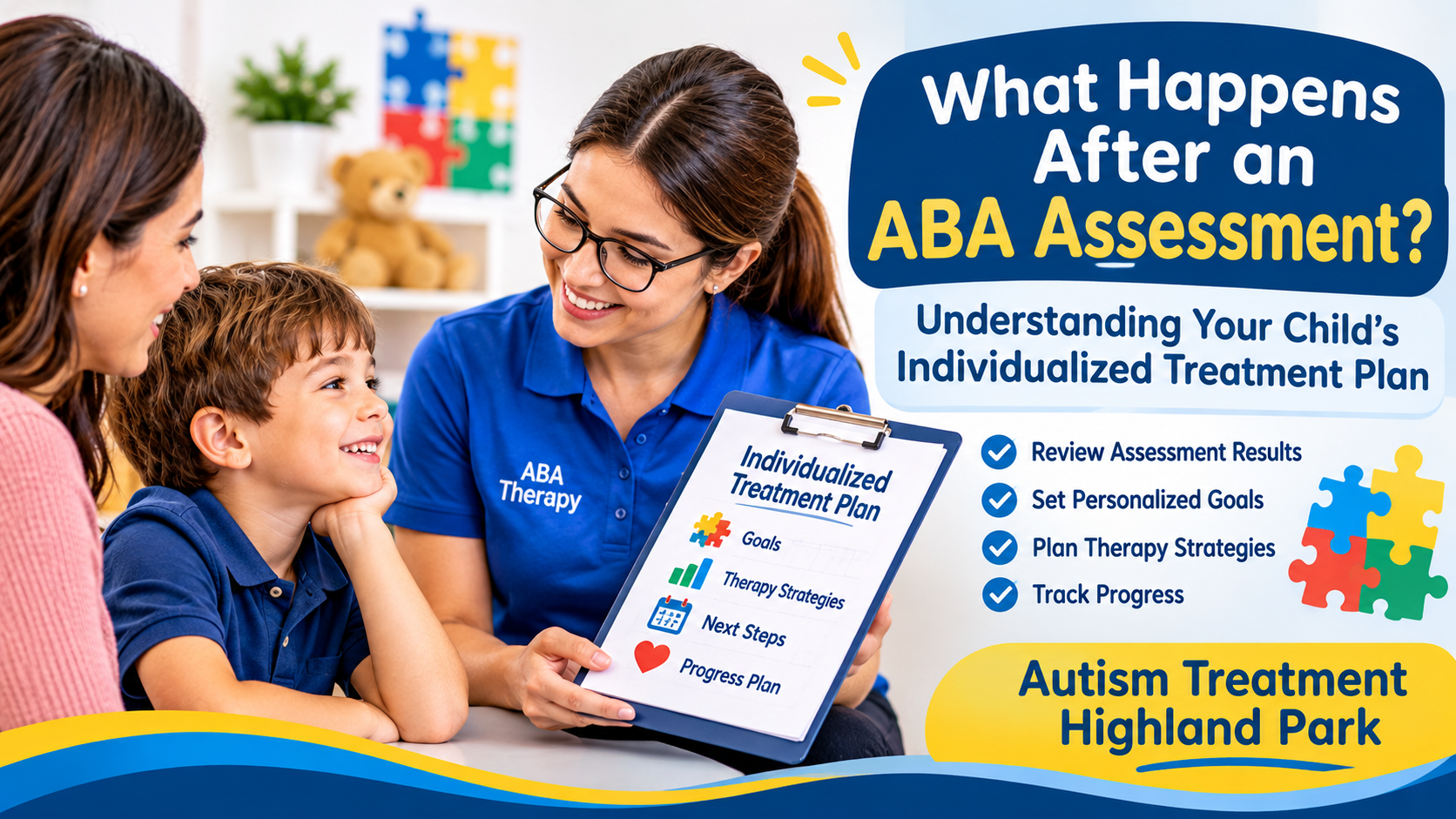
Completing an ABA assessment is an important first step in understanding your child’s developmental strengths, challenges, and support needs. For families exploring Autism Treatment Highland Park, the next question is often: What happens after the assessment? Once the evaluation is complete, the information gathered becomes the foundation for an individualized treatment plan designed around your child’s abilities, priorities, and everyday experiences. Rather than following a standard program, quality ABA therapy Highland Park should recognize that every child learns differently and may need different levels of support to reach meaningful developmental goals.
An ABA assessment is not simply a process of identifying behaviors that need to change. It is an opportunity to understand how a child communicates, interacts with others, approaches daily activities, responds to different environments, and develops new skills. The assessment helps a Board Certified Behavior Analyst (BCBA) identify areas where support may be beneficial and determine how therapy can encourage greater independence and participation.
After the assessment, families should expect a collaborative process that includes reviewing evaluation findings, establishing measurable goals, identifying appropriate teaching strategies, and creating a plan for monitoring progress. Understanding these steps can help parents feel more prepared, ask informed questions, and participate confidently in their child’s therapy journey.
Understanding What Happens After an ABA Assessment in Highland Park
Once the assessment is finished, the BCBA begins organizing the information collected into a comprehensive picture of the child’s current abilities and support needs. This information helps determine which skills should be prioritized and what types of intervention may be appropriate.
The goal is not to create a lengthy list of everything a child cannot do. Instead, the treatment team should identify opportunities to build on existing strengths while addressing challenges that affect communication, learning, safety, social participation, and everyday independence.
For families considering Applied Behavior Analysis Highland Park, understanding this process is especially important because the assessment should guide treatment decisions rather than simply serve as a requirement before services begin.
Reviewing Assessment Findings
The first step is reviewing the information gathered during the evaluation. Depending on the assessment process, this may include:
- Direct observation of the child’s behavior and interactions.
- Parent and caregiver interviews.
- Developmental and communication assessments.
- Evaluation of social interaction and play skills.
- Review of daily living and adaptive skills.
- Identification of environmental factors that influence behavior.
- Assessment of existing strengths and learning preferences.
The BCBA uses these findings to understand how the child currently functions in different situations. For example, a child may communicate effectively at home but have difficulty expressing needs in unfamiliar environments. Another child may demonstrate strong vocabulary skills but struggle with conversational exchanges or changes in routine.
These differences matter because treatment should address the child’s actual experiences, not assumptions based solely on an autism diagnosis.
Identifying Strengths Alongside Areas for Growth
A well-developed treatment plan recognizes what a child already does successfully.
A child who enjoys puzzles, music, pretend play, or movement activities may respond particularly well when those interests are incorporated into learning opportunities. These strengths can become useful tools for encouraging participation and building new skills.
For families exploring ABA therapy for autism Highland Park, this individualized approach is important. Therapy should not focus exclusively on reducing challenging behaviors. It should also help children develop practical skills that make everyday activities more accessible, comfortable, and meaningful.
How Individualized ABA Treatment Goals Are Developed
After reviewing the assessment, the BCBA begins developing treatment goals. These goals provide direction for therapy and help the team determine what progress should look like.
Goals should be specific enough to measure but flexible enough to reflect the child’s changing needs. They should also connect to skills that matter in the child’s everyday life.
For example, instead of creating a broad goal such as improving communication, a treatment plan might identify a specific skill: independently requesting help when an activity becomes difficult.
This makes it easier for therapists and parents to recognize progress and understand which teaching strategies are working.
Prioritizing Skills That Make a Difference
Not every identified skill needs to become an immediate treatment priority. Some areas may be more important because they affect safety, communication, participation, or independence.
Common areas addressed in individualized ABA treatment plans include:
Communication: Helping children express wants, needs, preferences, questions, and feelings using their preferred communication methods.
Social interaction: Supporting comfortable interactions, shared activities, conversational exchanges, and opportunities to connect with others.
Daily living skills: Building independence with dressing, eating, hygiene, personal care, and everyday routines.
Play and leisure: Encouraging exploration, functional play, creativity, and enjoyable interactions with toys and activities.
Emotional and behavioral regulation: Teaching practical ways to communicate discomfort, request breaks, manage transitions, and navigate difficult situations.
Safety skills: Developing awareness and responses that help children participate more safely in their environments.
For families researching pediatric ABA therapy Highland Park, these priorities demonstrate why individualized planning matters. Two children of the same age may have completely different learning needs, communication abilities, and personal goals.
Creating Measurable and Meaningful Goals
Treatment goals should describe observable skills that can be monitored over time.
For instance, a goal might involve independently requesting a preferred item using speech, gestures, or an appropriate communication device. Another might focus on following a familiar daily routine with fewer prompts.
Measurable goals allow the BCBA to evaluate whether a teaching strategy is effective or whether adjustments are needed.
Parents should also understand why each goal was selected. If a treatment objective does not seem connected to the child’s daily experiences, families should feel comfortable discussing its relevance with the BCBA.
The purpose of behavior therapy Highland Park should be to support meaningful development, not simply to meet predetermined performance expectations.
Family Collaboration: Why Parents Are Part of the Treatment Process
Parents and caregivers know their children in ways that cannot be fully captured during an assessment. They understand family routines, communication preferences, interests, sensitivities, and situations that may be difficult outside a therapy session.
That knowledge is essential when developing an effective treatment plan.
Family collaboration allows the BCBA to connect clinical observations with the child’s everyday experiences. It also helps ensure that treatment priorities reflect what matters most to the family.
Sharing Family Priorities and Everyday Challenges
During treatment planning, parents should have opportunities to discuss their concerns and goals.
These conversations may include questions such as:
- What activities does your child enjoy most?
- Which everyday routines are difficult?
- How does your child communicate when something is needed?
- Are there situations that commonly cause frustration?
- What skills would make family activities easier?
- What would greater independence look like for your child?
For example, a family may want their child to participate more comfortably in mealtimes, communicate when they need assistance, or become more independent when getting dressed.
These goals provide valuable context for the BCBA.
Families seeking autism behavior therapy Highland Park should look for a provider that takes time to understand these priorities instead of presenting a treatment plan without meaningful parental input.
Teaching Strategies That Fit the Family’s Routine
An effective treatment plan should consider where and how a child spends time.
Some skills can be practiced naturally during breakfast, playtime, getting ready for school, or preparing for bedtime. Other skills may benefit from more structured teaching sessions.
Parents can also learn strategies that support consistency between therapy sessions and everyday routines.
This does not mean families must become therapists. Rather, they should receive practical guidance that helps them recognize learning opportunities and support their child’s progress without making daily life feel like a continuous therapy session.
For families considering in-home ABA therapy Highland Park, this connection between treatment and everyday activities can be especially useful. Children have opportunities to practice skills in familiar surroundings, while therapists can better understand the environmental factors that influence learning.
Choosing the Right Treatment Setting
Once goals have been established, the BCBA and family can discuss which treatment setting may best support the child’s needs.
The appropriate setting depends on the child’s goals, learning preferences, family circumstances, and the types of skills being addressed.
In-Home ABA Therapy
In-home therapy allows children to practice skills within their familiar environment.
This setting can be particularly helpful for goals involving:
- Communication during everyday activities.
- Dressing and personal hygiene.
- Following household routines.
- Playing with siblings or family members.
- Requesting assistance and expressing preferences.
- Transitioning between familiar activities.
For families exploring ABA therapy services Highland Park, in-home services may provide opportunities to work on practical skills where they naturally occur.
A therapist may help a child practice requesting a snack in the kitchen, putting away toys in the playroom, or completing a familiar morning routine.
These experiences can make it easier to connect what is learned during therapy with everyday life.
Center-Based ABA Therapy
A center-based setting may provide opportunities for structured learning, peer interaction, and activities that are more difficult to arrange at home.
Depending on the program, children may practice:
- Participating in group activities.
- Taking turns during games.
- Following instructions in a structured environment.
- Interacting with peers.
- Transitioning between activities.
- Developing independence in different learning situations.
Families researching center-based ABA therapy Highland Park should ask how the provider incorporates individual goals into group opportunities and how progress is monitored.
Neither setting is automatically better for every child. The right choice should be based on the child’s individual treatment priorities rather than a one-size-fits-all recommendation.
How Early Intervention Influences Treatment Priorities
For younger children, treatment planning may place particular emphasis on foundational developmental skills.
Early learning opportunities can help children practice communication, play, imitation, social engagement, and everyday routines in ways that match their developmental level.
Families exploring early intervention ABA Highland Park may have questions about when therapy should begin and which skills deserve attention first.
The answer depends on the child’s individual assessment and developmental profile.
Supporting Toddlers Through Play-Based Learning
Young children often learn through exploration, repetition, interaction, and play.
For families considering ABA therapy for toddlers Highland Park, treatment activities may include opportunities to:
- Request favorite toys or activities.
- Participate in simple back-and-forth games.
- Respond to familiar instructions.
- Explore different types of play.
- Communicate when they need help.
- Participate in everyday routines.
These activities should be appropriate for the child’s age, abilities, interests, and comfort.
Building Developmental Skills Over Time
A treatment plan for younger children may focus on foundational skills before introducing more complex objectives.
For example, a child who is learning to communicate may first work on consistently expressing basic needs. As those abilities develop, additional goals may involve answering questions, expressing preferences, or participating in more involved interactions.
Families seeking developmental therapy Highland Park or special needs therapy Highland Park should understand how the provider connects developmental priorities with individualized treatment objectives.
Progress should be evaluated in terms of functional improvements, not simply how quickly a child completes a task.
Progress Monitoring: How the Treatment Team Measures Growth
An individualized treatment plan should not remain unchanged indefinitely.
Children develop new abilities, encounter different challenges, and demonstrate progress at different rates. Regular monitoring allows the BCBA to determine whether the current strategies remain appropriate.
For families considering BCBA services Highland Park, understanding how progress is evaluated is an important part of choosing a provider.
Collecting and Reviewing Progress Data
During therapy, the treatment team collects information about specific goals and the child’s responses to teaching strategies.
Depending on the objective, this information may include:
- How often a child demonstrates a particular skill.
- Whether a skill occurs independently or with assistance.
- How consistently the child uses the skill.
- Whether the skill appears in different environments.
- How the child responds to changes in teaching strategies.
For example, a child may initially need several prompts to request help during an activity. Over time, the child may begin requesting assistance with fewer prompts or independently.
That change provides useful information about learning and helps the BCBA determine the next appropriate step.
Understanding Why Progress May Look Different From One Child to Another
Progress is not always linear.
Some children develop a skill quickly but need additional practice to use it consistently. Others may demonstrate an ability during therapy but find it difficult to apply in a different environment.
Changes in routine, health, sleep, motivation, and environmental demands can also influence participation.
A responsible treatment team should recognize these factors rather than interpreting every difficult session as a lack of progress.
Parents should receive understandable updates about their child’s development, including which goals are progressing, which require additional support, and whether adjustments are being considered.
Adjusting the Treatment Plan When Needed
If a goal is no longer relevant, a child has mastered a skill, or a strategy is not producing meaningful results, the BCBA should review the treatment plan.
Adjustments may involve:
- Introducing a new developmental priority.
- Modifying teaching strategies.
- Breaking a complex skill into smaller steps.
- Reducing unnecessary prompts.
- Incorporating the child’s changing interests.
- Practicing skills in additional environments.
This flexibility is an essential part of individualized care.
Quality behavioral intervention Highland Park TX should respond to the child’s actual progress rather than expecting the child to fit into an unchanging program.
Questions Parents Should Ask Before Starting ABA Therapy
Understanding the treatment plan before services begin can help families feel more confident about their decision.
Whether you are comparing best ABA therapy providers Highland Park or researching top-rated ABA therapists Highland Park, it is important to look beyond general descriptions and ask specific questions about the treatment process.
Consider asking:
- Who will develop and supervise my child’s treatment plan?
- How are goals selected and prioritized?
- How will my child’s strengths and interests be incorporated into therapy?
- How often will progress be reviewed?
- How will parents participate in treatment planning?
- What happens if my child does not respond well to a particular strategy?
- Are services available at home, in a clinic, or in both settings?
- How does the provider support skill development across different environments?
- How are communication preferences and sensory needs considered?
- How will the team determine when a goal has been achieved?
Families searching for private ABA therapy Highland Park should also ask about staff qualifications, supervision arrangements, scheduling, parent training, and communication practices.
The answers can help you determine whether a provider’s approach aligns with your family’s expectations.
Understanding Treatment Recommendations, Costs, and Service Availability
After the assessment, families should receive an explanation of the recommended services, including the proposed treatment priorities and the reasoning behind them.
Recommendations may differ depending on the child’s needs and the assessment findings.
For example, one child may benefit from a focused treatment approach targeting communication and daily living skills. Another may require more comprehensive support across several developmental areas.
Understanding Treatment Intensity
Some children may benefit from more frequent therapy, while others may have goals that can be addressed with a less intensive schedule.
Families researching intensive ABA programs Highland Park should ask how recommended hours are determined and whether the proposed schedule is appropriate for their child’s age, needs, and daily routine.
Treatment intensity should be individualized. More hours do not automatically mean better outcomes.
The team should explain how the recommended schedule connects to specific goals and how progress will influence future treatment decisions.
Exploring Affordability and Insurance
Financial considerations are another important part of choosing a provider.
Parents researching affordable ABA therapy Highland Park TX or comparing ABA therapy cost Highland Park should request clear information about insurance coverage, authorization requirements, potential out-of-pocket expenses, and any additional fees.
Coverage may depend on the insurance plan, provider network, authorization process, and medical necessity requirements.
Families should ask for help understanding these details before beginning services.
It is also helpful to ask whether the provider accepts their insurance and what steps are required to move from assessment to treatment.
Finding Appropriate Local Support
Parents may begin their search by looking for autism support services Highland Park, comparing ABA clinics in Highland Park, or searching for ABA therapy near Highland Park.
Others may use searches such as ABA therapy in Highland Park TX, Highland Park autism services, or ABA therapy near me Highland Park when trying to identify nearby options.
Regardless of the search method, the most important consideration is whether the provider offers an individualized, family-centered approach.
Families searching for best ABA therapy in Highland Park should prioritize qualified clinical supervision, clear communication, meaningful goals, and consistent progress monitoring rather than relying on rankings alone.
What a Successful ABA Treatment Plan Should Accomplish
An effective treatment plan should help a child develop skills that improve participation and independence in everyday life.
Success should not be defined by making every child behave the same way or meet expectations that do not reflect their individual needs.
Instead, treatment should focus on meaningful improvements that support the child’s ability to communicate, make choices, participate in activities, and navigate daily experiences.
A strong plan should include:
- Goals that are based on the child’s assessment findings.
- Opportunities to build on existing strengths.
- Teaching strategies that respect the child’s communication and learning preferences.
- Family involvement and regular collaboration.
- Consistent progress monitoring.
- Adjustments based on developmental changes.
- Skills that are useful across everyday environments.
For example, a child who learns to communicate discomfort can express a need for a break rather than becoming overwhelmed. A child who practices daily routines may become more independent when getting dressed or preparing for an activity.
These practical improvements can make a meaningful difference for both children and their families.
Moving Forward With Individualized Autism Treatment Highland Park
The period after an ABA assessment is when evaluation findings begin turning into an actionable plan. It is an opportunity for families and clinical professionals to work together, identify meaningful priorities, and establish a clear direction for their child’s development.
At Radiant Spectrum Therapy, we believe every child deserves an approach that recognizes their individual strengths, respects their needs, and supports meaningful growth. Our goal is to help families understand the treatment process and feel included in decisions about their child’s care.
We recognize that parents may have many questions when exploring Autism Treatment Highland Park, from understanding treatment recommendations to choosing the right setting and knowing how progress will be measured.
That is why individualized planning, family collaboration, and ongoing communication are important parts of the therapy journey.
You do not need to have every answer before taking the next step. Understanding your child’s needs begins with listening, learning, and creating a plan that reflects what matters most to your family.
If you are exploring ABA therapy Highland Park, Radiant Spectrum Therapy is here to help you better understand your options and the next steps toward individualized support.
Every child has their own way of learning, communicating, and growing. The right treatment plan should make room for all three.
Contact Radiant Spectrum Therapy to learn more about individualized ABA services and how we can support your family’s journey.
Contact us at 972–310–4991 or visit https://radiantspectrumtherapy.com/our-locations-highland-park/ to learn more.