
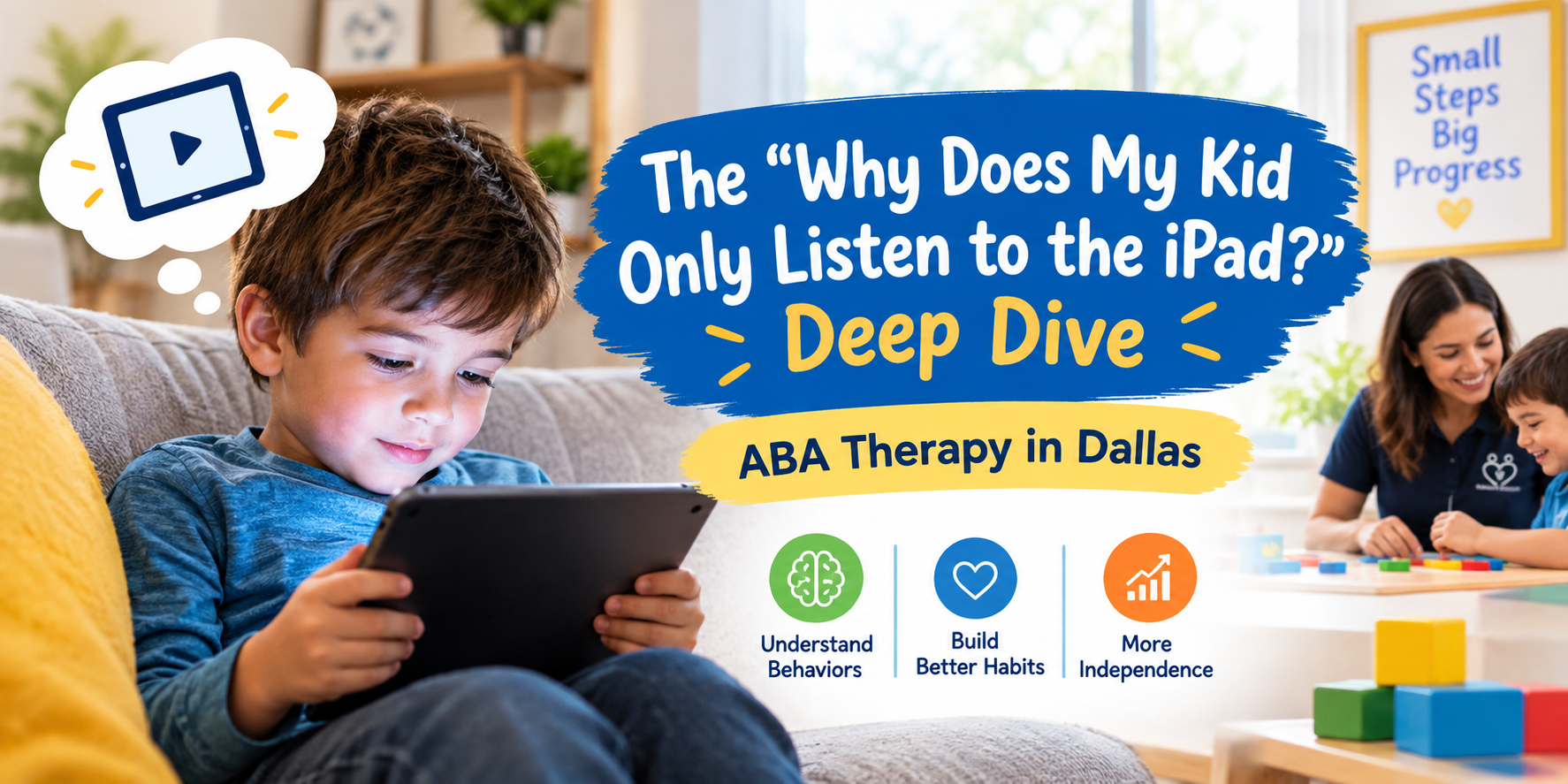
If you’ve ever found yourself saying, “My child ignores me until I mention the iPad,” you’re far from alone.
Maybe getting dressed turns into a negotiation. Brushing teeth becomes a dramatic standoff. Picking up toys somehow takes longer than the activity that made the mess. But the second you say, “Five more minutes of iPad after we’re done,” everything changes.
Many parents wonder if they’ve accidentally “created” the problem. The reality is much less about bad parenting and much more about how human brains work.
At Radiant Spectrum Therapy, we hear this question often from families looking into ABA Therapy in Dallas. The answer isn’t about taking away screens forever. It’s about understanding why screens are such powerful motivators and learning how the same principles used in Applied Behavior Analysis Dallas can help make real-life tasks feel more rewarding.
Let’s unpack what’s really happening.
The Short Answer: The iPad Is an Extremely Powerful Reinforcer
In ABA, a reinforcer is anything that increases the likelihood that a behavior will happen again.
If a child brushes their teeth and immediately gets something they love, they’re more likely to brush their teeth again next time.
Digital devices happen to combine several of the strongest reinforcers ever created.
They offer:
- Immediate feedback
- Endless novelty
- Bright visuals
- Engaging sounds
- Predictable access
- Personalized rewards
That’s an incredibly motivating package for a developing brain.
Why Screens Feel More Exciting Than Real Life
Think about your own phone.
You probably check notifications without thinking. You may open an app intending to spend one minute and realize twenty minutes disappeared.
Adults experience this too.
Children simply have less developed impulse control and self-regulation, making these experiences even more compelling.
Instant Gratification
Brushing teeth has a delayed payoff.
The reward is healthier teeth weeks or months later.
The iPad rewards every few seconds.
- Tap.
- Animation.
- Sound.
- Success.
- Next challenge.
The brain quickly learns:
“This activity always gives me something enjoyable immediately.”
Variable Rewards Keep Attention High
One reason games and videos hold attention so well is that rewards aren’t always identical.
A child might discover:
- a funny character
- a new level
- an exciting sound
- a surprise animation
This unpredictability keeps motivation high.
Behavior analysts call this a variable reinforcement pattern, which tends to produce persistent engagement.
Screens Reduce Effort
Real-life tasks often require:
- planning
- motor coordination
- waiting
- transitions
Screens reduce many of those demands.
Everything happens with a tap.
For children receiving ABA therapy for autism Dallas, transitions between preferred and less preferred activities are often an important skill area because those shifts require flexibility.
Why Everyday Tasks Feel “Impossible”
Parents often ask:
“Why can they focus on Minecraft for an hour but not brush their teeth for two minutes?”
The answer isn’t usually laziness.
Different activities require different amounts of effort.
Tooth Brushing Has Multiple Hidden Challenges
What looks like one task actually includes many steps.
A child has to:
- stop playing
- walk to the bathroom
- tolerate toothpaste
- manage sensory input
- coordinate brushing
- finish without quitting
Each step adds effort.
Some Tasks Include Sensory Discomfort
Many autistic children experience sensory differences.
Toothpaste may feel:
- too minty
- too foamy
- too cold
The toothbrush itself may feel uncomfortable.
Similarly, hair brushing, getting dressed, or washing hands can involve sensory experiences that make routines genuinely harder.
Professionals providing autism therapy Dallas TX often help families identify whether behavior is driven by sensory discomfort, communication needs, or other factors rather than assuming a child is simply refusing.
The ABC Model: What Happens Before, During, and After
One of the most helpful ABA tools is the ABC model.
- A: Antecedent (what happens before)
- B: Behavior (what the child does)
- C: Consequence (what happens after)
Let’s look at an example.
Example: Brushing Teeth
Antecedent
- Parent says it’s time to brush.
Behavior
- Child says no.
Consequence
- Parent negotiates for ten minutes.
Even though nobody intended it, the child may have learned that saying “no” delays brushing.
Now let’s change it.
Antecedent
- Visual schedule
- Two-minute warning
Behavior
- Child brushes.
Consequence
- Immediate praise
- Sticker
- Favorite song
- Short preferred activity afterward
Now brushing consistently leads to something positive.
This is one way behavior therapy Dallas focuses on building lasting routines.
The Goal Isn’t to Compete With the iPad
This is one of the biggest misconceptions.
Parents don’t need to make brushing teeth more exciting than YouTube.
Instead, we make real-life routines:
- predictable
- achievable
- rewarding
Small improvements create momentum.
How ABA Makes Everyday Tasks More Motivating
Pairing Positive Experiences With Difficult Tasks
Pairing means connecting something enjoyable with something challenging.
Examples include:
- singing while brushing
- using a favorite timer
- playing a silly tooth-brushing song
- celebrating completion immediately afterward
Over time, the routine itself becomes less stressful.
Break Big Tasks Into Smaller Steps
Instead of demanding perfect independence immediately, ABA often teaches skills gradually.
For brushing teeth:
- Walk to the bathroom.
- Pick up the toothbrush.
- Add toothpaste.
- Brush the top teeth.
- Brush the bottom teeth.
- Rinse.
Each successful step builds confidence.
This approach is commonly used in ABA therapy services Dallas to reduce overwhelm.
Offer Meaningful Choices
Choice increases cooperation.
Instead of asking:
“Do you want to brush?”
Try offering:
- Blue toothbrush or green toothbrush?
- Dinosaur toothpaste or bubblegum toothpaste?
- Brush before pajamas or after pajamas?
The task stays the same.
The child gains a sense of control.
Use Immediate Reinforcement
Remember how quickly the iPad rewards behavior?
We can borrow that principle.
Instead of waiting until bedtime to praise brushing, reinforce it immediately.
Examples include:
- High-five
- Enthusiastic praise
- Sticker
- Token
- Favorite dance together
The closer the reward follows the behavior, the more powerful it becomes.
What Makes a Reinforcer Actually Work?
Not every reward motivates every child.
A reinforcer has to matter to that specific child.
Some children love:
- bubbles
- spinning toys
- music
- jumping
- stickers
Others prefer:
- extra story time
- building blocks
- pretend play
- drawing
Part of BCBA services Dallas involves identifying what truly motivates each child rather than relying on generic reward systems.
The Magic of Momentum
One successful morning makes the next morning easier.
Why?
Because success changes expectations.
Children begin thinking:
“I’ve done this before.”
That confidence matters.
Instead of fighting every routine from scratch, they’re building a history of successful experiences.
What About Screen Time?
Many parents worry they need to eliminate screens entirely.
For most families, that’s not the goal.
Screens are tools.
The focus is teaching flexibility.
Healthy routines often include:
- predictable screen schedules
- clear expectations
- transition warnings
- balanced activities throughout the day
Rather than making screens the enemy, we help children learn that enjoyable experiences also happen away from screens.
When Transitions Are the Hardest Part
Often the biggest struggle isn’t brushing.
It’s stopping the iPad.
Transitions require:
- shifting attention
- ending something enjoyable
- beginning something less preferred
These are teachable skills.
Give Advance Warnings
Instead of suddenly saying “Time’s up,” try:
- five-minute warning
- two-minute warning
- one-minute reminder
Predictability reduces surprise.
Use Visual Timers
Many children understand visual countdowns better than verbal reminders.
Watching time disappear can make transitions feel more concrete.
Create a “First, Then” Routine
One of the simplest ABA strategies is the First-Then approach.
Examples include:
- First brush teeth, then read together.
- First pajamas, then one song.
- First cleanup, then bubbles.
This keeps expectations clear and reinforces completion.
What If Rewards Stop Working?
Parents often say:
“The sticker worked for three days.”
That’s normal.
Motivation changes.
Behavior analysts regularly adjust reinforcement by:
- rotating rewards
- increasing variety
- matching rewards to current interests
- fading rewards as habits become stronger
Eventually, many routines become rewarding simply because they’re familiar and successful.
When to Seek Extra Support
Sometimes daily routines become exhausting for everyone.
Support may help if:
- transitions consistently lead to intense meltdowns
- self-care routines remain extremely difficult
- communication barriers create frustration
- sensory challenges interfere with daily life
- family stress is growing around everyday tasks
Programs offering ABA therapy in Dallas TX can work alongside families to identify what’s driving the behavior and create individualized strategies that fit the child’s needs.
Support isn’t about making children compliant.
It’s about making daily life more manageable, predictable, and successful for the whole family.
How ABA Therapy in Dallas Can Help Families Build Better Routines
Every child is different.
Some children need support with transitions.
Others benefit from visual schedules.
Some respond best to play-based reinforcement, while others need help breaking large routines into manageable steps.
At Radiant Spectrum Therapy, our team uses individualized, evidence-informed strategies to help children build functional skills while supporting parents with practical tools they can use at home.
Whether through in-home ABA therapy Dallas or center-based ABA therapy Dallas, the goal is to create routines that feel less like daily battles and more like opportunities for growth.
Final Thoughts
If your child seems to “only listen to the iPad,” you’re not failing as a parent.
The iPad is simply an incredibly effective reinforcer because it delivers immediate, engaging, and predictable rewards.
The encouraging news is that those same behavioral principles can be applied to everyday life.
By making routines more predictable, breaking tasks into smaller steps, offering meaningful choices, and reinforcing success immediately, families can build motivation that extends far beyond screens.
If you’re exploring ABA Therapy in Dallas, individualized support can help identify what motivates your child and create strategies that make brushing teeth, getting dressed, cleaning up, and other daily routines feel more achievable.
Small wins add up — and over time, those everyday moments become opportunities for confidence, independence, and connection.
Contact us at 972–310–4991 or visit https://radiantspectrumtherapy.com/ to learn more.