
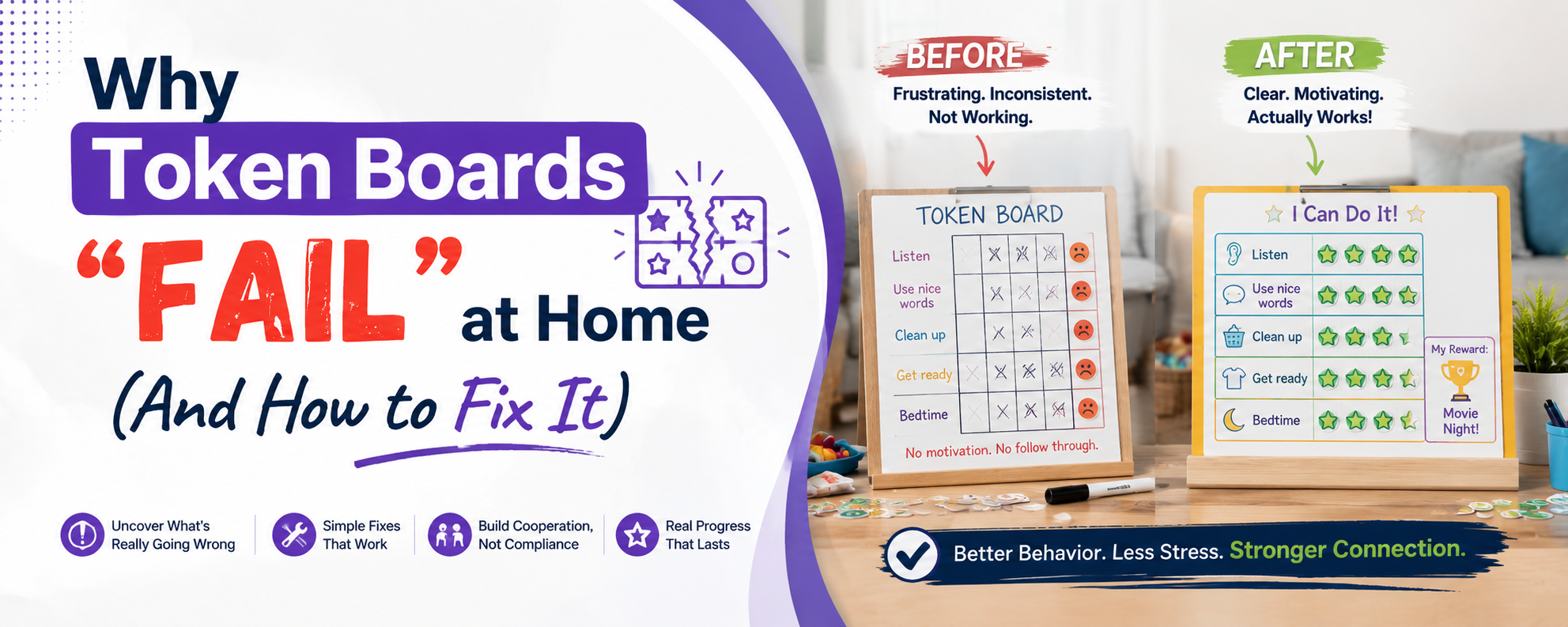
For many families, token boards are one of the first behavior support tools introduced during ABA therapy. They look simple enough: a child earns tokens for completing tasks, following directions, or demonstrating appropriate behavior, and once enough tokens are earned, they receive a reward.
In theory, it sounds straightforward. In practice, many parents find themselves frustrated when a token board that works beautifully during therapy sessions suddenly seems ineffective at home.
If you’ve ever thought, “This worked with the therapist, but it doesn’t work with my child,” you’re not alone. The good news is that token boards rarely fail because of the child. More often, they stop working because of a few common implementation mistakes that can be corrected with the right support and consistency.
Families receiving ABA Therapy in Dallas frequently encounter these challenges, especially when transitioning strategies from a structured therapy environment into everyday home life. Understanding why token boards lose effectiveness is the first step toward making them successful again.
What Is a Token Board?
A token board is a visual reinforcement system designed to motivate a child to complete desired behaviors. The child earns tokens for meeting specific expectations and exchanges those tokens for a preferred item, activity, or privilege.
For example:
- Complete homework = 1 token
- Follow a direction the first time = 1 token
- Stay seated during dinner = 1 token
After earning a predetermined number of tokens, the child receives a reward.
Token boards are commonly used in Center-Based ABA programs because they help children understand expectations, build motivation, and learn delayed gratification.
However, success in a therapy setting doesn’t automatically guarantee success at home.
Why Token Boards Work So Well During Therapy
Before discussing why they sometimes fail at home, it helps to understand why they often work exceptionally well during therapy sessions.
Therapists typically use token systems with:
- Clear expectations
- Consistent rules
- Immediate reinforcement
- Structured environments
- Data-driven adjustments
Every adult involved understands exactly how the system operates.
The child quickly learns:
“When I do the behavior, I earn a token. When I earn enough tokens, I get my reward.”
The connection between behavior and reinforcement remains predictable.
When that predictability disappears at home, problems begin to emerge.
Mistake #1: Inconsistent Use of the Token Board
Consistency is the foundation of any reinforcement system.
One of the most common reasons token boards fail at home is that parents use them inconsistently.
For example:
Monday:
- Child completes a task.
- Parent awards a token immediately.
Tuesday:
- Parent gets busy and forgets.
Wednesday:
- Child earns a token for the same behavior.
Thursday:
- Parent decides the behavior doesn’t deserve a token.
From the child’s perspective, the rules keep changing.
When earning tokens becomes unpredictable, motivation decreases.
Children quickly learn that the token board isn’t reliable, making them less likely to participate.
Families receiving ABA Parent Training often discover that maintaining consistency is far more important than creating a perfect token board.
How to Fix It
Choose a small number of target behaviors.
Keep expectations simple.
Most importantly, award tokens every single time the behavior occurs as planned.
Consistency builds trust in the system.
Mistake #2: Giving Rewards Away for Free
This may be the biggest reason token boards lose effectiveness.
Imagine a child is working toward earning five tokens for 20 minutes of tablet time.
They earn two tokens.
Then Grandma visits and hands them the tablet anyway.
Or a parent feels guilty after a difficult day and provides the reward without requiring the tokens.
The child learns an important lesson:
“I don’t actually need the tokens.”
Once the reward becomes available without effort, the token board loses value.
This challenge frequently appears during Home-Based ABA Therapy because multiple caregivers are involved throughout the day.
How to Fix It
Everyone caring for the child must understand the token system.
Parents, grandparents, babysitters, older siblings, and other caregivers should know:
- Which behaviors earn tokens
- How many tokens are needed
- Which rewards are available
- When rewards can be earned
Consistency across caregivers dramatically improves outcomes.
Many providers offering autism parent training Dallas services spend significant time helping families coordinate reinforcement systems among all household members.
Mistake #3: The Reward Isn’t Motivating Enough
A reward only works if the child actually wants it.
Sometimes adults select rewards based on what they think should be motivating rather than what truly motivates the child.
Examples include:
- Educational activities
- Healthy snacks
- Extra chores with parents
- Activities the child doesn’t enjoy
If the reward isn’t valuable, earning tokens won’t feel worthwhile.
Therapists providing ABA therapy Dallas services frequently reassess reinforcement preferences because children’s interests change over time.
How to Fix It
Observe what your child naturally enjoys.
Potential reinforcers may include:
- Screen time
- Favorite snacks
- Outdoor activities
- Music
- Building toys
- Arts and crafts
- Special one-on-one time
A reward that genuinely excites the child creates stronger motivation.
Mistake #4: Requiring Too Many Tokens
Sometimes parents accidentally make the goal too difficult.
A child may need to earn:
- 10 tokens
- 15 tokens
- 20 tokens
before receiving reinforcement.
For younger children or children just learning the system, this can feel overwhelming.
If the reward seems too far away, motivation drops.
Many professionals working in behavioral therapy North Texas programs recommend starting with smaller token requirements before gradually increasing expectations.
How to Fix It
Start small.
Allow success quickly.
For example:
- Earn 3 tokens
- Receive reward
Once the child consistently succeeds, gradually increase the requirement.
Building confidence first creates long-term success.
Mistake #5: Expectations Are Not Clearly Defined
Children need to know exactly what earns a token.
Parents sometimes use vague expectations such as:
- Be good
- Behave
- Listen better
- Have a good attitude
These expectations are difficult to understand and measure.
When children don’t know how to earn tokens, frustration increases.
Therapists working in Dallas ABA centers focus on identifying observable, measurable behaviors that children can clearly understand.
How to Fix It
Define behaviors specifically.
Instead of:
“Be good.”
Use:
- Put toys away
- Sit at the table
- Brush teeth
- Complete homework
- Follow one-step directions
Specific expectations create clarity and success.
Mistake #6: Delayed Token Delivery
Timing matters.
Imagine completing work and being told you’ll receive your paycheck sometime next month.
Motivation would probably decrease.
The same principle applies to children.
When tokens are delayed, the connection between behavior and reinforcement weakens.
Professionals providing in-home ABA therapy Dallas services often emphasize immediate reinforcement because it strengthens learning.
How to Fix It
Award tokens immediately after the desired behavior occurs.
Provide enthusiastic praise at the same time.
For example:
“Great job putting away your shoes! Here’s your token.”
Immediate feedback helps children understand exactly what behavior earned reinforcement.
Mistake #7: The Token Board Is Too Complicated
Some parents create elaborate systems with:
- Multiple reward levels
- Complex rules
- Numerous target behaviors
- Changing token values
While these systems may seem sophisticated, they often confuse children.
Simple systems are usually more effective.
Many Dallas autism specialists recommend starting with the easiest version possible and expanding only when necessary.
How to Fix It
Keep the system straightforward.
One behavior.
One token.
One reward.
As the child becomes successful, additional goals can be introduced gradually.
Mistake #8: Lack of Follow-Through
A child earns every required token.
The reward is promised.
Then the reward never happens.
Perhaps the family gets busy.
Perhaps plans change.
Regardless of the reason, the child learns that earning tokens doesn’t guarantee reinforcement.
This can quickly destroy trust in the system.
Whether services are delivered through DFW ABA therapy programs or home-based support, follow-through remains essential.
How to Fix It
If a reward is promised, provide it.
The token board should always remain trustworthy.
Children need confidence that their effort will produce the expected outcome.
Making Token Boards Successful at Home
When families first begin using token boards, they often assume the board itself is the intervention.
In reality, the board is only a tool.
The true effectiveness comes from:
- Consistency
- Clear expectations
- Immediate reinforcement
- Motivating rewards
- Family cooperation
- Reliable follow-through
These components create the structure children need to learn and succeed.
Many families receiving autism services Dallas TX discover that small adjustments make a dramatic difference in how well token systems work.
The goal isn’t perfection.
The goal is creating a predictable environment where children understand expectations and experience success.
The Importance of Parent Support
One reason token boards are often more successful in therapy settings is that therapists receive extensive training in reinforcement strategies.
Parents are managing work, school schedules, household responsibilities, and countless daily demands.
Implementing behavior strategies consistently can be challenging without support.
This is why ABA Parent Training plays such a critical role in helping families transfer skills from therapy sessions into everyday life.
Whether families receive services through ABA therapy providers 75201, participate in Center-Based ABA programs, or utilize Home-Based ABA Therapy, caregiver involvement remains one of the strongest predictors of long-term success.
Final Thoughts
Token boards do not usually fail because a child is unwilling to participate. More often, they fail because the system becomes inconsistent, rewards lose value, expectations are unclear, or caregivers unknowingly undermine the process.
The encouraging news is that these challenges can be addressed.
With consistency, collaboration, and appropriate support, token boards can become one of the most effective tools for encouraging positive behavior at home.
Families working with ABA Therapy in Dallas, pediatric behavioral therapy Dallas providers, and experienced Dallas autism specialists often find that a few simple adjustments transform a struggling token system into a powerful motivator.
When used correctly, token boards help children develop important skills, increase independence, and experience the satisfaction that comes from earning meaningful rewards through their own success.
Contact us at 972–310–4991 or visit https://radiantspectrumtherapy.com/ to learn more.