
Play is one of the most effective ways for children to explore the world, build confidence, and practice new skills. For many families, however, a room full of toys can quickly become overwhelming instead of engaging. When too many choices are available at once, children may jump from one activity to another, lose focus, or struggle to develop meaningful play patterns.
A simple toy rotation system can transform the way a child interacts with their environment. By organizing toys into manageable bins and introducing them on a rotating schedule, parents can encourage longer attention spans, support independent play, and help children practice specific skills without unnecessary distractions.
Families receiving ABA Therapy in Dallas often discover that structured play environments make it easier for children to transfer learned skills into everyday situations. Rather than constantly introducing new materials, thoughtful organization allows children to revisit familiar activities while practicing communication, problem-solving, and social interaction in different ways.
Why Toy Rotation Works
Many parents assume that having more toys available means more opportunities for learning. In reality, too many options can create visual clutter and decision fatigue.
When only a limited number of toys are available, children are more likely to:
- Stay engaged for longer periods
- Explore toys more creatively
- Practice functional play skills repeatedly
- Develop independent problem-solving abilities
- Experience less frustration during transitions
Instead of constantly moving from one toy to another, children can focus on mastering a skill before new materials are introduced.
This structured approach complements strategies often used in Center-Based ABA, where environments are intentionally designed to minimize distractions while maximizing opportunities for learning.
Understanding Skill Generalization
Learning a new skill is only the first step. The ultimate goal is helping children use that skill across different settings, with different people, and during different activities.
For example, a child may learn to:
- Match colors using blocks
- Sort shapes during therapy
- Request a toy using simple language
- Take turns during structured play
Skill generalization happens when those same abilities naturally appear during everyday play at home.
Toy rotation encourages this process because familiar skills are practiced with different materials over time instead of becoming tied to a single toy or activity.
Families participating in ABA Parent Training often learn that consistent practice across multiple environments is one of the most effective ways to strengthen long-term learning.
Creating a Simple Toy Rotation System
You do not need expensive organizers or elaborate storage systems. The goal is simplicity.
Start by gathering every toy in the home and sorting them into categories.
Examples include:
- Building toys
- Pretend play items
- Puzzles
- Sensory toys
- Fine motor activities
- Cause-and-effect toys
- Art supplies
- Books
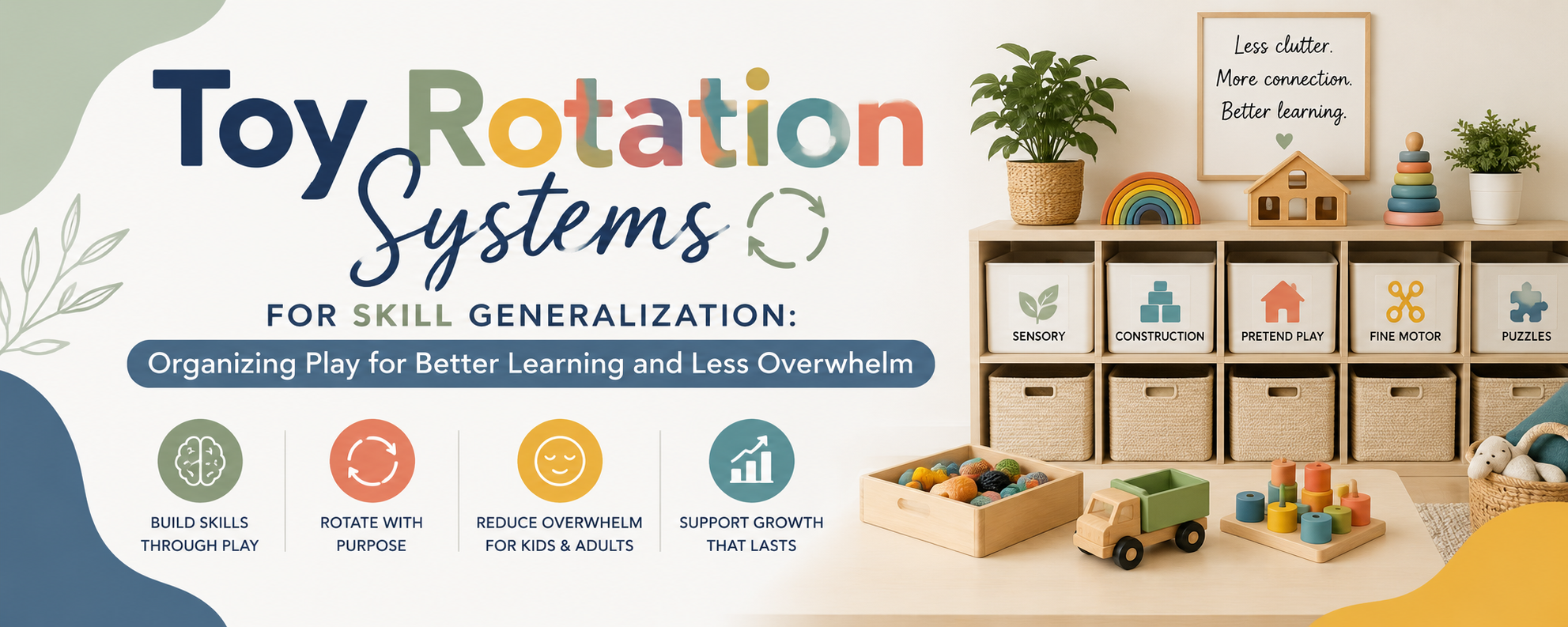
Once everything is sorted, divide similar toys into separate bins.
Instead of placing every block set together, create multiple building bins that can be rotated independently.
This keeps activities feeling fresh while maintaining familiar learning opportunities.
Label Every Bin
Clear labeling makes rotation easier for parents and caregivers.
Labels may include:
- Building Play
- Animal Play
- Kitchen Pretend Play
- Puzzles
- Fine Motor Activities
- Sensory Exploration
Picture labels can also help children participate in selecting activities and cleaning up afterward.
Many professionals providing Home-Based ABA Therapy recommend visual organization systems because they promote independence while reducing confusion.
Limit Available Choices
One of the biggest mistakes families make is putting every toy back into the play area after cleaning.
Instead, select only four to six bins for the week.
The remaining bins should be stored in a closet, cabinet, or another room where they are out of sight.
With fewer choices available, children often:
- Transition more smoothly
- Spend more time exploring each activity
- Become less distracted
- Demonstrate improved attention
Families involved in ABA therapy Dallas programs frequently notice that reducing environmental distractions leads to more meaningful engagement during play.
Organize Toys by Skill
Rather than rotating toys randomly, organize bins according to the skills you want to encourage.
Communication Bin
Include:
- Toy food
- Dolls
- Pretend telephones
- Puppets
These activities encourage requesting, labeling, commenting, and conversation.
Fine Motor Bin
Include:
- Peg boards
- Large beads
- Stacking cups
- Shape sorters
These activities strengthen hand coordination while supporting attention and persistence.
Social Play Bin
Include:
- Board games
- Cooperative building sets
- Turn-taking activities
These materials create opportunities for practicing sharing and waiting.
Problem-Solving Bin
Include:
- Puzzles
- Matching games
- Simple construction toys
Children learn flexibility and persistence while completing increasingly complex tasks.
Many providers offering autism services Dallas TX encourage organizing play around developmental goals instead of entertainment alone.
Rotate on a Predictable Schedule
Consistency helps children adjust to changes without frustration.
Many families find success with:
- Weekly rotations
- Every two weeks
- Monthly rotations
The ideal schedule depends on the child’s interests and engagement level.
If a child continues using a bin enthusiastically, there is no reason to rotate immediately.
Likewise, if interest fades after several days, introducing a different bin can renew motivation.
Professionals providing behavioral therapy North Texas often emphasize following the child’s learning pace rather than sticking rigidly to a calendar.
Avoid Introducing Too Many New Toys
New toys naturally attract attention, but too many unfamiliar materials can reduce opportunities for meaningful play.
Instead, combine:
- One familiar activity
- One slightly different variation
- One new experience
For example:
A child who enjoys stacking blocks may also receive magnetic tiles and wooden construction pieces while continuing to practice similar building skills.
This gradual approach supports flexibility without overwhelming the child.
Encourage Independent Exploration
Toy rotation is not meant to create constant adult-directed instruction.
Instead, parents can:
- Observe quietly
- Follow the child’s interests
- Join play naturally
- Model simple actions
- Expand existing activities
A child stacking blocks may eventually begin sorting colors, building towers, or pretending the blocks are buildings.
Allowing exploration encourages creativity while reinforcing previously learned skills.
Families using in-home ABA therapy Dallas strategies often incorporate natural play opportunities throughout daily routines rather than relying exclusively on structured teaching sessions.
Involve the Entire Family
Toy rotation becomes even more effective when everyone participates.
Older siblings can:
- Help organize bins
- Model imaginative play
- Practice turn-taking
- Encourage communication
Grandparents and caregivers can also use the same bins and routines, creating consistency across environments.
This consistency supports stronger skill generalization because expectations remain familiar regardless of who is supervising play.
Many Dallas ABA centers encourage collaboration between families and caregivers to reinforce learning beyond therapy sessions.
Watch for Signs of Success
Parents often notice positive changes within a few weeks of implementing a toy rotation system.
These improvements may include:
- Longer independent play sessions
- Increased creativity
- Better transitions between activities
- Less frustration
- Improved attention
- More spontaneous communication
Instead of constantly searching for something new, children begin exploring existing toys in deeper and more meaningful ways.
Families participating in autism parent training Dallas programs frequently discover that small environmental changes can produce significant improvements in everyday routines.
Adjust the System as Your Child Grows
Toy rotation should evolve alongside your child’s interests and developmental progress.
As skills improve, bins can include:
- More complex pretend play
- Cooperative games
- Advanced puzzles
- Construction challenges
- Art projects
- Sequencing activities
Older children may even enjoy helping choose which bins stay available each week, giving them a sense of ownership while maintaining the structure that supports successful play.
Professionals specializing in ABA therapy providers 75201 often encourage individualized approaches that adapt to changing needs instead of relying on one fixed system.
Building Everyday Learning Through Organized Play
A thoughtfully organized toy rotation system does much more than reduce clutter. It creates an environment where children can focus, practice important skills, and apply those skills across different situations without becoming overwhelmed.
By limiting distractions, organizing toys by developmental goals, and rotating materials intentionally, families create daily opportunities for meaningful learning through play. These simple routines support independence, encourage creativity, and reinforce skills in a natural and enjoyable way.
Whether supported by pediatric behavioral therapy Dallas, guided by experienced Dallas autism specialists, or incorporated into broader DFW ABA therapy services, toy rotation is a practical strategy that helps transform everyday playtime into valuable opportunities for growth, confidence, and lasting skill development.
Contact us at 972–310–4991 or visit https://radiantspectrumtherapy.com/ to learn more.