
Every family has that one daily routine that seems to take far longer than expected. For many parents, brushing teeth falls into that category. What should be a simple two-minute task can turn into negotiations, tears, avoidance, or frustration. Some children dislike the texture of toothpaste, others struggle with transitions, and many simply have difficulty remembering the sequence of steps involved.
The good news is that brushing teeth does not have to become a daily battle. By breaking the activity into manageable steps and introducing a fun, predictable routine, families can transform dental hygiene into an enjoyable experience rather than a stressful obligation.
Using task analysis, visual schedules, and positive reinforcement allows children to build confidence while developing an important life skill. These techniques are commonly used by professionals providing ABA Therapy in Dallas and can easily be adapted for everyday use at home.
Why Toothbrushing Can Feel Overwhelming
Adults often forget how many individual actions are involved in brushing teeth. What seems automatic actually requires planning, sequencing, coordination, and sensory processing.
A child may need to:
- Walk to the bathroom
- Pick up the toothbrush
- Apply toothpaste
- Turn on the water
- Brush different sections of the mouth
- Rinse
- Clean the toothbrush
- Put everything away
When viewed as a single task, brushing can feel overwhelming. Breaking it into smaller pieces makes the routine much easier to understand and complete successfully.
This approach is frequently incorporated into Center-Based ABA programs because it encourages independence while reducing anxiety around complex daily activities.
What Is Task Analysis?
Task analysis simply means dividing one large activity into smaller, teachable steps.
Instead of saying, “Go brush your teeth,” parents provide a sequence that the child can follow successfully.
A sample task analysis might look like this:
- Walk to the sink.
- Pick up the toothbrush.
- Put toothpaste on the brush.
- Turn on the water.
- Brush the top teeth.
- Brush the bottom teeth.
- Brush the front teeth.
- Brush the back teeth.
- Rinse the mouth.
- Rinse the toothbrush.
- Put the toothbrush away.
- Smile in the mirror.
Completing one small step at a time creates repeated opportunities for success and keeps the routine from feeling overwhelming.
Many professionals offering ABA Parent Training teach families how to create customized task analyses for everyday routines, allowing children to practice important life skills with greater confidence.
Introducing The Toothbrush Chronicles
Children naturally enjoy stories and games. Instead of presenting brushing teeth as a chore, families can turn it into an adventure.
Imagine each brushing session as a mission where tiny “sugar monsters” have invaded the mouth.
Every section of the mouth becomes a different kingdom:
- The Front Tooth Forest
- The Molar Mountains
- The Canine Castle
- The Sparkling River of Rinsing
The child becomes the hero who saves every kingdom by brushing away the sugar monsters before they can build cavities.
This playful approach keeps attention focused while reducing resistance.
Many therapists providing Home-Based ABA Therapy encourage parents to build routines around creativity and imagination because engagement often leads to better participation.
Using Visual Schedules to Reduce Stress
Visual schedules help children know exactly what comes next.
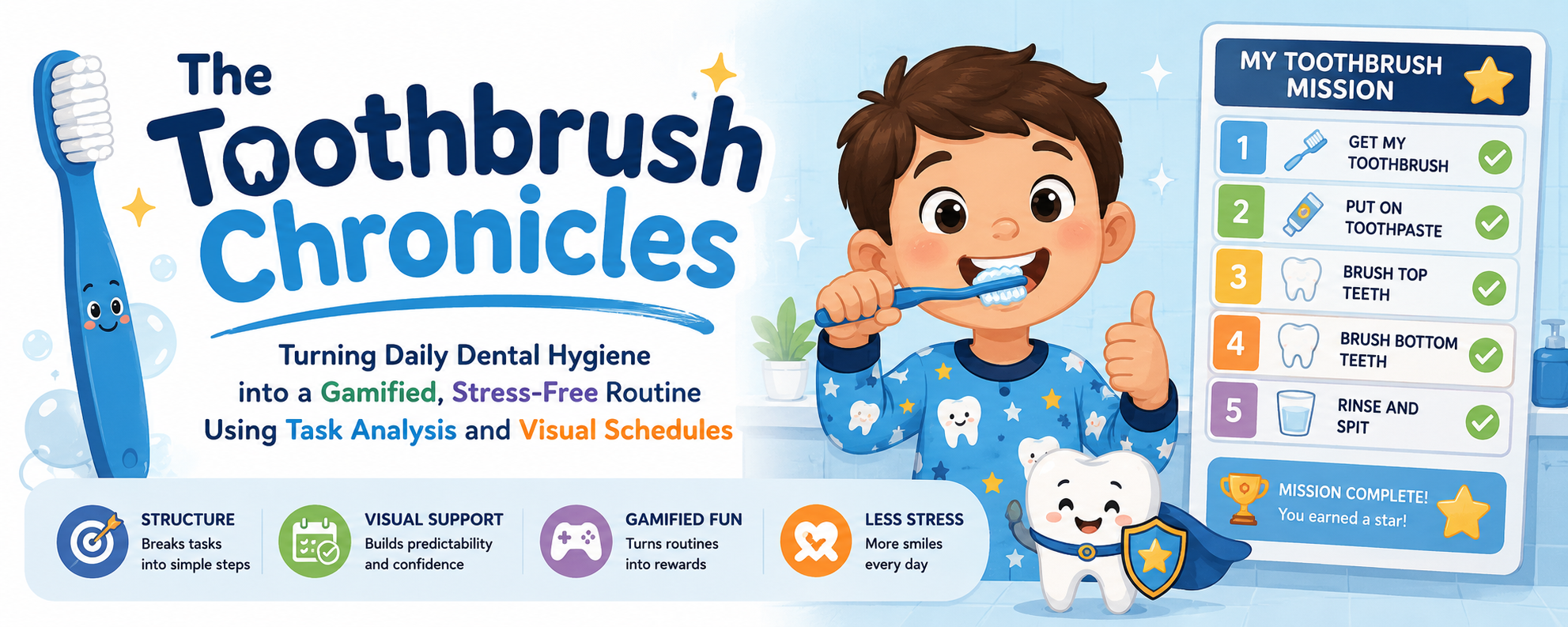
Rather than relying only on verbal instructions, parents can create a simple chart using pictures.
The schedule might include:
🪥 Pick up toothbrush
🦷 Add toothpaste
💧 Wet toothbrush
😁 Brush top teeth
😁 Brush bottom teeth
💦 Rinse
⭐ Earn a reward
As each step is completed, the child checks it off or moves a picture to a finished column.
Predictability often reduces anxiety because there are no surprises.
Professionals providing ABA therapy Dallas frequently incorporate visual supports to make routines more consistent across different environments.
Creating a Simple Reward System
Rewards do not need to be expensive or elaborate.
Many children stay motivated by collecting points, stickers, or stars.
For example:
- One successful brushing session earns one star.
- Five stars earn extra bedtime reading.
- Ten stars earn a special family activity.
- Twenty stars earn the opportunity to choose a weekend movie.
Immediate praise is equally important.
Simple comments like:
- “You remembered every step!”
- “Your brushing was so careful!”
- “You finished your mission!”
help reinforce positive behavior and encourage continued participation.
Families receiving autism services Dallas TX often discover that consistent positive reinforcement creates lasting habits without daily conflict.
Making Toothbrushing Feel Like a Game
Gamification works because it transforms routine tasks into interactive experiences.
Ideas include:
Beat the Timer
Set a colorful two-minute timer and challenge the child to complete every brushing zone before time runs out.
Color Hunt
Pretend each section of the mouth hides invisible colors that disappear with brushing.
Tooth Detective
Use a mirror and search for “hidden sugar bugs” after every brushing session.
Hero Levels
Assign different titles as skills improve:
- Rookie Brusher
- Super Cleaner
- Tooth Guardian
- Smile Champion
Creative routines encourage participation while making dental hygiene something children look forward to rather than avoid.
Many specialists providing behavioral therapy North Texas recognize that motivation often increases when learning feels playful instead of demanding.
Building Consistency at Home
Children thrive with routines that remain predictable.
Helpful strategies include:
- Brush at the same times every day.
- Use the same visual schedule.
- Keep supplies organized in one location.
- Follow the same sequence every session.
- Celebrate small successes consistently.
Over time, repetition builds independence and confidence.
Families using in-home ABA therapy Dallas services often practice these routines in familiar environments, helping children transfer new skills into everyday life.
Handling Difficult Days
Even well-established routines can have challenging moments.
Instead of focusing on what went wrong, parents can simplify expectations.
Maybe the child completes only the first five steps today.
That still represents success.
Progress rarely happens in a perfectly straight line. Consistency matters far more than perfection.
Professionals working in Dallas ABA centers often remind families that celebrating gradual improvement keeps motivation high while reducing stress for everyone involved.
Personalizing the Routine
Every child has unique preferences and sensory needs.
Some may enjoy:
- Electric toothbrushes
- Character-themed toothbrushes
- Different toothpaste flavors
- Musical timers
- Visual countdowns
Others may benefit from extra practice brushing stuffed animals or dolls before brushing their own teeth.
Families participating in autism parent training Dallas programs often learn how to individualize routines based on their child’s strengths, interests, and learning style.
Encouraging Independence
As children become comfortable with the sequence, parents can gradually reduce prompts.
Instead of giving every instruction, they might simply point to the visual schedule.
Eventually, the child completes the entire routine independently.
This process builds confidence that extends far beyond dental hygiene.
Skills learned through structured teaching often carry over into dressing, hand washing, homework, meal preparation, and other daily activities.
Many ABA therapy providers 75201 emphasize independence as a long-term goal because mastering everyday routines supports lifelong success.
Supporting the Whole Family
Morning and bedtime routines influence the entire household. When brushing teeth becomes predictable instead of stressful, families often experience calmer transitions and fewer conflicts.
Children gain confidence through repeated success, while parents spend less time negotiating and more time celebrating progress.
Providers of pediatric behavioral therapy Dallas frequently recommend combining visual supports, task analysis, and positive reinforcement because these strategies promote learning while preserving positive family interactions.
Small Steps Lead to Big Smiles
Every confident brusher starts with one simple step.
Turning toothbrushing into “The Toothbrush Chronicles” allows children to see themselves as capable heroes rather than reluctant participants. By using task analysis, visual schedules, and playful motivation, daily dental hygiene becomes an opportunity to practice independence, build confidence, and create positive routines that last a lifetime.
Families working with Dallas autism specialists often discover that small, consistent changes can make ordinary routines feel achievable and even enjoyable. Whether at home or through structured support, these practical strategies can help transform everyday moments into meaningful learning experiences.
For many families seeking DFW ABA therapy, success is built one step at a time — and sometimes that journey begins with a toothbrush, a visual schedule, and a mission to defeat the sugar monsters before bedtime.
Contact us at 972–310–4991 or visit https://radiantspectrumtherapy.com/ to learn more.