
Taking turns is a common part of childhood, but for some children, waiting, sharing control, and allowing another person to go first can feel surprisingly difficult. Through ABA Therapy in Dallas, families can explore practical, individualized strategies that help children develop flexibility, practice patience, and enjoy playing with others without turning every game into a struggle. With the right support, everyday activities can become opportunities to build meaningful social and communication skills at a comfortable pace.
For children who find it challenging to wait for a favorite toy, share a game piece, or accept a change in play, the goal is not simply to make them follow rules. Instead, it is to help them understand what to expect, communicate their needs, and gradually become more comfortable with shared activities. These skills can support relationships with siblings, parents, classmates, and peers.
At Radiant Spectrum Therapy, individualized support can help families identify what makes turn-taking difficult and introduce strategies that fit each child’s developmental level, interests, and communication abilities. Whether a child participates in home routines or structured learning activities, small, consistent opportunities can make social experiences more predictable and enjoyable.
Why Taking Turns Can Feel Difficult for Some Children
Turn-taking requires several skills to work together. A child must recognize when it is their turn, understand that another person will participate, tolerate a short wait, and sometimes accept that the activity may not unfold exactly as expected.
For children who benefit from additional developmental support, these demands may feel overwhelming, especially when the game involves a highly preferred toy or an unpredictable outcome.
Waiting Requires More Than Patience
Waiting is an active skill. Children need to understand that their opportunity to participate has not disappeared simply because someone else is going first.
A child might reach for a toy while a sibling is using it, become upset when a parent takes a turn, or repeatedly ask when they can play again. These behaviors may communicate excitement, uncertainty, frustration, or difficulty understanding how long the wait will last.
Instead of immediately treating these moments as disobedience, adults can look at what the child may need to understand the situation better.
Helpful questions include:
- Does the child know whose turn it is?
- Can the child see when their next turn will happen?
- Is the waiting period too long for their current skills?
- Does the child have a reliable way to request a turn or ask for help?
- Is the game enjoyable and appropriate for the child’s developmental level?
Understanding these factors allows parents and professionals to choose strategies that address the actual challenge rather than simply demanding better behavior.
Sharing Control Can Be Uncomfortable
Some children enjoy playing independently because they can choose the materials, control the pace, and decide what happens next. Introducing another person changes those expectations.
For example, a child building a tower may become upset when a parent adds a block in an unexpected place. Another child may want to spin a toy car repeatedly but struggle when a sibling suggests a different way to play.
These situations provide opportunities to practice flexibility without requiring a child to abandon their interests.
An adult might introduce a simple shared activity in which the child chooses the blocks while the adult adds one block during their turn. Over time, the child can practice allowing another person to participate while still maintaining a meaningful role in the activity.
The objective is not to eliminate independent play. It is to help children discover that playing together can offer enjoyable experiences while respecting their preferences and boundaries.
How ABA Therapy in Dallas Can Support Turn-Taking Skills
ABA therapy Dallas families explore can provide individualized strategies for teaching communication, social interaction, and flexible responding through meaningful activities. Applied Behavior Analysis examines how environmental conditions, learning experiences, and consequences influence behavior. When appropriately individualized, ABA strategies can help children practice specific skills in ways that are understandable and relevant to daily life.
The approach should be based on the child’s needs, strengths, preferences, and family priorities. A turn-taking goal should not automatically look the same for every child.
For one child, success might mean waiting a few seconds while looking at a visual cue. For another, it might mean asking, “My turn next?” or accepting a sibling’s participation in a familiar game.
Start With Small, Achievable Steps
A child who struggles with waiting may not be ready for a lengthy board game with several players. Beginning with a brief activity can make the experience easier to understand.
Consider a simple ball-rolling game between a parent and child. The parent rolls the ball once, then helps the child recognize that it is their turn to roll it back.
Initially, the child may need frequent reminders, a visual cue, or an immediate opportunity to participate. As the routine becomes familiar, the adult can gradually introduce short waits or another player.
Breaking a skill into manageable steps helps adults identify what the child can already do and what needs additional support.
Make the Next Turn Predictable
Predictability can reduce uncertainty. Children may find it easier to wait when they know what will happen next and can see that their opportunity to participate is coming.
Helpful supports may include:
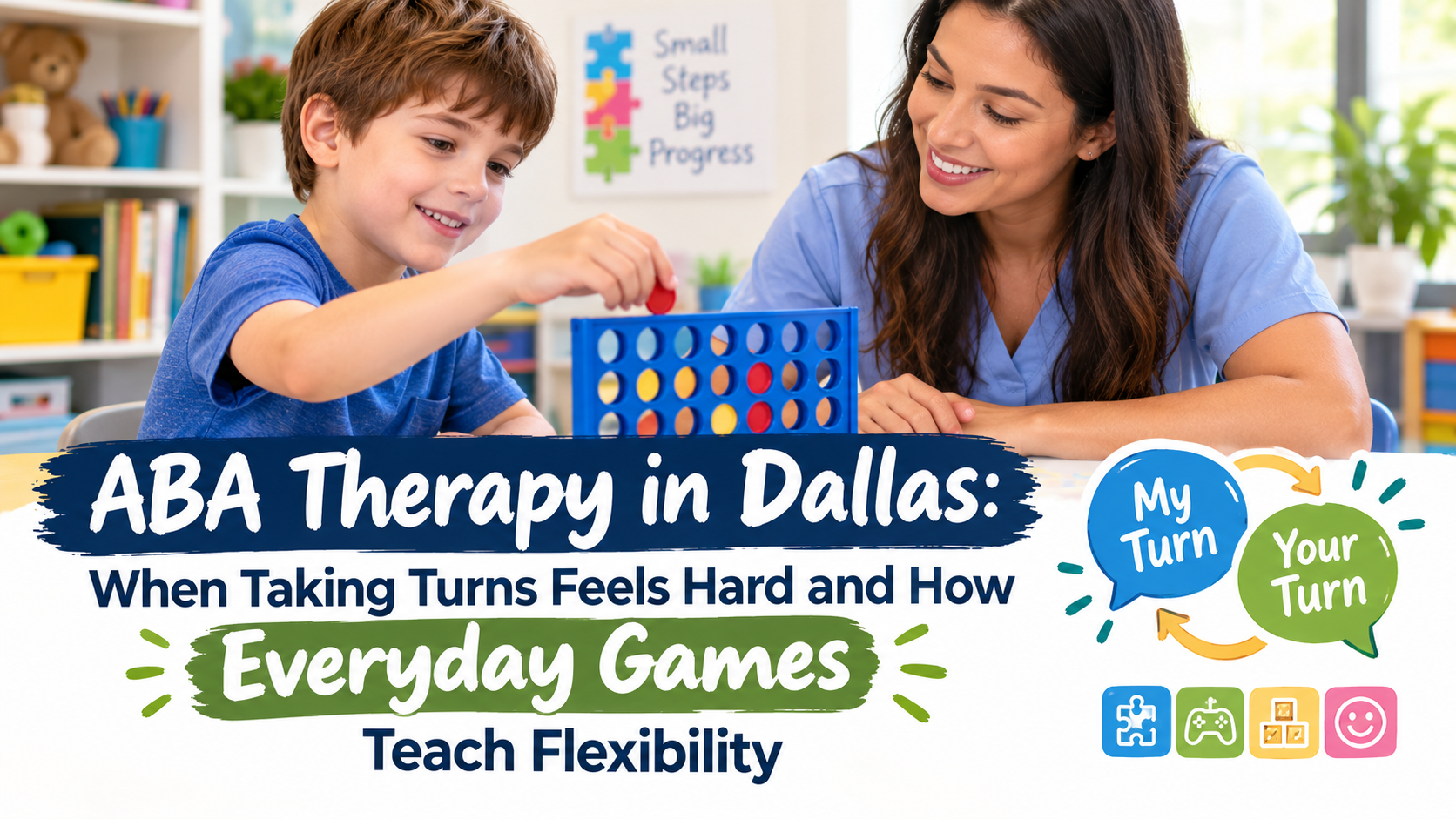
- A simple visual card labeled “My Turn” and “Your Turn.”
- A turn-taking board with each player’s name or picture.
- A small number of blocks or game pieces showing how many actions remain.
- A consistent phrase, such as “First my turn, then your turn.”
- A visual timer when understanding elapsed time is an appropriate goal.
The support should match the child’s communication and learning needs. Some children understand spoken reminders, while others benefit from pictures, gestures, objects, or communication devices.
Visuals are not meant to force compliance. They are tools for making the activity clearer and helping the child understand what to expect.
Five Everyday Games That Teach Flexibility
Turn-taking does not have to begin with complicated games or formal lessons. Familiar activities often provide the most natural opportunities to practice because children already understand the materials and enjoy participating.
1. Rolling a Ball Back and Forth
Skills practiced: Shared attention, reciprocal play, waiting briefly, and recognizing turns
Sit across from the child and roll a soft ball toward them. After they receive it, encourage them to roll it back.
Use simple language, such as “Your turn” and “My turn.” If the child prefers to roll the ball repeatedly in one direction, begin by joining their preferred activity before introducing a reciprocal exchange.
Keep the game brief at first. If the child becomes frustrated, reduce the demands or return to a familiar version of the activity.
The goal is to build an enjoyable back-and-forth interaction, not to require a fixed number of exchanges.
2. Building a Tower Together
Skills practiced: Sharing materials, allowing another person to contribute, and tolerating small changes.
Gather several blocks and take turns adding one block to a tower. Let the child choose the colors, shape, or starting arrangement whenever possible.
At first, an adult might add a block only after the child indicates readiness. Later, the child may become comfortable watching another person make a choice or add a piece.
If the tower falls, use the moment to model flexible responses. You might say, “It fell down. We can build it again or make something different.”
Avoid deliberately destroying a child’s creation to test their reaction. Flexibility is best practiced in supportive situations where the child feels safe and has meaningful choices.
3. Taking Turns With Bubbles
Skills practiced: Requesting, waiting for a preferred activity, and sharing control.
Bubbles can be a motivating activity for children who enjoy watching them float or popping them.
An adult can blow a few bubbles and then pause, giving the child an opportunity to request more using speech, gestures, pictures, or an assistive communication device.
Next, the child might take a turn operating the bubble wand with assistance if needed.
This activity can teach children that turns involve both receiving and initiating actions. It also creates opportunities to practice communication without requiring lengthy verbal responses.
If waiting is difficult, keep pauses very short and gradually adjust them according to the child’s comfort and progress.
4. Playing a Simple Matching Game
Skills practiced: Waiting, following a shared routine, and responding to another person’s participation.
Choose a matching game with only a few cards or familiar objects. Each player takes a turn selecting one item and finding its match.
If the full game feels overwhelming, simplify it. A child might choose between two cards while the adult takes the next turn.
As the child becomes more comfortable, introduce additional cards or another player.
The focus should remain on participating together. Winning, losing, and following every rule are not necessary starting points for learning turn-taking.
5. Making Music Together
Skills practiced: Reciprocal interaction, shared control, and flexible responding.
Use simple instruments such as shakers, drums, or rhythm sticks. One person makes a short sound, and the other responds.
You can also take turns choosing which instrument to play or deciding whether the group will play fast or slowly.
For children who enjoy repetitive sounds, preserve that interest while gradually introducing opportunities for another person to contribute.
Some children may prefer taking turns through movement, dance, or vocal sounds rather than traditional games. The activity should reflect what makes participation meaningful for them.
Teaching Turn-Taking Without Creating Pressure
One of the most important parts of teaching flexibility is recognizing the difference between providing support and creating unnecessary demands.
A child who cries, grabs an object, or leaves a game may be communicating that the activity is too difficult, unpredictable, or uncomfortable. Increasing demands in that moment may make the experience less successful.
Supportive teaching focuses on understanding the child’s response and adjusting the environment.
Keep Waiting Periods Short
Start with a waiting period the child can reasonably manage. This might be only a second or two, or there may be no deliberate delay at first.
For example, an adult could say, “My turn,” place one block, and immediately indicate that the child’s turn is next.
As the child becomes more comfortable, the adult can gradually introduce longer waits when appropriate.
There is no universal waiting duration that every child should reach. Progress should be based on individual needs and functional goals rather than comparison with other children.
Offer Meaningful Choices
Children can practice flexibility while still having control over important parts of an activity.
Try asking:
- “Would you like the red ball or the blue ball?”
- “Should we build a tower or a bridge?”
- “Would you like me to go first or would you like to start?”
- “Do you want to play one more round or take a break?”
Choices help children communicate preferences and participate more willingly. They also demonstrate that turn-taking does not mean giving up every decision.
When possible, honor the child’s choice. If neither option is appropriate, explain what is happening in simple, supportive language and offer another reasonable alternative.
Recognize Communication as Success
A child does not need to wait silently to demonstrate progress. Asking for a turn, requesting more time, saying “Help,” or communicating “All done” can be valuable skills.
For example, if a child reaches for a toy while another person is playing, an adult might model the phrase “Can I have a turn?” or provide a picture the child can use to make the request.
The child should have opportunities to use their preferred communication method without being required to speak if speech is not accessible or comfortable.
Honoring appropriate requests for breaks also helps children learn that communication is effective. This can reduce frustration and make future participation easier.
Respond to Frustration With Support
When a child becomes upset, pause and consider what may be contributing to the reaction.
The game might be too difficult, the waiting period too long, or the child might not understand when their turn will happen. They may also be tired, overwhelmed by noise, or simply finished with the activity.
An adult can reduce the number of players, shorten the game, provide a clearer visual cue, or offer a break.
Not every difficult moment needs to become a teaching opportunity. Sometimes, the most helpful response is to stop the activity and try again another time.
How Families Can Practice Turn-Taking at Home
Families do not need to set aside hours for structured practice. Small opportunities throughout the day can help children become familiar with reciprocal interactions.
For example, parents can take turns choosing a song during a car ride, adding ingredients while preparing a snack, selecting a bedtime story, or pressing a button on a favorite toy.
The key is to create natural opportunities for participation without making every enjoyable activity into a lesson.
Build Predictable Routines
Children may find turn-taking easier when the activity follows the same basic pattern each time.
A simple routine could be:
- Choose a familiar game the child enjoys
- Show who will take the first turn.
- Use a consistent visual or spoken cue.
- Keep each person’s turn brief.
- Celebrate participation and communication.
- End the game before frustration becomes overwhelming.
As the routine becomes familiar, families can make small adjustments based on the child’s progress.
Practice Across Different Settings
A child who takes turns comfortably with a parent may still find it difficult to do so with a sibling, therapist, or peer. Different people, materials, and environments can introduce new challenges.
Practice can gradually expand from one familiar adult to another trusted person, and eventually to a small group when appropriate.
Families should not expect skills to transfer automatically between settings. Children may need additional modeling, visual supports, or practice when the activity changes.
Parents and professionals can work together to identify which supports are helpful and how to use them consistently.
Recognizing Progress Beyond Perfect Turn-Taking
Progress is not measured only by whether a child completes a game without becoming upset. Meaningful changes may appear in smaller, everyday moments.
A child may begin looking toward a visual turn cue, waiting briefly with support, asking for the next turn, allowing a sibling to add a block, or returning to an activity after taking a break.
These are valuable signs that the child is learning to navigate shared experiences.
Progress may also look different from one day to the next. A child might comfortably take turns during a favorite activity but struggle when tired or introduced to an unfamiliar game.
Families can focus on practical outcomes that improve the child’s experience, including more successful communication, reduced frustration, increased enjoyment, and greater access to shared play.
The purpose of intervention is not to make every child play in the same way. It is to support meaningful participation while respecting individual differences, preferences, and boundaries.
Choosing Individualized ABA Therapy in Dallas
When turn-taking difficulties affect a child’s daily interactions, families may consider professional guidance to better understand their child’s needs.
ABA therapy services Dallas families explore should be individualized, developmentally appropriate, and guided by goals that matter to the child and family. A qualified Board Certified Behavior Analyst (BCBA) can help assess relevant skills, identify barriers to participation, and develop a plan that may include communication supports, visual cues, play-based practice, and caregiver collaboration.
Families considering Applied Behavior Analysis Dallas services can ask prospective providers how they teach social skills, how they respond when a child becomes distressed, and how they incorporate the child’s interests into sessions.
Other helpful questions include:
- How are goals selected and reviewed?
- How does the team support different communication styles?
- How are parents involved in practicing skills at home?
- How does the provider measure progress beyond compliance?
- How are breaks, assent, and individual boundaries respected?
- Can strategies be adapted for siblings, peers, and different settings?
The right approach should prioritize the child’s well-being, meaningful participation, and functional communication rather than simply requiring the child to tolerate every situation.
Understanding Available Therapy Options
Families researching ABA therapy for autism Dallas may encounter several service models. Depending on the provider, a child’s assessment, clinical needs, and insurance coverage, options may include in-home ABA therapy Dallas or center-based ABA therapy Dallas.
In-home sessions may allow a team to work with familiar toys, family routines, and everyday interactions. Center-based services may offer structured opportunities to practice skills in a dedicated therapeutic environment. Neither setting is automatically the best choice for every child.
For younger children, early intervention ABA Dallas, pediatric ABA therapy Dallas, and ABA therapy for toddlers Dallas may be relevant search terms when exploring age-appropriate support. Services should be matched to the child’s individual developmental profile and family priorities.
Families may also search for ABA therapy for kids Dallas, behavior therapy Dallas, autism behavior therapy Dallas, or developmental therapy Dallas when comparing support options. These terms can describe different services, so it is important to clarify what each provider actually offers.
Depending on individual needs, families may also investigate BCBA services Dallas, behavioral intervention Dallas TX, autism support services Dallas, and special needs therapy Dallas. Ask whether the provider’s services and professional qualifications align with the child’s goals.
Finding the Right Support for Your Family
Searching for ABA therapy near Dallas can bring up many providers, but choosing a service requires more than comparing websites. Families researching ABA therapy in Dallas TX, Dallas autism services, or ABA clinics in Dallas can benefit from reviewing provider qualifications, treatment philosophy, family involvement, and the availability of individualized services.
Online searches such as ABA therapy near me Dallas, best ABA therapy providers Dallas, best ABA therapy in Dallas, and top-rated ABA therapists Dallas may help create an initial list of options. However, ratings alone cannot determine whether a provider is a good fit for a particular child.
It is also reasonable to ask about cost and coverage. Searches for ABA therapy cost Dallas, affordable ABA therapy Dallas TX, private ABA therapy Dallas, and intensive ABA programs Dallas reflect common family concerns, but actual costs and service recommendations vary. Contact providers and insurance representatives directly to confirm current rates, benefits, authorization requirements, and out-of-pocket expenses.
Families who want to understand how ABA therapy works Dallas can ask for a clear explanation of assessment, goal development, progress monitoring, and caregiver participation. If you are ready to find ABA therapist Dallas, consider speaking with qualified providers about your child’s specific needs rather than relying on general descriptions alone.
Radiant Spectrum Therapy is committed to helping families explore individualized ABA support that emphasizes meaningful developmental progress, communication, and practical skills. Families can discuss their concerns and learn whether available services align with their child’s needs.
Helping Children Build Flexibility One Turn at a Time
Learning to take turns is about more than waiting for a toy or following a game’s rules. It involves communication, predictability, shared enjoyment, and learning how to participate in activities with other people.
Parents can begin with brief games, clear visual cues, familiar routines, and opportunities for children to make meaningful choices. When frustration occurs, adjusting the activity and respecting the child’s need for a break can help preserve trust and make future practice more positive.
With individualized ABA Therapy in Dallas, children may receive support in developing flexible play, communicating their needs, and participating in shared experiences at a pace suited to their abilities. The goal is not perfect turn-taking. It is helping each child build skills that make everyday interactions more comfortable, rewarding, and meaningful.
Radiant Spectrum Therapy encourages families to focus on small steps, celebrate individual progress, and make room for every child’s unique way of learning. With patience, collaboration, and the right support, everyday games can become valuable opportunities for connection and growth.
Contac us at 972–310–4991 or visit https://radiantspectrumtherapy.com/ to learn more.