
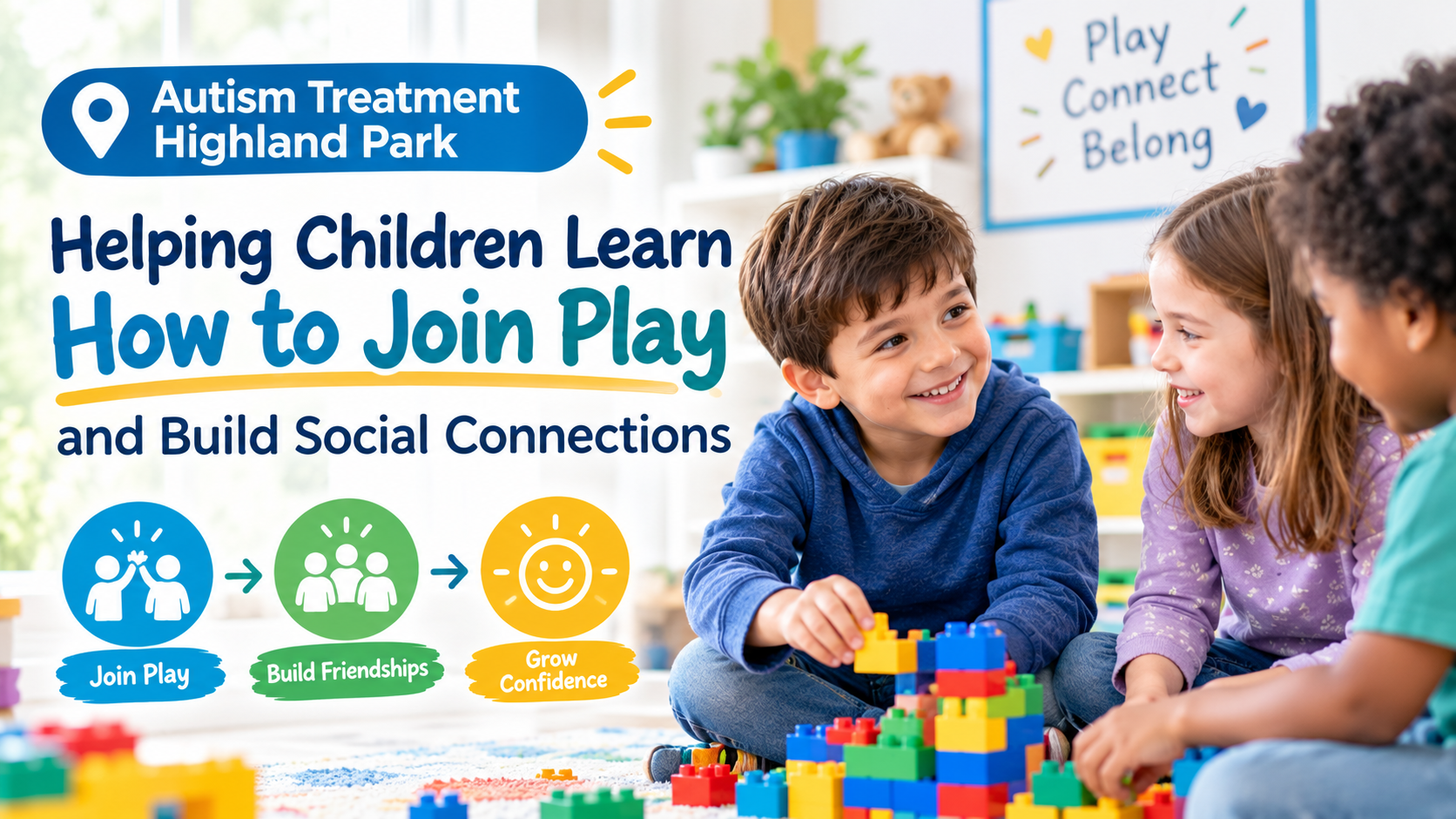
Play is one of the most natural ways children learn about friendships, communication, cooperation, and the world around them. However, some children may enjoy being near other children without knowing how to enter a game, ask to participate, or keep a shared activity going. Through individualized Autism Treatment Highland Park, families can explore practical ways to help children develop these skills while respecting their personalities, communication styles, and individual needs.
A child might watch other children build a tower, run around the playground, or pretend to be superheroes but remain on the sidelines. They may want to participate but feel unsure about what to say, when to approach, or how to respond when the game changes. Other children may communicate their interest through gestures, sounds, movements, or assistive communication devices rather than spoken words.
These experiences do not necessarily mean a child lacks interest in friendship. Sometimes, the child simply needs more opportunities to learn the steps involved in shared play.
Individualized ABA therapy Highland Park can help children practice meaningful social skills through play-based activities, modeling, encouragement, and gradual support. The goal is not to force children to interact or make every child play the same way. Instead, the goal is to help children communicate their preferences, explore social opportunities, and participate in ways that feel comfortable and rewarding.
Why Joining an Ongoing Game Can Be Difficult
Starting a game and joining a game that is already happening are two different experiences. When children initiate their own activities, they often have more control over the rules, materials, and pace. Joining other children requires noticing what is happening and figuring out how to become part of it.
For children who benefit from additional social communication support, these steps can involve several skills at once.
Recognizing What Other Children Are Doing
Imagine a group of children playing with toy animals. One child is pretending to run a zoo, another is handing out food, and a third is pretending to be a visitor.
A child who wants to join may understand how to play with the animals but not realize that the other children have created a shared pretend-play scenario. They might pick up an animal and begin playing independently, unintentionally missing an opportunity to connect with the group.
Learning to observe the activity can help children identify what is happening, what materials are being used, and whether there is a natural way to participate.
Knowing How to Enter the Activity
Children often join games through small social actions. They might ask, “Can I play?” offer a toy, copy an action, or suggest a new idea.
These actions may seem simple, but they involve communication, timing, and understanding the activity. A child who is still developing these skills may need explicit examples and opportunities to practice them.
With Applied Behavior Analysis Highland Park, a qualified professional can identify the specific skills a child needs and develop individualized strategies that support participation without expecting the child to rely on spoken language alone.
Understanding Social Cues
Social situations change quickly. A child may need to notice when another player offers a toy, when a group changes activities, or when someone communicates that they need more space.
Social cues are not always obvious, and children interpret them differently. Rather than expecting children to automatically understand every gesture or facial expression, adults can explain what is happening and demonstrate possible responses.
For example, a therapist might say, “Maya handed you the red block. You could use it to help build the house.” This connects an observable action with a possible way to participate.
Managing Uncertainty and Changes
Even when children successfully enter a game, keeping the interaction going can be challenging. Another child might change the rules, choose a different toy, or introduce an unexpected idea.
Predictable practice, flexible play activities, and supportive guidance can help children explore these situations. Effective ABA therapy services Highland Park should account for each child’s communication abilities, sensory preferences, developmental needs, and comfort level.
Practical Ways to Help Children Join Play
Children learn social skills through meaningful experiences, repetition, and opportunities to discover what works for them. Families and professionals can make play more approachable by breaking participation into manageable steps.
1. Start by Observing the Activity
Before encouraging a child to enter a game, help them notice what the other children are doing.
For example, if several children are rolling cars down a ramp, an adult might comment, “They’re sending the blue cars down the ramp. Look, now they’re getting another car.”
This simple observation provides information without immediately requiring the child to interact.
Over time, children can practice identifying:
- What the group is playing.
- Which toys or materials are being used.
- What actions the other children are taking.
- Where there may be an opportunity to participate.
Observation should not become a requirement for making eye contact or displaying a particular facial expression. Children can gather information in different ways.
2. Teach Several Ways to Enter a Game
There is no single correct phrase or action for joining play. Children benefit from learning options that fit different situations and communication preferences.
Possible entry strategies include:
- Asking, “Can I play?”
- Saying, “Can I have a turn?”
- Offering a toy that fits the activity.
- Bringing a similar toy and playing alongside the group.
- Copying an action that is part of the game.
- Using a gesture, picture, communication device, or other preferred communication method to express interest.
An adult can demonstrate these strategies during a relaxed play session. For example, while two people build a block tower, the adult can model offering another block and saying, “Can I help?”
Children can then practice the same action with a supportive partner before trying it in a more complex setting.
The purpose is to expand a child’s communication options, not require a memorized phrase in every situation.
3. Practice With Familiar People First
Joining an unfamiliar group can be intimidating. Practicing with a sibling, parent, therapist, or trusted play partner may make the experience easier.
Start with a simple activity that the child already enjoys, such as rolling a ball, completing a puzzle, or building with blocks.
An adult can create small opportunities for shared play by taking turns, offering materials, and introducing simple cooperative actions.
As the child becomes more comfortable, the activity can gradually include another person, additional materials, or a slightly longer interaction.
For children receiving ABA therapy for autism Highland Park, practice can be individualized to match their current skills and interests. Some children may begin with parallel play, where they play beside another person, while others may be ready to practice short exchanges or cooperative games.
Each starting point can be valuable.
How ABA Strategies Can Support Shared Play
Applied Behavior Analysis, commonly called ABA, is an individualized approach that can help children learn and strengthen skills through structured teaching, practice, and feedback. When social play is a meaningful goal for a child, a qualified clinician can break complex activities into smaller, teachable steps.
Breaking Play Into Manageable Steps
Joining a game can be taught as a sequence of smaller skills:
- Notice an activity that looks interesting.
- Move toward the activity when comfortable.
- Identify a possible way to participate.
- Communicate interest using an appropriate method.
- Respond to the other person’s communication.
- Participate for a comfortable period.
- Communicate when ready to change activities or take a break.
A child does not have to master every step before enjoying shared play. Instead, a therapist can determine which steps are useful starting points and build from there.
For example, one child may need support communicating a request to join. Another may already ask to participate but need help understanding how to take turns.
Individualized autism therapy Highland Park TX should address the child’s actual needs rather than use the same teaching plan for every child.
Using Modeling and Prompting
Modeling allows children to see how a social action might look. An adult might demonstrate how to offer a toy, ask for a turn, or suggest a new role in a pretend game.
Prompting provides additional assistance when needed. Depending on the child, this might involve a verbal reminder, a visual cue, a gesture, or an example.
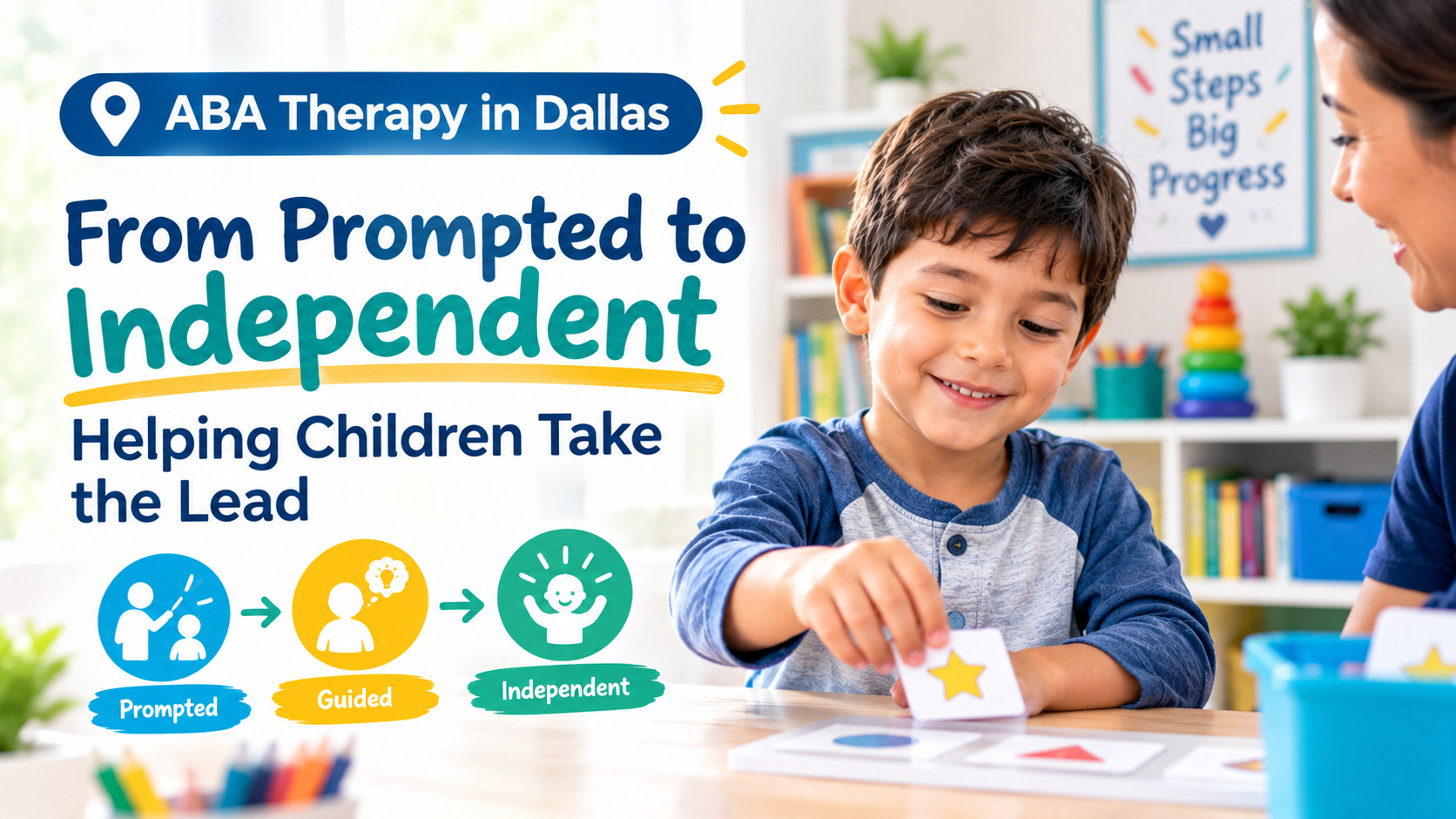
Prompts should be adjusted carefully. As a child becomes more confident, the adult can gradually reduce assistance and allow more opportunities for independent communication.
The long-term goal is meaningful participation, not dependence on an adult to direct every interaction.
Encouraging Natural Communication
Children communicate for many reasons during play. They may request an item, reject an idea, share excitement, ask for help, or invite someone to continue an activity.
Adults can create opportunities for these exchanges by following the child’s interests and responding to their communication.
For example, if a child enjoys trains, an adult might build a track together and pause to allow the child to choose the next piece. The child could communicate through speech, gestures, pointing, or an assistive device.
This approach creates opportunities for communication within an activity that already matters to the child.
Families exploring early intervention ABA Highland Park may find it helpful to discuss these everyday learning opportunities with a qualified provider. Early support can focus on communication, play, and participation while considering the child’s developmental level and family priorities.
Reinforcing Meaningful Participation
Positive feedback can help children understand that their efforts are noticed and valued.
When a child offers a toy, asks for a turn, or responds to another player’s idea, an adult might say, “You found a way to join the game,” or “You told Sam what you wanted to play.”
Feedback should be genuine and appropriate to the child. Some children enjoy verbal encouragement, while others respond better to continuing the activity they love or receiving more opportunities to make choices.
The emphasis should be on building useful skills and enjoyable experiences, rather than rewarding children simply for appearing socially typical.
Teaching Turn-Taking Without Making Play Feel Like Work
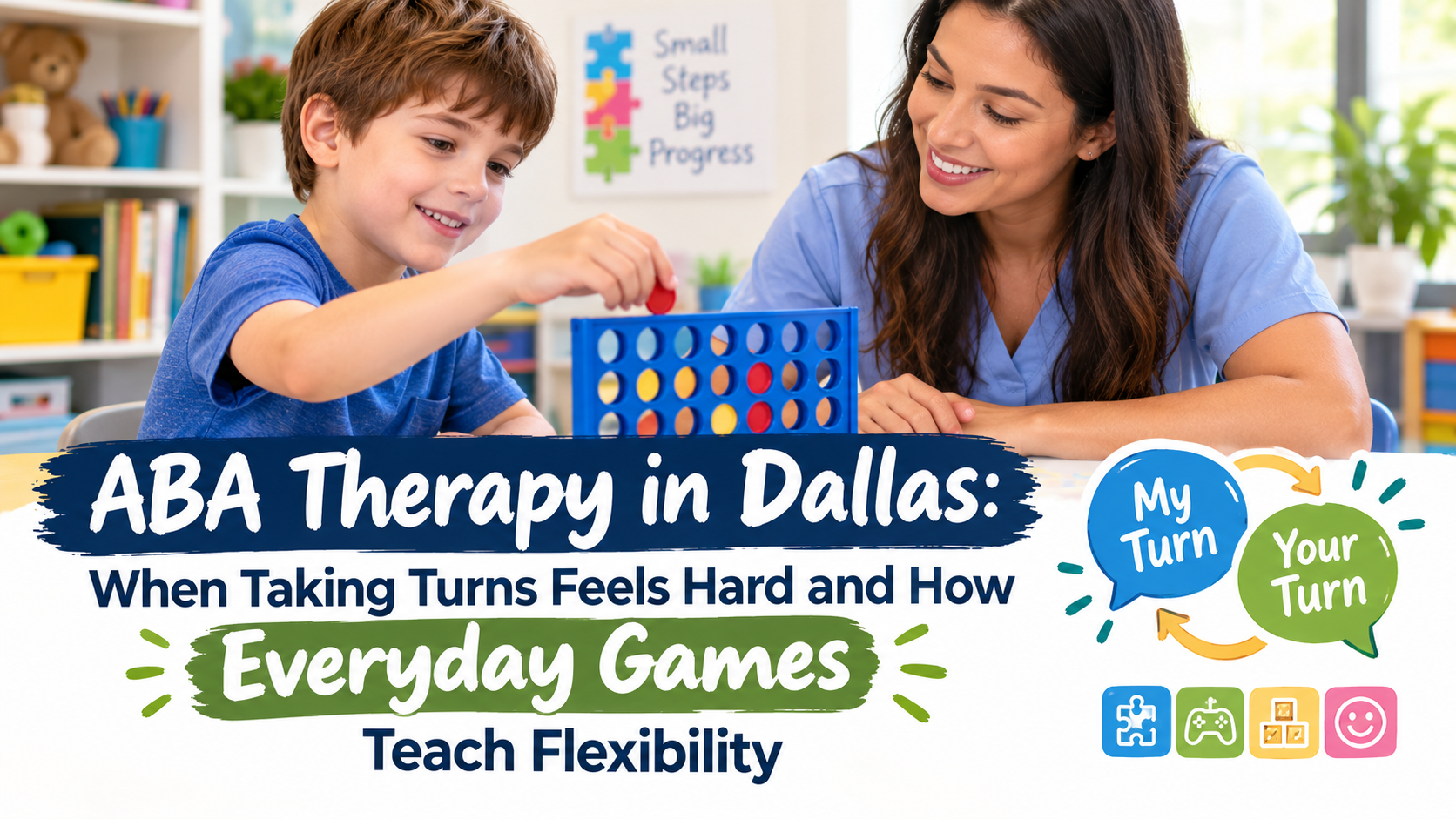
Turn-taking is an important shared-play skill, but it does not have to begin with complicated board games or strict rules.
A simple back-and-forth activity can provide an accessible starting point. One person rolls a ball, and the other rolls it back. One person adds a block, and the other chooses the next piece.
These activities introduce the idea that each person can contribute to something shared.
Make Turns Easy to Understand
Visual supports can help children understand whose turn it is. For example, a small card, a picture cue, or a clearly marked game piece can make the sequence more predictable.
Adults can also use simple language, such as “Your turn” and “My turn,” while demonstrating each action.
If waiting is difficult, begin with very short turns and gradually adjust the activity based on the child’s comfort and progress.
Include Choices and Flexibility
Turn-taking should not mean that children must always accept another person’s choice without expressing their own preferences.
A child can learn to communicate, “I want the blue car,” “Let’s do it this way,” or “I’m finished.”
Shared play involves both participating with others and expressing personal boundaries. Helping children communicate disagreement, ask for a break, or leave an activity appropriately is just as important as helping them enter a game.
Recognizing Social Cues Through Everyday Play
Social understanding develops through experience. Adults can help children notice meaningful cues by explaining them during real activities instead of relying entirely on abstract instructions.
Explain What You Notice
Suppose another child holds out a toy. An adult might explain, “Jordan is offering you the truck. You can take it if you want to play with it.”
If another child says, “Let’s build a bridge,” the adult can explain that this is an invitation to contribute an idea or help with the structure.
These explanations make social situations more understandable without assuming that children should automatically interpret every expression or gesture.
Teach Children to Check In
Social cues can be ambiguous. A child may not know whether another person wants to continue an activity or try something different.
Children can learn simple ways to check, such as asking, “Do you want to play?” or offering a choice between two activities.
Adults should also teach that other children can say no. Respecting another person’s response helps create interactions that are more comfortable and reciprocal.
Families seeking behavior therapy Highland Park can ask potential providers how they teach social communication, respect for boundaries, and flexible interaction in developmentally appropriate ways.
Moving From Practice Sessions to Everyday Opportunities
Skills learned with a familiar adult may not immediately transfer to playgrounds, classrooms, birthday parties, or other group settings. Children may need opportunities to practice the same skills in different environments.
Begin With Small, Predictable Play Opportunities
Rather than starting with a large group, consider a short activity with one compatible play partner.
Choose an activity with a clear purpose, such as completing a simple puzzle, building a road, or taking turns sending cars down a ramp.
A predictable activity can make it easier to identify opportunities for communication and participation.
Follow the Child’s Interests
Children are often more motivated to participate when an activity connects with something they already enjoy.
If a child loves drawing, shared play might begin with taking turns adding details to a picture. If they enjoy music, a cooperative activity could involve choosing instruments and creating a rhythm together.
Following a child’s interests does not mean every activity must remain unchanged. It provides a comfortable starting point for exploring new experiences.
Coordinate With Caregivers and Professionals
Consistency can help children recognize familiar strategies across settings. Parents, teachers, caregivers, and therapists can share information about communication methods, preferred activities, successful supports, and situations that feel overwhelming.
For example, if a visual turn-taking cue works well at home, the team can discuss whether the same cue would be useful during a small-group activity.
Families considering in-home ABA therapy Highland Park may appreciate opportunities to practice skills during familiar routines and play activities. Families interested in center-based ABA therapy Highland Park can ask how the provider supports generalization across peers, play materials, and group situations.
The most appropriate setting depends on the individual child’s needs, family preferences, treatment goals, and available services.
Choosing Individualized ABA Support in Highland Park
Every child develops social communication skills differently. Some children may need help initiating interactions, while others may benefit from support with turn-taking, flexible play, or communicating when an activity is no longer enjoyable.
Families researching pediatric ABA therapy Highland Park should look for providers who take time to understand the child’s strengths, preferences, communication style, and developmental needs.
A thoughtful treatment plan may include:
- Individualized goals that relate to the child’s everyday life.
- Play-based opportunities to practice social communication.
- Collaboration with caregivers and other relevant professionals.
- Respect for the child’s sensory needs and personal boundaries.
- Progress monitoring that considers meaningful participation, not just the number of social responses.
- Adjustments when a strategy is ineffective or causes unnecessary stress.
Parents exploring ABA therapy for toddlers Highland Park or ABA therapy for kids Highland Park can ask how goals will be tailored to the child’s age, current abilities, and family priorities.
When comparing the best ABA therapy providers Highland Park, consider the quality of individualized assessment, clinical supervision, caregiver collaboration, and the provider’s approach to child-centered care. Families may also ask about BCBA services Highland Park, including how a Board Certified Behavior Analyst evaluates goals and oversees treatment when applicable.
Practical questions about ABA therapy cost Highland Park are also important. Costs may depend on the recommended number of hours, provider rates, insurance benefits, and other factors. Families looking for affordable ABA therapy Highland Park TX should ask about insurance verification, available payment arrangements, and any additional fees before beginning services.
Whether you are researching private ABA therapy Highland Park, intensive ABA programs Highland Park, or other autism support services Highland Park, the focus should remain on finding appropriate, individualized support rather than choosing a program based on intensity or marketing claims alone.
Families can also compare developmental therapy Highland Park and special needs therapy Highland Park options to understand which services best address their child’s goals. Depending on individual needs, complementary services may be appropriate alongside ABA or as alternatives for particular goals.
When researching autism behavior therapy Highland Park, behavioral intervention Highland Park TX, or Highland Park autism services, ask how the provider defines progress, includes the child’s preferences, and adapts teaching strategies over time.
For families searching online for ABA therapy near Highland Park, ABA therapy in Highland Park TX, or ABA clinics in Highland Park, it is worth verifying service locations, availability, qualifications, and whether the provider offers the type of support your child needs. Search phrases such as ABA therapy near me Highland Park, best ABA therapy in Highland Park, and top-rated ABA therapists Highland Park can help identify options to investigate, but reviews and rankings alone cannot determine whether a service is the right fit.
If you are trying to find ABA therapist Highland Park, consider scheduling a consultation to discuss your child’s needs and the provider’s approach.
You can also ask how how ABA therapy works Highland Park in practical terms, including how goals are selected, how progress is reviewed, and how skills are practiced in everyday situations. A qualified provider should be able to explain the proposed approach in language your family can understand.
What Progress in Shared Play Can Look Like
Progress does not always mean a child suddenly joins a large group or participates in a complicated game from beginning to end.
Sometimes, progress begins when a child moves closer to an activity they enjoy. It may involve offering a toy, accepting a shared turn, communicating a preference, or staying engaged with another person for a little longer.
For another child, progress might mean independently asking to join a familiar game or finding a way to communicate with a peer without adult prompting.
These small steps can create more opportunities for connection over time.
It is also important to remember that children do not need to participate in every group activity to develop meaningful relationships. Solitary play, parallel play, and shared play can all be valuable. The purpose of support is to expand opportunities and communication, not eliminate a child’s preferred way of playing.
Families and professionals should regularly review whether the goals remain meaningful to the child and whether the strategies are helping them feel more confident and understood.
Helping Children Find Their Own Way Into Play
When children want to play but do not know how to join in, they may benefit from patient guidance, clear examples, and opportunities to practice with people they trust. Observing a game, offering a toy, communicating interest, taking turns, and recognizing boundaries are skills that can develop gradually.
With individualized Autism Treatment Highland Park, children can receive support that builds on their strengths and interests while helping them explore new ways to participate in everyday activities. Effective support recognizes that social connection looks different for every child and that communication does not have to follow one specific pattern to be meaningful.
For families exploring ABA therapy Highland Park, the next step may be discussing your child’s current play skills, interests, and social communication goals with a qualified professional. A personalized plan can help identify practical strategies that fit your child’s needs at home, in the community, and in other familiar environments.
At Radiant Spectrum Therapy, the focus is on compassionate, individualized support that helps children connect, grow, and shine. By creating opportunities for meaningful communication and shared experiences, families and professionals can help children discover that there are many ways to participate, express themselves, and build connections with others.
Contact us at 972–310–4991 or visit https://radiantspectrumtherapy.com/our-locations-highland-park/ to learn more.