
Receiving your child’s first ABA assessment can bring a mix of emotions. Many parents feel hopeful because they are finally getting answers, but they also feel overwhelmed by the pages of charts, scores, milestones, and unfamiliar terminology. If you’ve ever looked at a VB-MAPP report and wondered, “What does all of this actually mean?” you’re not alone.
Families seeking ABA therapy Highland Park, TX often discover that the assessment is one of the most important parts of the entire treatment process. Rather than being a test your child either passes or fails, the VB-MAPP is designed to identify strengths, skills that are emerging, and areas where additional teaching can help.
Understanding what your assessment says allows you to become an active participant in your child’s progress. Whether your child receives Center-Based ABA or Home-Based ABA Therapy, knowing how to read the report helps you ask better questions, understand treatment goals, and celebrate meaningful progress.
What Is the VB-MAPP?
The Verbal Behavior Milestones Assessment and Placement Program, commonly known as the VB-MAPP, is one of the most widely used assessment tools in Applied Behavior Analysis (ABA). It evaluates language, communication, learning, and social development using developmental milestones.
Instead of comparing your child to other children in a classroom, the assessment focuses on skills that typically develop during early childhood. The results help your clinical team determine where your child is today and which skills should be taught next.
Families searching for Autism Treatment Highland Park often hear the term VB-MAPP during the intake process. While the name sounds technical, its purpose is straightforward: create an individualized treatment plan that matches your child’s unique needs.
Why Does the Assessment Matter?
An effective ABA program is never based on guesswork. Every goal should come from data collected during a comprehensive assessment.
The VB-MAPP helps clinicians identify:
- Communication abilities
- Social interaction skills
- Play skills
- Learning readiness
- Daily living abilities
- Areas where additional support is needed
These findings guide programming whether your child receives center-based autism services or participates in in-home ABA therapy Dallas.
Without a detailed assessment, therapy goals could be too easy, too difficult, or simply not meaningful for your child’s current developmental level.
Understanding Milestones
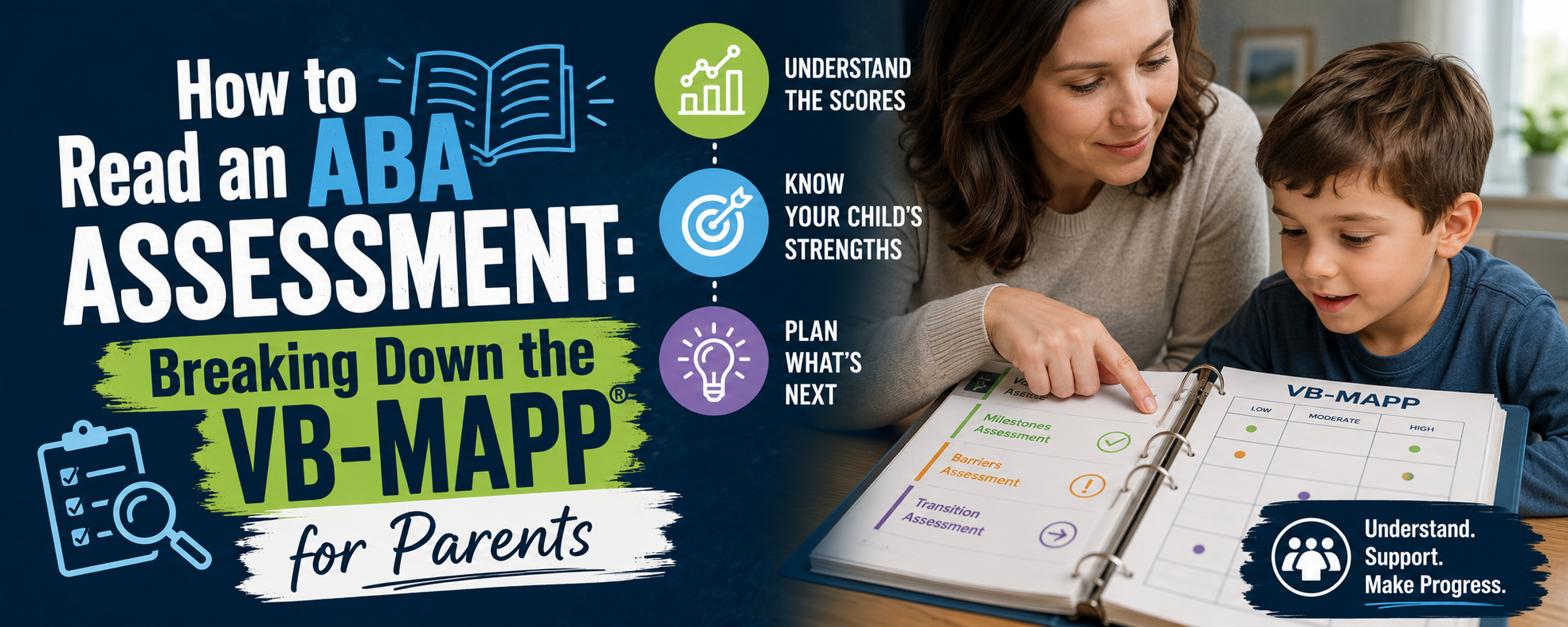
One of the first sections parents notice is the Milestones Assessment.
Think of milestones as building blocks rather than grades.
For example, the assessment looks at whether your child can:
- Request preferred items
- Follow simple directions
- Label familiar objects
- Engage in play
- Respond to questions
- Interact with peers
- Imitate actions
- Attend to learning activities
Each milestone provides valuable information about what your child can already do independently and what skills are ready to be taught next.
It is completely normal for children to show strengths in some areas while needing additional support in others.
What Are Verbal Operants?
This is often the section that confuses parents the most.
Verbal operants simply describe different ways people use language. Communication is much more than speaking words — it includes the purpose behind those words.
Here are some common examples.
Mand
A mand is a request.
If your child asks for juice, requests a favorite toy, or points to something they want while communicating, they are using a mand.
Teaching requests is often one of the earliest priorities because it helps reduce frustration and encourages functional communication.
Tact
A tact is labeling something.
For example, if your child sees a dog and says “dog,” they are labeling what they observe.
Building strong labeling skills helps children expand vocabulary and engage more naturally with others.
Listener Responding
This refers to following directions.
Examples include:
- Sit down.
- Bring your shoes.
- Touch your nose.
- Give me the ball.
Strong listener skills help children participate successfully at home, in school, and throughout the community.
Echoics
Echoics involve repeating sounds or words after another person.
Many speech and communication programs begin by strengthening imitation because it provides a foundation for developing spoken language.
Intraverbals
Intraverbals involve answering questions or participating in conversations.
Examples include:
- “What’s your name?”
- “What do you eat with a spoon?”
- “What color is the sky?”
These conversational skills become increasingly important as children grow older.
Don’t Focus Only on the Numbers
Parents sometimes compare milestone scores as though they were report card grades.
That isn’t the purpose of the assessment.
Instead, think of the results as a roadmap.
The numbers help your BCBA identify:
- Skills your child has already mastered
- Skills beginning to emerge
- Skills that should be taught next
- Areas that require additional practice
Even small improvements can represent meaningful developmental progress.
Families receiving behavioral therapy Park Cities often see reassessments every several months, allowing the clinical team to measure growth and update treatment goals as new skills develop.
Why Some Skills Are Stronger Than Others
Children with autism frequently develop uneven skill profiles.
For example, a child may:
- Know hundreds of vocabulary words
- Have difficulty requesting help
- Enjoy puzzles
- Struggle during social play
- Follow routines well
- Experience challenges with flexible thinking
These differences are completely expected.
The Barrier Assessment
Another important section of the VB-MAPP examines learning barriers.
These barriers are not permanent problems.
Instead, they identify factors that may interfere with learning, such as:
- Difficulty maintaining attention
- Limited motivation
- Challenges with transitions
- Prompt dependence
- Difficulty generalizing skills
- Problem behaviors that interrupt learning
Recognizing these barriers early allows therapists to create strategies that make learning more successful.
Whether your child attends a local ABA clinic Texas or receives therapy at home, addressing barriers often leads to faster and more meaningful progress.
How Goals Are Created
Many parents wonder why therapy goals look so specific.
Instead of writing a broad objective like “Improve communication,” ABA programs break large skills into smaller, measurable steps.
For example:
- Request three preferred items independently.
- Follow two-step directions.
- Label household objects.
- Answer simple “what” questions.
- Participate in cooperative play.
These goals come directly from the assessment results.
Because they are measurable, clinicians can objectively track whether progress is occurring.
How Often Is the VB-MAPP Updated?
ABA assessments are not one-time events.
Most children are reassessed periodically to determine:
- Which goals have been mastered
- Which skills are emerging
- Whether treatment priorities should change
- How much overall progress has occurred
Families participating in ABA Parent Training often review these updated assessments with their BCBA to better understand their child’s development and learn ways to support new skills at home.
The Parent’s Role
Parents are among the most important members of the treatment team.
No one knows your child better than you.
During assessment meetings, don’t hesitate to ask questions like:
- What does this score mean?
- Which skills should we practice at home?
- Which goals are highest priority?
- How will progress be measured?
- How often will goals change?
Strong communication between families and clinicians leads to more consistent learning across environments.
This is one reason parent training for autism is considered such an essential component of quality ABA services.
Why Assessments Look Different for Every Child
No two VB-MAPP reports are identical.
Every child has different strengths, interests, motivations, and learning histories.
One child may excel in communication while needing support with social interaction.
Another may have excellent academic readiness but require help with flexible play.
The assessment respects these individual differences by creating a treatment plan tailored specifically to the child’s needs rather than following a generic curriculum.
Whether services are delivered through Center-Based ABA or Home-Based ABA Therapy, individualized programming is what helps therapy remain meaningful and effective.
How Families Can Support Progress at Home
You don’t need to become an ABA expert to reinforce learning outside therapy.
Simple daily opportunities often make the biggest difference.
For example:
- Encourage your child to request favorite snacks before handing them over.
- Practice labeling objects during everyday routines.
- Read books together and ask simple questions.
- Celebrate communication attempts, even if they aren’t perfect.
- Follow your BCBA’s recommendations for practicing targeted skills.
Consistency between therapy sessions and home routines helps children apply new skills across multiple environments.
Looking Beyond the Assessment
The VB-MAPP is only the starting point.
It provides a snapshot of where your child is today — not a prediction of where they will be in the future.
Children grow, develop, and acquire new skills every day when provided with individualized instruction, supportive families, and evidence-based interventions.
The assessment serves as a guide that helps clinicians make informed decisions while giving families a clearer understanding of their child’s unique learning journey.
If your family is exploring ABA providers 75205 or looking for pediatric behavioral health Highland Park, understanding how assessments work can make the process feel much less intimidating. Rather than focusing on unfamiliar terminology, you’ll be able to see the bigger picture — a personalized roadmap designed to help your child build meaningful communication, social, and daily living skills over time.
Frequently Asked Questions
Is the VB-MAPP a pass-or-fail test?
No. It measures current developmental skills and helps identify appropriate treatment goals. Every child has a unique profile of strengths and learning opportunities.
Will my child take the assessment more than once?
Yes. Most ABA programs complete reassessments periodically to monitor progress and update goals as your child develops new skills.
Can parents attend assessment reviews?
Absolutely. Families are encouraged to participate, ask questions, and understand how treatment recommendations are developed.
Does every child receive the same treatment plan?
No. The assessment is designed to create individualized goals based on your child’s strengths, challenges, and developmental needs.
Why is parent involvement important?
Children often make the greatest progress when therapy strategies are reinforced consistently at home. Active participation through ABA Parent Training helps families support learning in everyday situations while working closely with the clinical team.
Contact us at 972–310–4991 or visit https://radiantspectrumtherapy.com/ to learn more.