
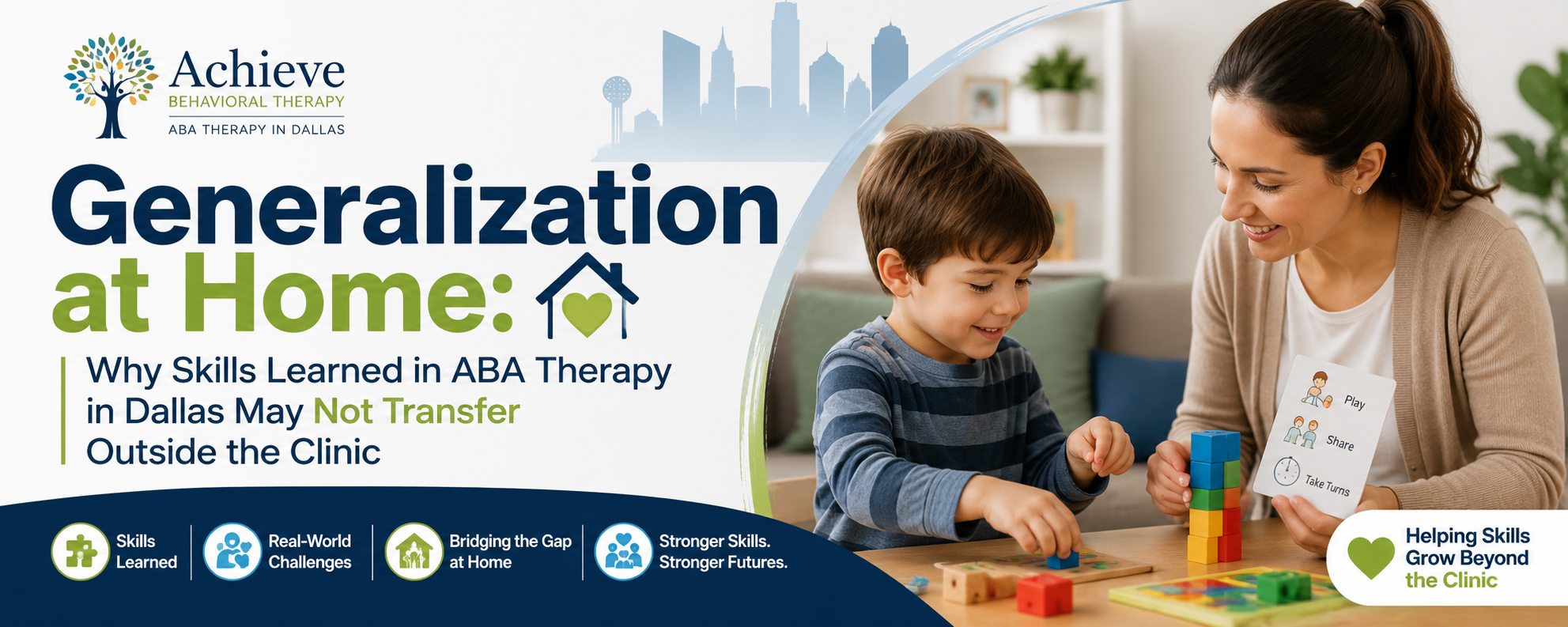
Parents often tell us the same thing after a few months of therapy:
“My child can do it perfectly at the clinic, but they won’t do it at home.”
This situation can feel frustrating and confusing. If your child is making progress during sessions but those skills are not showing up at home, school, the grocery store, or family gatherings, it does not necessarily mean therapy isn’t working.
In fact, this challenge is common in ABA Therapy in Dallas and is a major focus of modern treatment planning. The goal of effective ABA is not simply teaching a skill in one location — it is helping children use that skill across different environments, with different people, and in real-life situations.
At Radiant Spectrum Therapy, we help families understand how skill transfer, or “generalization,” works and what parents can do to support success outside of therapy sessions. Whether your child receives center-based ABA therapy Dallas services or in-home ABA therapy Dallas, understanding generalization can dramatically improve long-term outcomes.
What Is Generalization in ABA Therapy?
Generalization occurs when a child uses a learned skill in places, situations, or with people different from where the skill was originally taught.
For example:
- A child requests water during therapy sessions.
- They also request water at home.
- They ask for water at school.
- They communicate the need while visiting grandparents.
That is successful generalization.
Without generalization, skills can become tied to a specific setting. A child may answer questions perfectly with their therapist but struggle to do the same with parents, teachers, or peers.
One of the primary goals of Applied Behavior Analysis Dallas programs is helping children use meaningful skills throughout daily life rather than only during structured sessions.
Why Skills Sometimes Stay “Stuck” in the Therapy Setting
Many parents assume that once a child learns a skill, it should automatically appear everywhere.
Unfortunately, learning doesn’t always work that way.
Children with autism often learn behaviors under very specific conditions. They may associate a skill with:
- One room
- One therapist
- Specific materials
- Particular instructions
- A certain schedule
When any of those factors change, the child may not recognize that the same skill applies.
This concept is known as stimulus control.
Understanding Stimulus Control
Stimulus control simply means that a behavior occurs because of certain environmental cues.
For example:
A child learns to identify colors using flashcards with their therapist.
When shown the same colors in a book or on clothing, they may not respond correctly.
Why?
Because the skill became associated with the flashcards rather than the broader concept of color identification.
This is not a failure. It is a normal part of learning that requires additional teaching strategies.
Experienced providers offering ABA therapy services Dallas understand that building flexibility is just as important as teaching the initial skill.
Signs That Generalization May Be a Challenge
Parents may notice that their child:
- Uses words during therapy but not at home
- Follows instructions with therapists but not family members
- Demonstrates social skills only in structured settings
- Shows independence at the clinic but depends heavily on parents elsewhere
- Uses coping strategies during sessions but not during community outings
If any of these situations sound familiar, generalization may be the missing piece.
Fortunately, there are proven ABA strategies that help bridge this gap.
Multiple Exemplar Training: Teaching Skills in Many Ways
One of the most effective approaches used in ABA therapy for autism Dallas programs is called Multiple Exemplar Training.
Rather than teaching a skill in only one way, therapists intentionally vary the learning experience.
Example: Teaching Greetings
Instead of practicing “hello” only with one therapist, a child may practice with:
- Different therapists
- Parents
- Siblings
- Peers
- Teachers
The greeting may occur:
- At the clinic
- At home
- At school
- At the park
- During community outings
The child learns that greeting others is a flexible skill that works across many situations.
Example: Teaching Requests
A therapist may teach requesting:
- Snacks
- Toys
- Activities
- Help
- Attention
Across different settings and with different communication partners.
This variety helps prevent rigid learning patterns and supports stronger generalization.
Many ABA clinics in Dallas use this approach because it creates more durable and meaningful outcomes.
Why Parents Play a Critical Role
Therapists may see a child for several hours each week.
Parents see their child every day.
Because of this, families are essential partners in helping skills transfer beyond therapy.
The good news is that parents do not need to become therapists.
Simple, natural interactions can provide powerful learning opportunities.
When families participate in parent training and collaborate with their BCBA, skills often generalize more quickly.
This is one reason why BCBA services Dallas frequently include parent coaching and caregiver support.
How to Encourage Generalization at Home
1. Practice Skills in Everyday Routines
Real life provides countless opportunities for learning.
Instead of creating formal lessons, look for naturally occurring situations.
Examples include:
- Asking for a snack during lunch
- Requesting help while getting dressed
- Following directions during cleanup
- Taking turns during family games
- Greeting visitors at the door
These moments help children connect therapy skills to daily life.
Families receiving autism therapy Dallas TX services often find that embedding learning into routines feels more natural and sustainable.
2. Use the Same Language as the Therapy Team
Consistency matters.
If therapists are teaching a specific phrase or instruction, using similar wording at home can help reduce confusion.
For example:
Instead of alternating between:
- “Tell me what you want.”
- “Use your words.”
- “What do you need?”
You may temporarily use the same prompt the therapy team is using.
This consistency strengthens learning while still allowing flexibility over time.
3. Practice With Different People
Children should learn that skills apply with more than one person.
Encourage practice with:
- Parents
- Siblings
- Grandparents
- Family friends
- Teachers
This expands opportunities for success and reduces dependence on a single adult.
Many behavior therapy Dallas programs intentionally include caregiver participation for this reason.
4. Change the Environment
If a skill only occurs at a therapy table, it may become tied to that location.
- Kitchen
- Living room
- Backyard
- Playground
- Grocery store
- Community events
The more environments involved, the stronger generalization becomes.
This is one advantage of combining center-based ABA therapy Dallas services with in-home ABA therapy Dallas support when appropriate.
Natural Reinforcement: The Secret to Lasting Skills
One of the most important factors in generalization is reinforcement.
Children are more likely to continue using a skill when it naturally benefits them.
Example of Natural Reinforcement
A child asks for a favorite snack.
The natural reinforcement is receiving the snack.
No additional reward is needed.
Compare that to:
A child asks for a snack and receives a sticker.
While stickers can be useful during teaching, natural outcomes are often more effective for long-term maintenance.
The best ABA therapy in Dallas TX programs focus on helping children contact meaningful real-world rewards whenever possible.
Avoid the “Testing Trap”
Many well-intentioned parents accidentally create unnecessary pressure.
For example:
“What’s this color?”
“What’s this animal?”
“Say hello.”
“Tell me what shape that is.”
When children feel constantly tested, motivation may decrease.
Instead, create opportunities for natural use.
For example:
- Ask a child to help find the blue cup.
- Comment on animals during a story.
- Encourage greetings during actual social interactions.
Natural practice often produces better results than repeated quizzing.
When Progress Seems Slow
Generalization takes time.
Sometimes a child learns a skill quickly in therapy but requires weeks or months before using it consistently elsewhere.
Factors that can influence generalization include:
- Communication abilities
- Attention skills
- Cognitive flexibility
- Motivation
- Environmental differences
- Anxiety levels
This is why early intervention ABA Dallas programs emphasize teaching skills across multiple settings from the beginning.
Patience and consistency are critical.
How Parent Training Supports Generalization
Parent training is one of the most valuable components of quality ABA services.
Through coaching sessions, parents learn:
- How skills are being taught
- Which prompts to use
- When to reinforce behavior
- How to create practice opportunities
- Ways to reduce prompt dependency
Strong parent involvement often leads to faster and more sustainable outcomes.
Families searching for the best ABA therapy providers Dallas should ask about caregiver training and collaboration opportunities.
Generalization in Social Skills
Social skills are particularly vulnerable to generalization challenges.
A child may:
- Participate in structured social groups
- Answer social questions correctly
- Practice conversation scripts
Yet struggle during spontaneous peer interactions.
To support social generalization, therapists may:
- Use peer groups
- Conduct community outings
- Practice in multiple settings
- Vary communication partners
These strategies help children develop flexible social abilities rather than memorized responses.
This is a major focus of many pediatric ABA therapy Dallas and ABA therapy for kids Dallas programs.
Generalization for Toddlers
Young children often learn best through play and daily routines.
For families seeking ABA therapy for toddlers Dallas, generalization strategies may include:
- Practicing communication during meals
- Encouraging requests during playtime
- Teaching transitions throughout the day
- Building imitation skills with multiple caregivers
When skills are taught naturally and consistently, toddlers often show stronger carryover into everyday life.
Questions to Ask Your Child’s BCBA
If skills are not transferring outside therapy, consider asking:
- How is generalization currently being programmed?
- Are multiple people involved in teaching the skill?
- Can we practice the skill at home?
- What reinforcement should we use?
- Are there community-based opportunities available?
- How can family members support progress?
These conversations help create a team approach to learning.
Finding ABA Support in Dallas and Highland Park
Families seeking ABA therapy near Dallas, ABA therapy near me Dallas, or specialized Dallas autism services should look for providers that prioritize generalization from the start.
Effective treatment should include:
- Individualized programming
- Parent training
- Ongoing BCBA supervision
- Real-world skill application
- Collaboration across environments
Whether a child participates in private ABA therapy Dallas, intensive ABA programs Dallas, or receives broader autism support services Dallas, the ultimate goal remains the same: helping skills become part of everyday life.
Conclusion
One of the most common frustrations families experience is seeing progress in therapy but not at home. Fortunately, this does not mean your child is failing to learn. More often, it means additional work is needed to support generalization.
High-quality ABA Therapy in Dallas focuses not only on teaching skills but also on helping children use those skills across settings, people, and situations. Through strategies like stimulus control assessment, multiple exemplar training, parent coaching, and natural reinforcement, children can learn to apply meaningful skills wherever life takes them.
At Radiant Spectrum Therapy, we believe that successful treatment extends beyond the therapy room. Whether your family is exploring ABA therapy Dallas, behavioral intervention Dallas TX, developmental therapy Dallas, or special needs therapy Dallas, our goal is to help children build skills that truly transfer to home, school, community settings, and everyday life.
Frequently Asked Questions
What is generalization in ABA therapy?
Generalization is the ability to use a learned skill across different environments, people, and situations. It is a core goal of effective ABA therapy services Dallas programs.
Why does my child perform skills at therapy but not at home?
This often occurs because the skill has become associated with specific people or settings. Therapists use generalization strategies to help skills transfer into everyday life.
Can parents help with generalization?
Yes. Parents play a major role by practicing skills during routines, using natural reinforcement, and collaborating with their BCBA.
Is in-home ABA better for generalization?
In-home ABA therapy Dallas can provide valuable opportunities to teach skills in a child’s natural environment. However, both home-based and clinic-based services can support successful generalization when programmed appropriately.
How long does generalization take?
Every child is different. Some skills transfer quickly, while others require ongoing practice across multiple settings and people. Consistency and collaboration are key to long-term success.
Contact us at 972–310–4991 or visit https://radiantspectrumtherapy.com/ to learn more.