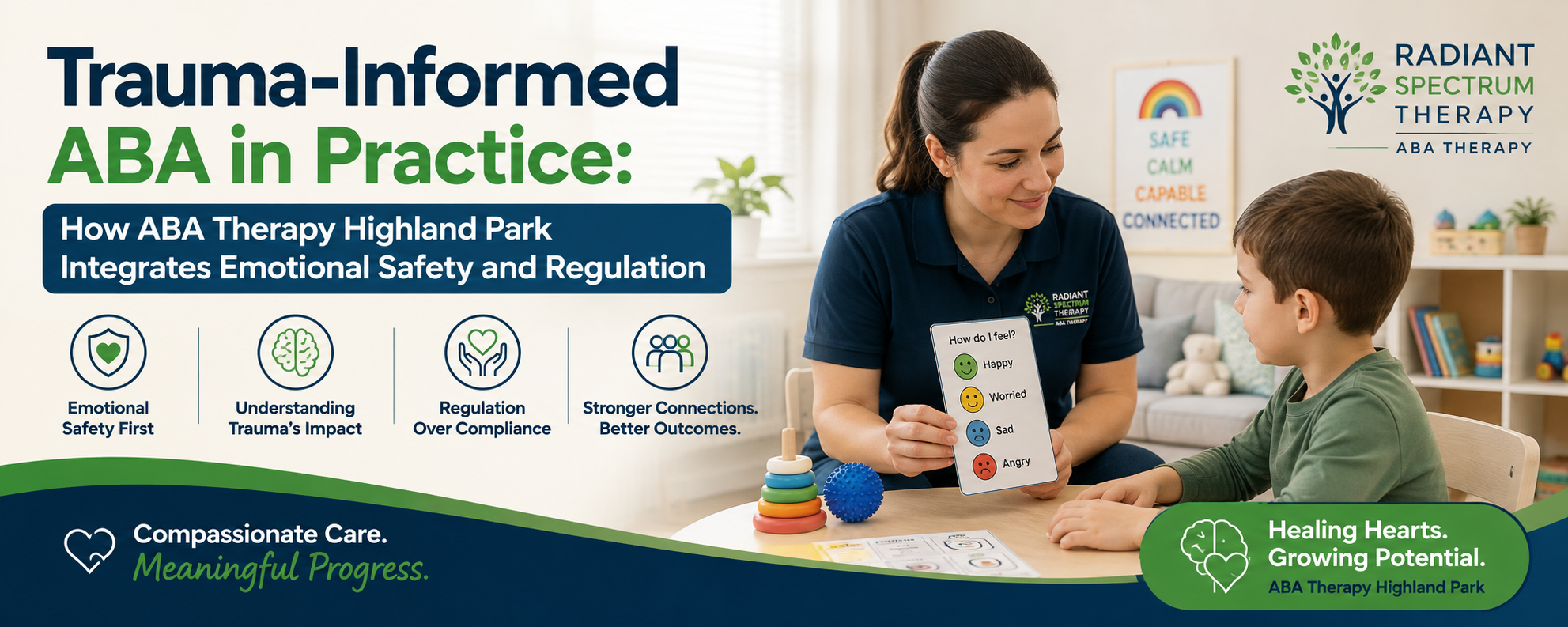
When parents begin researching ABA therapy Highland Park, one of the most important questions they may have is whether therapy looks beyond behavior and considers a child’s emotional well-being. Effective ABA should not simply focus on stopping behaviors. It should help children develop communication, independence, coping skills, and meaningful ways to participate in everyday life.
A trauma-informed approach recognizes that behavior can be influenced by anxiety, sensory differences, communication difficulties, changes in routine, and overwhelming environments. Instead of asking only how to reduce a behavior, behavior analysts can ask what the child may be communicating and what changes could make the situation safer and more manageable.
For families exploring Autism Treatment Highland Park, this distinction matters. A compassionate ABA program can combine behavioral science with emotional safety, individualized support, and family collaboration. This approach can help children feel understood while still working toward meaningful developmental goals.
What Is Trauma-Informed ABA?
Trauma-informed ABA combines the principles of Applied Behavior Analysis with an awareness of how stress and emotional experiences can affect learning and behavior.
The goal is not to assume that every child has experienced trauma. Instead, clinicians consider whether anxiety, fear, sensory overload, or previous difficult experiences may be influencing the child’s responses.
In Applied Behavior Analysis Highland Park, a trauma-informed approach may include:
- Building trust before introducing challenging tasks.
- Following the child’s interests to establish rapport.
- Teaching functional communication.
- Providing appropriate choices.
- Offering breaks when needed.
- Identifying environmental triggers.
- Teaching emotional regulation skills.
- Involving parents in treatment decisions.
- Adjusting strategies when an intervention causes unnecessary distress.
The result is a treatment environment designed around the individual child rather than a one-size-fits-all behavior plan.
Why Anxiety Can Affect Behavior
A child who is anxious may not always be able to explain what is wrong. For children with limited verbal communication, behavior may become one of the primary ways they express discomfort.
For example, a child might:
- Cry when a preferred activity ends.
- Run away from an overwhelming environment.
- Refuse an unfamiliar activity.
- Cover their ears when a room becomes noisy.
- Become upset when a routine suddenly changes.
- Avoid social situations that feel unpredictable.
These responses do not automatically mean that a child is being defiant.
In autism behavior therapy Highland Park, understanding the circumstances surrounding a behavior can help clinicians determine what support the child actually needs.
Common Sources of Stress
Children receiving ABA therapy for autism Highland Park may experience stress from:
- Unexpected transitions
- Sensory stimulation
- Difficult communication
- Unfamiliar people
- New environments
- School expectations
- Medical appointments
- Changes in routine
- Difficult social interactions
Identifying these factors can make behavior plans more preventative and supportive.
Emotional Safety Comes Before Meaningful Learning
Learning becomes difficult when a child is overwhelmed.
A child who is anxious or overstimulated may have difficulty attending to instructions, communicating, playing, or participating in a new activity. That is why behavior therapy Highland Park can incorporate regulation strategies before asking a child to complete more challenging tasks.
A therapist may begin a session by:
- Playing with a preferred toy.
- Allowing the child time to settle.
- Offering choices.
- Reviewing a visual schedule.
- Providing movement or sensory breaks.
- Using familiar activities to establish rapport.
These strategies are not a substitute for skill development. They create the conditions that can make skill development more successful.
Building Trust Between the Therapist and Child
Trust is one of the foundations of effective therapy.
Before expecting a child to participate in difficult activities, therapists can spend time learning what the child enjoys and what makes them comfortable.
Pairing in ABA
Pairing involves creating positive associations between the therapist, therapy environment, and enjoyable experiences.
A therapist may:
- Follow the child’s interests.
- Play alongside the child.
- Offer preferred activities.
- Use positive reinforcement.
- Provide choices.
- Avoid unnecessary demands during initial rapport building.
For families searching for the best ABA therapy providers Highland Park, the quality of the therapist-child relationship is an important consideration.
A child who trusts their therapist may be more willing to communicate, explore new activities, and practice difficult skills.
Respecting Assent During Therapy
Modern ABA conversations increasingly emphasize assent.
Assent involves paying attention to a child’s signals about whether they are comfortable participating in an activity. This is especially important for children who communicate primarily through body language or behavior.
Therapists may notice signs of engagement such as:
- Approaching an activity.
- Smiling.
- Participating voluntarily.
- Looking relaxed.
- Initiating interaction.
They may also recognize signs that a child needs a pause:
- Moving away.
- Turning away.
- Covering their ears.
- Becoming increasingly agitated.
- Attempting to escape.
- Becoming unusually quiet or withdrawn.
Respecting these signals can help create a more trusting therapeutic relationship while supporting ethical BCBA services Highland Park.
Teaching Emotional Regulation as a Skill
Emotional regulation is not simply something children either have or do not have. Many children need direct instruction and repeated practice.
In developmental therapy Highland Park, regulation goals may be incorporated into an individualized treatment plan.
Children may learn to:
- Identify basic emotions.
- Recognize signs of frustration.
- Ask for help.
- Request a break.
- Use calming strategies.
- Wait for preferred activities.
- Cope with changes.
- Communicate discomfort.
- Return to an activity after regulating.
The goal is not to eliminate emotions. The goal is to give children safer and more effective ways to manage and communicate them.
Practical Regulation Strategies Used in ABA
Every child has different needs, so regulation strategies should be individualized.
Sensory Supports
Depending on the child’s preferences and needs, therapists may incorporate:
- Noise-reducing headphones
- Fidget items
- Movement breaks
- Quiet spaces
- Dimmer lighting
- Preferred sensory activities
Visual Supports
Predictability can reduce anxiety.
Visual tools may include:
- Visual schedules
- First-Then boards
- Timers
- Transition warnings
- Picture-based communication
- Choice boards
These supports can be particularly useful in early intervention ABA Highland Park, when young children are developing communication and coping skills.
Co-Regulation
Children sometimes need an adult to help them regulate before they can independently use coping strategies.
Co-regulation can involve:
- Maintaining a calm voice.
- Slowing down the interaction.
- Giving the child additional processing time.
- Offering reassurance.
- Reducing environmental stimulation.
- Modeling calm behavior.
With practice, children can gradually develop more independent regulation skills.
Functional Communication Can Reduce Frustration
Communication is a major part of trauma-informed ABA.
When a child does not have an effective way to say “help,” “stop,” “break,” or “I don’t want that,” behavior may become the communication method.
Functional Communication Training can teach children alternative ways to express those needs.
A child may learn to request:
- A break
- Help
- More time
- A preferred item
- A different activity
- Attention
- Space
For children receiving ABA therapy for kids Highland Park, communication goals can support independence while reducing frustration.
Supporting Toddlers Through Early Intervention
Young children often benefit from learning through play and everyday routines.
In ABA therapy for toddlers Highland Park, therapists may incorporate goals into activities that naturally interest the child.
Sessions may focus on:
- Joint attention
- Imitation
- Early communication
- Functional play
- Social engagement
- Following simple routines
- Requesting preferred items
- Transitioning between activities
Play-based teaching can make learning feel more natural while allowing therapists to work on important developmental skills.
Trauma-Informed ABA in a Center-Based Setting
Families considering center-based ABA therapy Highland Park may wonder whether structured therapy can still be emotionally supportive.
It can.
A well-designed center can provide predictable routines while also offering opportunities for individualized regulation.
A center may include:
- Quiet spaces
- Organized learning areas
- Sensory supports
- Visual schedules
- Individualized activities
- Break areas
Structure does not have to mean rigidity. Therapists can maintain predictable routines while adjusting expectations when a child becomes overwhelmed.
Trauma-Informed ABA at Home
For some families, in-home ABA therapy Highland Park provides an opportunity to work on skills within the child’s everyday environment.
Home-based therapy can address situations such as:
- Morning routines
- Mealtimes
- Getting dressed
- Bedtime
- Playing with siblings
- Cleaning up
- Preparing to leave the house
- Community outings
Because these routines happen every day, parents can practice strategies between therapy sessions.
Parents Are an Important Part of the Treatment Team
Trauma-informed ABA should include family collaboration.
Parents know their children in ways that therapists cannot immediately understand. They can provide valuable information about:
- Triggers
- Preferences
- Communication
- Routines
- Previous experiences
- Successful calming strategies
- Family priorities
Parent training may cover:
- Supporting transitions.
- Encouraging communication.
- Teaching coping skills.
- Reinforcing appropriate requests.
- Creating predictable routines.
- Responding to challenging behavior.
This collaboration can make ABA therapy services Highland Park more consistent across home, school, and community environments.
How Behavior Analysts Assess the Bigger Picture
A behavior analyst should look beyond the behavior itself.
A comprehensive assessment may consider:
- What happens before the behavior.
- What happens after the behavior.
- Communication skills.
- Sensory factors.
- Motivation.
- Daily routines.
- Family priorities.
- Environmental conditions.
- Existing coping skills.
This information can help guide a personalized behavioral intervention Highland Park TX plan.
The objective is not simply to make behavior disappear. It is to determine why it occurs and teach skills that provide the child with more effective alternatives.
What Makes a High-Quality ABA Program?
Families comparing ABA clinics in Highland Park should consider more than the number of therapy hours offered.
Important questions include:
Is Treatment Individualized?
Children should have goals based on their specific needs, strengths, communication abilities, and family priorities.
Is There BCBA Oversight?
Qualified clinical supervision is important for developing, monitoring, and adjusting treatment plans.
Are Parents Included?
Families should have opportunities to participate in treatment planning and learn strategies they can use outside therapy.
Does the Program Prioritize Emotional Safety?
Ask how the provider responds when a child becomes anxious, overwhelmed, or unwilling to participate.
Does the Provider Measure Progress?
Data can help clinicians determine whether interventions are working and when treatment needs to change.
These factors can help families identify top-rated ABA therapists Highland Park and programs that are genuinely focused on individualized care.
Common Misconceptions About Modern ABA
Myth: ABA Only Focuses on Stopping Behaviors
Effective ABA can address communication, independence, social skills, daily living, play, and emotional regulation.
Myth: ABA Ignores Anxiety
A trauma-informed approach specifically considers anxiety and environmental factors that may influence behavior.
Myth: Every Child Receives the Same Program
Quality private ABA therapy Highland Park should be individualized rather than based on a universal template.
Myth: Emotional Regulation Is Separate From ABA
Regulation can be taught through systematic behavioral strategies, functional communication, reinforcement, environmental modifications, and practice.
Choosing an ABA Provider in Highland Park
Parents looking to find ABA therapist Highland Park should feel comfortable asking detailed questions before selecting a provider.
Consider asking:
- How do you build rapport with a new child?
- How do you respond when a child becomes overwhelmed?
- How do you teach children to request breaks?
- How are parents involved?
- How frequently does the BCBA review treatment?
- What communication methods do you support?
- How are treatment goals selected?
- How do you measure progress?
Families searching for ABA therapy near Highland Park or ABA therapy in Highland Park TX can use these questions to compare providers more thoughtfully.
For families researching Highland Park autism services, the right program should be one that balances clinical expertise with compassion and respect.
Understanding ABA Therapy Costs
Families frequently research ABA therapy cost Highland Park before beginning services.
The cost of ABA can vary based on:
- Insurance coverage
- Number of therapy hours
- Type of services
- Assessment requirements
- BCBA supervision
- In-home or center-based treatment
Families should ask providers about insurance verification, authorization requirements, available services, and expected out-of-pocket costs.
For families searching for affordable ABA therapy Highland Park TX, comparing coverage and treatment options can help identify a program that fits both clinical needs and financial circumstances.
How ABA Therapy Works in a Trauma-Informed Model
Parents often search how ABA therapy works Highland Park because they want to understand what therapy will actually look like.
A trauma-informed ABA program may follow a process such as:
- Initial assessment.
- Identification of strengths and needs.
- Development of individualized goals.
- Rapport and trust building.
- Communication and skill development.
- Emotional regulation teaching.
- Parent coaching.
- Ongoing data collection.
- Regular review and adjustment of treatment.
For children participating in intensive ABA programs Highland Park, emotional safety should remain part of treatment throughout the process.
More therapy hours should never mean that a child’s individual needs are overlooked.
The Future of Compassionate Autism Care in Dallas
Families in Dallas and Highland Park are looking for autism services that provide meaningful support while respecting each child’s individuality.
Trauma-informed ABA does not mean abandoning behavioral science. Instead, it means applying behavioral principles thoughtfully while considering emotional safety, communication, sensory needs, and the child’s overall experience.
Whether a child receives center-based ABA therapy Highland Park, in-home ABA therapy Highland Park, pediatric ABA therapy Highland Park, or another form of special needs therapy Highland Park, treatment should be designed around meaningful outcomes.
The goal is not simply to change what a child does. It is to help the child communicate more effectively, develop independence, manage difficult situations, participate in daily routines, and build skills that improve quality of life.
For families exploring autism therapy Highland Park TX, compassionate and individualized treatment can provide a stronger foundation for learning.
Frequently Asked Questions
What is trauma-informed ABA?
Trauma-informed ABA combines evidence-based behavioral strategies with an awareness of how stress, anxiety, sensory experiences, and emotional factors can influence learning and behavior.
Does ABA therapy address anxiety?
ABA can teach children functional communication, coping strategies, emotional regulation, and skills for navigating situations that may otherwise cause frustration or anxiety.
Is trauma-informed ABA appropriate for toddlers?
Yes. early intervention ABA Highland Park can incorporate play, communication, predictable routines, parent coaching, and regulation strategies for young children.
Is in-home ABA better than center-based ABA?
Neither setting is automatically better for every child. in-home ABA therapy Highland Park can be useful for practicing skills in daily routines, while center-based ABA therapy Highland Park may provide a structured environment with specialized resources.
How do I find an ABA therapist near Highland Park?
When searching for ABA therapy near me Highland Park, consider the provider’s clinical qualifications, BCBA supervision, treatment philosophy, parent involvement, service setting, and approach to emotional regulation.
What should parents look for in ABA therapy?
Families should look for individualized treatment, qualified clinical oversight, meaningful goals, functional communication training, parent involvement, data-based decision-making, and respect for the child’s emotional and behavioral needs.
Conclusion
Trauma-informed ABA recognizes an important reality: children cannot always learn effectively when they feel overwhelmed, anxious, or unsafe.
By combining behavioral science with emotional regulation, functional communication, environmental support, and strong therapeutic relationships, ABA can become more individualized and responsive to each child’s needs.
For families searching for best ABA therapy in Highland Park, autism support services Highland Park, or behavioral intervention Highland Park TX, understanding a provider’s approach to emotional safety is an important part of choosing the right care.
At Radiant Spectrum Therapy, compassionate, individualized support can help children build meaningful skills while families remain an active part of the treatment process.
Contact us at 972–310–4991 or visit https://radiantspectrumtherapy.com/ to learn more.