
Conversation is more than exchanging words. It involves listening, sharing interests, noticing another person’s responses, and finding ways to keep an interaction going. For some children, especially those who benefit from additional communication support, moving from one topic to another can be challenging. Autism Treatment Highland Park families explore may include support for conversational flexibility, helping children learn how to share their interests while recognizing opportunities for others to participate.
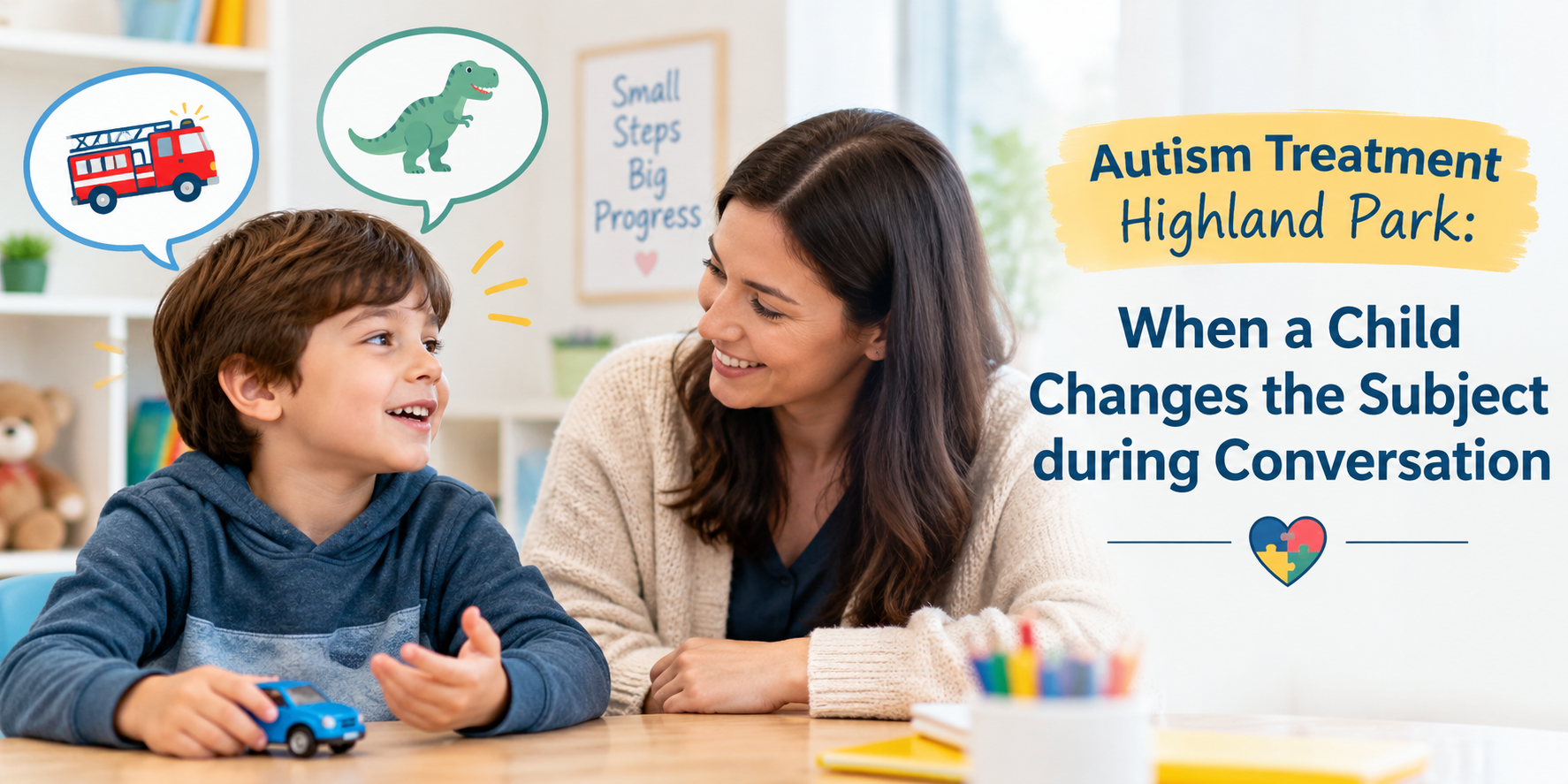
A child might enthusiastically talk about dinosaurs, favorite video games, or a beloved cartoon without noticing that the other person is trying to ask a question. Another child may abruptly introduce a new subject because they have difficulty connecting their thoughts to the current conversation. Some children may also change topics when they feel uncertain, overwhelmed, or unsure how to respond.
These moments do not necessarily mean a child is ignoring someone or refusing to communicate. Conversation involves several skills working together, and each child may need different kinds of support to develop them.
Through individualized strategies, everyday practice, and positive reinforcement, children can learn to navigate conversations more comfortably. At Radiant Spectrum Therapy, the goal is to support meaningful communication, respect individual differences, and help children participate in interactions without feeling pressured to communicate in only one way.
Understanding Why Children Change the Subject
Changing subjects is a normal part of conversation. People frequently introduce new ideas, remember something important, or connect one topic to another. The challenge arises when a child consistently finds it difficult to recognize shared conversational expectations or understand how another person can contribute.
For children who benefit from autism-related communication support, several factors may influence these interactions.
A Strong Interest in a Favorite Topic
Many children develop deep interests in particular subjects. These interests can provide enjoyment, comfort, motivation, and opportunities to learn. A child who loves trains, for example, may know extensive details about train models, routes, and railway systems.
When the child has an opportunity to discuss that interest, communication may become easier and more engaging. However, recognizing that another person has different interests or wants to introduce a new subject may require additional practice.
An individualized approach to ABA therapy Highland Park families consider can incorporate these preferred interests into communication activities. Rather than asking a child to stop talking about something they love, a therapist can help the child practice inviting another person into the discussion and responding to that person’s ideas.
Difficulty Recognizing Conversational Signals
Conversations include many signals that are not always expressed through words. Someone might pause, ask a question, introduce a related idea, or say, “Can I tell you something?”
Children may need help identifying these signals and understanding what they mean in context.
For example, a child may continue describing a favorite character while a sibling repeatedly attempts to share a story. Teaching conversational awareness can involve practicing how to notice a question, respond to a comment, and recognize when another person would like a turn.
These skills should be taught flexibly. Eye contact, facial expressions, and body language vary between individuals, and children should not be required to demonstrate a particular behavior to prove they are listening. The emphasis should be on understanding and responding to communication in ways that work for the child and the people around them.
Finding the Right Words to Continue
Sometimes, changing the subject happens because a child does not know what to say next. A question may feel confusing, a response may be difficult to formulate, or the current topic may require language the child has not yet learned.
In these situations, the child may move toward a familiar subject because it feels easier to discuss.
Communication support can introduce useful phrases, such as:
- “Can you explain that?”
- “I have a question.”
- “That reminds me of something.”
- “What happened next?”
- “Can we talk about something else?”
These phrases give children practical tools for navigating different conversational situations while preserving their ability to express preferences and needs.
Why Conversational Flexibility Matters
Conversational flexibility means being able to participate in an interaction as it develops. It does not mean always agreeing with someone, abandoning personal interests, or following rigid social rules.
Instead, it involves learning different ways to share ideas, respond to others, ask questions, and communicate when a topic becomes uncomfortable or uninteresting.
Building Reciprocal Communication
Reciprocal communication involves exchanging information rather than relying on one person to speak throughout an interaction.
For example, two children might discuss a playground visit. One child shares what happened on the slide, the other describes playing on the swings, and both ask questions or add relevant comments.
An individualized ABA therapy services Highland Park program may include activities that help children practice these exchanges in natural settings. The objective is not to make every conversation follow a strict pattern. It is to help children discover that communication can include their ideas and someone else’s ideas.
Strengthening Relationships
Shared conversations can help children connect with family members, classmates, teachers, and friends. When children have tools to express their interests and respond to others, they may find more opportunities to participate in activities they enjoy.
Caregivers can support this process by showing genuine curiosity about a child’s interests while gently creating space for additional perspectives.
For instance, a parent might say, “You told me about your favorite dinosaur. I want to tell you about something I saw today, too.” This communicates that both people have something worthwhile to contribute.
Supporting Independence and Self-Advocacy
Children should also learn that they can express when they want to change a topic. Flexibility includes being able to communicate personal boundaries, ask for a break, or explain that they would prefer to discuss something else.
Useful phrases might include “I’m finished talking about that,” “Can we switch topics?” or “I need a break.”
These skills can be particularly helpful when children feel overwhelmed or struggle to explain why an interaction has become difficult.
Practical Strategies for Teaching Conversational Flexibility
Children learn communication skills in different ways. Some benefit from visual supports, while others respond well to modeling, familiar routines, or opportunities to practice during play.
A supportive approach should reflect each child’s communication abilities, interests, sensory needs, and preferences.
1. Begin With the Child’s Preferred Interests
Preferred interests can serve as a bridge to new conversational experiences.
If a child enjoys animals, a caregiver might begin by discussing a favorite animal and then introduce a related question: “You told me that lions live in groups. Do you know which other animals live together?”
The conversation can gradually expand to related subjects without abruptly dismissing the child’s original interest.
A therapist providing Applied Behavior Analysis Highland Park services may use preferred activities to create motivating opportunities for communication practice. The child can learn to answer questions, ask follow-up questions, and respond to another person’s comments.
It is important to avoid turning every favorite activity into a lesson. Children also need opportunities to enjoy their interests without being constantly prompted to perform communication skills.
2. Use Visual Cues to Make Turns Easier to Understand
Visual supports can make the structure of a conversation more concrete.
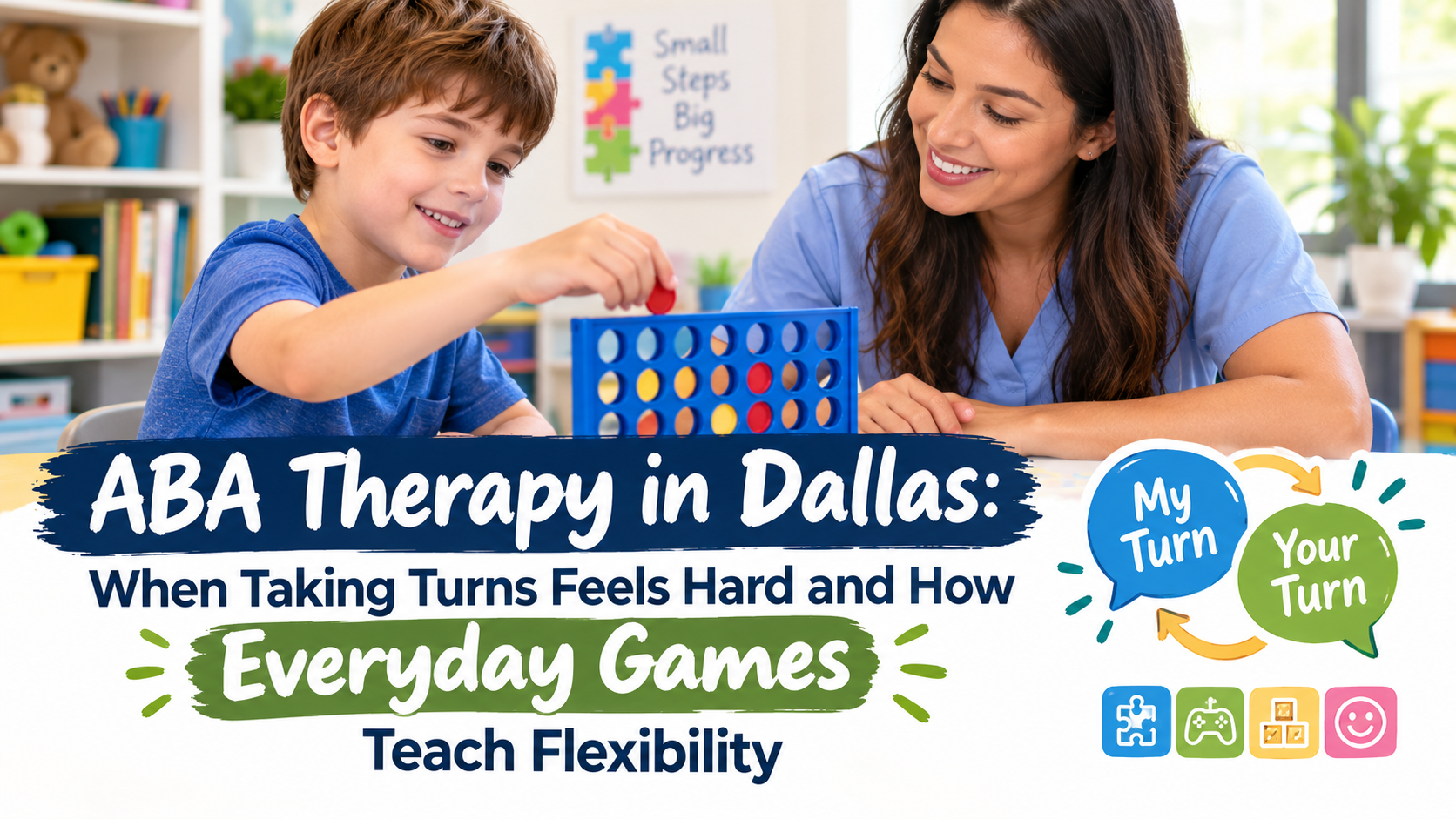
A simple card showing two speech bubbles, for example, can represent taking turns. One color might represent the child’s turn, while another represents the communication partner’s turn.
Other visual supports may include:
- Conversation maps showing how one topic connects to another.
- Picture cards with examples of questions and responses.
- A small reminder card with phrases such as “ask,” “answer,” and “add an idea.”
- A visual choice board that allows a child to select a preferred topic.
These tools should make communication easier rather than create unnecessary rules. Some children may benefit from pictures, while others may prefer written words or spoken reminders.
3. Model the Conversation Instead of Only Correcting It
Children often benefit from hearing examples of how a conversation can develop.
A caregiver might model the following exchange:
Child: “I love space rockets.”
Adult: “You really like rockets! What is your favorite part?”
Child: “They go into space.”
Adult: “That’s exciting. I like learning about the planets. Which planet would you want to visit?”
The adult acknowledges the child’s interest, contributes a related idea, and creates an opportunity for the child to respond.
Modeling should feel natural and collaborative. Instead of repeatedly saying, “Stay on topic,” adults can demonstrate what a connected response sounds like and allow the child time to process it.
4. Practice With Short, Predictable Activities
Long conversations can require sustained attention, language processing, and flexible thinking. Short activities may be more manageable, especially when a child is learning a new skill.
Try a brief activity in which each person contributes one idea about a shared subject. A conversation about pets might include favorite animals, feeding routines, or funny experiences with pets.
Another option is a simple question-and-comment game. Each participant can ask a question, answer one, or add a related thought.
For children who benefit from early intervention ABA Highland Park, developmentally appropriate activities may offer opportunities to practice emerging communication skills in familiar, engaging contexts.
Practice should be adjusted to the child’s needs. There is no universal number of conversational turns that every child must complete.
How ABA-Based Support Can Help
Applied Behavior Analysis, commonly called ABA, is an approach that examines how behavior relates to the environment and uses individualized teaching strategies to develop useful skills.
For communication goals, practitioners may break a complex activity into smaller steps, demonstrate skills, arrange opportunities for practice, and provide meaningful feedback.
Individualized Communication Goals
A child who frequently changes subjects may need support with one or several different skills. One child might benefit from learning to answer follow-up questions, while another may need help asking for clarification or recognizing when a communication partner introduces a related idea.
A qualified professional can assess the child’s existing strengths, communication preferences, and areas where additional support may be helpful.
Families considering ABA therapy for autism Highland Park can ask providers how communication goals are selected, how progress is measured, and how children’s preferences are incorporated into treatment.
An individualized plan may focus on goals such as:
- Responding to a communication partner’s question.
- Introducing a related idea.
- Asking another person about their interests.
- Communicating a desire to change the subject.
- Participating in a shared activity using speech, gestures, pictures, or an augmentative and alternative communication (AAC) system.
The purpose is meaningful communication, not enforcing conformity to a single conversational style.
Positive Reinforcement and Encouragement
Positive reinforcement can help children recognize when a new communication strategy is useful. This might involve specific praise, continuing an enjoyable activity, or acknowledging an effective attempt to communicate.
For example, when a child asks a follow-up question, an adult might respond enthusiastically and answer it. The natural continuation of the conversation can itself be rewarding.
Support should never depend on forcing a child to maintain a conversation when they need a break. A child’s ability to say no, express discomfort, and communicate a need to stop should be respected.
Practicing Skills in Everyday Settings
Communication skills become more useful when children can apply them outside structured teaching activities.
A child might practice discussing a favorite book at home, sharing observations during a walk, or asking a classmate about a game.
Caregivers and professionals can collaborate to identify realistic opportunities for practice without making ordinary family interactions feel like constant therapy sessions.
Depending on individual needs, families exploring in-home ABA therapy Highland Park may want to ask how providers incorporate communication goals into familiar routines. Families considering center-based ABA therapy Highland Park may ask how opportunities for interaction with peers and different communication partners are incorporated when appropriate.
Neither setting is automatically best for every child. The decision should reflect the child’s needs, family priorities, clinical recommendations, and available services.
Helping Children Explore Topics Beyond Their Favorite Interests
Introducing new subjects works best when children have enough time to understand the connection between familiar and unfamiliar ideas.
Use Related Topics as Bridges
Abruptly switching from a child’s favorite subject to something completely unrelated may make the conversation harder to follow.
Instead, look for connections.
A child interested in dinosaurs might enjoy talking about fossils, museums, prehistoric environments, or animal habitats. A child who loves vehicles might be interested in roads, maps, transportation, or how engines work.
These connections help children experience a conversation as an expanding network of ideas rather than a series of unrelated demands.
Offer Choices Instead of Unexpected Demands
Choices can give children a sense of control while encouraging exploration.
For example, an adult might ask, “Would you like to tell me more about your drawing, or should we talk about the story we read?”
Both options allow the child to participate. If the child chooses the familiar subject, the adult can respect that choice and introduce another topic later.
For children who find transitions challenging, advance notice can also help. A simple statement such as “Let’s talk about your game for another minute, then I want to tell you about our plans” makes the upcoming change more predictable.
Avoid Treating Every Topic Change as a Problem
Not every conversation needs to stay on one subject. Children may change topics because they have an exciting thought, remember something important, or want to share a new experience.
Adults can consider whether the change is preventing meaningful communication or simply reflects the child’s natural conversational style.
When a topic change interrupts an important exchange, a gentle prompt may help. When it adds enthusiasm or creates an enjoyable new direction, there may be no reason to redirect the child.
Choosing Autism and ABA Services in Highland Park
Families looking for Autism Treatment Highland Park options may encounter different providers, treatment approaches, and service arrangements. Understanding what a provider offers can help caregivers make informed decisions.
When comparing services, consider the following questions:
- Does the provider develop individualized goals based on the child’s strengths and needs?
- Are communication methods such as speech, gestures, pictures, and AAC respected?
- Are parents and caregivers included in planning when appropriate?
- How does the team measure meaningful progress?
- Are children encouraged to communicate discomfort, request breaks, and express preferences?
- Does the provider explain the recommended setting, expected involvement, and potential costs clearly?
Families researching pediatric ABA therapy Highland Park may also want to understand whether a provider serves their child’s developmental stage and communication needs. Those exploring ABA therapy for toddlers Highland Park can ask how teaching activities are adapted to early development, play, caregiver participation, and short attention spans.
For school-age children, questions about friendships, classroom participation, and everyday communication may be particularly relevant.
Understanding Available Services and Costs
Families may search for private ABA therapy Highland Park, intensive ABA programs Highland Park, or behavior therapy Highland Park depending on their needs and preferences. Service intensity should be based on an individualized assessment rather than a one-size-fits-all recommendation.
Some families also explore autism behavior therapy Highland Park, BCBA services Highland Park, behavioral intervention Highland Park TX, and developmental therapy Highland Park when comparing professional support options.
If you are researching best ABA therapy providers Highland Park, top-rated ABA therapists Highland Park, or best ABA therapy in Highland Park, look beyond rankings alone. Ask about clinical qualifications, treatment philosophy, communication practices, family involvement, and how the provider responds when a strategy is not helping.
Cost is another important consideration. Searches for affordable ABA therapy Highland Park TX and ABA therapy cost Highland Park may lead to different estimates because services, treatment hours, insurance coverage, and individual needs vary.
Ask prospective providers about insurance verification, potential out-of-pocket expenses, authorization requirements, and payment arrangements before beginning services.
Families looking for autism support services Highland Park, Highland Park autism services, or ABA clinics in Highland Park should verify the provider’s actual service area and available programs. Some providers may serve Highland Park from nearby communities rather than operate a clinic within the neighborhood itself.
If you are trying to find ABA therapist Highland Park, searching for ABA therapy near Highland Park, ABA therapy in Highland Park TX, or ABA therapy near me Highland Park can help generate options to investigate. Confirm credentials, current availability, and whether the provider’s approach aligns with your family’s priorities.
For parents who want to understand how ABA therapy works Highland Park, a useful starting point is a conversation with a qualified professional who can explain assessment, goal development, teaching strategies, progress monitoring, and caregiver collaboration in clear terms.
How Radiant Spectrum Therapy Supports Meaningful Communication
Every child brings unique interests, abilities, and communication preferences to an interaction. Some children communicate through spoken language, while others use gestures, pictures, devices, or a combination of methods. Effective support begins by understanding the individual rather than assuming every child should communicate in the same way.
At Radiant Spectrum Therapy, the focus is on helping children build useful skills through individualized support and positive, respectful interactions. Conversational flexibility can be approached as an opportunity to expand communication, not as a requirement to stop expressing personal interests.
A child who loves discussing the same subject every day may gradually learn to ask another person a question, recognize a related idea, or communicate when they are ready to move on. Progress may happen through small moments during play, family routines, and shared activities.
Caregivers can support these experiences by listening with interest, modeling flexible exchanges, allowing processing time, and making room for the child’s own preferences. When additional support is needed, a qualified professional can help identify strategies suited to the child’s developmental and communication needs.
Helping Every Conversation Become an Opportunity to Connect
When a child changes the subject during conversation, the most helpful response begins with curiosity. Consider what the child may be communicating, what makes the current topic meaningful, and whether additional tools could make the exchange easier.
Through preferred interests, visual cues, modeling, and reciprocal activities, children can explore new ways to share ideas while maintaining their individuality.
For families considering Autism Treatment Highland Park, the goal is not simply to keep a conversation on track. It is to help children communicate their thoughts, understand different perspectives, express boundaries, and participate in relationships in ways that feel meaningful to them.
Radiant Spectrum Therapy believes that communication support should honor each child’s strengths while creating opportunities for growth. With individualized guidance, patient practice, and collaboration between families and professionals, everyday conversations can become opportunities for connection, confidence, and understanding.
Contact us at 972–310–4991 or visit https://radiantspectrumtherapy.com/our-locations-highland-park/ to learn more.