
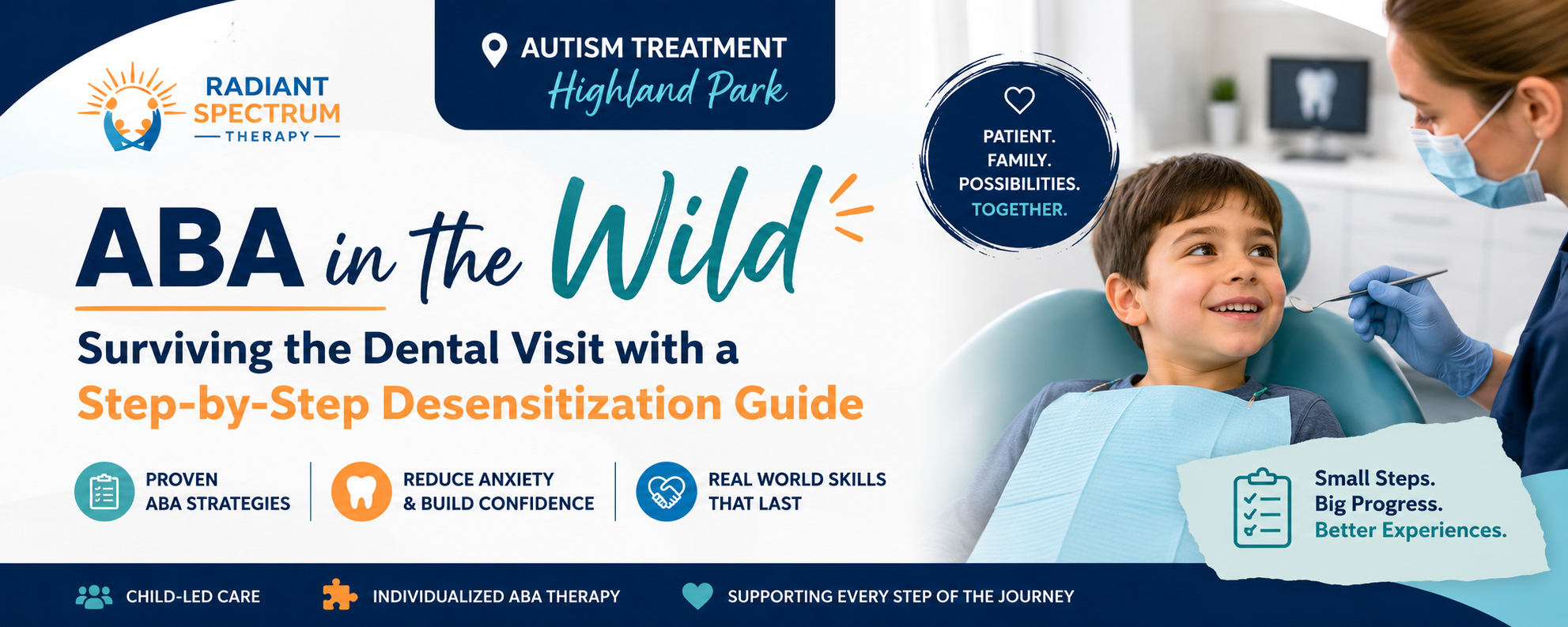
For many families, a routine dental appointment can feel anything but routine. Bright lights, unfamiliar sounds, strange smells, and someone working inside your child’s mouth can quickly become overwhelming. For children with autism, these sensory and social demands can make dental visits especially stressful.
The good news is that these challenges can often be reduced through thoughtful preparation. One of the most effective approaches comes from ABA therapy Highland Park professionals, who use gradual skill-building and positive reinforcement to help children develop confidence in real-world settings.
At Radiant Spectrum Therapy, we believe meaningful progress happens beyond the therapy room. Learning to tolerate a dental exam, communicate needs, and stay calm during unfamiliar experiences are valuable life skills that support greater independence. This guide explains how families can use practical ABA strategies at home and in the community to prepare for successful dental visits.
Whether your child is receiving ABA therapy services Highland Park, in-home ABA therapy Highland Park, or center-based ABA therapy Highland Park, these techniques can complement your child’s individualized treatment plan.
Why Dental Visits Are Challenging for Children with Autism
A dental office combines several experiences that may be difficult for autistic children.
Common challenges include:
- Bright overhead lights
- Loud equipment sounds
- Strong cleaning product smells
- Unexpected physical touch
- Difficulty understanding what will happen next
- Long waiting periods
- Anxiety from previous negative experiences
These reactions are not simply “bad behavior.” They are often understandable responses to sensory overload, communication barriers, or uncertainty.
Professionals providing Autism Treatment Highland Park often help children build coping skills that can transfer into environments like dental offices, hair salons, grocery stores, and schools.
How ABA Therapy Works Highland Park in Community Settings
Many people think ABA only happens in a clinic. In reality, one of the biggest goals of Applied Behavior Analysis Highland Park is helping children use their skills in everyday life.
Community-based learning focuses on:
- Following directions
- Waiting appropriately
- Communicating wants and needs
- Managing transitions
- Tolerating new experiences
- Building independence
Instead of expecting a child to suddenly tolerate a full dental cleaning, ABA breaks the experience into manageable steps.
This process is called task analysis, and it’s one of the most effective tools used in behavior therapy Highland Park programs.
Step 1: Start with a Dental Social Story
A social story introduces the experience before it happens.
Create a simple story with pictures showing:
- Driving to the dentist
- Walking into the office
- Sitting in the waiting room
- Meeting the dentist
- Opening your mouth
- Getting teeth cleaned
- Choosing a reward afterward
Read the story daily for one to two weeks before the appointment.
Children receiving ABA therapy for kids Highland Park often benefit from repeated exposure because predictability reduces anxiety.
Step 2: Build a Visual Schedule
Visual schedules help children understand what comes next.
Example schedule:
- Get dressed.
- Drive to the dentist.
- Check in.
- Sit in the waiting room.
- Meet the dentist.
- Open your mouth.
- Get your teeth cleaned.
- Pick a prize.
- Go home.
As each step finishes, let your child remove or check off the picture.
Many BCBA services Highland Park incorporate visual supports because they improve understanding without relying solely on spoken language.
Step 3: Practice at Home
The home becomes your practice environment.
Spend just five minutes each day practicing one small skill.
Week One
- Sit in a chair for 10 seconds.
- Increase gradually.
Week Two
- Lean back.
- Look at the ceiling.
- Count together.
Week Three
- Practice opening your mouth.
- Use a flashlight.
- Count teeth together.
Week Four
- Introduce a toothbrush or mirror.
- Practice gentle touches.
This gradual exposure is a key part of autism behavior therapy Highland Park and helps children develop tolerance without overwhelming them.
Step 4: Use Systematic Desensitization
Systematic desensitization means introducing small pieces of the experience while pairing them with positive outcomes.
Try this progression:
- Look at pictures of a dental office.
- Watch short dentist videos.
- Visit the office without an appointment.
- Sit in the dental chair briefly.
- Practice opening your mouth.
- Let the dentist count teeth.
- Work toward a full cleaning.
Each successful step earns praise or a preferred reward.
Children participating in intensive ABA programs Highland Park often practice similar progression plans for other community activities.
Step 5: Choose Powerful Reinforcers
Motivation matters.
Before the appointment, identify rewards your child truly enjoys.
Examples include:
- Favorite snack
- Small toy
- Extra tablet time
- Playground visit
- Stickers
- Bubble machine
- Ice cream after the appointment
The reward should immediately follow successful participation whenever possible.
Professionals providing private ABA therapy Highland Park often help families identify individualized reinforcers that increase motivation.
Step 6: Teach Coping Skills Before the Appointment
Waiting until anxiety appears is often too late.
Practice calming strategies every day.
Deep Breathing
Use simple prompts like:
“Smell the flower. Blow out the candle.”
Squeezing a Fidget
Keep one in your child’s pocket.
Counting
Count to ten together.
Requesting a Break
Teach a simple phrase, picture card, or gesture.
Examples include:
- “Break.”
- “All done?”
- “Help.”
These communication skills are an important part of behavioral intervention Highland Park TX and reduce frustration during stressful moments.
Step 7: Visit the Dental Office Before the Appointment
Many dental offices are willing to schedule brief practice visits.
Ask if your child can:
- Walk through the office
- Meet staff
- Sit in the chair
- Hear equipment from a distance
- Touch safe dental tools
These visits remove much of the mystery before the actual appointment.
Families receiving autism support services Highland Park often find that collaboration between therapists and community providers creates smoother experiences.
Step 8: Communicate with the Dental Team
Preparation works best when everyone is on the same team.
Before the appointment, share information about:
- Sensory sensitivities
- Preferred communication style
- Reinforcers
- Triggers
- Successful calming strategies
- Whether your child benefits from first-then language or visual supports
Many dentists appreciate knowing what helps your child succeed.
What to Bring to the Appointment
Pack a small comfort kit.
Suggested items include:
- Noise-reducing headphones
- Sunglasses for bright lights
- Favorite fidget
- Visual schedule
- Water bottle
- Preferred snack
- Small reward
- Comfort object
Having familiar items available can reduce anxiety during unexpected moments.
What If My Child Refuses?
Progress is rarely perfectly linear.
Instead of viewing refusal as failure, ask yourself:
- Was the step too big?
- Was the environment overwhelming?
- Was the reward motivating enough?
- Does my child need more practice?
If your child only sits in the waiting room successfully, celebrate that achievement.
The next visit builds on that success.
This mindset reflects the individualized approach used by best ABA therapy providers Highland Park, where progress is measured by meaningful growth rather than perfection.
Helping Toddlers Prepare for Their First Dental Visit
Children receiving early intervention ABA Highland Park often begin learning these skills long before school age.
For toddlers:
- Practice brushing with short sessions.
- Count teeth during bath time.
- Read picture books about dentists.
- Use pretend play with stuffed animals.
- Reward cooperation immediately.
Starting early makes future appointments much easier.
Families looking for ABA therapy for toddlers Highland Park often prioritize these foundational life skills because they support long-term independence.
Real-World ABA Beyond the Dentist
The same principles can help with many other community experiences.
Haircuts
Practice wearing a cape, sitting still, and tolerating gentle touch.
Grocery Stores
Build waiting, requesting, and transition skills.
Restaurants
Practice sitting, ordering, and waiting for food.
Doctor Visits
Prepare for temperature checks, listening to the heartbeat, and brief examinations.
School Events
Practice entering new buildings, following group routines, and managing transitions.
This is why many families choose ABA therapy for autism Highland Park because the goal extends far beyond therapy sessions.
Signs Your Child Is Making Progress
Celebrate small victories.
Look for improvements like:
- Walking into the office calmly
- Sitting longer
- Opening the mouth more easily
- Recovering faster after discomfort
- Asking for breaks appropriately
- Following simple directions
- Accepting praise and rewards
Even modest improvements represent important skill development.
Children receiving pediatric ABA therapy Highland Park often build confidence through these repeated successes.
How Parents Can Support Long-Term Success
Consistency matters more than perfection.
Try to:
- Practice regularly.
- Keep routines predictable.
- Celebrate effort.
- Stay calm during setbacks.
- Coordinate with your BCBA.
- Share updates with healthcare providers.
When everyone uses similar strategies, children experience greater consistency across environments.
Bringing ABA Skills into Everyday Life in Highland Park and Dallas
Families throughout Highland Park and Dallas encounter community experiences every day, from dental appointments and medical visits to school activities, parks, and local businesses. These moments become valuable opportunities for learning when they’re approached with preparation and realistic expectations.
Whether your child participates in ABA clinics in Highland Park, receives in-home ABA therapy Highland Park, or attends center-based ABA therapy Highland Park, practicing these skills in familiar environments helps bridge the gap between therapy and daily life.
Many parents searching for ABA therapy near Highland Park, ABA therapy in Highland Park TX, or looking to find ABA therapist Highland Park are seeking support that extends beyond the clinic. The strongest programs recognize that lasting progress happens when children can use their skills wherever life takes them.
Choosing the Right ABA Support in Highland Park
Finding the right therapy provider involves more than searching for the closest clinic. Every child has different strengths, challenges, and learning styles, so it’s important to choose a provider that develops individualized treatment plans and works closely with families.
When comparing ABA therapy near me Highland Park, consider asking questions such as:
- Will my child receive individualized goals?
- How involved are parents in therapy sessions?
- Do you offer home and community-based skill practice?
- Will a BCBA regularly review progress?
- How do you prepare children for real-world situations like dental visits?
Families exploring ABA therapy cost Highland Park should also ask about insurance coverage, available services, and whether treatment plans can be tailored to their child’s needs.
Conclusion
Dental visits don’t have to become overwhelming experiences for children with autism. With gradual preparation, visual supports, positive reinforcement, and consistent practice, many children learn to approach appointments with greater confidence and less anxiety.
At Radiant Spectrum Therapy, our approach to Autism Treatment Highland Park focuses on helping children build practical skills that improve everyday life, not just during therapy sessions. Through individualized Applied Behavior Analysis Highland Park, community-based practice, and family collaboration, we help children develop confidence in real-world situations like dental visits, doctor appointments, school activities, and other important milestones.
If you’re looking for Highland Park autism services, top-rated ABA therapists Highland Park, guidance on how ABA therapy works Highland Park, or information about best ABA therapy in Highland Park, our team is committed to creating personalized strategies that support your child’s unique strengths and goals.
Frequently Asked Questions
How can ABA therapy help with dental anxiety?
ABA therapy uses gradual exposure, positive reinforcement, visual supports, and communication strategies to help children become more comfortable with each part of the dental experience over time.
How early should we start preparing for a dental visit?
Preparation can begin several weeks before an appointment. Children receiving early intervention ABA Highland Park often benefit from practicing small steps long before the actual visit.
Can in-home ABA therapy help with community skills?
Yes. In-home ABA therapy Highland Park often includes practicing routines and coping strategies that transfer into community settings like dental offices, grocery stores, and schools.
What if my child can’t complete the entire appointment?
That’s okay. Progress often happens one step at a time. Successfully entering the office, sitting in the chair, or opening the mouth briefly are meaningful accomplishments that can become the foundation for future success.
Does ABA therapy only happen in a clinic?
No. Effective ABA focuses on helping children use their skills across different environments, including home, school, and community settings throughout Highland Park and Dallas.
Contact us at 972–310–4991 or visit https://radiantspectrumtherapy.com/ to learn more.