
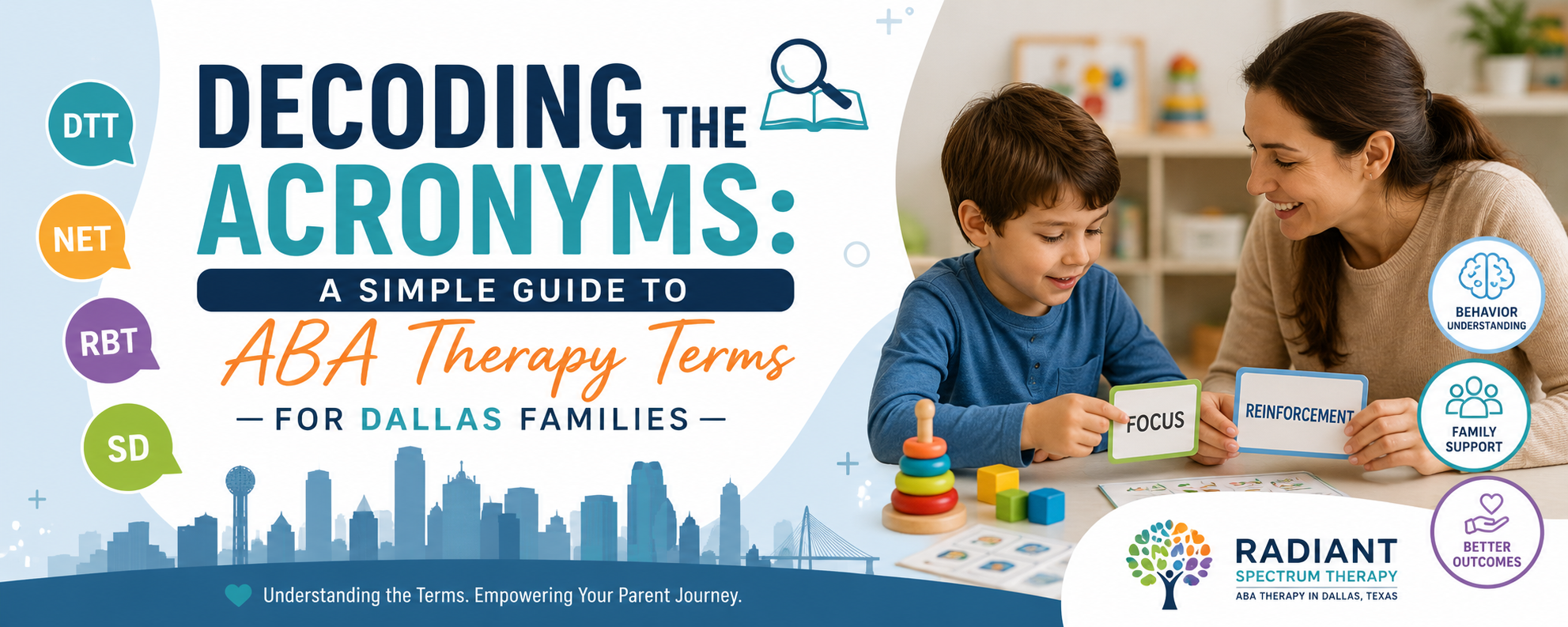
If you’ve recently started exploring ABA Therapy in Dallas, you’ve probably noticed that the field comes with its own language. During evaluations, consultations, or parent meetings, you may hear terms like BCBA, RBT, mand, tact, reinforcement, or elopement. For many parents, these words can feel overwhelming at first.
The good news is that you don’t need a degree in behavioral science to understand what your child’s therapy team is discussing. This guide breaks down the most common ABA therapy terms into simple, everyday language so you can feel more confident and informed as you navigate services.
Whether you’re researching ABA therapy Dallas, comparing ABA clinics in Dallas, or looking for the best ABA therapy in Dallas, understanding these terms can help you make informed decisions about your child’s care.
Why Learning ABA Terminology Matters
Parents are important members of the therapy team. When families understand the language used by therapists, communication becomes easier and collaboration improves.
Many families seeking ABA therapy for autism Dallas or autism therapy Dallas TX tell us that the terminology feels intimidating at first. However, once the jargon is translated into plain language, most concepts become surprisingly simple.
Understanding common ABA terms can help you:
- Better understand progress reports
- Communicate effectively with therapists
- Participate in parent training sessions
- Advocate for your child’s needs
- Feel more confident during evaluations and meetings
Whether your child receives in-home ABA therapy Dallas or attends a center-based ABA therapy Dallas program, these terms are commonly used throughout treatment.
The Professionals You’ll Meet
BCBA (Board Certified Behavior Analyst)
A BCBA is the professional who designs, supervises, and oversees your child’s therapy program.
Think of a BCBA as the architect of your child’s treatment plan.
A BCBA:
- Conducts assessments
- Creates individualized goals
- Trains therapists
- Monitors progress
- Adjusts strategies when needed
- Provides parent coaching
When searching for BCBA services Dallas, families are looking for these highly trained specialists who lead treatment programs.
Everyday Translation
BCBA = The therapy expert who creates the roadmap for your child’s success.
RBT (Registered Behavior Technician)
An RBT is the therapist who works directly with your child during sessions.
These professionals implement the treatment plan created by the BCBA and spend the most one-on-one time with your child.
RBTs often help children learn:
- Communication skills
- Social skills
- Daily living skills
- School readiness skills
- Play skills
Everyday Translation
RBT = The hands-on coach helping your child practice new skills every day.
Clinical Supervisor
Some organizations also employ clinical supervisors who assist BCBAs with program oversight and therapist training.
Everyday Translation
Clinical Supervisor = A team leader who helps ensure therapy is effective and consistent.
Communication Terms You’ll Hear Often
One area of focus in Applied Behavior Analysis Dallas programs is communication development.
Here are some common terms you’ll hear.
Mand
A mand is simply a request.
When a child asks for something they want or need, they’re making a mand.
Examples:
- “Water, please.”
- Pointing to a favorite toy
- Signing “more”
- Using a communication device to request a snack
Everyday Translation
Mand = Asking for something.
Tact
A tact is labeling or naming something.
Examples:
- Saying “dog” when seeing a dog
- Pointing to an airplane and naming it
- Identifying colors or objects
Everyday Translation
Tact = Naming what you see.
Echoic
An echoic occurs when a child repeats what someone else says.
Examples:
- Adult says “ball”
- Child says “ball”
Everyday Translation
Echoic = Copying words.
Listener Responding
This refers to following directions or understanding language.
Examples:
- “Touch your nose.”
- “Bring me the book.”
- “Sit down.”
Everyday Translation
Listener Responding = Understanding and following instructions.
Behavior Terms Explained
Families seeking behavior therapy Dallas or autism behavior therapy Dallas often hear these terms during assessments.
Behavior
In ABA, behavior means anything a person does.
This includes:
- Talking
- Walking
- Playing
- Crying
- Reading
- Asking questions
Everyday Translation
Behavior = Any action a person does.
Target Behavior
A target behavior is a specific skill or behavior the therapy team is focusing on.
Examples:
- Asking for help
- Staying seated
- Following directions
- Reducing aggression
Everyday Translation
Target Behavior = The specific skill we’re working on.
Replacement Behavior
A replacement behavior is a safer or more effective alternative to a challenging behavior.
Example:
Instead of screaming when frustrated, a child learns to ask for a break.
Everyday Translation
Replacement Behavior = A better way to meet the same need.
Elopement
One of the most misunderstood terms in ABA is elopement.
In therapy, elopement does not refer to marriage.
It means leaving a safe area without permission.
Examples:
- Running from a classroom
- Leaving a playground
- Bolting from a store
Elopement can create serious safety concerns, which is why many behavioral intervention Dallas TX programs address it.
Everyday Translation
Elopement = Running away from a safe area.
Self-Injurious Behavior (SIB)
These are behaviors that may cause harm to the individual.
Examples:
- Head banging
- Biting oneself
- Excessive scratching
Everyday Translation
SIB = Hurting oneself.
Learning Terms You’ll See in Therapy Plans
Many ABA therapy services Dallas providers use these concepts to teach new skills.
Reinforcement
Reinforcement is one of the most important concepts in ABA.
When a child receives something they enjoy after a behavior, that behavior becomes more likely to happen again.
Examples:
- Praise
- Stickers
- Favorite toys
- Extra playtime
Everyday Translation
Reinforcement = A reward that encourages a behavior to happen again.
Positive Reinforcement
This involves adding something desirable after a behavior.
Example:
A child cleans up toys and receives praise.
Everyday Translation
Positive Reinforcement = Good things happen after a desired behavior.
Prompt
A prompt is help given to encourage success.
Examples:
- Verbal reminders
- Gestures
- Visual cues
- Physical guidance
Everyday Translation
Prompt = A helpful hint.
Prompt Fading
As a child learns a skill, prompts are gradually reduced.
The goal is independence.
Everyday Translation
Prompt Fading = Slowly removing help so a child can do it alone.
Generalization
Generalization occurs when a skill is used in different places and situations.
Example:
A child learns to greet people in therapy and then greets teachers, relatives, and neighbors.
Everyday Translation
Generalization = Using a skill everywhere, not just in therapy.
Assessment Terms Parents Often Hear
When beginning ABA therapy in Dallas TX, families typically encounter several assessment-related terms.
Assessment
An assessment is a detailed evaluation of strengths, challenges, and developmental needs.
The results help create an individualized treatment plan.
Everyday Translation
Assessment = Finding out where your child is now so we know where to start.
Baseline
Baseline data shows how often a behavior or skill occurs before intervention begins.
Everyday Translation
Baseline = The starting point.
Data Collection
ABA relies on measurable information.
Therapists collect data during sessions to track progress.
Everyday Translation
Data Collection = Keeping score to see what’s working.
Treatment Plan
A treatment plan outlines goals, strategies, and services.
Everyday Translation
Treatment Plan = Your child’s personalized roadmap.
Program Types Explained
Families exploring ABA therapy near Dallas often compare different service models.
Center-Based ABA Therapy
In a center setting, children attend therapy at a clinic.
Benefits may include:
- Structured learning environments
- Peer interaction opportunities
- Access to multiple professionals
- Consistent routines
Many families seeking center-based ABA therapy Dallas choose this option for intensive skill-building.
Everyday Translation
Center-Based Therapy = Therapy provided in a specialized clinic.
In-Home ABA Therapy
Therapy occurs in the child’s home.
Benefits may include:
- Familiar environment
- Real-life practice opportunities
- Family involvement
- Natural routines
Many families interested in in-home ABA therapy Dallas appreciate the convenience and individualized support.
Everyday Translation
In-Home Therapy = Therapy that comes to your home.
Early Intervention
Early intervention refers to services provided during the earliest developmental years.
Research consistently shows that early support can significantly improve outcomes.
Families seeking early intervention ABA Dallas, ABA therapy for toddlers Dallas, and pediatric ABA therapy Dallas often begin services soon after diagnosis.
Everyday Translation
Early Intervention = Starting support as early as possible.
Intensive ABA Programs
Some children benefit from higher therapy hours each week.
Programs may range from a few hours weekly to more comprehensive schedules.
Everyday Translation
Intensive ABA Programs = More therapy time for children who need additional support.
Common Parent Training Terms
Parent involvement is a major component of successful treatment.
Many autism support services Dallas include family training.
Parent Training
Parents learn strategies that can be used at home and in the community.
Everyday Translation
Parent Training = Teaching parents the same tools therapists use.
Behavior Intervention Plan (BIP)
A written plan describing strategies for addressing challenging behaviors.
Everyday Translation
BIP = A step-by-step guide for handling difficult situations.
Functional Communication Training (FCT)
A strategy that teaches children to communicate their needs effectively.
Everyday Translation
FCT = Teaching communication instead of challenging behavior.
Frequently Asked Questions
Do I need to memorize all these terms?
No. Most parents learn them naturally over time. Understanding the basics can simply make conversations with providers easier.
Are BCBAs and RBTs both important?
Absolutely. BCBAs create and oversee treatment plans, while RBTs provide direct therapy. Both play important roles in successful outcomes.
Is ABA terminology the same at every clinic?
Most terms are used consistently across providers offering private ABA therapy Dallas, affordable ABA therapy Dallas TX, and other services. However, individual clinics may have slightly different ways of explaining concepts.
How can I learn more about my child’s therapy program?
Ask questions. Quality providers welcome parent involvement and are happy to explain terminology in plain language.
Choosing the Right ABA Provider in Dallas and Highland Park
When evaluating ABA clinics in Dallas, it’s important to look beyond the terminology and focus on finding a team that communicates clearly, values family involvement, and develops individualized treatment plans.
The best ABA therapy providers Dallas families choose are often those who take time to explain concepts, answer questions, and ensure parents feel comfortable throughout the process.
Whether you’re looking for ABA therapy for kids Dallas, ABA therapy near me Dallas, developmental therapy Dallas, or comprehensive Dallas autism services, understanding the language of ABA can help you feel empowered throughout your child’s journey.
If you’re researching ABA Therapy in Dallas, remember that terms like BCBA, RBT, mand, tact, reinforcement, and elopement may sound technical at first, but they represent practical tools and strategies designed to help children build communication, independence, and life skills. The more familiar you become with these concepts, the easier it becomes to partner with your therapy team and support your child’s growth both at home and in the community.
Contact us at 972–310–4991 or visit https://radiantspectrumtherapy.com/ to learn more.