
For many parents and caregivers, one of the most confusing moments is trying to understand whether a child is experiencing an autism meltdown or a temper tantrum. From the outside, they can sometimes look similar — crying, yelling, dropping to the floor, or refusing to cooperate. However, the reasons behind these behaviors are very different, and understanding those differences can completely change how you respond.
Families seeking ABA Therapy in Dallas often ask whether behavior therapy teaches children to stop having meltdowns. The answer is more nuanced. Quality ABA therapy does not aim to suppress emotions. Instead, it helps children build communication, self-regulation, and coping skills while helping caregivers recognize what a child needs during overwhelming moments.
Whether you’re raising a toddler recently diagnosed with autism or supporting an older child navigating school, learning to distinguish between meltdowns and tantrums can create calmer, safer experiences for everyone involved.
Why the Difference Matters
Responding to a meltdown as though it’s a tantrum can unintentionally increase distress. Likewise, assuming every challenging behavior is a meltdown may prevent children from learning appropriate ways to communicate their needs.
The goal isn’t to label every behavior perfectly. Instead, it’s to understand the child’s underlying experience.
Children receiving ABA therapy Dallas often make the most progress when caregivers learn to recognize patterns, identify triggers, and respond consistently across home, school, and community settings.
What Is an Autism Meltdown?
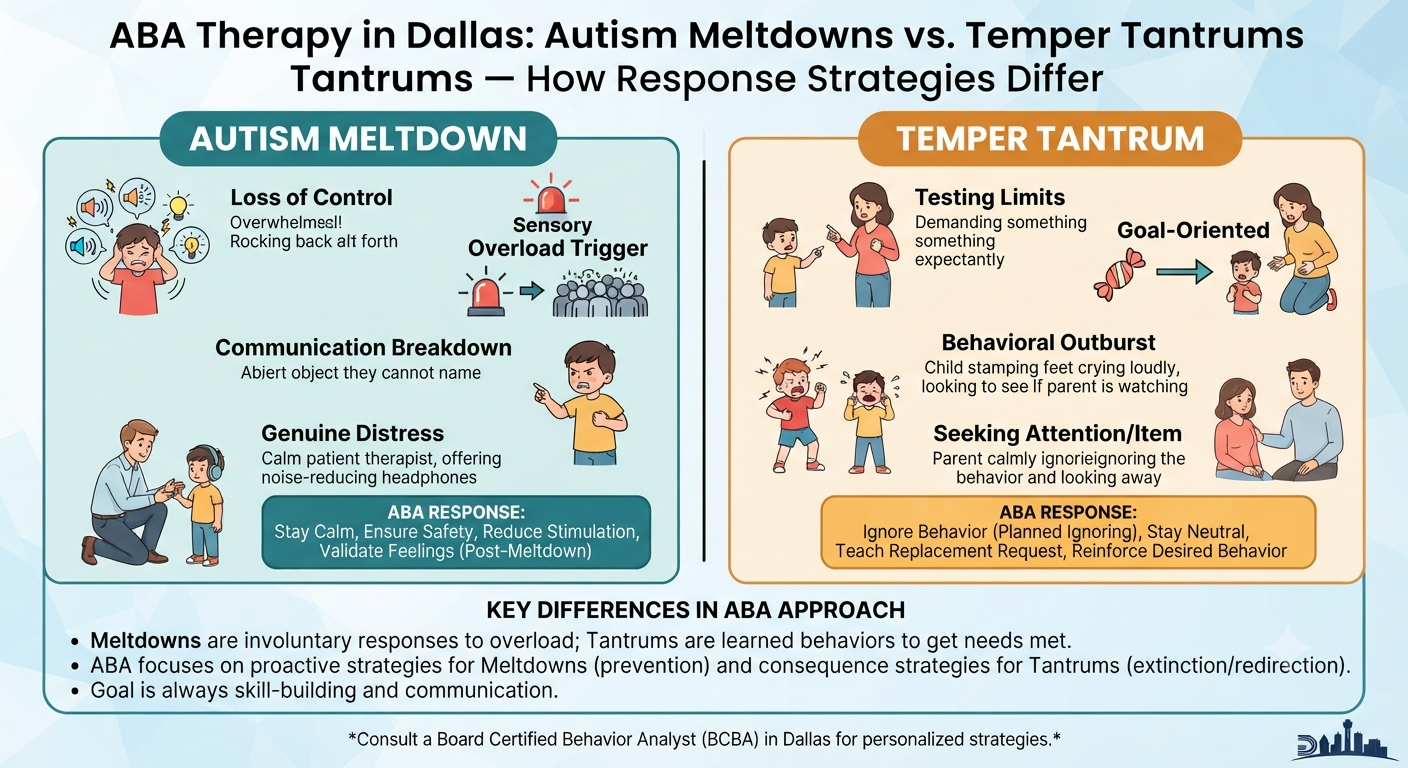
An autism meltdown is an involuntary response to overwhelming stress. The child’s nervous system becomes overloaded, making it difficult — or impossible — to regulate emotions, communicate effectively, or follow directions.
Think of a meltdown as the brain’s emergency response when sensory input, emotions, or demands exceed the child’s current ability to cope.
Common Meltdown Triggers
Children receiving ABA therapy services Dallas may experience meltdowns due to:
- Loud environments
- Bright lights
- Unexpected schedule changes
- Difficult transitions
- Hunger or fatigue
- Too many verbal instructions
- Strong emotions without communication tools
- Physical discomfort
Every child has unique triggers. Identifying those patterns is an important part of Applied Behavior Analysis Dallas.
What Is a Temper Tantrum?
A temper tantrum is generally a goal-directed behavior. The child wants something specific and expresses frustration when they don’t get it.
For example:
- Wanting another cookie
- Wanting more screen time
- Refusing bedtime
- Wanting a preferred toy
Unlike meltdowns, tantrums often decrease once the desired outcome changes or once the child realizes the behavior isn’t producing the expected result.
Children with autism can absolutely have tantrums too. Autism doesn’t eliminate
Signs Your Child Is Experiencing Sensory Overload
Many meltdowns begin long before crying or screaming starts.
Early warning signs may include:
- Covering ears
- Avoiding eye contact
- Increased stimming
- Pacing
- Hiding
- Becoming unusually quiet
- Rapid breathing
- Repeating phrases
- Difficulty answering questions
Recognizing these early signals allows caregivers to intervene before the nervous system becomes completely overwhelmed.
Professionals providing autism therapy Dallas TX often teach families how to spot these subtle changes.
What Happens During a Meltdown?
During a meltdown, the child’s brain shifts into survival mode.
The child may:
- Cry uncontrollably
- Scream
- Throw themselves on the floor
- Run away
- Hit themselves
- Push others away
- Hide
- Become temporarily nonverbal
At this point, reasoning rarely works because the child’s ability to process language is reduced.
Instead of expecting immediate compliance, caregivers can focus on co-regulation.
What Is Co-Regulation?
Co-regulation means helping a child borrow your calm while their nervous system settles.
This doesn’t mean giving in to every demand.
Instead, it means becoming a steady, predictable source of safety.
Children participating in early intervention ABA Dallas often benefit when parents practice these skills consistently at home.
Step-by-Step: How to Respond During a Meltdown
1. Stay Calm
Children often mirror adult emotional energy.
Use:
- Slow breathing
- Gentle voice
- Relaxed posture
Avoid raising your voice, even when you’re stressed.
2. Reduce Sensory Input
If possible:
- Dim lights
- Lower noise
- Move to a quieter room
- Remove unnecessary people
Many families using center-based ABA therapy Dallas also create similar calming spaces at home.
3. Use Minimal Language
During overload, less is more.
Instead of:
“You need to calm down because we’re leaving in five minutes.”
Try:
“You’re safe.”
Or:
“I’m here.”
Short phrases are easier to process.
4. Offer Regulation Tools
Depending on the child, helpful supports may include:
- Noise-canceling headphones
- Weighted lap pad
- Favorite stuffed animal
- Fidget toy
- Water
- Deep pressure (if the child enjoys it)
Every child responds differently.
5. Wait Before Problem-Solving
Once the nervous system settles, that’s the time to discuss what happened.
Not during the peak of the meltdown.
How to Respond During a Temper Tantrum
Tantrums require a different approach.
Helpful strategies include:
- Stay calm.
- Keep expectations consistent.
- Avoid rewarding inappropriate behavior.
- Praise appropriate communication.
- Offer choices when appropriate.
For example:
Instead of arguing about bedtime:
“Would you like the blue pajamas or the green pajamas?”
Giving appropriate choices helps children practice independence while maintaining boundaries.
Children receiving behavior therapy Dallas often learn replacement communication skills that reduce frustration over time.
The Role of Communication
Many meltdowns happen because children cannot express what they’re experiencing.
Imagine feeling:
- Overwhelmed
- Confused
- In pain
- Scared
— but not having the words to explain it.
That’s why communication is a major focus of autism behavior therapy Dallas.
Children may learn to request:
- Breaks
- Help
- Quiet
- Water
- More time
- Finished
- Different activity
Even simple communication can dramatically reduce stress.
Preventing Meltdowns Before They Start
While no one can prevent every meltdown, many can become less frequent with proactive planning.
Create Predictable Routines
Visual schedules help children understand what’s coming next.
This is especially helpful during:
- Morning routines
- School transitions
- Bedtime
- Community outings
Prepare for Changes
Give advance notice.
Examples:
- Five-minute warnings
- Countdown timers
- Picture schedules
Watch for Basic Needs
Many challenging moments become harder when children are:
- Hungry
- Tired
- Sick
- Overstimulated
Meeting these needs early makes regulation easier.
These prevention strategies are commonly included in behavioral intervention Dallas TX plans.
Supporting Toddlers Through Early Intervention
For young children, recognizing the difference between meltdowns and tantrums is especially important.
ABA therapy for toddlers Dallas focuses on building foundational skills like:
- Joint attention
- Communication
- Play skills
- Emotional regulation
- Transition tolerance
Early support can help children develop coping strategies before challenging behaviors become more frequent.
Families exploring pediatric ABA therapy Dallas often find that parent coaching becomes just as valuable as direct therapy sessions.
How Parents Can Build Emotional Safety
Children regulate best when they feel emotionally safe.
Ways to build safety include:
- Validate feelings without reinforcing unsafe behavior.
- Maintain predictable routines.
- Celebrate small successes.
- Model calm responses.
- Repair after difficult moments.
For example:
“That was really hard. We got through it together.”
This helps children learn that emotions are acceptable, even when behaviors need guidance.
What Happens After the Meltdown?
Recovery matters just as much as the response.
Once the child is calm:
- Offer water or a snack.
- Allow quiet time.
- Avoid lengthy lectures.
- Briefly discuss what helped.
- Practice communication skills later.
This is when learning can happen.
Children receiving BCBA services Dallas often review these moments with caregivers to identify patterns and improve future support plans.
How ABA Therapy Helps Without Ignoring Emotions
Modern Applied Behavior Analysis Dallas is increasingly centered on understanding the whole child.
Rather than simply reducing behaviors, therapists work to understand:
- Why behaviors happen
- What skills are missing
- How environments contribute
- Which supports increase success
This compassionate approach recognizes that behavior is communication.
Whether through private ABA therapy Dallas, intensive ABA programs Dallas, or in-home ABA therapy Dallas, therapy should prioritize dignity, collaboration, and meaningful skill development.
Choosing the Right ABA Support in Dallas
Families searching for ABA therapy near Dallas, ABA therapy near me Dallas, or ABA clinics in Dallas often have many options.
When comparing providers, consider:
- Board Certified Behavior Analyst (BCBA) involvement
- Parent training opportunities
- Individualized treatment plans
- Communication-focused goals
- Compassionate, child-centered care
- Home and clinic service options
Many Dallas autism services now offer flexible programs that combine clinic sessions, home support, and caregiver coaching to meet each family’s needs.
If you’re researching best ABA therapy providers Dallas, top-rated ABA therapists Dallas, or wondering about ABA therapy cost Dallas, asking about parent involvement, individualized goals, and insurance options can help you make a more informed decision.
Understanding how ABA therapy works Dallas can also make it easier to identify programs that emphasize skill building, emotional regulation, and family collaboration.
Supporting Families in Dallas and Highland Park
Families in Dallas and Highland Park often juggle school transitions, therapy appointments, and busy daily routines. Whether your child receives services at home or in a clinic, understanding the difference between meltdowns and tantrums can reduce stress and strengthen family relationships.
Learning to recognize sensory overload, respond with co-regulation, and build communication skills creates a more supportive environment for children to thrive.
At Radiant Spectrum Therapy, we believe every child deserves compassionate, individualized support that respects their unique needs. Through ABA Therapy in Dallas TX, families can develop practical strategies that improve daily life while helping children build confidence, communication, and emotional regulation skills.
If you’re ready to find ABA therapist Dallas families trust, seeking personalized support can make a meaningful difference for your child’s growth and your family’s confidence.
Frequently Asked Questions
Can children with autism have both meltdowns and tantrums?
Yes. A child with autism can experience sensory-overload meltdowns and also have typical childhood tantrums when frustrated or seeking a preferred outcome.
Should I discipline my child during a meltdown?
During a true meltdown, the priority is helping the child regain regulation and feel safe. Teaching and problem-solving are generally more effective after the child has recovered.
How can ABA therapy help reduce meltdowns?
ABA therapy for kids Dallas helps identify triggers, teach communication skills, strengthen coping strategies, and coach caregivers on effective co-regulation techniques.
Is in-home ABA therapy helpful for meltdowns?
Yes. In-home ABA therapy Dallas allows therapists to observe real-life routines and help families practice strategies in the environments where meltdowns are most likely to occur.
When should I seek professional support?
If meltdowns happen frequently, involve self-injury, interfere with daily life, or make school and community participation difficult, consulting professionals who provide special needs therapy Dallas, developmental therapy Dallas, and affordable ABA therapy Dallas TX can help create a personalized support plan.
Contact us at 972–310–4991 or visit https://radiantspectrumtherapy.com/ to learn more.