
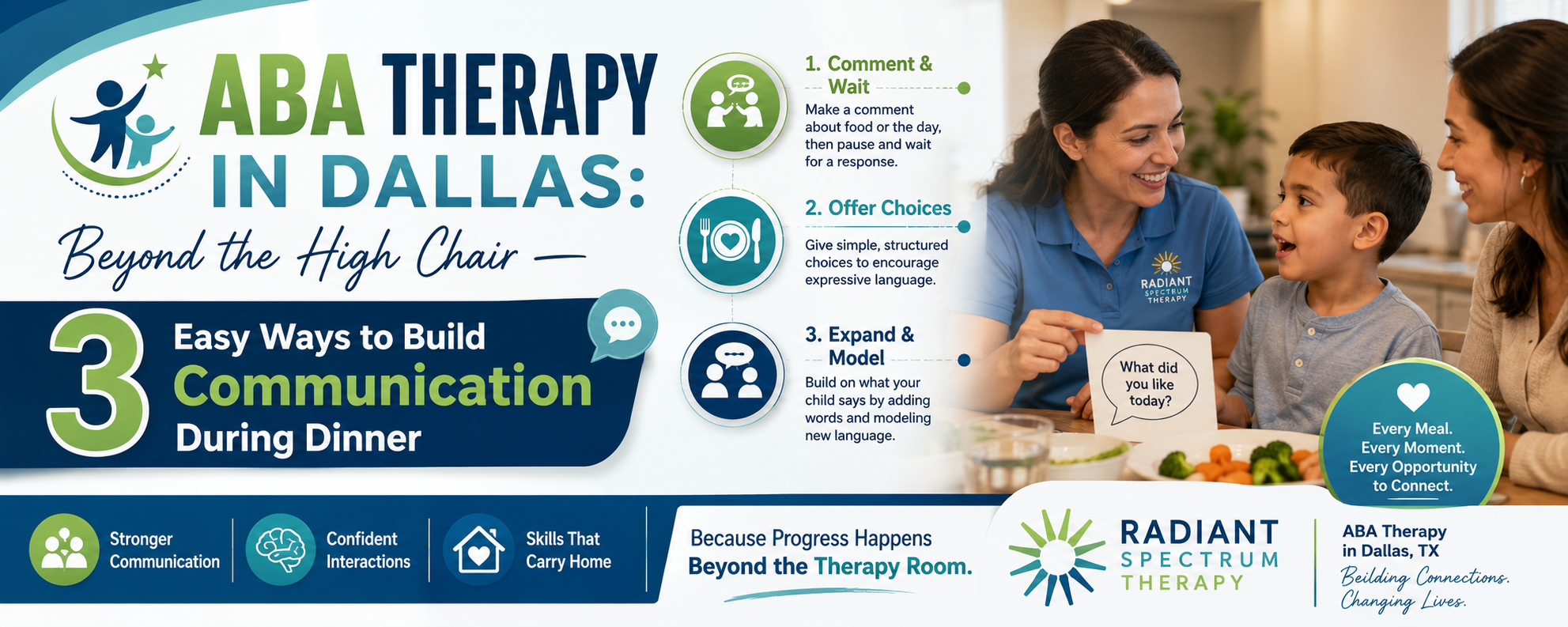
Dinner doesn’t have to become another therapy session to help your child build communication skills. In fact, some of the best language-learning moments happen during everyday routines, especially around the dinner table.
For families exploring ABA Therapy in Dallas, one of the most effective approaches is using Natural Environment Teaching (NET). Instead of sitting at a desk with flashcards, NET helps children practice communication where it naturally matters — asking for juice, requesting more food, pointing to favorite snacks, or signaling when they’re all done.
At Radiant Spectrum Therapy, we encourage parents in Dallas and Highland Park to view mealtime as an opportunity for connection rather than pressure. Small moments repeated consistently often create meaningful progress over time.
This guide explains three simple strategies you can begin using during dinner tonight, whether your child receives center-based ABA therapy Dallas, in-home ABA therapy Dallas, or you’re simply looking for practical ways to support communication at home.
Why Mealtime Is a Powerful Learning Opportunity
Meals naturally create motivation. Children already want something during dinner — a bite of chicken, another strawberry, ketchup for fries, or a sip of water.
That motivation makes communication more meaningful.
Rather than practicing words in isolation, your child learns that communicating helps them accomplish real goals.
In Applied Behavior Analysis Dallas, this is called using natural reinforcement. The reward isn’t a sticker or token. The reward is getting the thing they wanted.
Imagine the difference.
Instead of repeating “juice” ten times because someone asked them to, a child says “juice” once because they’re actually thirsty. That communication has purpose, which often leads to stronger learning.
Children receiving ABA therapy for autism Dallas frequently practice these skills during therapy sessions, but parents can reinforce them during everyday routines without turning dinner into structured work.
What Is Natural Environment Teaching (NET)?
Natural Environment Teaching, often shortened to NET, is an evidence-based teaching strategy used within ABA.
Instead of creating artificial lessons, therapists teach skills during real-life activities.
Examples include:
- Asking for bubbles during play
- Requesting a favorite toy
- Taking turns during games
- Asking for help with shoes
- Communicating during dinner
This approach works because learning happens in context.
Children begin understanding that communication has a purpose beyond answering questions correctly.
Many families participating in early intervention ABA Dallas notice that NET feels less stressful because it blends naturally into daily routines.
The Goal Isn’t Perfect Speech
Before jumping into strategies, it’s important to adjust expectations.
Communication doesn’t only mean speaking.
A successful communication attempt might include:
- Pointing
- Looking toward an item
- Reaching appropriately
- Using a sign
- Pressing an AAC device
- Saying part of a word
- Saying the whole word
Every appropriate communication attempt deserves recognition.
This perspective is central to both behavior therapy Dallas and autism behavior therapy Dallas, where progress is measured by functional communication rather than perfection.
Strategy 1: Contrive Choices That Encourage Requests
The first strategy is incredibly simple.
Create small opportunities that encourage your child to communicate.
Professionals call these “contrived opportunities.”
Don’t worry — the name sounds more complicated than it is.
How to Set It Up
Instead of placing everything within immediate reach, intentionally position one preferred item where your child can see it but needs help accessing it.
Good examples include:
- Ketchup
- Juice
- Strawberries
- Ranch dressing
- Crackers
- Dessert
- Favorite dipping sauce
A clear container works especially well because your child can easily see what’s inside.
What This Looks Like
Imagine your child wants ketchup.
Instead of handing it over immediately:
- Place the bottle nearby.
- Wait a few seconds.
- Watch for any communication attempt.
That attempt might be:
- Looking at the ketchup
- Pointing
- Reaching
- Saying “ket.”
- Signing “please.”
Once they communicate, respond promptly.
The goal isn’t making them frustrated.
The goal is creating a meaningful reason to communicate.
Avoid Making It Too Hard
A common mistake is waiting too long.
If your child becomes upset, the learning opportunity disappears.
Instead:
- Wait briefly.
- Prompt gently if needed.
- Reinforce quickly.
Families working with BCBA services Dallas often learn how to find this balance between creating opportunities and avoiding unnecessary frustration.
Choosing the Right Foods for Communication Practice
Not every food creates a good teaching opportunity.
Start with highly preferred items.
Good choices often include:
- Fruit
- Chicken nuggets
- French fries
- Yogurt
- Cookies after dinner
- Juice
- Popsicles
Less motivating foods may not encourage communication.
The stronger the motivation, the more likely communication becomes meaningful.
This individualized approach is one reason pediatric ABA therapy Dallas emphasizes tailoring teaching strategies to each child’s interests.
Strategy 2: Model First Before Expecting Communication
Parents often wonder:
“What if my child doesn’t know what to say?”
That’s where modeling comes in.
Instead of repeatedly asking,
“What do you say?”
provide the communication model first.
The “More” Example
Your child finishes their strawberries.
Before giving another piece, calmly model:
“More.”
Or demonstrate the sign for “more.”
Then pause briefly.
Your child may:
- Copy the word
- Attempt the sound
- Use the sign
- Press their AAC button
Any reasonable attempt counts.
Other Helpful Words to Model
Keep language short.
Examples include:
- More
- Please
- Juice
- Help
- Done
- Eat
- Open
- Water
Single-word models often reduce pressure while increasing success.
Children receiving ABA therapy for toddlers Dallas frequently begin with these functional words because they’re useful throughout the day.
Why Modeling Works Better Than Quizzing
Imagine someone constantly asking you questions in a language you’re still learning.
It feels stressful.
Modeling removes that pressure.
Instead of testing your child, you’re showing them what successful communication looks like.
This creates a supportive learning environment that aligns with evidence-based behavioral intervention Dallas TX practices.
Keep Your Tone Natural
Avoid sounding overly instructional.
Instead of:
“Say juice.”
Try:
“Juice.”
Then smile.
Hand it over once they attempt communication.
The interaction stays warm, predictable, and encouraging.
Strategy 3: Celebrate Small Wins Immediately
This may be the most important strategy of all.
Timing matters.
When your child communicates appropriately, respond immediately.
Don’t delay praise.
Don’t wait for perfect pronunciation.
Instead, reinforce the effort.
What Immediate Reinforcement Looks Like
Examples include:
- “Great asking!”
- “You said more!”
- “Nice pointing!”
- “You asked for juice!”
Then immediately provide the item.
This creates a powerful learning connection.
Communication leads to positive outcomes.
Over time, children become more likely to communicate again.
Why Small Wins Matter
Progress rarely happens overnight.
One week your child points.
The next week they sign.
A month later they say part of the word.
Eventually, they may use the full word independently.
Each step deserves recognition.
This gradual skill-building process is a cornerstone of how ABA therapy works Dallas.
Make Dinner Feel Like Family Time
Parents sometimes worry they’ll accidentally turn every meal into work.
You don’t need to.
Instead, aim for just a few communication opportunities during dinner.
For example:
- One request for juice
- One request for more food
- One “all done”
That’s enough.
The rest of dinner should still feel relaxed.
Conversations, laughter, and family connection remain the priority.
Many families receiving autism support services Dallas appreciate that meaningful learning doesn’t require constant instruction.
Common Mealtime Challenges and Simple Solutions
Challenge: My Child Gets Frustrated Quickly
Keep wait times short.
Offer gentle prompts before frustration escalates.
Challenge: My Child Throws Food
Instead of focusing only on stopping the behavior, teach an alternative communication response.
Examples include:
- “Done”
- “Break”
- Pointing away from food
Teaching replacement behaviors is a key component of autism behavior therapy Dallas.
Challenge: My Child Doesn’t Like Sitting at the Table
Start with realistic expectations.
Maybe today’s goal is sitting for three minutes.
Tomorrow might be four.
Building routines gradually often leads to more sustainable success.
How Therapists Use These Same Strategies
Parents sometimes assume therapists use completely different methods.
In reality, many therapists use similar techniques.
During center-based ABA therapy Dallas, therapists might:
- Create requesting opportunities during snack time.
- Model simple language.
- Reinforce communication immediately.
- Expand language naturally.
During in-home ABA therapy Dallas, therapists can help parents adapt these strategies to their own kitchens, routines, and family schedules.
That consistency between therapy and home often helps children generalize skills more effectively.
Adapting Dinner Strategies for Different Ages
Toddlers
Focus on:
- More
- Drink
- Help
Use gestures alongside words.
This aligns well with early intervention ABA Dallas.
Preschoolers
Encourage:
- Two-word requests
- Choosing between foods
- Asking for utensils
School-Age Children
Expand communication by encouraging:
- “Can I have ketchup?”
- “I’m all done.”
- “Can I have another?”
Older children can also practice conversational skills by talking about their day during dinner.
Building Consistency Without Feeling Overwhelmed
Parents don’t need perfection.
Instead, focus on consistency.
Choose one strategy this week.
For example:
Monday through Friday:
- Practice requesting juice.
Next week:
- Add “more.”
Small habits repeated daily often produce bigger long-term results than occasional intensive practice.
Families searching for ABA therapy near Dallas often discover that therapist guidance combined with consistent home practice creates a strong foundation for communication growth.
When to Seek Additional Support
Every child develops differently.
If your child consistently struggles with:
- Requesting needs
- Responding to simple communication opportunities
- Using gestures or words
- Participating during daily routines
additional support may be helpful.
Working with experienced professionals can help identify which communication strategies best match your child’s strengths and developmental goals.
Whether you’re exploring private ABA therapy Dallas, researching ABA clinics in Dallas, or comparing best ABA therapy providers Dallas, look for programs that involve parents and teach skills that carry over into everyday life.
Family involvement is one of the strongest predictors of successful skill generalization.
Supporting Communication Beyond Dinner
The same NET strategies work throughout the day.
Try using them during:
- Breakfast
- Bath time
- Playground visits
- Grocery shopping
- Bedtime routines
For example:
- Keep bubbles closed until your child requests help.
- Hold shoes briefly before putting them on.
- Pause before opening a snack.
These tiny moments create repeated opportunities for meaningful communication.
Over time, children begin recognizing that communication helps them interact successfully across many different environments — not just during therapy.
Bringing Everyday Moments Into ABA Therapy in Dallas
The dinner table offers far more than nourishment — it offers opportunities for connection, confidence, and communication. By creating simple requesting opportunities, modeling language before expecting it, and celebrating every communication attempt, parents can support meaningful progress without turning meals into formal lessons.
For families interested in ABA Therapy in Dallas, these Natural Environment Teaching strategies complement professional therapy by helping children practice skills where they matter most. Whether your child participates in center-based ABA therapy Dallas, in-home ABA therapy Dallas, or is just beginning early intervention ABA Dallas, everyday routines can become powerful opportunities for growth.
At Radiant Spectrum Therapy, we believe communication develops best when children feel supported, motivated, and celebrated during real-life experiences. Dinner doesn’t have to be perfect — it just needs to create small, consistent opportunities for your child to connect with the people around them.
FAQ About ABA Therapy in Dallas and Mealtime Communication
Can I use these strategies if my child doesn’t talk yet?
Yes. Communication includes pointing, gestures, signs, facial expressions, and AAC devices — not only spoken words.
How many opportunities should I create during dinner?
Start with just two or three communication opportunities during a meal to keep dinner relaxed and enjoyable.
What if my child becomes upset while waiting?
Reduce the wait time. The goal is encouraging communication, not creating frustration.
Do these strategies replace professional ABA therapy?
No. These techniques work best as home practice that complements services like Applied Behavior Analysis Dallas, in-home ABA therapy Dallas, or center-based ABA therapy Dallas.
How can parents learn more about using NET at home?
Many BCBA services Dallas include parent coaching that helps families use Natural Environment Teaching during everyday routines like meals, playtime, and bedtime.
Contact us at 972–310–4991 or visit https://radiantspectrumtherapy.com/ to learn more.