
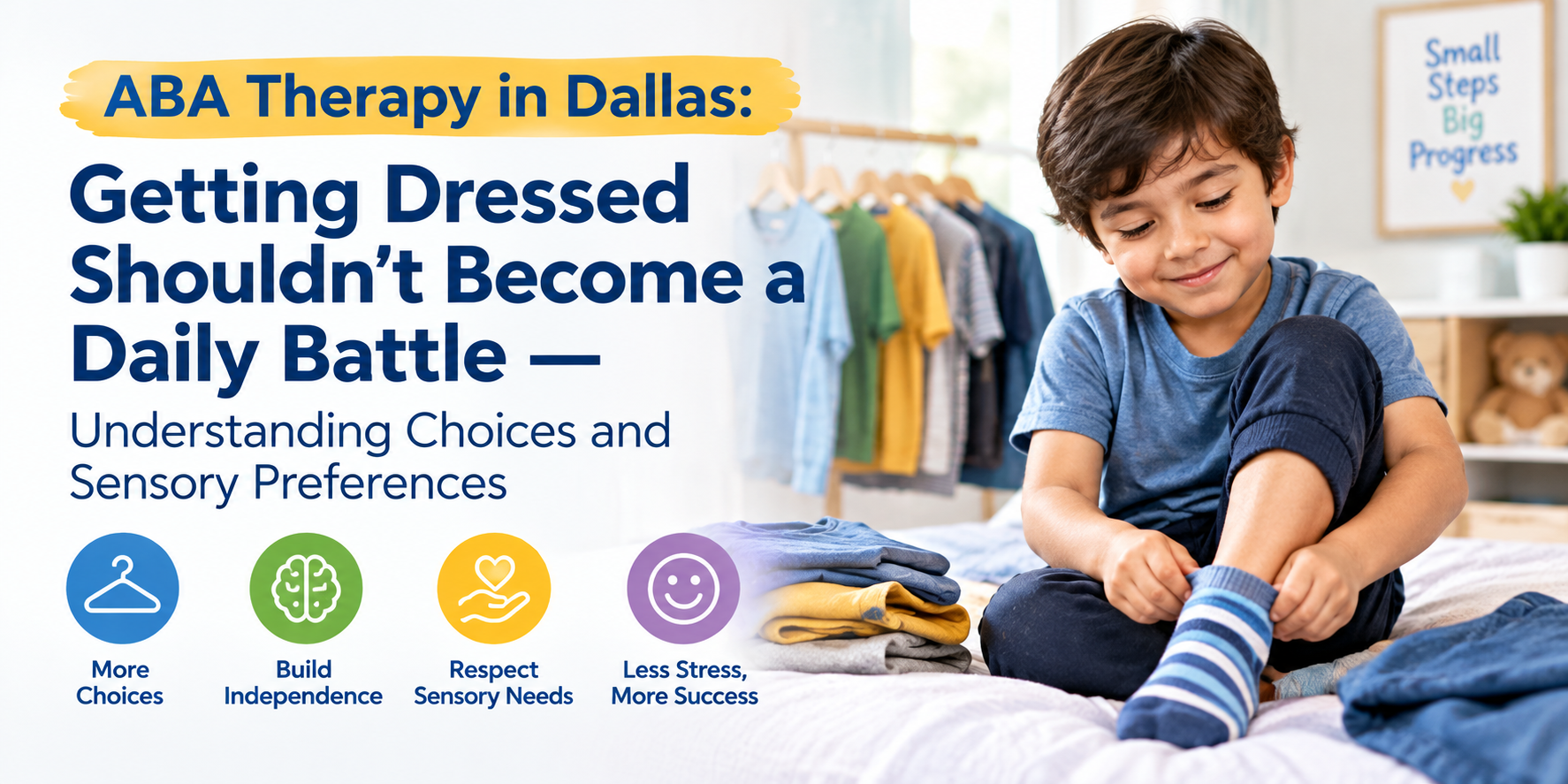
For many families, getting dressed is a simple part of the morning routine. For others, it can become a daily struggle filled with tears, frustration, repeated outfit changes, and difficulty leaving the house on time. Children may refuse certain shirts, become upset when socks feel uncomfortable, resist wearing shoes, or insist on wearing the same outfit every day. Through ABA Therapy in Dallas, families can explore practical, individualized strategies to understand these behaviors, respect sensory preferences, and make dressing a more comfortable experience for their children.
Dressing involves much more than putting on clothes. It requires tolerating different textures, managing temperature, coordinating movements, following a sequence of steps, and transitioning from one activity to another. For children with autism, these demands may feel overwhelming, especially when their preferences or communication needs are not fully understood.
At Radiant Spectrum Therapy, the goal is to help families recognize what their children may be communicating through their actions and find supportive ways to build daily living skills. With patience, meaningful choices, predictable routines, and individualized guidance, getting dressed can gradually become less stressful for everyone involved.
Why Getting Dressed Can Be Difficult for Children With Autism
Parents sometimes interpret clothing refusal as stubbornness or a desire to control the morning routine. However, a child who refuses to wear a particular outfit may be responding to genuine discomfort, uncertainty, or difficulty communicating what they need.
Understanding the reason behind the behavior is an important first step toward finding a solution.
Clothing Textures Can Feel Uncomfortable
Some children notice clothing sensations more intensely than others. A shirt tag that seems insignificant to an adult may feel irritating against a child’s skin. Seams, elastic waistbands, embroidery, stiff denim, and tight collars can also create discomfort.
A child might tolerate one cotton shirt but become distressed when asked to wear another shirt made from a slightly different material. They may repeatedly pull at their sleeves, remove their socks, or refuse clothing with certain designs.
These reactions are not necessarily attempts to avoid cooperation. They may reflect sensory preferences that deserve attention.
Parents can begin by observing which fabrics, fits, and clothing features their children consistently accept or reject. Instead of immediately insisting on a different outfit, consider whether a small adjustment could make the clothing more comfortable.
Temperature and Physical Sensations Matter
Temperature can influence dressing preferences just as much as fabric.
Some children feel uncomfortable wearing multiple layers, even when the weather is cold. Others may strongly prefer long sleeves, soft hoodies, or familiar clothing regardless of the temperature outside.
Children may also dislike the sensation of damp clothing, tight shoes, or socks that bunch around their toes.
These preferences can become especially challenging during seasonal changes, when families introduce jackets, sweaters, or different types of footwear.
A practical approach is to offer weather-appropriate options while allowing the child to choose between comfortable alternatives. This helps parents maintain necessary boundaries without dismissing their child’s physical experience.
Transitions Can Make Dressing More Challenging
Getting dressed often happens during a busy part of the day. A child may need to stop playing, leave a preferred activity, enter the bathroom or bedroom, and follow several instructions in succession.
For children who benefit from predictable routines, these transitions can create additional stress.
The difficulty may not be the clothing itself. It may be the sudden interruption of an enjoyable activity or uncertainty about what happens next.
Families can reduce this pressure by giving advance warnings, using a visual schedule, and keeping the dressing routine consistent. When children know what to expect, they may feel more prepared to participate.
How ABA Therapy in Dallas Can Help Families Understand Dressing Challenges
ABA therapy Dallas families explore can provide individualized support for understanding daily living challenges and teaching useful skills. Applied Behavior Analysis focuses on understanding the relationship between a person’s environment, experiences, communication, and behavior.
In dressing situations, the objective should not be to force a child to tolerate every garment or eliminate harmless preferences. Instead, support can focus on identifying barriers, improving communication, building independence, and helping the child participate in routines in ways that respect their needs.
Understanding What Happens Before and After Clothing Refusal
An important part of individualized support is observing what happens before, during, and after a difficult moment.
For example, a child might become upset when a parent presents a shirt with a scratchy tag. Another child might resist getting dressed immediately after being asked to stop watching a favorite show.
Although the behaviors may look similar, the underlying circumstances can be different.
Families and qualified professionals can look for patterns by considering questions such as:
- Does the child resist specific fabrics, seams, fasteners, or clothing styles?
- Does dressing become harder when the child is rushed?
- Does the child have difficulty stopping a preferred activity?
- Can the child communicate that something feels uncomfortable?
- Are certain dressing steps physically difficult or confusing?
- Does offering two acceptable outfits reduce distress?
Understanding these patterns helps families select strategies that address the actual difficulty rather than treating every refusal as the same problem.
Teaching Communication Before Expecting Cooperation
Children need effective ways to communicate discomfort, preferences, and requests for help.
Some children may say, “This is itchy,” or “I want the blue shirt.” Others may point, use gestures, communicate through pictures, or rely on an augmentative and alternative communication device.
ABA therapy services Dallas families seek may include individualized goals that help children communicate these needs more effectively, when appropriate to the child’s circumstances.
Useful communication targets might include:
- Asking for a different shirt.
- Requesting help with a zipper or button.
- Indicating that socks feel uncomfortable.
- Choosing between two outfits.
- Asking for a short break.
- Communicating that a clothing item feels too tight or too warm.
When a child’s communication is understood and respected, dressing can become a collaborative process instead of a repeated struggle.
Meaningful Choices: Giving Children a Voice in Their Clothing
Choice is one of the simplest ways to make dressing more manageable.
Children often have limited control over their daily schedules. Parents determine when they need to leave, which activities are necessary, and what clothing is appropriate for the weather or occasion.
Offering meaningful choices within those boundaries can help children feel more involved.
Offer Two Comfortable, Appropriate Options
Instead of asking an open-ended question such as, “What do you want to wear today?” consider presenting two acceptable choices.
For example:
- “Would you like the soft blue shirt or the green cotton shirt?”
- “Do you want to put on your pants first or your shirt first?”
- “Would you like to wear these sneakers or those sneakers?”
- “Do you want to put on your socks yourself, or would you like help?”
These questions reduce the number of decisions a child needs to make while allowing them to express preferences.
The options should be genuine. If a child selects the blue shirt, whenever it is appropriate and available, the adult should honor that choice.
Offering choices does not mean children must decide everything independently. It means recognizing where they can participate meaningfully.
Avoid Choices That Are Not Truly Available
Asking a child to choose between two outfits and then rejecting their selection can undermine trust.
Likewise, asking whether they want to get dressed when leaving the house is necessary may create confusion if the answer cannot be respected.
Instead, communicate the expectation clearly while offering flexibility within it.
For instance, “It’s time to get dressed. Would you like to start with your shirt or your pants?”
This approach keeps the routine predictable without removing every opportunity for independence.
Sensory Preferences: Finding Clothing That Works for Your Child
Sensory preferences can influence the clothing a child chooses, the order in which they dress, and how much assistance they need.
Rather than focusing exclusively on expanding a child’s wardrobe, families can begin by identifying what makes certain clothing comfortable or uncomfortable.
Create a List of Preferred Clothing
Pay attention to clothing items your child consistently accepts.
You may discover that your child prefers:
- Soft, breathable cotton.
- Tagless shirts.
- Seamless or smooth socks.
- Elastic waistbands instead of stiff buttons.
- Lightweight layers.
- Loose-fitting pajamas.
- Shoes with familiar fasteners.
- Clothing in particular colors or styles.
These preferences can serve as a starting point for building a practical wardrobe.
Parents do not need to purchase an entirely new set of clothes immediately. Small adjustments, such as removing a tag or trying a different sock style, may make a noticeable difference.
Introduce Changes Gradually and Respect Discomfort
Sometimes a child needs to wear different clothing for school, special occasions, weather changes, or other daily activities. When a new item is necessary, introducing it gradually may be more helpful than insisting that the child wear it for an entire day immediately.
For example, a family might first allow the child to inspect a new shirt, touch the fabric, or place it near familiar clothing. If the child is comfortable, they may choose to try it on briefly at another time.
The child should not be forced through escalating distress to prove that they can tolerate the item.
If discomfort continues, consider whether the clothing is genuinely unsuitable or whether additional support is needed. Occupational therapy may also be appropriate when sensory or motor challenges significantly interfere with daily living.
The goal is to expand comfortable participation where helpful, not to make every sensory preference disappear.
Building a Predictable Dressing Routine
A consistent routine can reduce uncertainty and help children understand what happens next.
This can be especially useful when dressing involves several steps or when mornings are frequently rushed.
Use a Simple Visual Schedule
A visual schedule can break dressing into manageable steps. Depending on the child’s needs, it may use photographs, drawings, symbols, or written words.
A basic sequence might include:
- Choose an outfit.
- Put on underwear.
- Put on a shirt.
- Put on pants or shorts.
- Put on socks.
- Put on shoes.
- Check that everything feels comfortable.
Not every child needs a visual for every step. Some may benefit from a short checklist, while others may need more detailed visual support.
Keep the schedule accessible and refer to it consistently. Over time, the child may begin moving through familiar steps with less adult prompting.
Prepare Clothing Ahead of Time
Preparing clothes the night before can reduce the number of decisions required in the morning.
Allow the child to participate by selecting an outfit from a small group of appropriate choices. Check the weather, confirm that the clothing is clean and comfortable, and place the items somewhere easy to access.
For children who become overwhelmed by too many options, organizing a few preferred outfits in separate sets may make selection easier.
This preparation can also help parents identify problems before the morning rush, such as uncomfortable socks or a missing shoe.
Allow Enough Time for Independence
Children may need additional time to process instructions, complete movements, or manage clothing fasteners.
When every step happens under pressure, adults may take over the entire task to avoid being late. Although this can solve an immediate problem, repeatedly doing everything for a child may limit opportunities to practice skills they are ready to learn.
Where possible, build extra time into the routine. Allow the child to complete manageable steps independently while offering help with more difficult ones.
Independence does not have to happen all at once. Even participating in one additional step can represent meaningful progress.
Developing Dressing Skills Through Small, Achievable Steps
Putting on an entire outfit involves multiple skills. A child may be able to pull on a shirt but struggle to identify its front and back. Another may manage pants independently but need assistance with buttons or zippers.
Breaking the task into smaller steps makes it easier to identify what the child can already do and where support is needed.
Focus on One Skill at a Time
Rather than expecting immediate independence with the entire routine, select a manageable goal.
Examples include:
- Pulling a shirt over the head.
- Finding the opening in a pair of pants.
- Pulling up an elastic waistband.
- Matching socks.
- Placing shoes on the correct feet.
- Practicing a zipper with adult assistance.
Once the child becomes comfortable with one skill, another can be introduced when appropriate.
This approach can help reduce frustration because the child is not expected to master several new demands simultaneously.
Use Support That Encourages Independence
Some children benefit from verbal reminders. Others may respond better to gestures, pictures, demonstrations, or carefully planned physical assistance.
Support should be individualized, respectful, and adjusted as the child develops skills.
For example, a parent might initially demonstrate how to pull up a waistband, then provide a brief verbal reminder, and eventually allow the child to complete the step independently.
Any physical prompting should be handled sensitively, with attention to the child’s comfort, assent, and individual needs.
Progress should also be measured realistically. A child who completes one step with less assistance has made progress, even if the entire dressing routine still requires adult support.
How Positive Reinforcement Can Support Dressing Skills
Positive reinforcement involves recognizing and strengthening behaviors that help a child reach a meaningful goal.
During dressing, reinforcement does not need to involve prizes or elaborate reward systems. It can be as simple as offering specific, encouraging feedback when a child communicates a preference, attempts a new step, or participates in the routine.
For example, a parent might say, “You told me the socks felt uncomfortable. That helped me understand what you needed.”
This acknowledges communication rather than rewarding silent compliance.
Other examples include:
- Recognizing an independent attempt to put on a shirt.
- Praising the child for asking for help.
- Acknowledging a successful transition to the dressing area.
- Celebrating the use of a visual schedule.
- Offering a preferred activity after completing an agreed-upon routine, when appropriate.
Reinforcement should be meaningful to the individual child. It should never be used to pressure a child to ignore pain, tolerate unsuitable clothing, or suppress legitimate communication about discomfort.
How ABA Therapy for Autism Can Address Everyday Living Skills
Daily living skills are an important part of a child’s development. Dressing, grooming, bathing, and other routines can support growing independence, participation in family life, and preparation for school and community activities.
ABA therapy for autism Dallas families consider may include goals related to these skills when they are relevant to the child’s needs and priorities.
Individualize Goals Instead of Comparing Children
Children develop at different rates. One child may be ready to practice fasteners, while another may need support tolerating the sensation of a shirt or communicating clothing preferences.
A qualified Board Certified Behavior Analyst (BCBA) can work with families to identify meaningful goals, understand barriers, and develop individualized strategies.
For some children, the priority may be dressing independently. For others, success may mean reducing distress, communicating discomfort clearly, or participating in a predictable routine with appropriate assistance.
The most useful goals are those that improve the child’s daily experience and align with the family’s priorities.
Consider the Environment Where Dressing Happens
Some children benefit from practicing skills in the place where the routine naturally occurs.
For families exploring in-home ABA therapy Dallas, home-based support may provide opportunities to work with familiar clothing, existing routines, and the actual challenges that arise during the morning or bedtime routine.
Others may benefit from clinic-based services that address broader learning and daily living goals in a structured environment.
Center-based ABA therapy Dallas options may offer opportunities to practice selected skills within a clinic, depending on the provider’s services and the child’s individualized plan.
Neither setting is automatically the right choice for every family. The decision should consider the child’s needs, family priorities, available services, and recommendations from qualified professionals.
When Should Parents Seek Additional Support?
Occasional clothing preferences are common during childhood. However, additional support may be helpful when dressing difficulties consistently interfere with daily life.
Consider seeking guidance if your child:
- Experiences frequent or intense distress during dressing.
- Cannot tolerate clothing necessary for school or weather conditions.
- Repeatedly removes clothing in situations where doing so creates safety or participation concerns.
- Has difficulty communicating discomfort or requesting help.
- Struggles with multiple dressing steps despite regular practice.
- Experiences challenges that affect school attendance, family routines, or community participation.
Start by discussing your observations with your child’s pediatrician or relevant care providers. Depending on the circumstances, support may involve a BCBA, occupational therapist, or another qualified professional.
If your child has a sudden change in clothing tolerance accompanied by pain, skin irritation, or other physical symptoms, investigate possible medical causes rather than assuming the behavior is related to autism.
The purpose of additional support is to understand the problem, reduce unnecessary distress, and help the child participate more comfortably in everyday activities.
Finding Individualized ABA Support in Dallas
Families searching for ABA therapy in Dallas TX often want more than help with a single behavior. They want practical strategies that fit their child’s personality, communication style, developmental needs, and everyday environment.
When researching providers, consider asking how they approach daily living goals, sensory-related concerns, family collaboration, and children’s ability to communicate discomfort or decline an activity.
Families may compare Dallas autism services, autism support services Dallas, and other local developmental resources to determine which services best fit their needs.
Depending on the child and provider, relevant services may include:
- Early intervention ABA Dallas for eligible young children who may benefit from individualized developmental support.
- Pediatric ABA therapy Dallas for children whose plans include relevant skill-building goals.
- ABA therapy for toddlers Dallas when developmentally appropriate services are available.
- ABA therapy for kids Dallas tailored to individual learning and daily living needs.
- Behavior therapy Dallas focused on understanding behavior and building useful skills.
- Autism behavior therapy Dallas that addresses relevant behavioral and adaptive goals.
- BCBA services Dallas for assessment, individualized planning, and professional guidance.
- Behavioral intervention Dallas TX when individualized strategies may help address specific challenges.
- Developmental therapy Dallas and special needs therapy Dallas when additional developmental support is appropriate.
Not every provider offers every service, and eligibility, treatment approaches, and availability can vary.
Questions to Ask Potential Providers
Before selecting a provider, consider asking:
- How do you assess the reasons behind dressing-related distress?
- How do you incorporate sensory preferences into individualized plans?
- How do you teach children to request help or communicate discomfort?
- How do you involve parents in practicing skills at home?
- How do you measure progress beyond simple compliance?
- Can goals be adjusted when a strategy increases distress?
- Which services and treatment settings are available?
Families comparing the best ABA therapy providers Dallas, best ABA therapy in Dallas, or top-rated ABA therapists Dallas should look beyond rankings alone. Professional qualifications, individualized care, family communication, treatment philosophy, and fit with the child’s needs are important considerations.
If you are trying to find ABA therapist Dallas, ask prospective providers about their experience with adaptive living skills and their approach to respecting children’s communication and sensory needs.
Understanding ABA Therapy Costs and Available Options
Cost is another important consideration for families exploring services.
The ABA therapy cost Dallas families encounter may depend on the provider, the type and intensity of services, insurance coverage, assessments, and the number of authorized treatment hours.
Families researching affordable ABA therapy Dallas TX or private ABA therapy Dallas should request clear information about fees, insurance participation, and potential out-of-pocket expenses.
For example, ask whether an insurance plan covers eligible services, whether a referral or authorization is required, and whether the provider can explain anticipated costs before treatment begins.
Some families may also explore intensive ABA programs Dallas, although a higher number of treatment hours is not automatically better for every child. The appropriate service intensity should be individualized and based on clinical needs, family circumstances, and the child’s well-being.
When evaluating ABA therapy near Dallas or searching online for ABA therapy near me Dallas, confirm the provider’s actual service area, available treatment settings, qualifications, and current availability.
Families comparing ABA therapy Dallas options should also ask whether daily living goals, such as dressing, can be included in an individualized treatment plan when clinically appropriate.
What Parents Can Start Doing Today
You do not need to overhaul the entire morning routine to make a difference. Start by observing your child’s experience and introducing one practical change at a time.
Here are five steps to try:
- Identify the difficult part. Notice whether the challenge involves fabric, temperature, transitions, fasteners, or uncertainty about what happens next.
- Prepare two acceptable outfits. Choose clothing that fits the weather and your child’s known preferences.
- Use predictable language. Give a simple warning before dressing begins and explain the next step.
- Encourage communication. Help your child request a different item, ask for assistance, or indicate discomfort.
- Recognize small successes. Acknowledge participation, communication, and independent attempts rather than expecting perfection.
If a strategy does not help, reconsider the underlying difficulty. A child who continues refusing a shirt may not need more reminders; they may need a different shirt.
The most effective routine is not necessarily the fastest one. It is the one that supports safety, comfort, communication, and gradually developing independence.
Conclusion: Making Dressing Easier With ABA Therapy in Dallas
Getting dressed should not have to become a daily battle. When families understand clothing textures, temperature preferences, transitions, and the need for meaningful choices, they can begin creating routines that better support their children.
ABA Therapy in Dallas can be one resource for families who want individualized guidance with communication, adaptive living skills, and everyday routines. With an appropriate plan, children may learn to express preferences, participate in dressing, and complete manageable steps with greater independence.
At Radiant Spectrum Therapy, supporting a child’s growth means looking beyond the immediate behavior to understand the needs, experiences, and skills behind it. Every child is different, and progress does not require eliminating harmless preferences or forcing a child to tolerate discomfort.
Start with curiosity, offer choices that matter, and make room for your child’s voice. A softer shirt, a predictable sequence, or an opportunity to choose between two outfits may be a small change, but small changes can make mornings feel more manageable.
For families exploring ABA therapy in Dallas, the goal is to find support that respects the individual child while helping the entire family build more comfortable, practical, and sustainable daily routines.
Contact us at 972–310–4991 or visit https://radiantspectrumtherapy.com/ to learn more.