

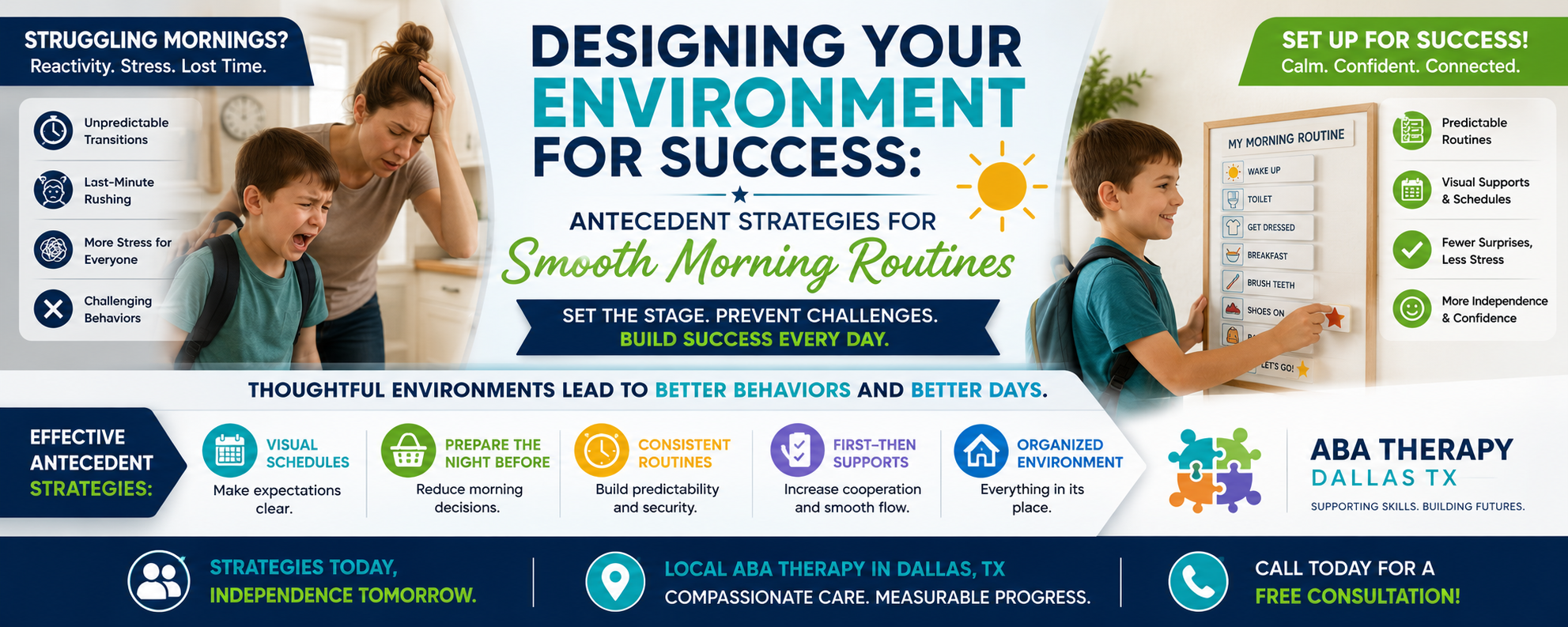
Mornings can set the tone for the entire day. For many families raising a child with autism, however, mornings often feel rushed, stressful, and unpredictable. Getting dressed, eating breakfast, brushing teeth, finding shoes, and leaving on time can quickly become overwhelming when multiple demands are placed on a child within a short period.
One of the most effective approaches used in ABA therapy Dallas TX is focusing on what happens before a behavior occurs rather than only reacting afterward. These proactive techniques are known as antecedent strategies. By making small environmental adjustments, parents can reduce challenging behaviors, increase cooperation, and create smoother, more successful mornings for the entire family.
At Radiant Spectrum Therapy, we work with families throughout Dallas and Highland Park to develop practical solutions that fit their daily lives. Whether services occur in the clinic, home, school, or community, antecedent interventions can dramatically improve morning routines while reducing stress for both children and parents.
Understanding Antecedent Strategies in ABA
In Applied Behavior Analysis (ABA), behavior is often viewed through the ABC model:
- A = Antecedent (what happens before a behavior)
- B = Behavior (the action itself)
- C = Consequence (what happens after the behavior)
Many parents naturally focus on consequences because they occur after the behavior. However, experienced behavior analysts know that modifying antecedents can often prevent challenging behaviors from occurring in the first place.
An antecedent strategy involves changing the environment, instructions, schedule, or expectations before a behavior occurs.
Examples include:
- Creating visual schedules
- Providing warnings before transitions
- Organizing materials in advance
- Simplifying instructions
- Reducing distractions
- Offering choices
These strategies are frequently used in antecedent interventions ABA programs because they proactively set children up for success.
Why Mornings Are Difficult for Many Children with Autism
Before discussing solutions, it’s important to understand why mornings can be challenging.
Many children with autism experience difficulties with:
Transitions
Moving from one activity to another may feel abrupt or overwhelming.
Examples include:
- Leaving bed
- Stopping a preferred activity
- Moving from breakfast to getting dressed
- Leaving home for school
Executive Functioning Challenges
Children may struggle with:
- Planning
- Organization
- Sequencing tasks
- Time management
Without support, even simple morning tasks can become overwhelming.
Sensory Sensitivities
Sensory challenges can create unexpected obstacles.
Examples include:
- Clothing textures
- Bright bathroom lights
- Toothpaste taste
- Hair brushing
- Loud household noises
Communication Difficulties
Some children may have trouble expressing:
- Hunger
- Fatigue
- Anxiety
- Frustration
These emotions may appear as challenging behaviors instead.
This is why autism morning routine strategies often focus on environmental modifications rather than punishment or correction.
The Power of Designing the Environment
One of the core principles of positive behavior support autism programs is recognizing that behavior often reflects the environment.
Instead of asking:
“How do we stop this behavior?”
A better question may be:
“How can we make success easier?”
When families redesign their environment thoughtfully, children often experience:
- Less frustration
- Increased independence
- Better cooperation
- Reduced anxiety
- Improved confidence
Create a Visual Morning Schedule
A visual schedule is one of the most effective tools used in ABA therapy Highland Park TX and throughout the Dallas area.
Visual schedules help children understand:
- What needs to happen
- When it will happen
- What comes next
- When the routine will end
Example Morning Schedule
- Wake up
- Use bathroom
- Get dressed
- Eat breakfast
- Brush teeth
- Put on shoes
- Grab backpack
- Leave for school
Children who struggle with verbal instructions often respond better when expectations are visible.
Benefits of Visual Schedules
- Reduces uncertainty
- Improves transitions
- Promotes independence
- Decreases repetitive reminders
- Reduces anxiety
Many families receiving ABA parent coaching Dallas services report significant improvements after implementing visual schedules.
Prepare the Night Before
Morning success often begins the evening before.
Parents can reduce decision-making and stress by preparing in advance.
Night-Before Checklist
- Lay out clothing
- Pack backpacks
- Prepare lunches
- Charge communication devices
- Set out shoes
- Review the next day’s schedule
When these tasks are completed ahead of time, children face fewer demands during the morning rush.
This simple environmental modification is a powerful example of an antecedent intervention.
Reduce Verbal Overload
Many well-meaning parents accidentally overwhelm children with too many verbal directions.
Examples:
- “Get dressed.”
- “Brush your teeth.”
- “Don’t forget your backpack.”
- “We have to leave soon.”
- “Why aren’t your shoes on yet?”
For some children, processing multiple instructions at once can be difficult.
Try These Alternatives
Use:
- One-step directions
- Visual supports
- Gestures
- Picture cues
Instead of:
“Go get dressed, brush your teeth, and meet me downstairs.”
Try:
“First, get dressed.”
Then provide the next instruction once that task is complete.
This strategy is commonly taught during parent training ABA therapy sessions.
Use Transition Warnings
Unexpected transitions often trigger resistance.
A simple warning can help children prepare mentally.
Examples:
- “Five more minutes.”
- “Two more minutes.”
- “One more minute.”
Visual timers can be especially helpful.
Children can see time passing rather than relying solely on verbal reminders.
Many BCBAs providing BCBA services Dallas TX recommend visual timers as a key component of morning routines.
Build Predictability into the Routine
Predictability reduces anxiety.
Try to keep:
- Wake-up times consistent
- Breakfast routines similar
- Departure times predictable
Consistency allows children to learn what to expect each day.
When routines change, provide advance notice whenever possible.
Example
Instead of surprising your child with:
“We’re leaving early today.”
Try:
“Tomorrow we’ll leave ten minutes earlier because of an appointment.”
This small adjustment can prevent significant stress.
Organize Your Physical Environment
The environment itself can either support success or create obstacles.
Ask yourself:
- Are shoes easy to find?
- Is the backpack in the same location every day?
- Are clothing options organized?
Create Dedicated Stations
Consider creating:
Shoe Station
A designated area for:
- Shoes
- Socks
- Jackets
Backpack Station
A consistent location for:
- Backpack
- Communication folders
- Water bottle
Morning Checklist Area
Place visual schedules in highly visible locations.
Reducing the need to search for items can eliminate unnecessary frustration.
Offer Choices Whenever Possible
Choice-making increases cooperation because it provides a sense of control.
Examples include:
- “Blue shirt or red shirt?”
- “Apple slices or banana?”
- “Brush teeth before breakfast or after breakfast?”
Both options remain acceptable to parents while allowing the child to participate in decision-making.
Choice-making is frequently incorporated into behavior therapy for autism Dallas programs because it can reduce power struggles.
Address Sensory Challenges
Many morning difficulties are actually sensory issues.
Clothing Sensitivities
Some children may dislike:
- Tags
- Certain fabrics
- Tight clothing
Consider:
- Tagless clothing
- Soft fabrics
- Preferred textures
Bathroom Sensitivities
Challenges may involve:
- Bright lights
- Loud fans
- Strong toothpaste flavors
Simple modifications can make these tasks more manageable.
Breakfast Sensitivities
Some children struggle with:
- Food textures
- Smells
- Temperatures
Working with your ABA team can help identify accommodations that support success.
Reinforce Success
While antecedent strategies focus on prevention, reinforcement remains important.
Notice and praise successful behavior.
Examples:
- “Great job getting dressed independently.”
- “You followed your schedule perfectly.”
- “I love how quickly you put on your shoes.”
Specific praise helps children understand exactly what they did well.
Positive reinforcement increases the likelihood that those behaviors will occur again.
Create a Morning Motivation System
For some children, a simple reward system can improve participation.
Examples include earning:
- Extra playtime
- Stickers
- Tokens
- Preferred activities
The key is making expectations clear and achievable.
Morning routines should feel successful rather than overwhelming.
Many families participating in in-home ABA therapy Dallas services use customized token systems to encourage independence.
Common Mistakes Parents Make
Even with the best intentions, certain habits can make mornings harder.
Waiting Until Problems Occur
Reactive strategies often create stress.
Proactive planning is usually more effective.
Too Many Changes at Once
Introduce one strategy at a time.
Gradual changes tend to be more successful.
Inconsistent Expectations
Children benefit from consistency.
If expectations change daily, routines become harder to learn.
Forgetting Individual Needs
Every child is different.
What works for one child may not work for another.
This is why individualized support is such an important part of autism therapy Dallas TX.
How ABA Therapy Supports Morning Routine Success
Professional ABA services can help families identify the specific factors contributing to morning challenges.
A BCBA may:
- Conduct assessments
- Identify behavioral patterns
- Develop visual supports
- Create individualized interventions
- Train parents
- Monitor progress
The goal is not simply compliance.
The goal is creating routines that support independence, confidence, and family well-being.
At Radiant Spectrum Therapy, our team works closely with families to develop practical solutions that can be implemented in everyday life.
Supporting Families in Dallas and Highland Park
Families throughout Dallas and Highland Park face unique schedules, school demands, and daily responsibilities. Morning stress can affect everyone in the household, but effective antecedent strategies can transform the start of the day.
Whether your child struggles with transitions, sensory sensitivities, communication challenges, or independence skills, proactive environmental modifications can create meaningful improvements.
Through individualized treatment plans, ABA therapy Dallas TX, parent coaching, and ABA therapy Highland Park TX services, families can learn practical techniques that make daily routines more manageable and enjoyable.
Related Services to Explore
When optimizing this article, consider linking internally to:
- ABA Therapy Services
- In-Home ABA Therapy
- Parent Training Programs
- BCBA Consultation Services
- Early Intervention Programs
- Social Skills Training
- School Readiness Programs
- Autism Assessments
- Family Support Services
Conclusion
Creating smoother mornings is not about enforcing stricter rules or increasing consequences. Instead, it often begins with changing what happens before behavior occurs. By using antecedent interventions ABA, visual schedules, environmental organization, transition supports, sensory accommodations, and positive reinforcement, families can dramatically reduce stress and improve cooperation.
At Radiant Spectrum Therapy, we help families throughout Dallas and Highland Park use evidence-based strategies that support long-term success. Through ABA therapy Dallas TX, in-home ABA therapy Dallas, and personalized parent training ABA therapy, families can build routines that encourage independence, confidence, and positive behavior from the moment the day begins.
FAQ
What are antecedent interventions in ABA?
Antecedent interventions are proactive strategies that modify the environment before a behavior occurs. They are designed to prevent challenging behaviors and increase successful outcomes.
Why are morning routines difficult for children with autism?
Common reasons include transition difficulties, sensory sensitivities, communication challenges, anxiety, and executive functioning deficits.
Can ABA therapy help improve morning routines?
Yes. ABA professionals can assess challenges, identify triggers, create visual supports, teach replacement skills, and train parents to implement effective strategies.
What is the best morning routine strategy for autism?
There is no one-size-fits-all solution, but visual schedules, consistency, transition warnings, and environmental organization are often highly effective.
Does Radiant Spectrum Therapy provide parent training?
Yes. Parent training is an important component of our services and helps families implement evidence-based strategies at home, school, and in the community.
Contact us at 972–310–4991 or visit https://radiantspectrumtherapy.com/ to learn more.