
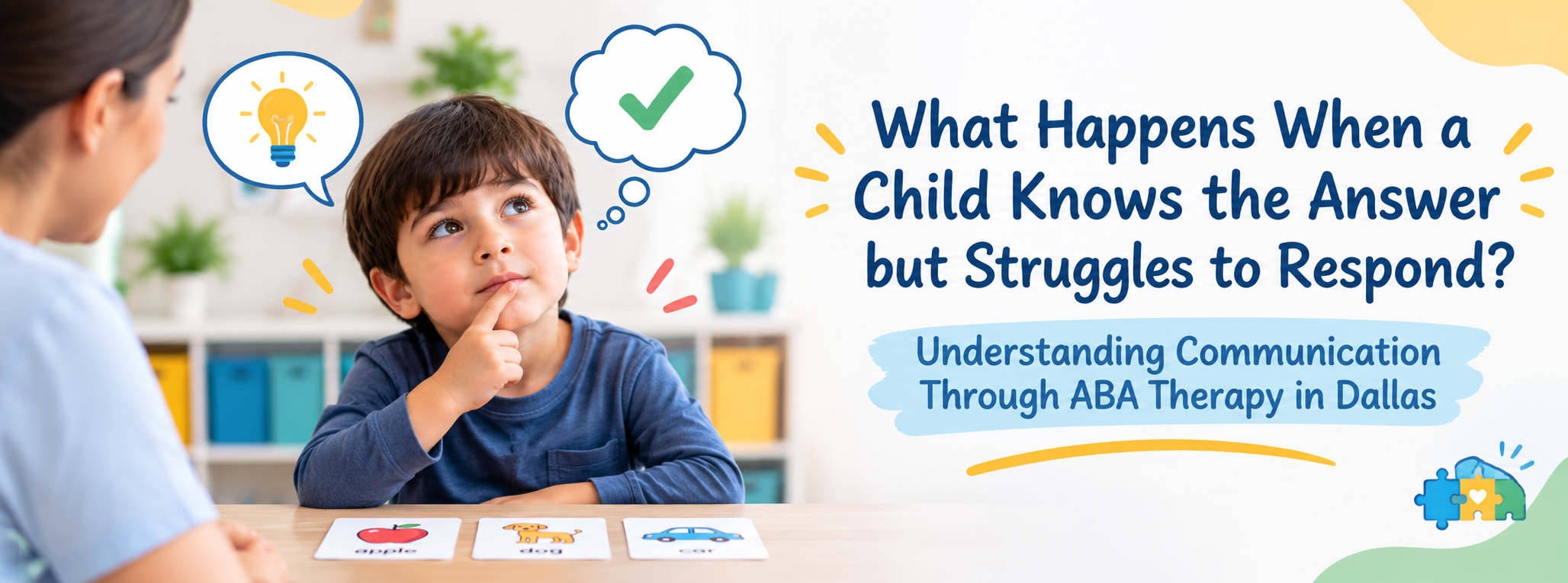
A child may clearly understand what someone is saying but still struggle to respond. They may answer a question incorrectly, repeat part of the question, take a long time to respond, walk away, or seem as though they are not listening. These moments can be confusing for parents, especially when their child demonstrates understanding in other situations. ABA Therapy in Dallas can help families understand what may be happening and teach communication skills in ways that are individualized to each child’s needs.
Communication is more than simply talking. A child may have words, phrases, or even a large vocabulary while still experiencing difficulty with the back-and-forth nature of conversation. Responding to questions, requesting help, commenting, taking turns, and understanding what another person expects can all involve different skills.
For families exploring ABA therapy Dallas, understanding the difference between knowing an answer and being able to respond consistently can be an important starting point.
Knowing the Answer Is Not Always the Same as Responding
One of the most important things parents may notice is that their child sometimes appears to know the answer but cannot provide it when asked.
For example, a child may correctly identify animals in a book but struggle when someone asks, “What animal is that?” They might point instead of speaking, repeat “What animal is that?” or remain quiet.
This does not necessarily mean the child does not know the information.
The difficulty may involve the communication process itself.
Responding requires a child to:
- Notice that someone is speaking to them
- Understand what the person is asking
- Process the question
- Determine what information is needed
- Select an appropriate response
- Communicate that response
- Continue the interaction when another question follows
Each of these steps can involve separate skills.
This is one reason Applied Behavior Analysis Dallas services often focus on observable communication behaviors rather than assuming a child is simply choosing not to respond.
Why Can a Child Understand but Struggle to Respond?
There are many possible reasons a child may have difficulty responding consistently.
Processing Time May Be Different
Some children need additional time to process spoken language.
A parent might ask a question and receive no answer immediately. If the question is repeated several times, the child may eventually respond.
In this situation, giving the child more time may be helpful.
Rapid questioning can unintentionally make the interaction more difficult. Instead of immediately asking the same question again, an adult can pause and allow the child an opportunity to process what was said.
The Question May Be Too Broad
Questions such as “What did you do today?” require a child to think about multiple events, choose one, organize the information, and communicate it.
For a child who struggles with open-ended questions, a more specific question may be easier.
For example:
“What did you eat for lunch?”
may be easier to answer than:
“How was your day?”
This does not mean the child should always receive simple questions. Rather, communication can be developed gradually by starting with skills the child can successfully practice.
Understanding and Expressive Communication Can Differ
A child may understand considerably more language than they can express.
They may follow directions, identify objects, or demonstrate knowledge without being able to formulate a verbal response quickly.
This distinction is important when considering ABA therapy for autism Dallas. A child’s receptive and expressive communication skills may develop at different rates.
Repeating the Question May Be Communication, Too
Parents sometimes notice that their child repeats exactly what was just said.
For example:
Parent: “Do you want juice?”
Child: “Do you want juice?”
At first, this may look like the child did not understand the question. However, repetition can serve different purposes depending on the child and situation.
A child may be:
- Processing the language they heard
- Practicing words
- Attempting to participate in the conversation
- Unsure how to answer
- Seeking additional information
- Using familiar language instead of generating a new response
The goal should not simply be to stop repetition.
Instead, behavior therapy Dallas professionals may look at what happens before and after the behavior and determine what communication skill could be taught or strengthened.
Communication Is More Than Verbal Answers
A common misconception is that successful communication always means giving a spoken answer.
Children communicate in many different ways.
Communication may include:
- Words
- Gestures
- Pointing
- Facial expressions
- Sign language
- Picture-based communication
- Communication devices
- Body movements
- Written responses
For some children, alternative or augmentative communication can provide an important way to express wants, needs, thoughts, and choices.
The goal of autism behavior therapy Dallas is not to make every child communicate in exactly the same way. Effective intervention should consider the individual child’s current abilities and functional communication needs.
What Does ABA Therapy Look At?
ABA therapy services Dallas programs may examine communication within everyday situations rather than looking at isolated skills.
A BCBA may observe questions such as:
- When does the child respond successfully?
- Which types of questions are difficult?
- Does the child respond better to familiar people?
- Does the child need additional processing time?
- Are visual supports helpful?
- Does the child communicate more effectively during preferred activities?
- What happens when communication becomes difficult?
- What skills would make daily interactions easier?
This information can help create individualized goals.
For example, one child may need support answering simple “who” questions. Another may need to practice requesting assistance. A third child may need help participating in short conversational exchanges.
There is no single communication program that works identically for every child.
How ABA Can Teach Better Responses
A major component of behavioral intervention Dallas TX can be breaking complex skills into smaller, teachable steps.
Instead of expecting a child to immediately carry on a long conversation, therapy may begin with simpler communication exchanges.
Start With Familiar Questions
A child may begin by practicing questions they can answer successfully.
Examples include:
“What is your name?”
“How old are you?”
“What do you want?”
“Where is your shoe?”
Success with familiar questions can create opportunities to practice responding.
Provide Appropriate Support
Some children benefit from prompts.
A prompt may involve:
- A visual cue
- A gesture
- A verbal hint
- Modeling
- Offering choices
The purpose is not to answer for the child indefinitely. Instead, supports can help the child learn the response and gradually become more independent.
Reinforce Communication Attempts
When a child attempts to communicate successfully, positive reinforcement can help make that behavior more valuable and likely to occur again.
Reinforcement should be individualized.
For one child, receiving access to a preferred activity may be motivating. For another, praise, attention, or continuing an enjoyable interaction may be meaningful.
This is one reason individualized pediatric ABA therapy Dallas can be different from a standardized approach.
Why Waiting Can Be an Important Skill
Adults often feel uncomfortable with silence.
A parent asks a question, waits for a moment, and then asks it again because there has been no response.
But the child may still be processing the first question.
A brief pause can provide an opportunity for the child to respond independently.
Therapists and caregivers can work together to identify an appropriate amount of wait time for the individual child.
This can be especially useful for children who demonstrate understanding but need additional processing time.
Practicing Communication During Everyday Activities
Communication skills do not only happen during formal therapy sessions.
Everyday routines create natural opportunities to practice.
Mealtimes
Parents can encourage simple requests and choices.
“Do you want milk or water?”
“More?”
“All done?”
These short exchanges can create functional communication opportunities.
Playtime
Play can provide opportunities to practice:
- Requesting
- Turn-taking
- Commenting
- Answering questions
- Following directions
- Initiating interactions
A child may be more motivated to communicate when the interaction involves something they genuinely enjoy.
Getting Ready
Daily routines can also create opportunities for communication.
Parents might encourage a child to request a missing item, identify clothing, follow a sequence, or ask for assistance.
These skills can transfer directly into everyday independence.
In-Home ABA Therapy Can Bring Practice Into Daily Routines
For some families, in-home ABA therapy Dallas can provide an opportunity to practice communication within the environment where many daily interactions naturally occur.
A therapist may be able to work on communication during routines such as meals, dressing, play, transitions, and household activities.
This can allow skills to be practiced in meaningful situations rather than only in a structured setting.
For families considering ABA therapy near Dallas, the setting of therapy is one factor to discuss with a qualified provider when determining what type of service fits their child’s needs.
Center-Based ABA Therapy Can Provide Structured Practice
Some children may benefit from center-based ABA therapy Dallas, where therapy takes place in a structured environment with planned activities and opportunities for social interaction.
A center-based setting can provide opportunities to practice communication across different activities and with different people.
The right setting depends on the child’s needs, family circumstances, treatment goals, and recommendations from qualified professionals.
Some children may benefit from one setting, while others may use a combination of approaches.
What BCBA Services Can Contribute
A Board Certified Behavior Analyst, or BCBA, can help assess a child’s behavior and communication skills and develop individualized intervention goals.
BCBA services Dallas may involve:
- Assessing current communication skills
- Identifying barriers to responding
- Developing measurable goals
- Selecting teaching strategies
- Training caregivers
- Monitoring progress
- Adjusting interventions when needed
A BCBA may also consider how communication difficulties affect other areas of a child’s life.
For example, a child who cannot easily answer questions may also have difficulty asking for help, participating in school activities, interacting with peers, or communicating during community outings.
Addressing functional communication can therefore support many areas of daily life.
Parents Can Support Communication at Home
Families do not need to turn every conversation into a therapy session.
Small changes can make everyday interactions more supportive.
Give One Question at a Time
Asking several questions in a row can become overwhelming.
Instead of:
“What did you do at school, who did you play with, and what did you eat?”
Try one question at a time.
Allow Processing Time
Ask the question and pause.
Give your child an opportunity to respond before immediately repeating or changing the question.
Use Choices When Appropriate
Choices can make responding easier.
For example:
“Do you want apples or bananas?”
This can be easier than:
“What do you want?”
Celebrate Attempts
Communication does not need to be perfect to be meaningful.
A child who points, gestures, uses a word, or uses a communication device to express a need is communicating.
Recognizing those attempts can encourage continued communication.
When Should Parents Consider Additional Support?
Occasional difficulty responding is common among children.
However, parents may want to discuss communication concerns with a pediatrician or qualified developmental professional when difficulties are persistent or significantly interfere with everyday life.
Consider seeking additional guidance if a child frequently:
- Does not respond to questions or their name
- Has difficulty communicating basic needs
- Relies heavily on repetition
- Becomes frustrated when trying to communicate
- Has difficulty participating in age-appropriate interactions
- Understands considerably more than they can express
- Struggles with communication across multiple environments
An evaluation can help determine what support may be appropriate.
Families searching for ABA therapy cost Dallas, how ABA therapy works Dallas, or find ABA therapist Dallas may also want to ask providers about assessment procedures, treatment goals, caregiver involvement, therapy settings, and how progress is measured.
Choosing an ABA Program for Your Child
When researching ABA clinics in Dallas, families may encounter many different programs and service models.
Rather than focusing only on labels, it can be helpful to ask specific questions about the services provided.
Consider asking:
- How is my child’s communication currently assessed?
- How are treatment goals selected?
- How is progress measured?
- How are parents involved?
- What communication methods are supported?
- How are prompts gradually reduced?
- How does the team help skills transfer into everyday environments?
- Is therapy available in-home, center-based, or both?
- How often are goals reviewed?
These questions can help families better understand what a program offers and whether its approach matches their child’s individual needs.
Communication Growth Takes Time
A child who struggles to respond today may develop stronger communication skills with appropriate teaching, practice, and support.
Progress may not always look like suddenly answering every question.
It may look like:
- Responding after a short pause
- Answering a familiar question independently
- Asking for help
- Making a choice
- Initiating an interaction
- Taking a turn in conversation
- Using a new communication method
- Responding in a new environment
Each of these can represent meaningful progress.
The goal is not simply to produce an answer. The larger goal is to help a child communicate more effectively and participate more independently in everyday life.
Understanding the Child Behind the Response
When a child does not answer a question, it can be easy to interpret the behavior as ignoring, refusing, or not paying attention.
But communication is complex.
A child may understand the question and still need support turning that understanding into a response. They may need more processing time, a different type of prompt, a clearer question, or a communication system that better matches their abilities.
ABA Therapy in Dallas can provide individualized support for children who are developing communication, social, behavioral, and independence skills. Through careful assessment and structured teaching, ABA therapy in Dallas can help families identify the skills behind difficult moments and create opportunities for children to practice meaningful communication.
For parents exploring Dallas autism services, autism support services Dallas, developmental therapy Dallas, special needs therapy Dallas, or ABA therapy near me Dallas, the most important starting point is understanding the child’s individual strengths and needs.
A child who answers differently, responds slowly, or struggles to respond consistently is still communicating. With patient support, appropriate teaching strategies, and opportunities to practice, those communication skills can continue to grow.
Contact us at 972–310–4991 or visit https://radiantspectrumtherapy.com/ to learn more.