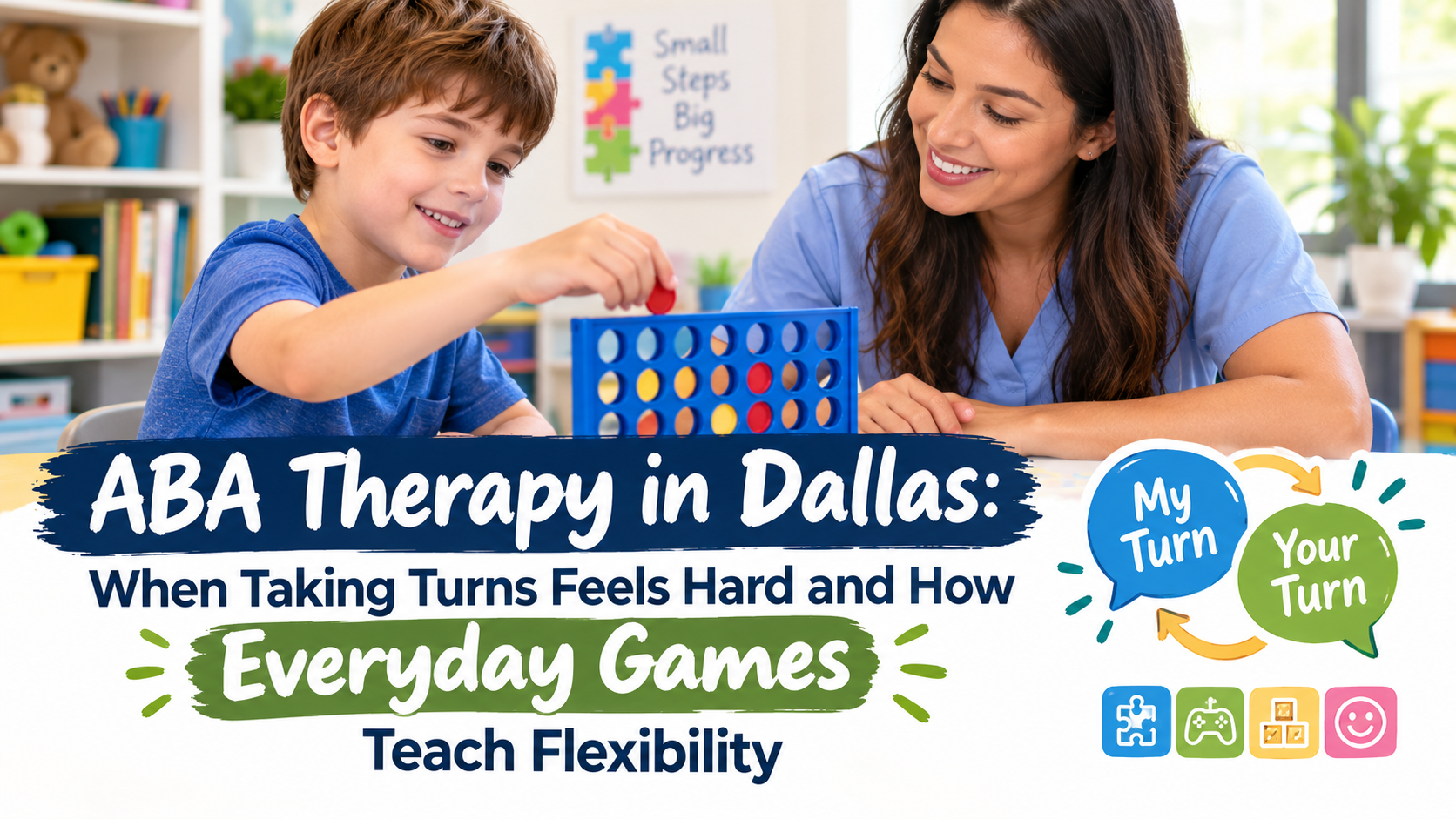

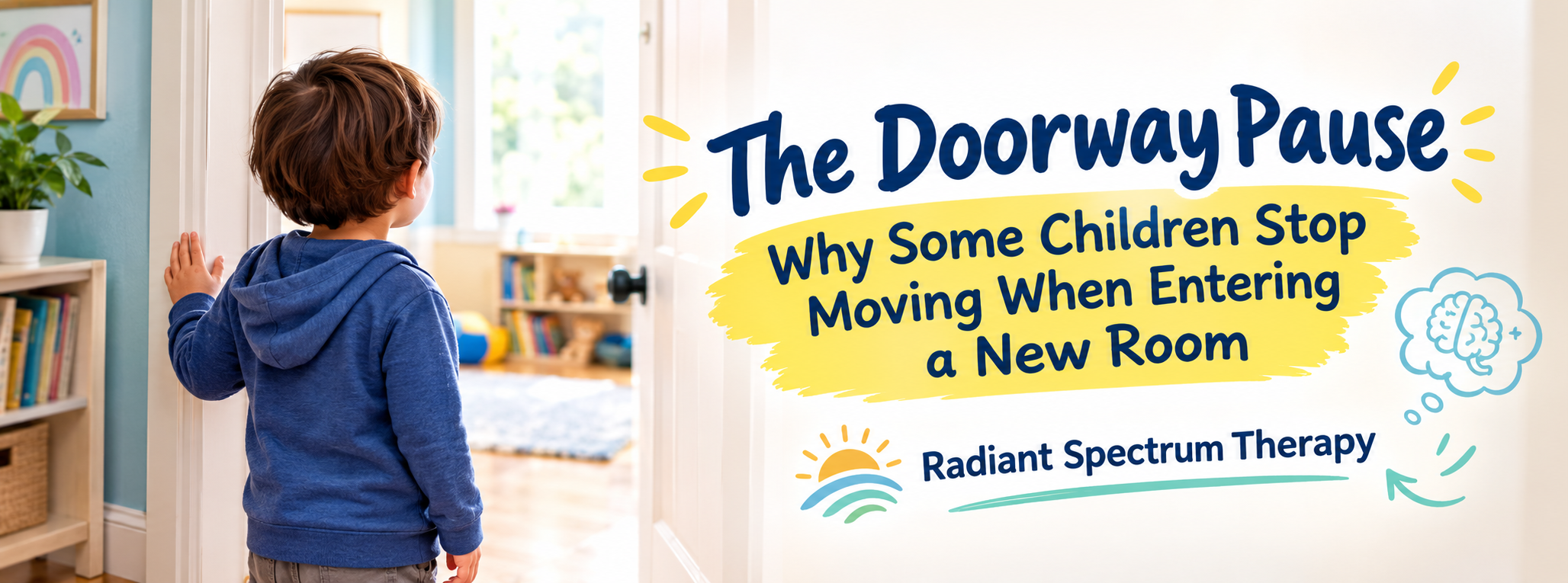
Have you ever watched your child walk toward a new room, reach the doorway, and suddenly stop? They may stand completely still, look around, turn back, or seem unsure about taking the next step. For some children, especially children with autism or developmental differences, this brief “doorway pause” can happen regularly.
Understanding this behavior is one of the many areas where ABA Therapy in Dallas can help families look beyond what a child is doing and explore why they are doing it. A child stopping at a doorway is not necessarily being stubborn, refusing to cooperate, or “not listening.” There may be a very specific reason the transition feels difficult.
For families in Dallas, Highland Park, and surrounding communities, understanding the behavioral function behind these moments can make everyday transitions less stressful. With thoughtful observation and individualized support, children can learn strategies that make moving from one environment to another more predictable and comfortable.
What Is the “Doorway Pause”?
The doorway pause is not a formal diagnosis or clinical term. It is simply a way to describe a behavior some parents and therapists notice when a child approaches a transition point and temporarily stops.
The pause might last only a few seconds, or it could continue for several minutes.
A child might:
- Stop at the doorway without moving forward.
- Look around the new room before entering.
- Hold onto the doorframe.
- Step backward or return to the previous room.
- Ask repeated questions about where they are going.
- Become upset when encouraged to continue.
- Wait for an adult to physically guide them.
- Become distracted by something near the doorway.
- Cover their ears or show other signs of discomfort.
The important part is not simply noticing that the child stopped. It is figuring out what happens immediately before and after the pause.
That information can provide valuable clues.
Why Can a New Room Feel Like a Big Change?
To an adult, walking from one room to another may seem insignificant. For a child, however, the change can involve multiple unfamiliar variables at once.
The lighting may be different. The sounds may change. The floor may feel different under their feet. There may be unfamiliar objects, people, smells, or activities.
Even when the physical distance is only a few feet, the environment has changed.
For children receiving ABA therapy for autism Dallas families often discover that seemingly small environmental differences can influence behavior.
The Brain May Need Time to Process the Change
Moving through a doorway requires a child to stop interacting with one environment and begin processing another.
Imagine being comfortable in a quiet bedroom and then entering a busy playroom. Suddenly, there may be voices, toys, movement, music, brighter lights, and people asking questions.
A child who pauses may simply need a moment to understand what is happening.
This does not mean the child is incapable of transitioning. It may mean the transition currently requires more processing time.
Predictability Can Make Transitions Easier
Many children do better when they know what is coming next.
If a child is playing with a preferred toy and suddenly hears, “Come on, we’re going to the other room,” they may have no clear idea what awaits them.
The doorway becomes a boundary between the activity they understand and something uncertain.
Visual schedules, verbal countdowns, transition cues, and consistent routines can help make that boundary less intimidating.
The ABA Perspective: Look at What Happens Around the Behavior
One of the most useful concepts in Applied Behavior Analysis Dallas families can learn is that behavior does not happen in isolation.
Instead of asking only, “How do I get my child through the doorway?” a behavior professional may ask:
What happened before the child stopped?
What did the child do?
What happened immediately afterward?
This type of observation can help identify patterns.
The Antecedent
The antecedent is what happens immediately before a behavior.
For a doorway pause, the antecedent might be:
- A parent saying, “Let’s go to the kitchen.”
- A preferred activity ending.
- A transition from a quiet room to a noisy room.
- A request to complete a difficult task.
- A change in the child’s usual routine.
- The appearance of unfamiliar people.
- A sudden change in lighting or sound.
Identifying the antecedent helps therapists understand what may be setting the stage for the pause.
The Behavior
The behavior is the observable action.
In this example, it may be stopping, backing away, crying, dropping to the floor, holding onto furniture, or simply standing motionless.
Describing the behavior objectively is important.
Instead of saying, “My child refuses to go into the room,” a parent might document:
“When asked to enter the playroom, my child stopped at the doorway, looked inside for approximately 20 seconds, and then walked back to the bedroom.”
That description gives a therapist much more useful information.
The Consequence
The consequence is what happens immediately after the behavior.
Does the parent wait?
Does the child get to stay in the original room?
Does someone carry the child inside?
Does the transition disappear?
Does the child receive reassurance?
Does the child get access to a preferred item?
These details can help a BCBA determine what may be maintaining the behavior.
Is the Doorway Pause Avoidance?
Sometimes the answer may be yes.
Imagine that every time a child reaches the doorway of the bathroom, an adult asks them to brush their teeth.
The child stops.
The parent waits.
The child eventually returns to the living room.
If the brushing task is delayed, the pause may be serving an escape or avoidance function.
This doesn’t mean the child is intentionally manipulating the situation. Behavior can become more likely simply because it has previously produced a particular outcome.
In behavior therapy Dallas families can learn how to identify these patterns without labeling a child as defiant or difficult.
The goal is not to punish the pause.
The goal is to understand it and teach a more effective response.
Or Could It Be Sensory Overload?
Avoidance is not the only possible explanation.
A new room may contain sensory information that is difficult for a child to tolerate.
Consider a child walking toward a room with:
- Loud voices.
- A television playing.
- Bright overhead lights.
- Strong smells.
- Crowded furniture.
- Multiple people moving around.
- A buzzing appliance.
- A different floor texture.
The doorway may become the point where the child realizes what they are about to experience.
Stopping could be the child’s way of gathering information or protecting themselves from something uncomfortable.
This is one reason individualized assessment matters.
A strategy that works beautifully for one child may not be appropriate for another.
What If the Child Is Waiting for Information?
Some children pause because they are unsure what is expected of them.
Adults often provide directions using assumptions that children may not share.
For example:
“Let’s go!”
An adult may understand that this means:
- Stop what you’re doing.
- Stand up.
- Walk to the doorway.
- Enter the next room.
- Go to the requested location.
- Begin the next activity.
But the child may only hear a vague instruction to move.
Breaking a transition into smaller, predictable steps can make the expectation clearer.
For children receiving ABA therapy services Dallas providers may use individualized prompting and reinforcement strategies to help children become more independent with transitions.
The Doorway Can Become a Predictive Cue
Here’s an interesting behavioral concept.
A doorway itself can become associated with what happens next.
If a child repeatedly experiences difficult demands immediately after entering a particular room, the doorway may eventually become a signal that something challenging is coming.
For example:
Bedroom → doorway → bathroom → tooth brushing
If tooth brushing is consistently difficult, the child may eventually begin slowing down before even entering the bathroom.
The pause may start earlier and earlier in the sequence.
This is why therapists often look at the entire routine rather than focusing on one isolated behavior.
How Parents Can Make Doorway Transitions Easier
Families do not need to turn every transition into a complicated therapy exercise.
Small changes can make a meaningful difference.
Give a Transition Warning
Instead of abruptly ending an activity, provide a simple warning.
For example:
“Two more minutes, then kitchen.”
Then:
“One more minute, then kitchen.”
Then:
“Kitchen time.”
The exact wording is less important than consistency.
Use Visual Supports
A simple picture schedule can show:
Play → Kitchen → Snack → Bathroom
For some children, seeing what comes next is easier than processing a long verbal explanation.
A visual transition cue may also be useful when moving between rooms at home.
Make the First Step Very Clear
Instead of saying:
“Come on, let’s go.”
Try:
“Stand up.”
Then:
“Walk to the doorway.”
Then:
“Walk to the kitchen.”
Clear, manageable directions can reduce uncertainty.
Allow Processing Time
One of the easiest mistakes adults make is repeating a direction immediately.
“Come on.”
“Let’s go.”
“Come on.”
“Why aren’t you moving?”
For a child who needs extra processing time, repeated instructions can actually increase pressure.
Give the child a moment to respond.
Reinforce Successful Transitions
If a child successfully walks through the doorway, notice it.
“Great walking!”
“You came right into the kitchen!”
“Nice transition!”
For some children, a meaningful reinforcer can make practicing transitions more motivating.
This is an area where individualized ABA therapy for kids Dallas programs may help determine which forms of reinforcement are most effective for a particular child.
What About Children Who Freeze Completely?
Some children don’t cry, resist, or run away.
They simply stop.
This can be easy to overlook because the behavior may not appear disruptive.
But “quiet” does not necessarily mean “comfortable.”
A child who freezes at a doorway may be experiencing uncertainty, sensory discomfort, anxiety-like responses, difficulty processing instructions, or another challenge.
Parents and caregivers should look at the child’s entire body language.
Are they:
- Looking repeatedly toward the room?
- Covering their ears?
- Clenching their hands?
- Avoiding eye contact?
- Breathing differently?
- Looking toward a parent for help?
- Repeating a phrase?
- Attempting to leave?
- Waiting for a familiar cue?
These details can help professionals understand what the child may be communicating through behavior.
When Doorway Pauses Happen at School or in Public
The behavior isn’t always limited to the home.
A child may pause when entering:
- A classroom.
- A doctor’s office.
- A therapy center.
- A restaurant.
- A grocery store.
- A relative’s house.
- A playground.
- A crowded event.
In these settings, the environment is less predictable.
For families looking into in-home ABA therapy Dallas, practicing transitions in familiar environments can provide opportunities to build skills gradually.
A therapist may also help caregivers identify strategies that can eventually be generalized to community settings.
Generalization Matters
Learning to walk from the bedroom into the kitchen is one skill.
Being able to transition from a car into a doctor’s office is another.
A child may learn a transition strategy in one environment but struggle when the surroundings change.
This is why effective behavioral intervention Dallas TX services often consider how skills will transfer across people, locations, and situations.
The ultimate goal isn’t simply:
“Get through this doorway.”
The goal is:
Help the child become more comfortable and independent with transitions across everyday life.
When Should Parents Seek Professional Guidance?
An occasional pause is not automatically a sign that something is wrong.
Children can hesitate because they are tired, distracted, unsure, or simply don’t want to stop what they are doing.
However, professional guidance may be helpful when transitions consistently interfere with daily routines.
Consider seeking support if your child regularly:
- Becomes extremely distressed during room-to-room transitions.
- Avoids specific rooms.
- Drops to the floor when asked to transition.
- Runs away from transition areas.
- Becomes aggressive or self-injurious during transitions.
- Requires extensive physical prompting.
- Struggles with transitions at home, school, and community settings.
- Appears overwhelmed by changes in sensory environments.
- Is becoming increasingly dependent on adults to move between activities.
A BCBA can observe the behavior, look for patterns, and help develop an individualized intervention plan.
How ABA Can Address Transition Challenges
ABA therapy in Dallas can address transition-related behaviors by focusing on the individual child’s needs rather than using a one-size-fits-all approach.
Depending on the assessment, treatment may involve:
Teaching Functional Communication
A child may need a way to communicate:
“I need more time.”
“I don’t want to go yet.”
“It’s too loud.”
“Help me.”
“What’s next?”
Teaching functional communication can give children alternatives to simply stopping or becoming distressed.
Building Transition Tolerance Gradually
A child who struggles with a five-minute transition may not benefit from immediately being expected to handle a complicated transition independently.
A therapist may break the skill into smaller steps and gradually increase expectations.
Pairing Transitions With Positive Experiences
If a particular room has become associated with difficult tasks, therapists may look for ways to introduce positive experiences into that environment.
This can help change the child’s expectations over time.
Teaching Independence
The long-term goal is not for an adult to physically guide a child through every doorway.
Instead, children can learn to recognize transition cues, follow routines, communicate needs, and move between activities with increasing independence.
A Dallas and Highland Park Perspective
Families throughout Dallas and Highland Park encounter transitions everywhere — not just at home.
A child may need to move from a bedroom to the kitchen, from the car into a clinic, from a classroom into the hallway, or from a playground into the car.
These everyday moments can become opportunities for skill development.
For parents exploring ABA therapy in Dallas, an individualized approach can help uncover why a child is struggling with transitions and identify practical ways to support them.
Services such as in-home ABA therapy Dallas families use can be especially helpful when transition challenges occur naturally throughout the home. A therapist can observe routines where they actually happen and work with caregivers to build strategies into everyday life.
For families in Highland Park and nearby Park Cities communities, therapy can similarly focus on practical skills that support participation at home, school, and in the community.
The Goal Isn’t to Eliminate Every Pause
It can be tempting to think success means a child should immediately walk through every doorway without hesitation.
But that isn’t necessarily the most meaningful goal.
Sometimes a child simply needs a few extra seconds.
Sometimes they need a visual cue.
Sometimes they need to communicate that something is uncomfortable.
Sometimes they need support understanding what happens next.
Progress may look like a child who once needed physical guidance now walking through the doorway independently after seeing a visual cue.
It may look like a child who used to cry now saying, “Wait.”
It may look like a child who needed several minutes to transition now moving forward after a short countdown.
Those small changes matter.
Final Thoughts
The next time your child stops at a doorway, try to see the pause as information rather than misbehavior.
What happened immediately before it?
What does the new room look, sound, and feel like?
What happens after your child stops?
Does the pause help them escape something, gain assistance, access something they want, or simply give them time to process?
Those questions can reveal much more than simply asking, “Why won’t my child move?”
For families exploring ABA Therapy in Dallas, these everyday moments can provide valuable opportunities to understand behavior, teach communication, build transition skills, and increase independence. Whether the challenge happens at home in Dallas, in a Highland Park community setting, or somewhere else entirely, the right support can help a child move from uncertainty toward greater confidence — one doorway at a time.
Contact us at 972–310–4991 or visit https://radiantspectrumtherapy.com/ to learn more.