
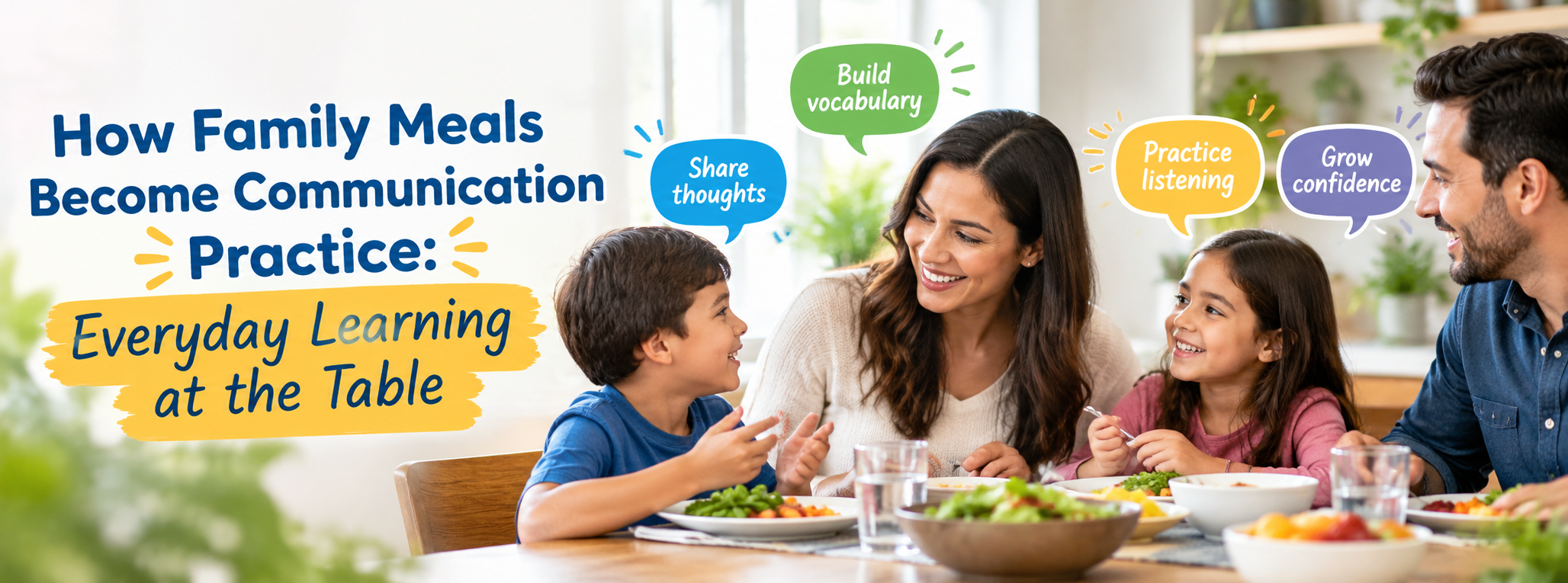
Family meals can be much more than a time to eat together. For children who are developing communication and social skills, the dinner table can become a natural place to practice requesting, answering questions, taking turns, making choices, and participating in simple conversations. For families exploring ABA Therapy in Dallas, everyday routines like meals can provide valuable opportunities to support skills that children can use at home, school, and in the community.
A family meal does not need to look like a therapy session. In fact, it can be more helpful when communication practice happens naturally. A child might ask for more food, point to a preferred item, answer a question about their day, or wait for another person to finish speaking. Each of these small moments can become an opportunity to encourage communication.
Whether a child receives ABA therapy Dallas families can access through in-home or center-based services, communication goals can often be connected to familiar routines. Family meals are one of the easiest routines to build into because they happen regularly and involve plenty of natural interaction.
Why Family Meals Create Natural Communication Opportunities
Mealtimes naturally involve communication.
Someone needs to ask for a drink. Another person may offer a food choice. Parents may ask questions, siblings may tell stories, and children may express preferences or needs.
For a child working on communication skills, these moments can provide practice without requiring a separate activity.
Meals involve many types of communication
During a typical meal, children may have opportunities to practice:
- Requesting food or drinks
- Choosing between two options
- Answering simple questions
- Asking for help
- Commenting on food
- Greeting family members
- Taking conversational turns
- Waiting patiently
- Following simple directions
- Identifying foods and objects
- Expressing likes and dislikes
- Using appropriate social responses
These skills can be particularly important for children receiving Applied Behavior Analysis Dallas families use to support communication, independence, social interaction, and other developmental goals.
The goal is not to turn every bite into a lesson. Instead, parents can notice opportunities that are already happening and give their child a reason to communicate.
Start With Communication That Has a Purpose
One of the most useful ways to encourage communication at the table is to create situations where communication actually helps the child get what they need.
For example, instead of automatically placing every preferred item within reach, a parent might place a small serving on the table and wait for the child to indicate that they want more.
That communication could look different depending on the child’s current skills.
A child might:
- Reach toward the item
- Point
- Use a picture or communication device
- Sign
- Say a word
- Use a short phrase
- Ask a complete question
The important part is meeting the child at their current communication level while gradually supporting progress.
Families considering ABA therapy for autism Dallas programs can also discuss individual communication goals with their BCBA. A child’s therapy team can help identify appropriate ways to encourage requesting and other functional communication skills during everyday routines.
Let Children Make Choices
Choice-making is another simple skill that can be practiced during meals.
Instead of asking a broad question such as, “What do you want?” try offering two clear choices.
For example:
“Do you want apples or strawberries?”
“Milk or water?”
“Chicken or pasta?”
Giving choices can make communication easier for children who have difficulty responding to open-ended questions.
It also gives children a meaningful reason to communicate.
Choices can build more than language
Making a choice can support several skills at once.
A child has to notice the options, decide what they prefer, communicate that decision, and then understand the result.
For children receiving early intervention ABA Dallas services, these everyday opportunities may be especially useful because early communication skills can be incorporated into familiar routines.
Parents can ask their child’s therapy team about ways to make choice-making appropriate for the child’s current developmental level.
Practice Asking for Help
Family meals also create natural opportunities to practice asking for assistance.
A container might be difficult to open. A spoon might be missing. A preferred food might be out of reach.
Rather than immediately solving every problem, parents can pause briefly and give the child an opportunity to communicate.
For example:
“Need help?”
The child might respond verbally, with a gesture, through a communication device, or in another established way.
The purpose is not to frustrate the child. It is to create a reasonable opportunity for functional communication.
For families using in-home ABA therapy Dallas, these types of routines can be especially convenient because therapists can help caregivers identify communication opportunities within the child’s actual home environment.
Turn “How Was Your Day?” Into Easier Questions
Many parents ask, “How was your day?” because they want to start a conversation.
For some children, however, this question can be difficult to answer.
It is broad, requires recalling information, and does not provide much guidance about what kind of response is expected.
Instead, try asking specific questions.
Try questions like:
- “What did you eat for lunch?”
- “Did you play outside?”
- “Who did you sit with?”
- “What was your favorite activity?”
- “Did anything funny happen?”
- “What game did you play?”
- “What was easy today?”
- “What was hard?”
You can also use the meal itself as a conversation starter.
“What does your food smell like?”
“Is your chicken hot or cold?”
“Which food do you like better?”
“Does this taste sweet or salty?”
The goal is to make conversation easier to enter rather than expecting a child to immediately produce a detailed story.
Practice Taking Turns
Communication is not only about talking.
Listening and taking turns are important parts of social interaction too.
Family meals naturally create a turn-taking environment. One person talks while others listen. Someone asks a question, and another person responds.
Parents can make this practice simple.
For example, each family member could answer one question before moving to the next person.
A parent might say:
“Everyone gets a turn. Let’s start with Emma.”
After Emma responds, another family member gets a turn.
This creates a predictable structure that can make participation easier for children who benefit from clear expectations.
For children receiving pediatric ABA therapy Dallas families seek for communication and social development, structured turn-taking can be one area to discuss with the child’s treatment team.
Encourage Comments, Not Just Requests
Requesting is an important communication skill, but children also benefit from learning how to comment.
A child might learn to say:
“That’s good.”
“I like this.”
“Look at my plate.”
“It’s hot.”
“I want more.”
“That’s funny.”
Parents can model these types of comments naturally during meals.
If a parent takes a bite and says, “This is really good,” the child may eventually begin using similar language.
There is no need to demand that a child repeat every phrase. Modeling language gives the child examples of how communication can be used socially.
Use Siblings as Communication Partners
Siblings can provide additional opportunities for social interaction.
A brother or sister might ask:
“Do you want the blue cup?”
“What are you eating?”
“Do you want some?”
“Is that your favorite?”
These interactions can help children practice communicating with people other than adults.
However, siblings should not be expected to become therapists. Their role is simply to participate as family members.
Parents can encourage natural interaction without making the entire meal revolve around therapy goals.
This is one reason autism support services Dallas families use may include caregiver education and strategies for incorporating skills into everyday family life.
Keep Communication Practice Comfortable
Communication practice should fit into the family routine rather than completely taking over it.
If every request becomes a test, mealtime can quickly become stressful.
Instead, look for small opportunities.
Maybe your child usually points to their drink. You could model, “More water,” and give them an opportunity to communicate.
Maybe your child rarely comments about food. You could casually say, “The noodles are hot!” and wait to see whether they respond.
Maybe your child struggles with turn-taking. You can establish a simple family routine where everyone gets a chance to answer one question.
Small moments add up.
What About Children Who Use Alternative Communication?
Not every child communicates primarily through spoken language.
Some children use gestures, signs, picture systems, communication boards, or speech-generating devices.
Family meals can accommodate these communication methods.
A communication device should be available when appropriate. Pictures or symbols can also be incorporated into choices.
For example:
Apple or banana?
The child can select the corresponding picture, point, gesture, or use their preferred communication system.
The objective is meaningful communication, not requiring every child to communicate in exactly the same way.
Families receiving behavior therapy Dallas providers offer can ask their BCBA or other qualified professionals how communication supports can be incorporated into family routines.
Make the Environment Easier for Communication
Sometimes small environmental changes can make communication opportunities easier.
Consider:
- Keeping communication devices accessible
- Offering two choices instead of many
- Sitting where family members can interact comfortably
- Reducing unnecessary distractions
- Using familiar foods and routines
- Giving the child enough time to respond
- Keeping expectations appropriate to the child’s abilities
Some children need several seconds to process a question before responding. Immediately repeating the question or answering for them may unintentionally remove the opportunity to communicate.
A short pause can be surprisingly helpful.
Avoid Turning Every Silence Into a Problem
A successful family meal does not require constant conversation.
Children may need breaks. They may prefer listening. They may communicate differently depending on their energy level, surroundings, or interests.
Communication practice should be supportive rather than forced.
If your child does not answer a question, consider simplifying it.
Instead of:
“Tell me everything you did at school today.”
Try:
“Did you have recess?”
Instead of:
“What do you think about dinner?”
Try:
“Do you like the chicken?”
Breaking communication into manageable steps can make participation feel more achievable.
Connect Meal-Time Skills to Everyday Independence
Family meals can also support independence.
A child might learn to:
- Get their own napkin
- Choose a cup
- Ask for a missing utensil
- Pour a drink with assistance
- Clear their plate
- Throw away a wrapper
- Wipe their place
- Ask for more food
- Tell someone when they are finished
These skills involve more than communication. They can also support independence and participation in family routines.
For families exploring special needs therapy Dallas options, these practical daily-living skills can be an important part of discussing what support may look like for their child.
How ABA Can Support Communication During Daily Routines
ABA therapy services Dallas families consider can be individualized around a child’s specific strengths, needs, and goals.
A BCBA may evaluate how a child currently communicates and identify skills that could be developed further.
For example, one child may be working on functional requesting.
Another may be practicing answering questions.
Another may be developing conversational exchanges.
Another may be learning to tolerate waiting while someone else takes a turn.
ABA does not have to happen only at a therapy table. Skills can be practiced across environments and routines when appropriate.
For families considering BCBA services Dallas, discussing how therapy goals can transfer into home routines can help parents understand how treatment may fit into everyday life.
In-Home vs. Center-Based Support
Families may encounter both in-home ABA therapy Dallas and center-based ABA therapy Dallas when researching services.
The appropriate setting depends on the child’s individual needs, family circumstances, treatment goals, and recommendations from qualified professionals.
In-home services can provide opportunities to work within familiar routines such as meals, dressing, play, and bedtime.
Center-based services can provide structured opportunities for learning and interaction in a dedicated therapeutic environment.
Some providers may offer different models or combinations of services.
Families researching ABA clinics in Dallas can ask how communication goals are developed, how progress is monitored, and how caregivers are included in the process.
Family Meals Can Be Practice Without Feeling Like Therapy
One of the biggest advantages of using meals as a communication opportunity is that the routine already exists.
You do not have to create a complicated activity.
You do not need special materials.
You simply need to notice moments when communication can naturally happen.
A child asking for another serving is communication.
Choosing between two foods is communication.
Telling a sibling “stop” is communication.
Asking for help is communication.
Answering a question is communication.
Commenting on something funny is communication.
These everyday interactions can help children see communication as something useful and meaningful.
When Families Are Looking for ABA Support
Choosing services is a personal decision, and families may have many questions before getting started.
They may wonder how ABA therapy works Dallas, what goals might be addressed, how often therapy occurs, and whether services are available in the home, clinic, or both.
Cost can also be an important consideration. Families searching for ABA therapy cost Dallas may want to ask providers about insurance coverage, authorization requirements, session frequency, and potential out-of-pocket expenses.
Families may also search for affordable ABA therapy Dallas TX, private ABA therapy Dallas, or intensive ABA programs Dallas depending on their child’s needs and circumstances.
When comparing providers, it can be useful to ask about:
- The child’s individual treatment goals
- Communication and social-skill support
- Caregiver involvement
- Treatment setting options
- BCBA supervision
- Progress measurement
- Coordination with other providers when appropriate
- Scheduling and availability
- Insurance and payment information
Families searching for ABA therapy near Dallas, ABA therapy in Dallas TX, or find ABA therapist Dallas can use these questions to guide conversations with potential providers.
Communication Happens in the Little Moments
A family meal does not have to become a formal therapy session to support communication.
The simple act of asking for another serving, choosing a drink, answering a question, waiting for a turn, or telling someone about the day can create meaningful opportunities to practice.
For children receiving ABA therapy for kids, these everyday experiences can complement structured therapeutic goals when they are incorporated appropriately into the child’s individualized plan.
The most important thing is to keep communication meaningful. Give children opportunities to express needs, make choices, interact with family members, and participate in routines in ways that work for them.
For families exploring ABA Therapy in Dallas, those ordinary moments around the dinner table can be one more place where communication, independence, and connection grow together.
Contact us at 972–310–4991 or visit https://radiantspectrumtherapy.com/ to learn more.