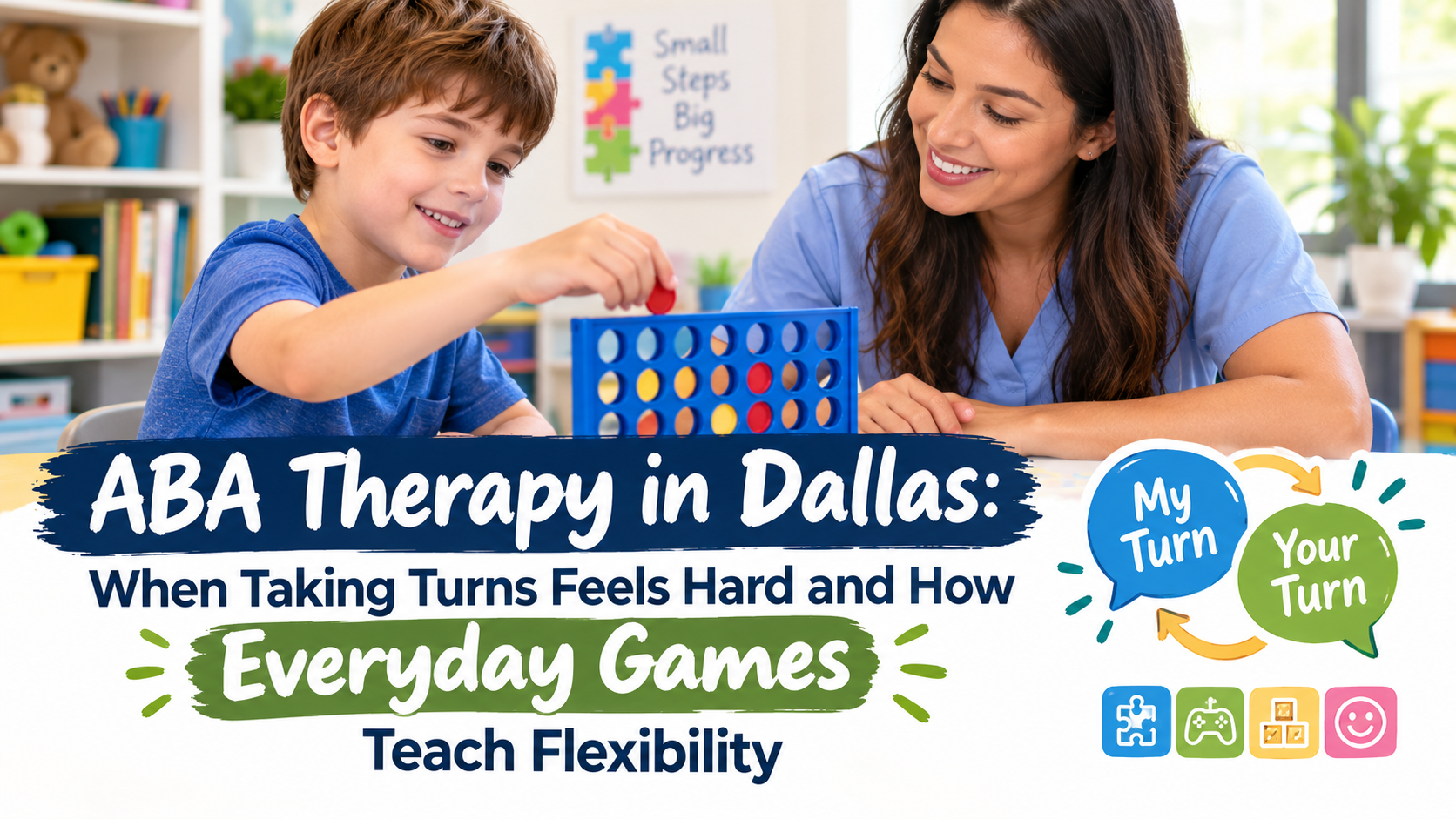


For many children, starting a favorite activity is exciting, but stopping it can be surprisingly difficult. A child may happily play with blocks, watch a favorite video, complete a puzzle, or spend time on a preferred toy, only to become upset when it is time to move on. Understanding these moments is an important part of providing compassionate support through ABA Therapy in Dallas. Even when a child knows what comes next, transitioning away from something enjoyable can require emotional regulation, flexibility, and skills that are still developing.
Parents and caregivers may wonder why their child struggles to finish an activity when the next part of the day is familiar. A child might understand that dinner is coming, recognize that it is time to get dressed, or know that a favorite toy will be available again later. Yet that understanding does not always make the transition easier.
The challenge is not necessarily a refusal to cooperate. Sometimes, the child needs more time to process the change, communicate their feelings, or shift attention from one experience to another. With predictable routines, advance notice, visual countdowns, and meaningful choices, adults can make these moments more manageable.
At Radiant Spectrum Therapy, understanding a child’s individual needs is an important part of supporting meaningful progress. Families exploring ABA therapy Dallas options can benefit from learning how individualized strategies help children practice transitions while feeling understood, respected, and supported.
Why Ending a Favorite Activity Can Be So Difficult
A favorite activity may provide enjoyment, comfort, predictability, or a sense of control. When an adult announces that it is time to stop, several things can happen at once. The child must shift attention, accept a change, process new information, and prepare for something different.
For some children, these demands can feel overwhelming.
Understanding the Difference Between Knowing and Doing
A child may understand a direction without being ready to act on it. For example, a child might know that playtime ends when the timer rings but still struggle to put away their toys.
Understanding the instruction is only one part of a transition. The child may also need to:
- Shift attention away from something enjoyable.
- Manage disappointment about stopping.
- Process the next instruction.
- Adjust to a different environment or activity.
- Communicate a need for more time or assistance.
- Begin an unfamiliar or less-preferred task.
These skills develop at different rates. A child who can explain what happens next may still need help managing the feelings and actions associated with the change.
This distinction matters when families consider ABA therapy services Dallas providers. A helpful approach looks beyond whether a child follows a direction and considers the skills, communication needs, and circumstances affecting the transition.
The Role of Predictability and Control
Children often feel more comfortable when they know what to expect. A sudden ending can interrupt that sense of predictability, especially when a child is deeply engaged.
Imagine a child building an elaborate tower. An adult announces that it is time to leave immediately. Even if the child understands the schedule, they may feel disappointed because they have not finished what they wanted to do.
Offering a brief warning or a chance to complete one final step can make the change feel less abrupt.
For children receiving Applied Behavior Analysis Dallas services, individualized transition support may involve identifying which situations are most difficult, recognizing patterns, and practicing appropriate ways to request help, more time, or a clear ending.
The goal is not to eliminate every moment of disappointment. It is to help children develop useful skills for handling change with growing confidence.
Why Advance Notice Can Make a Difference
One practical way to support transitions is to provide advance notice. Instead of announcing that an activity must end without warning, adults can give children time to prepare.
Advance notice helps make the upcoming change more predictable. It also gives children an opportunity to finish a small part of their activity, ask a question, or begin shifting their attention.
Give Warnings That Are Clear and Consistent
A warning is most useful when it is specific and understandable.
For example, instead of saying, “We’ll leave soon,” a caregiver might say, “You have five more minutes to play, and then we will put the toys away.”
A few minutes later, the caregiver can repeat the message: “Two more minutes. When the timer rings, it will be time to clean up.”
Helpful practices include:
- Use simple language that matches the child’s communication level.
- Give warnings early enough for the child to prepare.
- Keep the wording consistent whenever possible.
- Pair spoken warnings with visual or auditory cues if helpful.
- Follow through calmly so the warning remains meaningful.
Some children need several reminders, while others respond well to a single cue. The right approach depends on the child, the activity, and the situation.
Families seeking ABA therapy for autism Dallas may find it useful to discuss transition difficulties with a qualified provider who can help determine which supports are appropriate for their child’s individual learning needs.
Avoid Giving Too Much Information at Once
When a child is already frustrated, long explanations may make the situation harder to process. A simple statement such as “Two more minutes, then shoes” may be more useful than a lengthy explanation about the entire afternoon.
The purpose of advance notice is to prepare the child, not overwhelm them with information.
Parents can also use the same phrases across familiar routines. When the wording and sequence remain consistent, the child has more opportunities to recognize what the cue means and respond over time.
Using Visual Countdowns to Make Time Easier to Understand
Time can be an abstract concept for young children. Telling a child that an activity will end in five minutes may not provide enough information if they do not yet understand what five minutes feels like.
Visual countdowns make the approaching end more concrete.
Different Types of Visual Countdown Tools
Caregivers can experiment with several options to discover what works best for the child:
- Visual timers: A colored section gradually disappears as time passes.
- Countdown cards: Cards displaying numbers or pictures show how much time remains.
- First-then boards: A simple visual shows the current activity and what will happen next.
- Picture schedules: A sequence of images shows the order of activities throughout the day.
- Activity completion cues: A picture or symbol indicates that the final step has arrived.
For example, a child playing with a preferred toy might see a timer with a red section representing the remaining time. As the section becomes smaller, the child receives a visible reminder that the activity is approaching its end.
Another child might benefit more from a picture showing playtime followed by snack time.
The most effective tool is one the child can understand and use comfortably. Visual supports should be introduced during calm moments, rather than appearing for the first time during a difficult transition.
Pair Visuals With Practice
A visual countdown is not a guarantee that a child will transition without difficulty. It is a support that can make expectations easier to understand.
Caregivers can practice using the timer during short, low-pressure activities. They might begin with an activity that lasts only a few minutes and provide encouragement when the child responds to the ending cue.
As the child becomes more familiar with the routine, adults can gradually use the same strategy in other situations.
For families exploring autism therapy Dallas TX, a provider may help determine whether visual schedules, timers, verbal prompts, or a combination of supports would best fit a child’s needs.
Creating Predictable Ending Routines
A consistent ending routine helps children understand that an activity is finishing and what they can do next. Rather than making every transition feel like an unexpected interruption, adults can create a familiar sequence that signals the change.
Build a Simple Routine Around the Final Moments
Consider a child who enjoys playing with building blocks. Instead of suddenly taking the blocks away, a caregiver could use this sequence:
- Give a two-minute warning.
- Invite the child to finish the current building step.
- Announce that playtime is ending.
- Help the child place the blocks in their container.
- Show the child a picture of the next activity.
- Acknowledge the child’s effort in completing the transition.
The routine does not need to be complicated. In fact, simple and repeatable steps are often easier for children to learn.
The same principle can be used for ending screen time, leaving the playground, finishing a craft, or putting away a favorite puzzle.
Allow Meaningful Closure When Possible
Sometimes, a child becomes upset because they are not finished with what they are doing. When practical, allowing a natural stopping point can help.
For example, a child might be allowed to place the final puzzle piece, save a game, take a picture of a block structure, or put a bookmark in a favorite book.
These options help preserve the child’s sense of participation while maintaining the expectation that the activity will end.
However, closure does not always mean completing everything. A family may need to leave the house immediately or stop an activity for safety reasons. In those situations, a brief explanation and a clear next step can still provide support.
Children can learn that activities sometimes end before they feel completely ready. The goal is to help them navigate those experiences with appropriate assistance.
Meaningful Choices That Support Smoother Transitions
Choices can help children feel involved in a transition instead of feeling that every decision is being made for them.
When adults provide appropriate options, children can practice communication, flexibility, and decision-making while still moving toward the next necessary activity.
Offer Choices Within Clear Boundaries
The most useful choices are genuine, limited, and connected to the transition.
For example, a caregiver might ask:
- “Would you like to put away the blocks or the cars first?”
- “Do you want to walk to the bathroom or hold my hand?”
- “Would you like to carry your book or your stuffed animal?”
- “Do you want to turn off the tablet, or would you like help?”
- “Would you like to put on your shoes before or after your jacket?”
These questions give children some control without making the ending itself optional.
If the family must leave, the choice is not whether to leave. The child can choose how to participate in the transition, provided the available options are safe and practical.
Respect the Child’s Communication
Some children communicate their preferences through spoken words, gestures, picture cards, communication devices, or other methods. Caregivers should make sure choices are accessible to the child.
For example, a child who does not consistently use spoken language may benefit from seeing two pictures and pointing to the preferred option.
When a child asks for more time, adults can acknowledge the request and respond consistently. Depending on the situation, they might allow a short extension, explain why the activity must end now, or offer a clear opportunity to return later.
Supporting communication does not mean every request must be granted. It means helping the child express a need and ensuring that their communication receives a meaningful response.
Understanding What Happens Before and After a Difficult Transition
When transitions repeatedly lead to distress, it can be helpful to look at the entire situation rather than focusing only on the moment when the child becomes upset.
What happened before the activity ended? What did the child do? How did adults respond? What happened afterward?
Looking at these patterns can help families identify practical changes.
Recognize Common Triggers
A child may have more difficulty ending activities when they are tired, hungry, overwhelmed by noise, or uncertain about what comes next.
Other possible contributors include:
- The activity is especially enjoyable or absorbing.
- The next activity is unfamiliar or less preferred.
- The transition happens without warning.
- The child is asked to stop in the middle of a complex task.
- The environment changes suddenly.
- The child does not have an effective way to ask for help or more time.
Keeping brief notes about difficult transitions may reveal patterns. For example, a parent may notice that leaving the playground is especially challenging when the child has not been shown what will happen after arriving home.
This information can help adults adjust the routine instead of repeatedly relying on the same approach when it is not working.
Focus on Teaching Skills, Not Assigning Blame
A difficult transition is an opportunity to understand what support is missing. It does not automatically mean that the child is being deliberately defiant or that the caregiver has done something wrong.
The child may need more preparation, a clearer communication option, additional practice, or a different way to approach the ending.
For families exploring behavior therapy Dallas services, it is important to find a provider who considers the child’s communication, environment, individual strengths, and learning needs rather than using a one-size-fits-all approach.
How ABA Therapy Can Support Activity Transitions
ABA therapy in Dallas may help children develop skills that make daily transitions more manageable. Applied Behavior Analysis involves understanding behavior in context, identifying meaningful learning goals, and using individualized strategies to support skill development.
Transition support should be based on the child’s needs, abilities, and circumstances. It should also respect the child’s communication and emotional experiences.
Building Communication Skills
Children may benefit from learning ways to communicate during difficult moments. Depending on their abilities and goals, this might include asking for more time, requesting help, saying they are not finished, or indicating that they need a break.
When children have accessible ways to communicate, adults can better understand what they need and respond appropriately.
Practicing Flexibility Gradually
Some children benefit from practicing small changes in predictable settings before tackling more challenging transitions.
For example, a therapist might help a child practice ending a short preferred activity, moving to another enjoyable activity, and gradually working toward transitions involving less-preferred tasks.
The pace should be individualized. Children should not be expected to master difficult transitions immediately, and signs of distress should be taken seriously.
Reinforcing Useful Skills
Encouragement can help children recognize when they have used a helpful skill. A caregiver might acknowledge a child’s successful request for more time, use of a visual schedule, or participation in putting away toys.
Reinforcement should be individualized and respectful. It should support meaningful skill development rather than pressure a child to suppress communication or ignore genuine discomfort.
Families considering autism behavior therapy Dallas can ask prospective providers how they teach transitions, support communication, and adapt strategies when a child becomes overwhelmed.
Supporting Transitions at Home, School, and in the Community
Children often experience transitions in many settings, and a strategy that works in one environment may need adjustments in another.
At home, caregivers might use a visual schedule for morning routines or a consistent sequence for ending screen time. At school, teachers may use countdowns before changing classroom activities. In the community, a parent might explain the plan before entering a store or leaving a playground.
Consistency between adults can help, but consistency does not mean every situation must look identical.
Helping Adults Work Together
Parents, teachers, and therapists can share information about which strategies appear helpful. If a child responds well to a visual timer at home, the same type of support might be worth exploring at school.
Useful questions include:
- Which transitions are easiest and hardest?
- What warnings or visual cues does the child understand?
- How does the child communicate a need for assistance?
- Does the child need additional processing time?
- What helps the child recover after an upsetting change?
- Are expectations realistic for the child’s current skills?
Families seeking autism support services Dallas can discuss these questions with qualified professionals who understand individualized developmental support.
The purpose is to create a more supportive environment in which children can practice skills across daily routines, not to make every transition perfectly smooth.
Choosing Individualized ABA Support in Dallas
Families researching ABA therapy Dallas options may encounter many providers offering different approaches, settings, and services. Looking beyond general promises can help parents identify a provider that takes time to understand their child.
When comparing providers, consider asking about:
- How individualized goals are developed.
- How parents and caregivers participate in treatment planning.
- How communication and emotional regulation are supported.
- How progress is evaluated and shared with families.
- How strategies are adjusted when they are not helping.
- Whether services are available in a home, clinic, or other appropriate setting.
Some families may prefer in-home ABA therapy Dallas because they want support within familiar routines, such as ending playtime or getting ready to leave the house. Others may consider center-based ABA therapy Dallas for structured learning opportunities. The best setting depends on the child’s needs, family priorities, clinical recommendations, and available services.
For younger children, early intervention ABA Dallas and ABA therapy for toddlers Dallas may involve developmentally appropriate opportunities to practice communication, play, routines, and transitions. Goals should be selected based on the individual child rather than age alone.
Similarly, pediatric ABA therapy Dallas and ABA therapy for kids Dallas should reflect each child’s strengths, preferences, support needs, and family goals.
Parents comparing the best ABA therapy providers Dallas or searching for top-rated ABA therapists Dallas should consider clinical qualifications, individualized care, family collaboration, and the provider’s willingness to explain its approach. Ratings can be one source of information, but they should not be the only basis for a decision.
Families may also compare private ABA therapy Dallas options, intensive ABA programs Dallas, and providers offering BCBA services Dallas. A Board Certified Behavior Analyst (BCBA) may help assess needs, develop individualized treatment plans, and guide appropriate behavior-analytic services. The intensity and format of services should be based on an individualized assessment and family discussion.
Depending on the child’s needs, families may also explore behavioral intervention Dallas TX, developmental therapy Dallas, or special needs therapy Dallas. These terms can describe different types of support, so it is important to ask what each service includes and which professionals provide it.
Parents researching ABA clinics in Dallas, ABA therapy near Dallas, ABA therapy in Dallas TX, or Dallas autism services should confirm service availability, eligibility requirements, provider credentials, and whether the setting meets their child’s needs.
Cost is another consideration. Families searching for affordable ABA therapy Dallas TX or researching ABA therapy cost Dallas can ask providers about insurance participation, benefits verification, deductibles, copayments, authorization requirements, and any out-of-pocket expenses. Costs vary, so families should request information specific to their circumstances rather than relying on a general estimate.
Whether parents search online for ABA therapy near me Dallas or try to find ABA therapist Dallas, the most important step is finding a qualified professional who listens to the family, respects the child, and explains how treatment goals will be developed and reviewed.
Families wondering how ABA therapy works Dallas can ask for a clear explanation of assessment, goal selection, caregiver collaboration, progress monitoring, and the strategies proposed for everyday challenges.
Small Changes Can Make Endings Easier Over Time
Progress with transitions does not always look like a child happily stopping every favorite activity. Sometimes, progress means asking for more time instead of crying, accepting a visual countdown with support, putting away one toy, or recovering more quickly after an unexpected change.
These small steps matter because they help children build skills they can use throughout daily life.
Caregivers can support progress by remaining calm, keeping expectations clear, allowing reasonable processing time, and recognizing when a strategy needs to change. It is also important to acknowledge that some transitions will remain difficult, particularly when a child is tired, uncomfortable, or facing an unexpected disruption.
A supportive approach balances preparation with flexibility. Adults can maintain necessary boundaries while making room for the child’s preferences, communication, and individual pace of learning.
Conclusion: Helping Children Move Forward With Confidence
When finishing is harder than starting, children may need more than a reminder that it is time to move on. They may need advance notice, visual countdowns, predictable ending routines, meaningful choices, and opportunities to practice communication and flexibility.
These strategies can help make transitions more understandable without expecting children to hide their feelings or adapt instantly to every change.
For families considering ABA Therapy in Dallas, individualized support can provide opportunities to understand why transitions are difficult and identify practical ways to help. Through thoughtful planning, caregiver collaboration, and developmentally appropriate teaching, children can gradually learn to navigate the end of favorite activities with greater confidence and independence.
At Radiant Spectrum Therapy, the focus is on understanding each child’s unique needs and supporting meaningful progress in everyday life. With the right guidance, finishing an activity does not have to mean losing a sense of control. It can become an opportunity to practice communication, build flexibility, and move toward the next part of the day with support.
Contact us at 972–310–4991 or visit https://radiantspectrumtherapy.com/ to learn more.