
When children are learning something new, it can be easy to focus on whether they got it right. But learning rarely happens perfectly on the first attempt. ABA Therapy in Dallas can help children develop the confidence and skills to keep trying, even when something does not work the first time. Instead of viewing mistakes as failures, children can learn that trying, adjusting, and trying again are important parts of learning.
For some children, especially children who struggle with frustration, communication, transitions, or unfamiliar situations, making a mistake can feel overwhelming. A simple task may quickly turn into tears, avoidance, or giving up.
The goal is not to make every attempt successful. The goal is to help children become more comfortable with the learning process.
Why the First Try Can Feel So Difficult
Adults often understand that learning takes practice. Children may not see it the same way.
A child who is learning to tie their shoes, write their name, ask for help, complete a puzzle, or participate in a new activity may expect themselves to get it right immediately.
When they do not, they may think:
- “I can’t do it.”
- “I’m bad at this.”
- “I don’t want to try again.”
- “This is too hard.”
- “I don’t know what to do.”
For children who have difficulty communicating their frustration, these feelings may show up through behavior rather than words.
They might push materials away, leave the activity, cry, become upset, or refuse to continue.
This is where changing the message around mistakes can make a meaningful difference.
Instead of:
“You need to get it right.”
The message becomes:
“You are learning. Let’s try it another way.”
That small shift can help children understand that the first attempt is simply information about what to do next.
What Does a “First Try Doesn’t Have to Be Perfect” Mindset Mean?
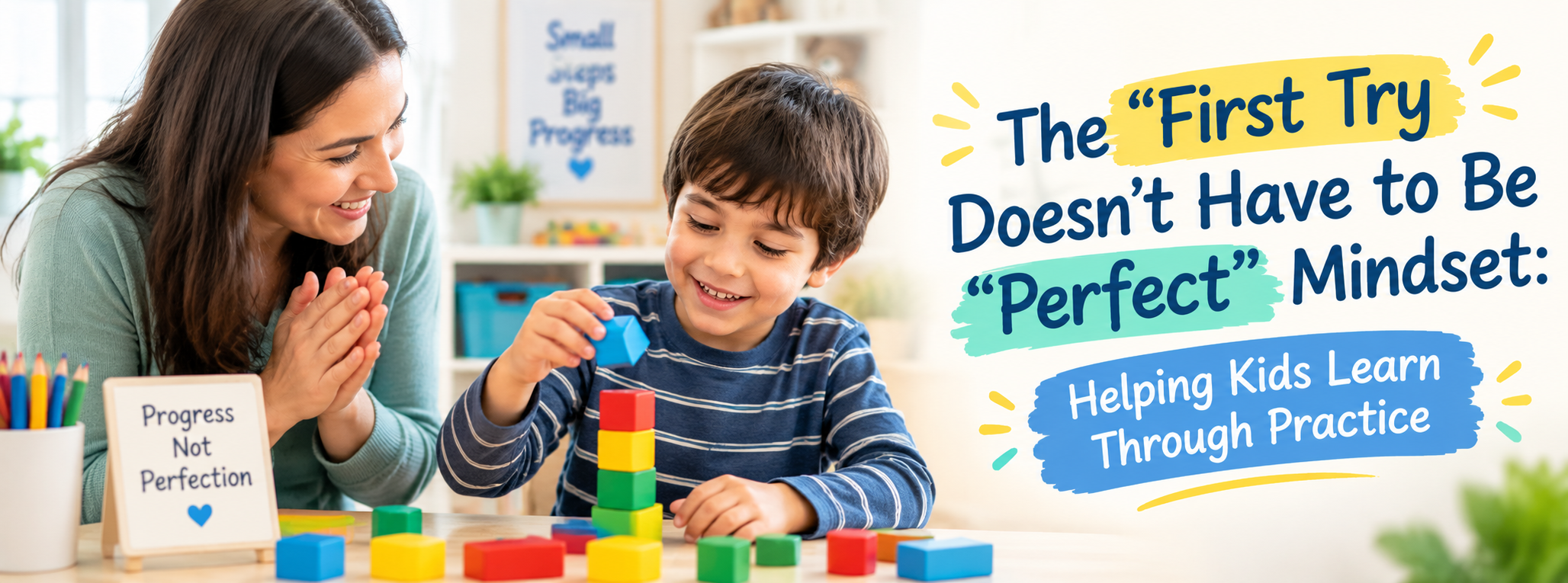
The mindset is simple: the first attempt is an opportunity to learn, not a final judgment of ability.
A child does not have to master a skill immediately for the attempt to be valuable.
For example, imagine a child is learning to complete a simple dressing routine. They put their shirt on backward.
Instead of treating the mistake as a problem, an adult can calmly say:
“Your shirt is on. Let’s look at the tag and see which way it goes.”
The child gets another opportunity to practice.
The same approach can apply to communication, play, social interaction, academic tasks, self-care, and everyday routines.
The Goal Is Progress, Not Perfection
Progress can look different for every child.
One child may complete an entire task independently after several attempts. Another may need verbal guidance. Another may need visual support, modeling, or physical prompting before gradually becoming more independent.
Each attempt can provide useful information.
Maybe the task needs to be broken into smaller steps.
Maybe the instructions need to be simpler.
Maybe the child needs a short break.
Maybe they need to see someone demonstrate the skill.
The important part is recognizing that struggling does not automatically mean the child cannot learn the skill.
How ABA Therapy Can Support This Mindset
ABA therapy services Dallas can be individualized around a child’s current skills, needs, communication abilities, and learning goals.
Applied Behavior Analysis looks at how behaviors occur within everyday situations and how environmental factors, teaching strategies, reinforcement, and communication can influence learning.
One important part of teaching is creating opportunities for children to practice skills in manageable ways.
Instead of expecting a child to perform a complicated task perfectly, an ABA therapist may break the task into smaller, achievable steps.
This can help the child experience success while continuing to work toward greater independence.
Breaking Skills Into Smaller Steps
Consider a child who is learning to clean up after playing.
“Clean up your toys” may sound simple to an adult, but it can involve several individual skills:
- Stop playing.
- Understand the direction.
- Identify which toys belong where.
- Pick up the first toy.
- Move toward the storage area.
- Put the toy away.
- Continue until the area is reasonably organized.
For some children, completing all of those steps at once may feel overwhelming.
Breaking the routine into smaller parts can make the task easier to understand and practice.
Using Prompts Without Making Children Dependent on Them
Children may need help when learning a new skill.
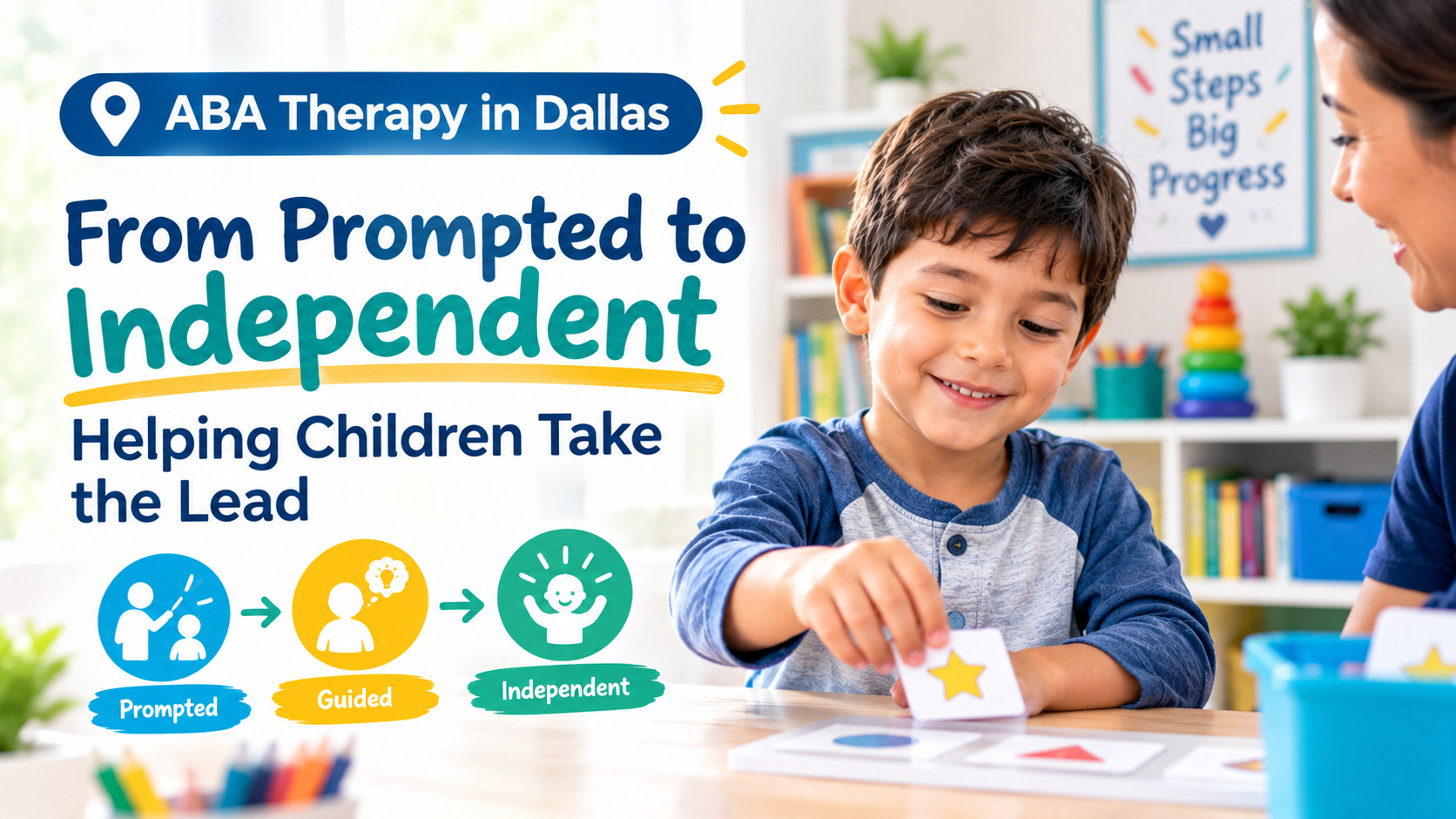
A therapist might use verbal instructions, demonstrations, gestures, visual supports, or other appropriate prompts to help a child complete a step.
Over time, the goal is generally to help the child become more independent by gradually reducing unnecessary assistance.
This teaches an important lesson:
“I can do this.”
And sometimes that confidence comes after many imperfect attempts.
Teaching Children That Mistakes Are Information
One of the most helpful changes adults can make is how they respond when something goes wrong.
A mistake can become a signal about what needs to happen next.
For example:
The child gets frustrated with a puzzle.
Instead of immediately saying, “No, that’s wrong,” try:
“Let’s see where this piece might fit.”
The child gives an incomplete answer.
Instead of ending the interaction, try:
“You got part of it. Let’s think about the rest.”
The child struggles to ask for something.
Instead of guessing immediately, provide an opportunity to practice communicating the request.
The goal is not to ignore mistakes. It is to make mistakes feel manageable.
Helping Kids Handle the Feeling of “I Can’t”
Sometimes the biggest challenge is not the task itself. It is the emotional reaction to difficulty.
A child may know how to complete a task but become upset as soon as something goes wrong.
Learning to tolerate small amounts of frustration can be an important part of development.
Start With Manageable Challenges
A child does not need to begin with the hardest possible version of a task.
Start with something that is challenging but achievable.
For example, if a child struggles with puzzles, begin with a puzzle containing a manageable number of pieces. Once the child becomes comfortable with that level of challenge, the activity can gradually become more complex.
This allows children to practice both the skill and the emotional experience of working through difficulty.
Reinforce the Effort to Keep Trying
Adults often praise the final result:
“You finished!”
But it can also be valuable to recognize the process:
“You tried again.”
“You kept working.”
“You asked for help.”
“You tried a different way.”
“You didn’t give up when it was hard.”
This helps children connect positive experiences with persistence rather than only with getting the correct answer.
What Parents Can Say During Difficult Moments
The language adults use can influence how children view mistakes.
Try simple, calm phrases such as:
- “It’s okay to try again.”
- “Let’s figure it out together.”
- “You don’t have to get it right the first time.”
- “That way didn’t work. What could we try next?”
- “You’re still learning.”
- “Let’s do one step at a time.”
- “It’s okay to ask for help.”
- “You made a mistake, and we can fix it.”
- “Trying again is part of learning.”
The goal is not to give a long explanation while a child is already frustrated.
Short, consistent language is often easier to understand in the moment.
Avoid Turning Every Mistake Into a Correction
Children need feedback, but constant correction can sometimes make learning feel stressful.
If every attempt is immediately followed by “No,” “Wrong,” or “That’s not how you do it,” a child may begin avoiding the activity altogether.
Instead, consider whether the child needs:
- A demonstration
- A smaller step
- A visual cue
- A brief pause
- A different instruction
- Encouragement to try again
- An opportunity to ask for help
The purpose of feedback should be to support learning, not simply point out errors.
Building Confidence Through Small Wins
Confidence often develops from repeated experiences of successfully working through challenges.
That does not mean making everything easy.
It means giving children opportunities where effort and practice can lead somewhere.
A child who initially needs help putting on a jacket may eventually complete one part independently.
A child who previously avoided a difficult puzzle may eventually stay with it for several minutes.
A child who used to cry when they made a mistake may eventually learn to say, “Help me.”
These may look like small changes from the outside, but they can represent meaningful progress.
The Role of Reinforcement in Learning
Reinforcement is an important concept within Applied Behavior Analysis Dallas services.
When a behavior is followed by something meaningful to the child and that behavior becomes more likely to happen again, reinforcement has occurred.
In everyday learning, reinforcement does not always have to mean a tangible reward.
It could include:
- Specific praise
- Access to a preferred activity
- A favorite toy
- Social attention
- A short break
- Encouragement
- A successful opportunity to continue an enjoyable activity
For example, if a child asks appropriately for help instead of throwing materials, an adult can respond positively to that communication.
The child learns that asking for help is an effective way to handle difficulty.
Teaching “Try Again” Without Creating Pressure
There is an important difference between encouraging persistence and pressuring a child to continue when they are overwhelmed.
“Try again” should not mean:
“Keep doing this until you finally get it right.”
Instead, it can mean:
“Let’s figure out what support you need to make another attempt.”
Sometimes another attempt should happen immediately.
Sometimes the child needs a brief break.
Sometimes the task needs to be changed.
Sometimes the adult needs to adjust the way the skill is being taught.
Good teaching involves paying attention to the child rather than following a rigid expectation that every challenge must be completed immediately.
How Parents Can Practice This at Home
Parents do not need to create elaborate lessons to teach children this mindset.
Everyday routines provide opportunities to practice.
During Mealtimes
If a child struggles to use a utensil, allow opportunities to practice rather than expecting perfect technique immediately.
During Dressing
Let the child attempt part of the routine independently before stepping in with help.
During Play
If a game does not go the way the child expects, model flexible language such as, “That didn’t work. Let’s try something else.”
During Homework
Break challenging assignments into smaller sections and acknowledge effort along the way.
During Social Situations
If a conversation does not go as expected, help the child identify another way to respond rather than treating the interaction as a failure.
These small moments can become powerful learning opportunities.
When a Child Needs More Support
Some children may consistently struggle with frustration, flexibility, communication, or learning new skills despite regular support at home.
That does not mean parents are doing something wrong.
Children develop at different rates, and some may benefit from more individualized support.
ABA therapy for autism Dallas can focus on specific developmental and behavioral goals based on a child’s individual needs.
Depending on the child and their treatment plan, services may address areas such as:
- Communication
- Social skills
- Self-care
- Functional living skills
- Following directions
- Flexibility
- Emotional regulation
- Reducing behaviors that interfere with learning
- Increasing independence
A qualified BCBA can help identify appropriate goals and develop an individualized approach to teaching them.
In-Home and Center-Based Learning Opportunities
Children do not learn only in therapy rooms.
Skills are also practiced at home, school, community settings, and during everyday routines.
In-home ABA therapy Dallas can provide opportunities to work on skills within the child’s familiar environment.
For example, a therapist may work on communication during mealtime, self-care during morning routines, or following directions during play.
Center-based ABA therapy Dallas can provide a structured setting where children can practice skills alongside other planned activities.
The appropriate setting depends on the child’s individual needs, goals, and treatment plan.
What Progress Can Really Look Like
Progress is not always dramatic.
Sometimes it looks like a child making one more attempt before asking for help.
Sometimes it means recovering more quickly after a mistake.
Sometimes it means tolerating a difficult task for another minute.
Sometimes it means using words instead of behavior to communicate frustration.
And sometimes progress is simply becoming willing to try something that previously felt too difficult.
These moments matter.
A child’s development is not defined by how quickly they master a skill. The process of learning, practicing, adjusting, and trying again is valuable in itself.
Creating a Home Where Learning Feels Safe
Children are more likely to explore new skills when they feel that mistakes are manageable.
Parents can help create that environment by modeling the same mindset themselves.
Adults make mistakes too.
You might spill something while cooking, forget an appointment, make an error at work, or struggle to assemble something.
Instead of hiding every mistake, adults can model calm problem-solving:
“That didn’t work. I’ll try it another way.”
Children hear the words, but they also observe the behavior.
They learn that mistakes do not have to end the activity.
They can simply become part of the process.
Finding Support for Your Child
If your child has difficulty with new tasks, frustration, communication, or recovering from mistakes, additional support may help you better understand what is happening and what strategies may be appropriate.
Families exploring ABA therapy in Dallas TX can look for providers that take time to understand the child’s individual strengths, challenges, environment, and goals.
A thoughtful approach should focus on teaching useful skills while respecting the child’s individual needs.
At Radiant Spectrum Therapy, the focus is on helping children build meaningful skills that can support greater independence and participation in everyday life.
Conclusion: Learning Doesn’t Have to Be Perfect
Children do not need to get everything right on the first try.
They need opportunities to practice.
They need adults who can help them break difficult tasks into manageable steps. They need opportunities to communicate when something is hard. They need encouragement to try again without feeling that every mistake is a failure.
The “first try doesn’t have to be perfect” mindset teaches children something that can extend far beyond one activity: learning is a process.
For families exploring ABA Therapy in Dallas, individualized support can help children develop communication, independence, flexibility, and other skills while learning how to navigate challenges one step at a time.
The goal isn’t perfection.
The goal is helping a child feel capable of saying:
“That didn’t work yet. I’ll try again.”
Contact us at 972–310–4991 or visit https://radiantspectrumtherapy.com/ to learn more.