
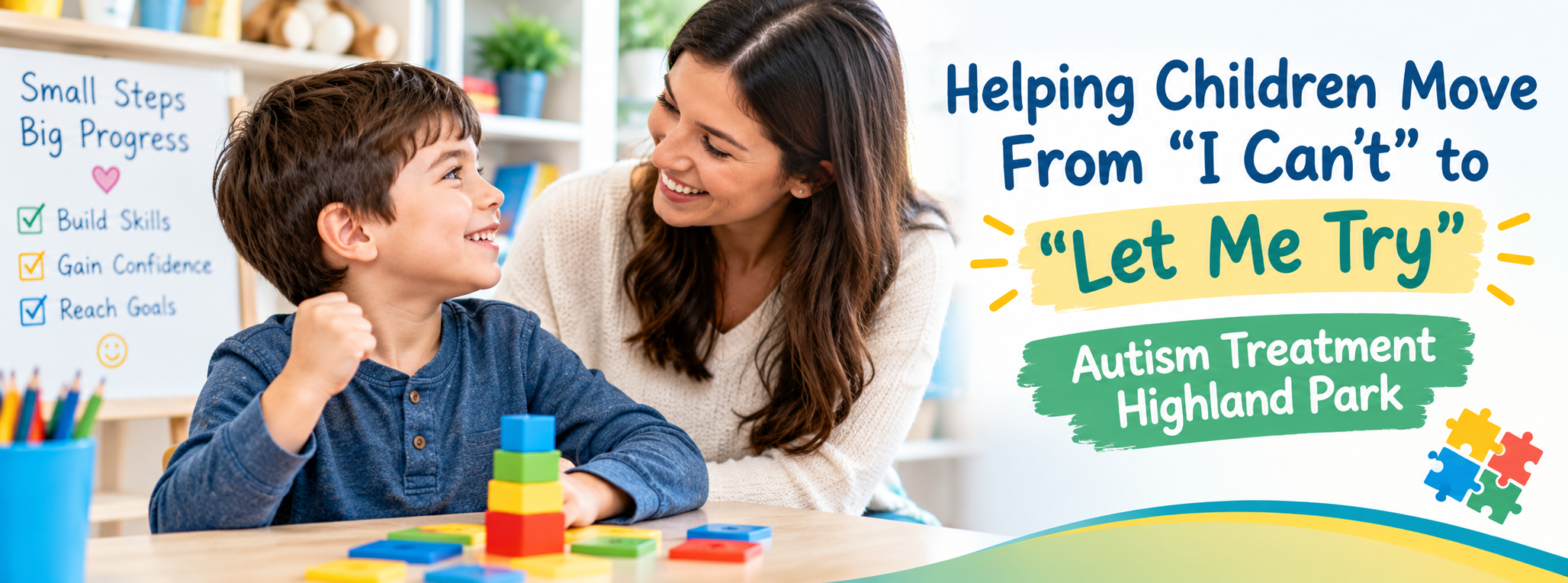
A child saying “I can’t” does not always mean they are unwilling to try. Sometimes, it means the task feels too difficult, unfamiliar, frustrating, or overwhelming. For children who benefit from Autism Treatment Highland Park, learning how to move from “I can’t” toward “let me try” can be an important part of building confidence, independence, communication, and everyday skills.
Through individualized ABA therapy Highland Park, children can learn that difficult tasks do not have to be completed perfectly on the first attempt. They can learn to ask for help, break a task into smaller steps, practice new skills, and experience success along the way.
At Radiant Spectrum Therapy, the goal is not simply to get a child to complete a task. It is to help children develop practical skills while supporting their individual needs, communication styles, and pace of learning.
Why Children Say “I Can’t”
“I can’t” can communicate many different things.
A child may genuinely believe a task is impossible. Another child may not know how to begin. Someone else may have tried before, struggled, and decided that avoiding the task feels safer than trying again.
For some children, “I can’t” can also be connected to communication difficulties, sensory challenges, frustration, or uncertainty about what is expected.
Understanding what is behind the statement is important.
Instead of immediately responding with, “Yes, you can,” adults can pause and consider:
- Is the task too complicated?
- Does the child understand the instructions?
- Is there a communication barrier?
- Has the child practiced this skill before?
- Does the child know how to ask for help?
- Is the environment distracting or overwhelming?
- Has the child experienced repeated difficulty with similar tasks?
This type of observation is one reason individualized Applied Behavior Analysis Highland Park services can be useful. Rather than assuming every child responds to challenges in the same way, ABA approaches can examine the circumstances surrounding a behavior and identify ways to teach more effective skills.
Confidence Often Starts With Small Successes
Confidence is not always something a child has before learning a new skill. Sometimes, confidence develops because a child experiences success while learning.
A large task can feel impossible when presented all at once.
For example, “Get dressed by yourself” contains several individual steps:
- Find the clothing.
- Choose the appropriate items.
- Put on a shirt.
- Put on pants.
- Put on socks.
- Put on shoes.
- Adjust clothing as needed.
For a child who is still developing independence, expecting the entire routine immediately may create unnecessary frustration.
Breaking the routine into smaller, achievable steps can make the experience more manageable.
This principle can be used with many everyday skills, including:
- Cleaning up toys
- Washing hands
- Brushing teeth
- Getting dressed
- Preparing a simple snack
- Following directions
- Completing schoolwork
- Waiting for a preferred activity
- Asking for assistance
- Participating in family routines
With appropriate support, a child can begin to experience the difference between “I can’t do this” and “I can’t do this yet.”
Turning “I Can’t” Into “What’s the First Step?”
One helpful strategy is to replace the question “Can you do it?” with “What’s the first step?”
The first step should be small enough that the child has a realistic opportunity to succeed.
For example, if a child says, “I can’t clean my room,” the adult might avoid treating the entire room as one task.
Instead:
First: “Let’s put the books on the shelf.”
Then:
Next: “Let’s put the cars in the bin.”
Then:
Next: “Let’s put the clothes in the basket.”
The child is still working toward the larger goal, but the goal has become easier to understand.
This approach can also support behavioral intervention Highland Park TX by making expectations clearer and creating opportunities to practice individual skills.
The Goal Is Progress, Not Perfection
A child does not need to complete every task independently immediately.
Sometimes progress looks like:
- Trying one step without assistance
- Staying with a task for another minute
- Asking for help appropriately
- Trying again after making a mistake
- Accepting a small change in routine
- Completing part of a familiar activity
- Using a communication strategy instead of giving up
These moments matter because independence develops over time.
Teaching Children How to Ask for Help
One of the most important alternatives to “I can’t” is “Can you help me?”
Asking for help is not failure. It is a functional life skill.
A child who knows how to communicate, “Help please,” has another option when a task becomes difficult.
Depending on the child’s communication abilities, asking for help might involve:
- Spoken words
- A visual support
- A communication device
- A gesture
- Pointing
- Sign language
- A practiced phrase
During ABA therapy for autism Highland Park, communication skills can be incorporated into everyday situations so that children have practical ways to express what they need.
Parents can reinforce this at home by responding positively when a child appropriately asks for assistance.
For example:
“Thank you for asking for help. Let’s do the first part together.”
That response communicates two important ideas: asking for help is acceptable, and difficult tasks can be approached together.
What If a Child Refuses to Try?
Refusal can be frustrating for parents, particularly when a task seems simple from an adult’s perspective.
However, a task that looks easy to an adult may not feel easy to a child.
Instead of turning the situation into a battle, adults can look for the reason behind the refusal.
Perhaps the child:
- Does not understand the instruction
- Does not know how to begin
- Is tired or overwhelmed
- Is worried about making a mistake
- Wants more control over the situation
- Finds the task unpleasant
- Has difficulty transitioning from a preferred activity
- Needs additional practice
The response can then focus on teaching the missing skill rather than simply demanding compliance.
Individualized ABA therapy services Highland Park may address these challenges by identifying patterns, teaching replacement skills, and practicing new responses in appropriate contexts.
Using Choices to Encourage Participation
Sometimes children respond better when they have an appropriate choice within a task.
For example:
“Do you want to put your shoes on first or your jacket?”
The child is still expected to get ready, but they have some control over how they approach the routine.
Other examples include:
- “Do you want the blue cup or the green cup?”
- “Do you want to clean up the blocks or the cars first?”
- “Do you want to start with math or reading?”
- “Do you want to sit at the table or on the floor?”
Choices should be realistic and limited. The purpose is not to remove expectations. It is to help the child participate in the process.
Celebrating Attempts, Not Just Finished Tasks
If adults only celebrate completed tasks, children may learn that success means getting everything right.
“You tried that yourself.”
“You kept going when it was difficult.”
“You asked for help.”
“You tried another way.”
“You finished the first step.”
These statements help draw attention to the process of learning.
For children receiving pediatric ABA therapy Highland Park, reinforcement can also be individualized based on what motivates the child and what is appropriate for their developmental needs.
The goal is to create meaningful opportunities for children to connect effort and persistence with positive experiences.
Learning to Recover From Mistakes
Mistakes are unavoidable when learning.
A child learning to button a shirt may button it incorrectly. A child practicing handwriting may write a letter backward. A child learning to prepare food may spill something.
These moments can become opportunities to teach recovery.
Instead of focusing only on the mistake, adults can model:
“That’s okay. Let’s try again.”
“We made a mistake. What’s next?”
“Let’s fix it together.”
“This part was tricky. We can practice.”
Children do not need to become comfortable with every mistake immediately. They can gradually learn that making an error does not mean the entire activity has failed.
This can be particularly valuable when building independence through early intervention ABA Highland Park and other developmental supports.
Making New Skills Easier to Practice at Home
Parents do not need to create elaborate training sessions at home.
Everyday routines provide opportunities to practice.
During Mealtimes
Children can practice:
- Choosing between two foods
- Opening an easy container
- Carrying a cup
- Asking for more
- Cleaning up
- Trying a new step independently
During Morning Routines
Children can practice:
- Following a visual schedule
- Selecting clothing
- Getting dressed
- Brushing teeth
- Packing belongings
- Checking what comes next
During Play
Children can practice:
- Taking turns
- Asking for help
- Trying a different strategy
- Following simple directions
- Cleaning up
- Handling small changes
During Community Activities
Children can practice:
- Waiting
- Making choices
- Asking questions
- Following safety directions
- Navigating transitions
- Communicating when something is difficult
These small moments can create repeated opportunities for skill development without making every interaction feel like a formal lesson.
How ABA Therapy Can Support “Let Me Try”
ABA therapy Highland Park can be individualized around the skills a child needs in everyday life.
Depending on the child’s needs and treatment goals, therapy may focus on communication, social skills, daily living skills, learning readiness, independence, behavior support, or other functional goals.
A BCBA may assess current skills and identify areas where a child needs additional teaching or support. A treatment plan can then be developed around measurable goals and adjusted as the child progresses.
BCBA services Highland Park may also help families understand why certain challenges occur and how consistent strategies can be used across different environments.
For some families, in-home ABA therapy Highland Park provides opportunities to practice skills within familiar routines. Other children may benefit from center-based ABA therapy Highland Park, where they can work on specific goals within a structured therapeutic environment.
The appropriate setting depends on the individual child and their treatment needs.
Supporting Independence Without Removing Support Too Quickly
There is an important balance between helping a child and allowing them to try.
If an adult completes every difficult task immediately, the child may have fewer opportunities to practice.
But expecting complete independence before a child is ready can also create frustration.
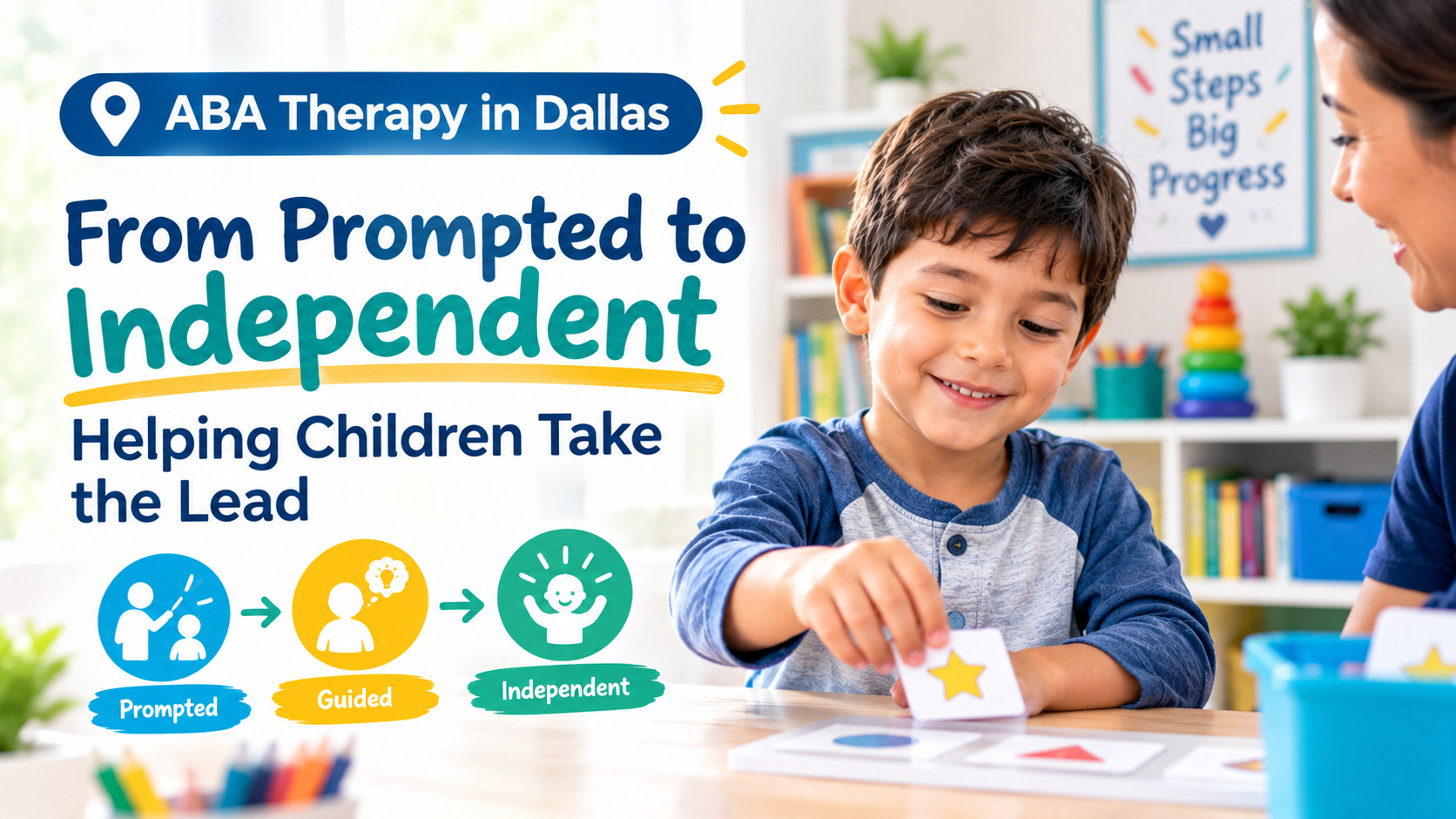
A helpful approach is to provide the amount of support the child needs and gradually encourage more independence as the skill develops.
For example:
Adult does the task:
The child watches.
Adult and child do it together:
The child participates.
Child does most of the task:
The adult provides limited assistance.
Child completes the task independently:
The adult steps back while remaining available.
This gradual process can help children develop confidence without expecting them to master a skill overnight.
Why Individualized Support Matters
Every child has different strengths, challenges, interests, communication abilities, and learning patterns.
That is why autism therapy Highland Park TX should not be viewed as a one-size-fits-all process.
One child may need help with communication before they can participate independently in a task. Another may need a visual routine. Another may need repeated practice with transitions. Someone else may need support with tolerating mistakes or asking for assistance.
Individualized autism support services Highland Park can help families identify practical goals that matter in the child’s daily life.
Depending on the family’s needs, services may include special needs therapy Highland Park, developmental support, behavior therapy, or other individualized interventions.
Families exploring ABA therapy near Highland Park can ask providers how they individualize treatment, involve caregivers, measure progress, and adapt goals over time.
Finding the Right Support for Your Family
Parents researching ABA therapy in Highland Park TX often have many questions.
They may wonder:
- How does ABA therapy work?
- What skills can therapy address?
- Is in-home or center-based therapy more appropriate?
- How frequently will therapy take place?
- What does ABA therapy cost in Highland Park?
- Does insurance cover services?
- What qualifications does the clinical team have?
- How are treatment goals selected?
- How will progress be measured?
These are all reasonable questions.
Families looking for ABA clinics in Highland Park, ABA therapy near me Highland Park, or find ABA therapist Highland Park can start by speaking directly with providers about their child’s individual needs.
It can also be helpful to ask how parents and caregivers are included in the treatment process. Consistency between therapy and home routines can make it easier for children to practice developing skills across different environments.
From “I Can’t” to “Let Me Try”
The transition from “I can’t” to “let me try” does not happen because a child is simply told to be more confident.
It happens through practice, support, communication, patience, and opportunities to experience success.
A child may first learn to tolerate one small step. Then they may learn to ask for help. Eventually, they may attempt a task with less assistance. Over time, those small moments can contribute to greater independence.
For families considering Autism Treatment Highland Park, the focus can be on helping children build skills that have meaning in their everyday lives — not expecting perfection, but creating opportunities for progress.
At Radiant Spectrum Therapy, individualized support can help children work toward meaningful goals while giving families practical strategies they can carry into daily routines. Whether a child needs support with communication, independence, transitions, social interaction, or learning new skills, the journey can begin with something very simple:
“Let’s try the first step.”
With the right support, “I can’t” does not have to be the end of the conversation. It can become the starting point for learning, practicing, and discovering, “Let me try.”
Contact us at 972–310–4991 or visit https://radiantspectrumtherapy.com/ to learn more.