
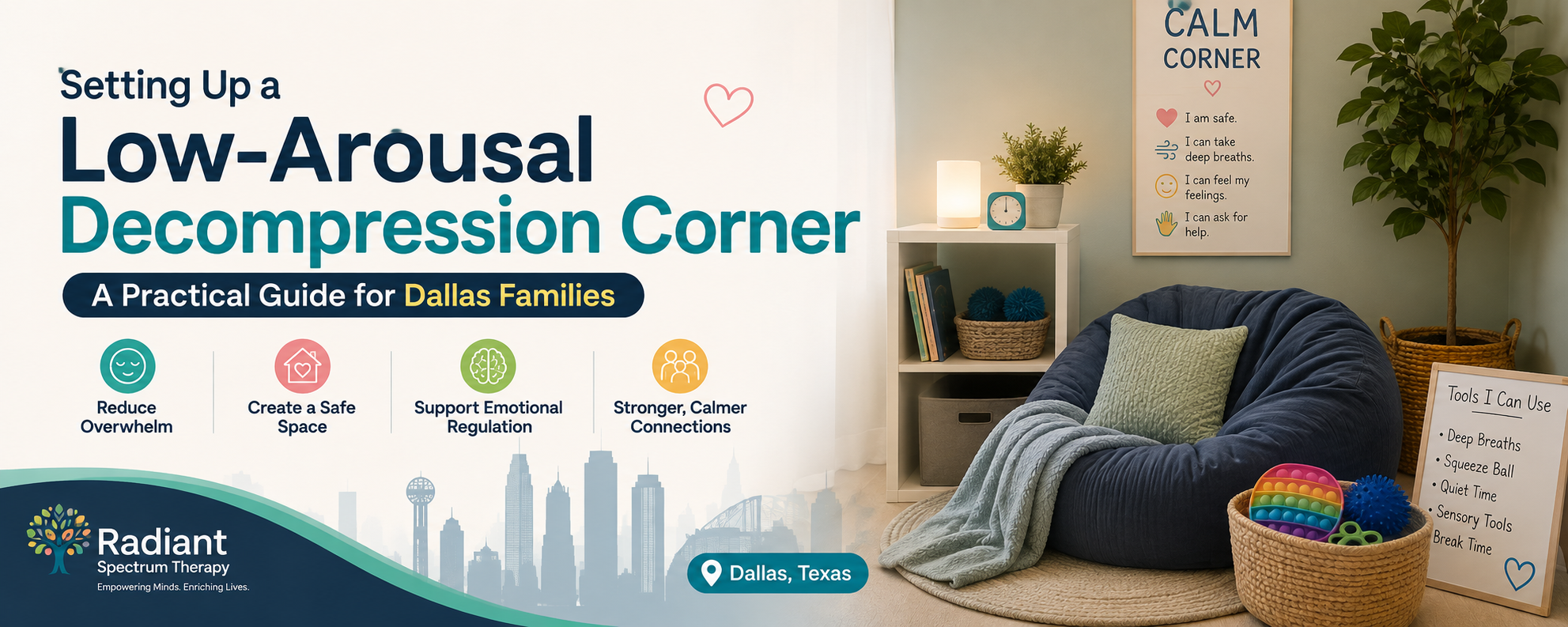
For families exploring ABA Therapy in Dallas, creating a supportive home environment can be just as important as the skills practiced during therapy sessions. A low-arousal decompression corner gives a child a predictable place to step away from overwhelming sounds, lights, demands, or emotions and regain a sense of control before distress escalates into a larger behavioral episode.
Unlike a traditional “calm-down corner,” a decompression corner is not meant to punish, isolate, or force a child to stop a behavior. It is designed around regulation. The goal is to recognize early signs of dysregulation and provide appropriate sensory supports that help a child return to a more comfortable state.
For Dallas and Highland Park families, this type of space can be especially useful when incorporated thoughtfully alongside ABA therapy Dallas families already use to support communication, independence, emotional regulation, and daily living skills.
What Is a Low-Arousal Decompression Corner?
A low-arousal decompression corner is a designated area of the home where a child can reduce sensory input and use individualized regulation tools.
It may include:
- Dim or adjustable lighting
- Soft seating or floor cushions
- A weighted lap pad, when appropriate
- Noise-reducing headphones
- Comfortable blankets
- Visual supports
- Fidget or tactile items
- A compression swing, when professionally recommended and safely installed
- Books or quiet activities
- A simple visual routine
- Access to water
- A small number of preferred calming objects
The space should feel neutral, comfortable, and predictable rather than like a place where a child is sent after “misbehaving.”
This distinction matters. ABA therapy services Dallas families seek should focus on understanding why behavior occurs and teaching useful replacement skills. A decompression corner can complement that process by giving children an appropriate way to respond when their nervous system is becoming overwhelmed.
Why Regulation Should Come Before Behavior Escalates
Many parents notice behavioral changes only after a child has already reached a high level of distress. However, dysregulation often develops gradually.
A child may first:
- Cover their ears
- Pace around the room
- Become unusually quiet
- Increase repetitive movements
- Ask to leave
- Avoid eye contact
- Speak louder or faster
- Cry
- Refuse simple requests
- Push materials away
- Become more sensitive to touch
- Seek intense movement
These behaviors can be early signals that the child’s ability to process additional demands is decreasing.
Rather than waiting until a child reaches a crisis point, families can learn to recognize these signals and introduce regulation strategies earlier.
This is one reason Applied Behavior Analysis Dallas programs may incorporate functional behavior assessment, communication training, environmental modifications, and replacement behaviors. The goal is not simply to stop a behavior. It is to understand what the child is communicating and teach safer, more effective ways to meet the same need.
Decompression Corner vs. a Traditional Calm-Down Corner
The terms may sound interchangeable, but there is an important difference.
A traditional calm-down corner may focus primarily on teaching a child to sit quietly and calm down after becoming upset.
A low-arousal decompression corner takes a broader approach. It considers:
- What sensory input may be overwhelming the child?
- What does the child seek when becoming dysregulated?
- What environmental changes reduce stimulation?
- Which tools help the individual child regulate?
- How can the child learn to request a break?
- How can adults intervene before escalation?
The space should not become another demand.
For example, telling a highly distressed child, “Go sit in your corner until you calm down,” may add another demand when the child is already overwhelmed. A better approach may be teaching the child to communicate “break,” guiding them toward the space when appropriate, and allowing them to use an individualized regulation strategy.
This type of approach can work particularly well when coordinated with ABA therapy for autism Dallas families are already receiving.
How to Design a Low-Arousal Space at Home
You do not need an entire room. A small, carefully planned area can work.
A corner of a bedroom, playroom, family room, or quiet hallway may be enough.
1. Start With Location
Choose an area that is naturally quieter than the rest of the home.
Avoid placing the corner directly beside:
- A television
- A loud kitchen appliance
- A frequently used doorway
- A busy play area
- A barking dog
- A constantly running fan or machine
For families in busy Dallas neighborhoods, apartment communities, or homes with multiple children, reducing background stimulation may require some creativity. The goal is not complete silence. It is simply to create a noticeable reduction in sensory demands.
2. Keep Visual Stimulation Low
A decompression corner should not become another toy station.
Too many colors, decorations, toys, lights, or hanging objects can defeat the purpose.
Choose a few useful items rather than filling the space with everything a child enjoys.
A simple setup might include a comfortable chair, floor mat, dim lamp, visual break card, and two or three preferred regulation tools.
3. Consider Adjustable Lighting
Bright overhead lighting can be uncomfortable for some children.
A small lamp with adjustable brightness may create a softer environment. Blackout curtains or curtains that reduce direct sunlight can also help.
The important point is individualization. Some children prefer darkness, while others become more comfortable with a soft but visible light.
There is no universal sensory setup that works for every child.
Sensory Regulation Tools to Consider
Sensory tools should be selected based on the child’s individual needs rather than because they are popular online.
Weighted Lap Pads
A weighted lap pad can provide gentle pressure while a child sits.
Some children find this type of pressure organizing and comforting. Others may dislike it or find it restrictive.
If a family is considering a weighted item, it is important to use it appropriately and follow guidance from qualified professionals familiar with the child’s needs. A weighted product should never be treated as a restraint.
For some children receiving autism therapy Dallas TX families may find that pressure-based sensory input is useful during seated activities, while others respond better to movement, deep breathing, quiet, or another strategy.
Dim Lighting
Reducing light intensity can help lower environmental stimulation.
Consider using:
- A dimmable lamp
- Soft curtains
- Indirect lighting
- A lamp positioned away from the child’s face
Avoid turning the area into a completely dark space unless the child clearly prefers it and it is safe.
Compression Swings
A compression swing can provide deep-pressure and movement input for some children.
However, this is an area where safety matters significantly. Swings must be appropriately installed, used according to manufacturer instructions, and selected based on the child’s size and needs.
Families should also seek professional guidance before introducing specialized sensory equipment.
A compression swing should never be used as a restraint or as a way to physically force a child to remain in one location.
For families participating in in-home ABA therapy Dallas, a BCBA and other members of the child’s care team can help parents think through how environmental supports fit into the child’s broader behavior plan.
Noise Reduction
Noise-canceling or noise-reducing headphones can be helpful for children who are sensitive to household sounds.
However, children should still be able to safely communicate and remain aware of important environmental sounds when necessary.
The objective is to reduce unnecessary stimulation, not completely disconnect the child from the environment.
Tactile and Fidget Tools
Fidget items can provide an appropriate outlet for movement and tactile exploration.
Keep the selection small. A child may benefit from:
- A soft textured object
- A squeeze item
- A simple fidget
- A sensory ball
- A fabric item
- A quiet manipulative
Observe what the child actually uses. If an item consistently increases frustration or becomes a source of conflict, it probably does not belong in the corner.
Teach the Child How to Use the Space
A decompression corner works best when the child understands what it is for.
Parents can introduce it when the child is already calm.
For example:
“This is your quiet space. You can come here when you need a break.”
A visual card can make the concept easier for children who have difficulty communicating verbally.
A simple sequence might show:
I feel overwhelmed → I ask for a break → I go to my quiet space → I use a calming activity → I return when ready.
This can be incorporated into early intervention ABA Dallas families receive, particularly when communication and functional replacement behaviors are goals.
The child may initially need adult prompting. Over time, the objective may be for the child to recognize the need for a break and communicate it more independently.
Look for Early Signs of Dysregulation
Parents do not have to wait for a meltdown to offer support.
Every child will have different warning signs.
For one child, dysregulation may look like increased pacing. For another, it may involve becoming unusually still or withdrawing.
Create a list of your child’s early signals.
Possible Early Warning Signs
- Increased vocalizations
- Repetitive movements becoming more intense
- Covering ears
- Increased refusal
- Rapid breathing
- Hiding
- Pacing
- Crying
- Throwing nearby objects
- Repeatedly asking the same question
- Seeking pressure or movement
- Attempting to escape a situation
Identifying these patterns can help parents intervene earlier.
This is one area where BCBA services Dallas families access can be particularly valuable. A BCBA can help families examine patterns surrounding behavior and determine whether the decompression space is supporting a meaningful replacement behavior.
Make the Corner Part of Everyday Life
Do not introduce the decompression corner only during difficult moments.
Let your child explore it when they are calm.
They might read there, listen to quiet music, use a sensory item, or simply sit for a few minutes.
This helps prevent the space from becoming associated exclusively with challenging behavior.
It can also make it easier for the child to recognize the area as a normal part of their environment rather than a punishment area.
Families receiving center-based ABA therapy Dallas services can also discuss how skills practiced in the center can be generalized to the home. Regulation and communication strategies are more useful when children can apply them across different environments.
What Parents Should Avoid
A decompression corner can become counterproductive if it is designed around control rather than regulation.
Avoid:
- Sending a child there as punishment
- Locking or blocking the area
- Physically forcing a child into the space
- Using sensory equipment as restraint
- Overloading the corner with toys
- Expecting immediate calm
- Taking away all communication options
- Assuming one sensory tool works for every child
- Using the space to avoid teaching functional communication
- Treating every difficult behavior as sensory-related
The purpose is to provide an appropriate support, not to eliminate every behavior that adults find inconvenient.
For children receiving behavior therapy Dallas families should look at behavior in context. A child who repeatedly leaves a noisy room may be communicating that the environment is too overwhelming. A child who throws materials when a difficult task begins may need a more appropriate way to request assistance or a break.
How ABA Therapy Can Support Regulation Skills
A decompression corner is only one component of a larger support strategy.
ABA therapy for toddlers Dallas families consider may focus on early communication, play, imitation, following directions, transitions, and functional skills. Regulation can be incorporated when it affects the child’s ability to participate in everyday routines.
For older children, therapy may address:
- Functional communication
- Waiting
- Flexibility
- Transitions
- Coping with changes
- Asking for breaks
- Social skills
- Independence
- Self-management
- Replacement behaviors
An individualized plan may help determine when a child should be offered a break, what communication method should be used, and how the child can gradually return to an activity.
Families looking into intensive ABA programs Dallas providers offer should ask how regulation, parent training, generalization, and home programming are incorporated into treatment.
Creating a Decompression Routine for Dallas Families
Busy family schedules can make regulation more challenging.
Children may move from school to therapy, appointments, extracurricular activities, errands, and family activities within a single afternoon.
A predictable decompression period can help.
For example:
After School
Allow the child to have a short, predictable transition period before presenting additional demands.
After Therapy
Give the child an opportunity to transition home and process the change in environment.
Before Bed
Use lower lighting, reduced noise, and familiar activities to create a predictable evening routine.
During Family Gatherings
The decompression corner can remain available if visitors, conversations, or household activity become overwhelming.
This can be particularly useful in homes around Highland Park and throughout the Dallas area where family gatherings, school activities, and busy schedules can create frequent transitions.
When to Get Professional Guidance
Parents do not need to figure everything out alone.
If a child frequently experiences intense distress, has difficulty communicating needs, regularly attempts to escape environments, or displays behaviors that create safety concerns, professional support may be appropriate.
A qualified provider can help determine whether behavior may be connected to communication difficulties, environmental demands, sensory preferences, skill deficits, reinforcement patterns, or other factors.
Families researching autism behavior therapy Dallas, behavioral intervention Dallas TX, or developmental therapy Dallas should look for providers who emphasize individualized assessment and family involvement.
For families considering private ABA therapy Dallas, it is also reasonable to ask about parent training, home programming, BCBA supervision, treatment goals, and how progress is measured.
Choosing ABA Services in Dallas and Highland Park
Parents searching for ABA therapy near Dallas, ABA therapy in Dallas TX, or ABA clinics in Dallas have many factors to consider.
Look beyond location alone.
Questions to ask include:
- Does the provider offer individualized treatment plans?
- Are BCBAs involved in treatment planning and supervision?
- Is parent training available?
- Are communication and functional skills addressed?
- Does the provider offer in-home or center-based services?
- How is progress measured?
- How are skills generalized to home and community settings?
- What ages does the provider serve?
- What insurance plans are accepted?
- What should families expect regarding ABA therapy cost Dallas?
Families specifically searching for pediatric ABA therapy Dallas, ABA therapy for kids Dallas, or ABA therapy for toddlers Dallas may also want to ask how the provider adapts treatment to the child’s developmental level.
If you are trying to find ABA therapist Dallas families can trust, the best fit will depend on your child’s needs, goals, schedule, location, and insurance or payment considerations.
For parents searching for the best ABA therapy providers Dallas, best ABA therapy in Dallas, or top-rated ABA therapists Dallas, remember that the right provider is not necessarily the one with the most advertising or the highest rating. Look for a team that communicates clearly, respects your child’s individuality, involves caregivers, and builds practical skills that can be used outside the therapy setting.
Supporting Regulation at Home and in Therapy
The strongest results often come when parents and therapy teams use consistent language and expectations.
If a child learns to request a break during therapy but does not have a way to request one at home, generalization becomes more difficult.
Likewise, if a child has a decompression corner at home but adults never teach them how to request access appropriately, the space may not become an independent coping strategy.
Communication between caregivers and providers can help connect the two environments.
This is particularly important for families seeking autism support services Dallas, special needs therapy Dallas, or Dallas autism services that involve multiple professionals.
Parents can share observations such as:
- What situations trigger distress
- What early warning signs they notice
- Which tools the child prefers
- What helps the child recover
- How long recovery typically takes
- What communication method the child uses
- What situations are consistently difficult
These details can provide valuable information for treatment planning.
Frequently Asked Questions
Is a decompression corner the same as a timeout area?
No. A decompression corner should not be used as punishment. Its purpose is to reduce stimulation and give the child access to appropriate regulation supports.
Does every autistic child need a sensory corner?
No. Children have different sensory preferences and needs. Some may benefit from a quiet area, while others may regulate better through movement, communication, outdoor activities, or another strategy.
Can I use a weighted lap pad?
Some children may find weighted input helpful, but it should be used appropriately and based on the child’s individual needs. It should never be used as a restraint.
Should the decompression corner be completely dark?
Not necessarily. Some children prefer reduced lighting, while others may become uncomfortable in darkness. Start with adjustable lighting and observe your child’s response.
Can a BCBA help us create one?
Yes. A BCBA can help families examine behavior patterns, teach functional communication, develop replacement behaviors, and determine how a decompression space can fit into an individualized treatment plan. Occupational therapy may also be appropriate when sensory processing needs require specialized assessment.
Can this be used with in-home ABA therapy?
Yes. Families receiving in-home ABA therapy Dallas services can discuss how the space can be incorporated into daily routines and how regulation skills can be practiced naturally at home.
A Calm Space Should Support, Not Control
A low-arousal decompression corner is not a magic solution for challenging behavior. Its value comes from how thoughtfully it is introduced and how well it fits the individual child.
For families exploring ABA Therapy in Dallas, the bigger goal is not simply creating a quiet corner. It is helping a child recognize their needs, communicate those needs, access appropriate support, and gradually develop greater independence.
Whether your family is looking for ABA therapy Dallas, ABA therapy services Dallas, ABA therapy near me Dallas, or ABA therapy for autism Dallas, regulation strategies should be individualized rather than based on a one-size-fits-all checklist.
For families in Dallas and Highland Park, a simple low-arousal space can become one useful part of a larger support system — especially when parents, BCBAs, therapists, teachers, and caregivers work together.
At Radiant Spectrum Therapy, families can also explore related services and resources such as in-home ABA therapy, center-based ABA therapy, parent training, individualized ABA programs, and other autism support services. When adding internal links during optimization, consider linking these service terms to the corresponding Radiant Spectrum Therapy service pages.
A thoughtfully designed decompression corner gives a child somewhere to reset before distress becomes overwhelming. More importantly, it creates an opportunity to teach a lifelong skill: recognizing when something feels too much and learning an appropriate way to ask for support.
ABA Therapy in Dallas can be about much more than reducing challenging behaviors. With individualized goals, family involvement, and practical strategies that carry over into everyday life, therapy can help children build communication, independence, coping, and regulation skills that matter at home, at school, and throughout the Dallas community.
Contact us at 972–310–4991 or visit https://radiantspectrumtherapy.com/ to learn more.