

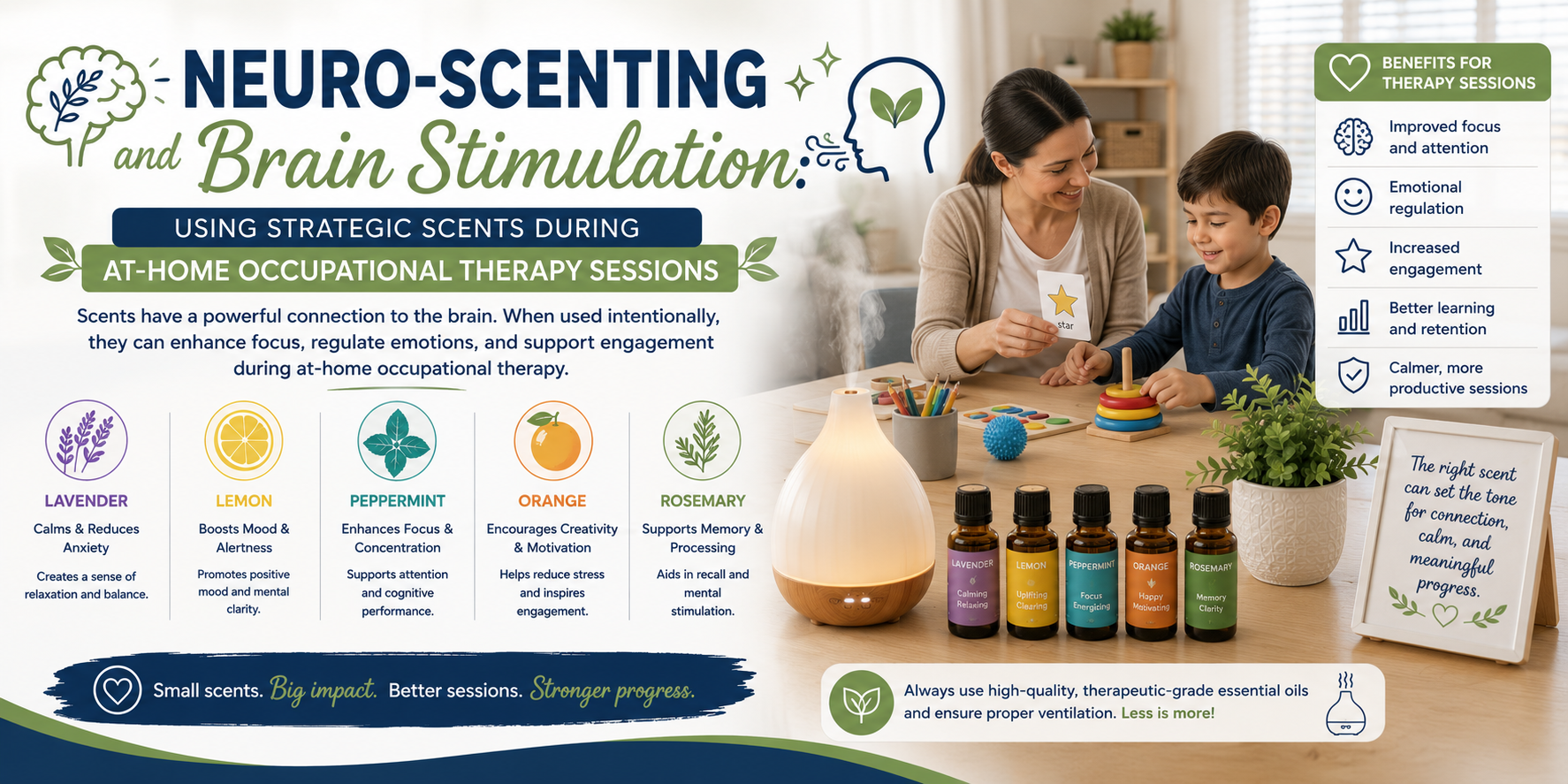
Parents are always looking for safe, practical ways to support their child’s learning at home. While structured routines, sensory activities, and movement exercises often receive the most attention, one powerful sensory system is sometimes overlooked — the sense of smell. Our brains process scents differently than sights or sounds, making olfactory stimulation a unique tool that can encourage focus, promote relaxation, and create positive learning experiences when used thoughtfully.
This approach, often referred to as neuro-scenting, involves intentionally introducing specific scents during activities to help support attention, emotional regulation, or calming. Although scent is never a replacement for individualized therapy, it can become a valuable complement to occupational therapy activities when used appropriately and under professional guidance.
Families participating in Home-Based ABA Therapy, occupational therapy, or other developmental programs often search for additional ways to create supportive environments at home. Incorporating carefully selected scents into structured routines may help children associate particular aromas with calming, learning, or transitioning between activities.
Understanding How the Brain Responds to Smell
Unlike many of our other senses, smell has a direct connection to areas of the brain responsible for emotion, memory, and behavior. When we inhale a scent, odor molecules travel through the nose and activate receptors that send signals to the olfactory bulb. These signals quickly reach brain regions involved in emotional processing and memory formation.
Because of this direct neurological pathway, certain scents can evoke feelings of calm, alertness, familiarity, or comfort almost instantly. Many adults experience this phenomenon when the smell of fresh cookies reminds them of childhood or when the scent of pine recalls holiday memories.
Children experience these connections as well, although every child responds differently. This individuality is especially important when working with children who have sensory processing differences.
Why Olfactory Stimulation Matters
Many therapy sessions naturally involve visual, tactile, auditory, and movement-based activities. Smell is often left out despite being one of the body’s strongest sensory systems.
Strategic olfactory stimulation can help support:
- Attention during structured activities
- Emotional regulation
- Transitioning between tasks
- Relaxation before bedtime routines
- Calm participation during therapy exercises
- Positive associations with learning environments
For families participating in ABA Therapy in Dallas, introducing consistent sensory supports at home can complement established routines while reinforcing predictable environments.
Common Scents and Their Potential Uses
Research into aromatherapy and olfactory stimulation continues to grow. While responses vary from child to child, several scents are commonly associated with particular effects.
Peppermint
Peppermint is often linked with alertness and concentration.
Some families introduce peppermint during:
- Homework
- Fine motor activities
- Tabletop learning
- Occupational therapy exercises
- Morning routines
Because peppermint can feel stimulating, it may not be appropriate for children who are already highly energetic or easily overstimulated.
Vanilla
Vanilla is frequently associated with comfort and relaxation.
Parents sometimes use vanilla during:
- Quiet reading
- Bedtime preparation
- Calming sensory breaks
- Relaxation exercises
- Deep breathing activities
Its familiar scent may help create predictable calming routines.
Lavender
Lavender has long been associated with relaxation.
It may be introduced before:
- Rest periods
- Mindfulness activities
- Yoga stretches
- Sensory regulation exercises
Children who dislike floral scents should never be forced to participate.
Citrus
Orange or lemon scents may help create an energetic atmosphere during active movement sessions.
These scents are sometimes paired with:
- Gross motor activities
- Obstacle courses
- Dance breaks
- Movement games
Again, every child responds differently.
Every Child Has Unique Sensory Preferences
Perhaps the most important principle of neuro-scenting is recognizing that there is no universal response.
One child may find peppermint energizing.
Another may find it overwhelming.
One child may enjoy vanilla.
Another may avoid sweet smells completely.
This is why therapists emphasize observation rather than assumption.
Families involved in ABA Parent Training often learn how to monitor behavioral responses carefully before introducing any new sensory support into home routines.
Introducing Scents Gradually
Less is almost always more.
Rather than filling an entire room with fragrance, consider introducing only a mild scent.
Examples include:
- A cotton ball with one drop of diluted essential oil placed several feet away
- Naturally scented play dough
- Fresh herbs
- Citrus peels
- Vanilla extract used during baking activities
The goal is subtle sensory input — not overwhelming fragrance.
Pairing Scents With Predictable Activities
Consistency helps children build meaningful sensory associations.
For example:
Focus Time
A light peppermint scent is introduced only during seated learning.
Eventually, the brain may begin associating that scent with concentration.
Calm Time
Vanilla appears only during quiet breathing exercises.
Over time, the scent becomes part of the calming routine.
Transition Time
Lavender accompanies the move from active play to reading.
The repeated pairing helps establish predictability.
These routines may complement broader goals addressed through Center-Based ABA programs when coordinated with a child’s therapy team.
Activities That Work Well With Neuro-Scenting
Olfactory stimulation should always support an activity rather than distract from it.
Examples include:
Fine Motor Practice
Children completing:
- Cutting
- Coloring
- Beading
- Writing
- Puzzle work
may benefit from consistent environmental cues.
Sensory Bins
Adding naturally scented materials like cinnamon sticks, dried lavender, or citrus peels creates additional sensory exploration.
Always ensure materials are safe and age appropriate.
Deep Breathing Exercises
Parents can encourage slow breathing while introducing a mild calming scent.
This combines respiratory regulation with olfactory input.
Reading Time
Children may associate a comforting scent with relaxing literacy activities.
Over repeated sessions, reading itself may become more enjoyable.
Safety Always Comes First
Although essential oils are popular, they are not automatically safe for every child.
Parents should remember:
- Never apply undiluted essential oils directly to skin.
- Avoid placing oils where children can ingest them.
- Keep oils out of reach.
- Use only in well-ventilated areas.
- Stop immediately if headaches, coughing, discomfort, or irritation occur.
- Consult healthcare professionals before using scents around children with respiratory conditions.
Natural does not always mean harmless.
Observing Responses
Successful neuro-scenting depends on careful observation.
Parents might notice:
Positive responses:
- Longer attention span
- Improved participation
- Easier transitions
- Reduced resistance
- Greater relaxation
Negative responses:
- Covering the nose
- Increased agitation
- Complaints about smell
- Headaches
- Leaving the activity area
If negative reactions appear, discontinue the scent immediately.
Families receiving autism parent training Dallas services often learn how to document behavioral observations, making it easier to identify which environmental supports are truly beneficial.
Creating Positive Learning Environments
Scents should never be used as rewards or punishments.
Instead, they become part of an overall supportive learning environment.
Combined with:
- predictable schedules
- visual supports
- movement breaks
- sensory tools
- positive reinforcement
they may help create a more comfortable atmosphere for learning.
Children receiving pediatric behavioral therapy Dallas often benefit from consistency across home and professional settings whenever appropriate.
Working Alongside Professional Therapy
Neuro-scenting is not intended to replace occupational therapy, behavioral intervention, or medical treatment.
Instead, it works best as one small piece of a comprehensive plan developed by qualified professionals.
Families participating in ABA therapy Dallas programs should always discuss sensory strategies with their child’s therapy team before making significant changes to home routines.
This collaboration ensures that environmental supports align with each child’s individualized goals.
Building Confidence Through Small Changes
Parents sometimes feel pressure to create elaborate therapy environments at home. In reality, meaningful progress often comes from simple, consistent routines practiced every day.
Adding a carefully selected scent to an already familiar activity requires little time or expense. More importantly, it encourages parents to think intentionally about how the home environment influences learning, regulation, and participation.
Children thrive when routines feel predictable. If a calming vanilla scent consistently accompanies bedtime stretches or a refreshing peppermint aroma is reserved for focused tabletop work, those sensory cues may gradually become part of a child’s expectation for each activity.
Patience is essential. Some children may respond immediately, while others may show no noticeable difference. Both outcomes are perfectly acceptable. The goal is never to force a response but to explore supportive strategies that respect each child’s unique sensory profile.
Supporting Families Across North Texas
Families searching for autism services Dallas TX often discover that successful intervention extends beyond scheduled appointments. Everyday experiences at home provide countless opportunities to reinforce learning, emotional regulation, and independence.
Whether participating in in-home ABA therapy Dallas, visiting Dallas ABA centers, or working with Dallas autism specialists, parents play a central role in creating supportive environments where children can practice new skills with confidence.
Likewise, professionals providing behavioral therapy North Texas understand that no two children process sensory information in exactly the same way. Individualized care remains the foundation of effective intervention, with environmental supports like neuro-scenting serving as optional tools rather than universal solutions.
Families exploring ABA therapy providers 75201 or seeking DFW ABA therapy services are encouraged to communicate openly with their therapy teams about sensory preferences, observations, and home routines. This collaborative approach helps ensure that strategies introduced at home complement therapeutic goals while remaining safe, appropriate, and tailored to each child’s needs.
Final Thoughts
Neuro-scenting offers an intriguing way to incorporate the sense of smell into everyday occupational therapy activities at home. By thoughtfully introducing gentle scents such as peppermint for alertness or vanilla for relaxation, families may create meaningful sensory cues that support focus, transitions, and emotional regulation.
Success depends on careful observation, consistency, and respect for each child’s individual sensory preferences. No scent works for every child, and every new strategy should be introduced gradually and monitored closely.
When combined with professional guidance, structured routines, and individualized therapy plans, strategic olfactory stimulation can become one more practical tool that helps children feel comfortable, engaged, and ready to learn in their home environment.
Contaact us at 972–310–4991 or visit https://radiantspectrumtherapy.com/ to learn more.