
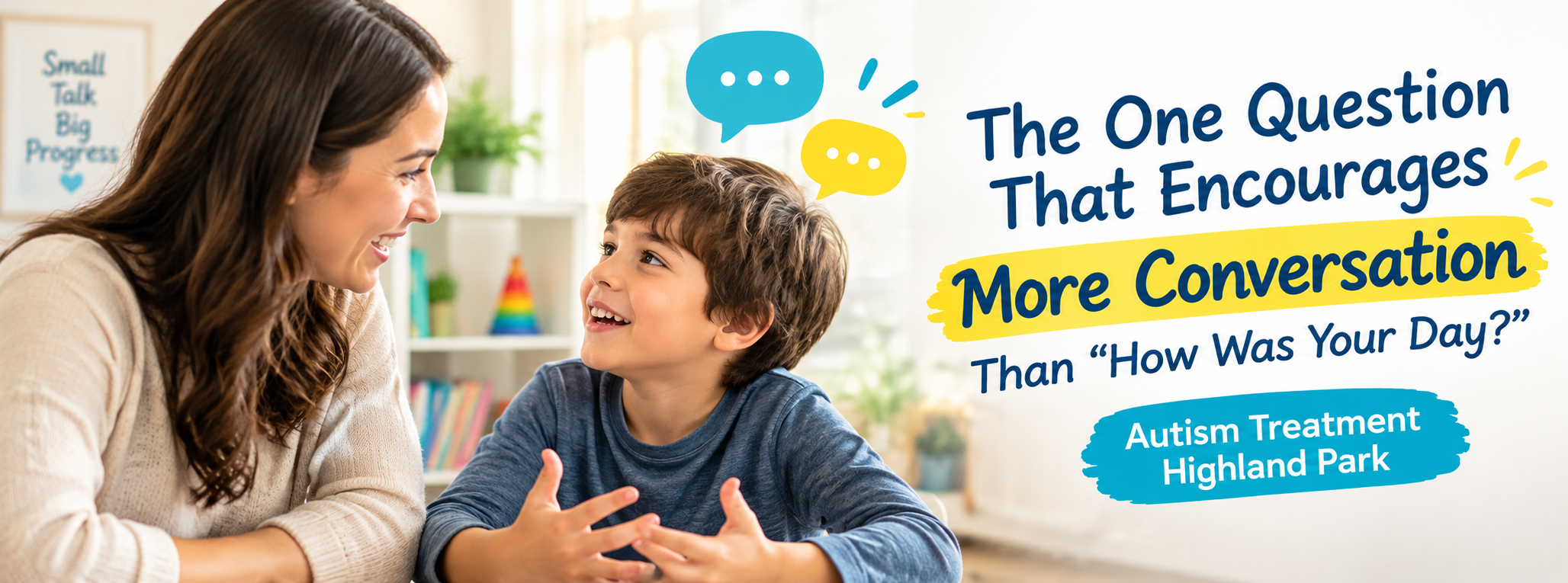
If you’ve ever picked up your child from school and asked, “How was your day?” you’ve probably heard one of three answers: “Fine.” “Good.” Or the classic, “I don’t know.”
For many children, especially those receiving Autism Treatment Highland Park, this isn’t because they don’t want to share. The question itself is simply too broad. It asks children to sort through hours of experiences, choose what matters, and put it into words — all in a matter of seconds.
A small change in how we ask questions can open the door to richer conversations, stronger communication skills, and more meaningful family connections. Instead of asking about the entire day, asking one specific, curiosity-driven question often encourages children to share much more.
At Radiant Spectrum Therapy, we use communication-building strategies through ABA therapy Highland Park that help children become more confident expressing their thoughts, feelings, and experiences. The same principles can work beautifully at home.
Why “How Was Your Day?” Is Hard to Answer
Adults often forget how complicated this question actually is.
To answer it, a child has to:
- Remember multiple events from the day.
- Decide which event is worth mentioning.
- Organize their thoughts.
- Find the right words.
- Respond while possibly feeling tired or overstimulated.
For children with autism, these steps may require significant effort. Many children are still developing skills related to:
- Recalling sequences of events
- Identifying emotions
- Starting conversations
- Expanding beyond one-word answers
- Processing language after a busy school day
This is one reason Applied Behavior Analysis Highland Park often focuses on breaking communication into smaller, more manageable skills.
The Question That Often Works Better
Instead of asking:
“How was your day?”
Try asking:
“What made you smile today?”
This simple question works because it gives the brain a smaller target.
Instead of searching through an entire day, children only need to remember one positive moment.
Even better, there isn’t a “right” answer.
They might say:
- “Snack time.”
- “I played with Noah.”
- “My teacher made a funny face.”
- “The swings.”
Each answer becomes a doorway to a longer conversation.
Why Specific Questions Encourage More Conversation
Specific questions reduce pressure.
Instead of testing memory, they encourage storytelling.
Children often find it easier to answer questions like:
- What made you laugh today?
- What was the funniest thing that happened?
- Who did you sit next to?
- What color did you use the most?
- What game did you play?
- What surprised you today?
These questions provide clear mental cues, making it easier to retrieve memories.
The Science Behind Better Conversation
Communication grows through repeated opportunities to practice.
In ABA therapy services Highland Park, therapists often create natural opportunities for children to:
- Answer questions
- Ask questions
- Take conversational turns
- Expand their responses
- Describe events
- Share preferences
Rather than forcing long conversations, therapy builds these skills one step at a time.
For example:
Therapist: “What did you build?”
Child: “Tower.”
Therapist: “A tall tower?”
Child: “Yes.”
Therapist: “What color?”
Child: “Blue.”
Each successful exchange strengthens communication without overwhelming the child.
Conversation Isn’t Just About Talking
Many parents think communication means speaking.
In reality, communication includes:
- Gestures
- Facial expressions
- Eye gaze
- Pointing
- Using pictures
- AAC devices
- Sign language
- Written words
Children receiving Autism Treatment Highland Park may communicate in many different ways, and every form of communication deserves encouragement.
The goal isn’t perfect speech.
The goal is helping children successfully share their thoughts.
Turn One Answer Into Five Minutes of Conversation
Let’s compare two conversations.
Conversation One
Parent: “How was school?”
Child: “Good.”
Conversation ends.
Conversation Two
Parent: “What made you smile today?”
Child: “Art.”
Parent: “What did you make?”
Child: “A dinosaur.”
Parent: “Was it big or little?”
Child: “Big.”
Parent: “What color was it?”
Child: “Green.”
Suddenly, you’ve created several conversational turns from one simple question.
Questions That Work at Different Ages
For Toddlers
Children receiving ABA therapy for toddlers Highland Park often benefit from simple choices.
Try asking:
- Did you play inside or outside?
- Did you see bubbles?
- Did you sing today?
- Who did you play with?
Offering two choices reduces language demands.
For Preschoolers
Preschoolers often enjoy imagination-based questions.
Examples include:
- What was the silliest thing today?
- What was your favorite toy?
- What made you laugh?
- What did your teacher say?
For School-Age Children
Older children can handle more reflective questions.
Try:
- What challenged you today?
- What are you proud of?
- Who helped someone today?
- What would you do again tomorrow?
These questions encourage both communication and emotional awareness.
How ABA Therapy Supports Conversation Skills
Many families are surprised that conversation itself can be taught.
Through behavior therapy Highland Park, children may work on skills such as:
Answering WH Questions
Children practice:
- Who
- What
- Where
- When
- Why
- How
These questions become easier with structured practice.
Expanding Responses
Instead of saying:
“Blocks.”
They learn to say:
“I built a tall block tower.”
Taking Conversational Turns
Conversation is like playing catch.
One person talks.
The other responds.
Then the first person asks another question.
Autism behavior therapy Highland Park often helps children practice this back-and-forth rhythm naturally.
The Best Time to Ask Questions
Timing matters.
Many children need a few minutes to decompress after school.
Instead of asking questions immediately:
- Offer a snack.
- Give quiet time.
- Allow movement.
- Wait until they’re regulated.
Once they’re calmer, conversation often becomes easier.
This is especially important for children participating in in-home ABA therapy Highland Park, where therapists frequently help families recognize the connection between regulation and communication.
Avoid Turning Conversations Into Quizzes
One common mistake is asking too many rapid-fire questions.
Instead of:
- What did you eat?
- Who did you sit with?
- Did you finish your work?
- What did your teacher say?
- Did you play outside?
Pause after each answer.
Give your child time.
Follow their interests.
If they mention dinosaurs, stay with dinosaurs.
If they mention swings, talk about swings.
Following their lead keeps conversations enjoyable rather than feeling like an interview.
Visual Supports Can Help
Some children communicate better with visual prompts.
Try creating:
- Emotion charts
- Picture cards
- “High and Low” boards
- Daily choice boards
For example, after school, your child can point to:
- Happy
- Excited
- Tired
- Frustrated
- Proud
This creates an easier starting point for conversation.
Many BCBA services Highland Park incorporate visual supports because they reduce language demands while encouraging communication.
Celebrate Every Attempt
It’s easy to focus on getting longer answers.
Instead, celebrate the effort.
If your child says:
“Swing.”
Respond with enthusiasm.
“You loved the swing! Tell me more.”
Positive responses encourage children to keep trying.
Over time, small successes build confidence.
Everyday Routines That Build Conversation Naturally
The best conversations don’t always happen around a table.
They happen during everyday life.
During Dinner
Ask everyone to share:
- One fun moment
- One kind moment
- One interesting thing
During Bedtime
Try:
- What made you feel brave today?
- What should we do again tomorrow?
During Car Rides
Car rides reduce face-to-face pressure, which can make talking easier for many children.
During Play
Instead of asking questions constantly, narrate what you notice.
For example:
“Your race car is going so fast!”
This invites conversation without demanding it.
When to Seek Extra Support
Every child develops communication differently.
If your child consistently struggles with:
- Starting conversations
- Answering simple questions
- Sharing experiences
- Expressing emotions
- Taking conversational turns
Professional support may help.
Families looking for Highland Park autism services often discover that communication goals can be woven into everyday routines, making progress feel natural rather than forced.
Whether through center-based ABA therapy Highland Park or private ABA therapy Highland Park, individualized therapy can help children build communication skills that transfer into real-life conversations with parents, teachers, siblings, and friends.
Building Stronger Conversations One Question at a Time
The goal isn’t to get a perfect answer.
It’s to create opportunities for connection.
Replacing “How was your day?” with a more specific question like “What made you smile today?” gives children a clearer path into conversation. Combined with the personalized strategies used in Autism Treatment Highland Park, these small daily moments can help children build confidence, strengthen communication skills, and enjoy sharing their world with the people who matter most.
At Radiant Spectrum Therapy, our team provides compassionate ABA therapy in Highland Park TX, including in-home ABA therapy Highland Park, center-based ABA therapy Highland Park, and individualized support from experienced BCBAs. Through evidence-based, family-centered care, we help children develop meaningful communication skills that extend far beyond the therapy room — one conversation at a time.
Contact us at 972–310–4991 or visit https://radiantspectrumtherapy.com/ to learn more.