
New experiences can be exciting, but they can also feel overwhelming when a child does not know what to expect. For many families exploring Autism Treatment Highland Park, one helpful strategy is to create predictable routines around unfamiliar activities. Predictability does not mean every day has to look exactly the same. Instead, it gives children a familiar structure they can rely on while they gradually learn to handle change.
A predictable routine can make it easier to visit a new place, meet unfamiliar people, try a different activity, or participate in a new family tradition. With the right support, routines can provide a sense of security while still leaving room for flexibility and growth.
Why Predictability Can Matter During New Experiences
Think about how you feel when you know what is coming next. If someone tells you that you are going to a new restaurant but explains where you will park, where you will sit, what the restaurant might look like, and what will happen afterward, the experience may feel much easier to manage.
Children can benefit from that same sense of preparation.
A new experience may involve several unfamiliar things at once:
- A different location
- New sounds or smells
- Unfamiliar people
- Changes to the normal schedule
- New instructions
- Different expectations
- Unexpected waiting
- Unfamiliar sensory experiences
For a child who depends heavily on familiar routines, these changes can make an otherwise simple activity feel much more complicated.
This is one reason ABA therapy Highland Park may incorporate routines, preparation, visual supports, and gradual exposure into individualized programming. The goal is not to prevent change. It is to help children develop skills that allow them to participate more comfortably when change happens.
Predictable Does Not Mean Rigid
There is an important difference between predictability and rigidity.
A rigid routine may communicate that an activity must happen in exactly one specific way. A predictable routine can provide a familiar framework while allowing small changes.
For example, a family’s bedtime routine might usually look like:
- Put pajamas on.
- Brush teeth.
- Choose a book.
- Read together.
- Turn off the lights.
The order provides predictability. But the book can change. The pajamas can be different. A parent might read one story instead of two.
That flexibility matters.
For children receiving Applied Behavior Analysis Highland Park, building flexibility can be an important part of learning. A routine can serve as a starting point for practicing small, manageable changes rather than expecting a child to suddenly handle a major change without preparation.
How Routines Can Prepare Children for Something New
A routine can create familiar steps around an unfamiliar activity.
Imagine that a child is visiting a dentist for the first time. The dentist’s office itself is unfamiliar, but the preparation routine at home can be familiar.
The family might:
- Talk about the visit using simple language.
- Look at pictures of the office.
- Practice opening the child’s mouth.
- Pack a familiar comfort item.
- Follow the same getting-ready routine used before other outings.
- Explain what will happen before and after the appointment.
The destination is new, but much of the preparation is familiar.
This approach can help reduce the amount of uncertainty surrounding the experience.
Familiar Steps Can Surround New Activities
Parents can use familiar routines before and after a new activity.
For example:
Before: Get dressed → eat breakfast → pack bag → review plan
New experience: Visit a new playground
After: Come home → have a snack → choose a favorite activity
The new activity becomes one part of a larger pattern the child already understands.
This can be especially useful when families are working on behavior therapy Highland Park goals related to transitions, community participation, communication, or independence.
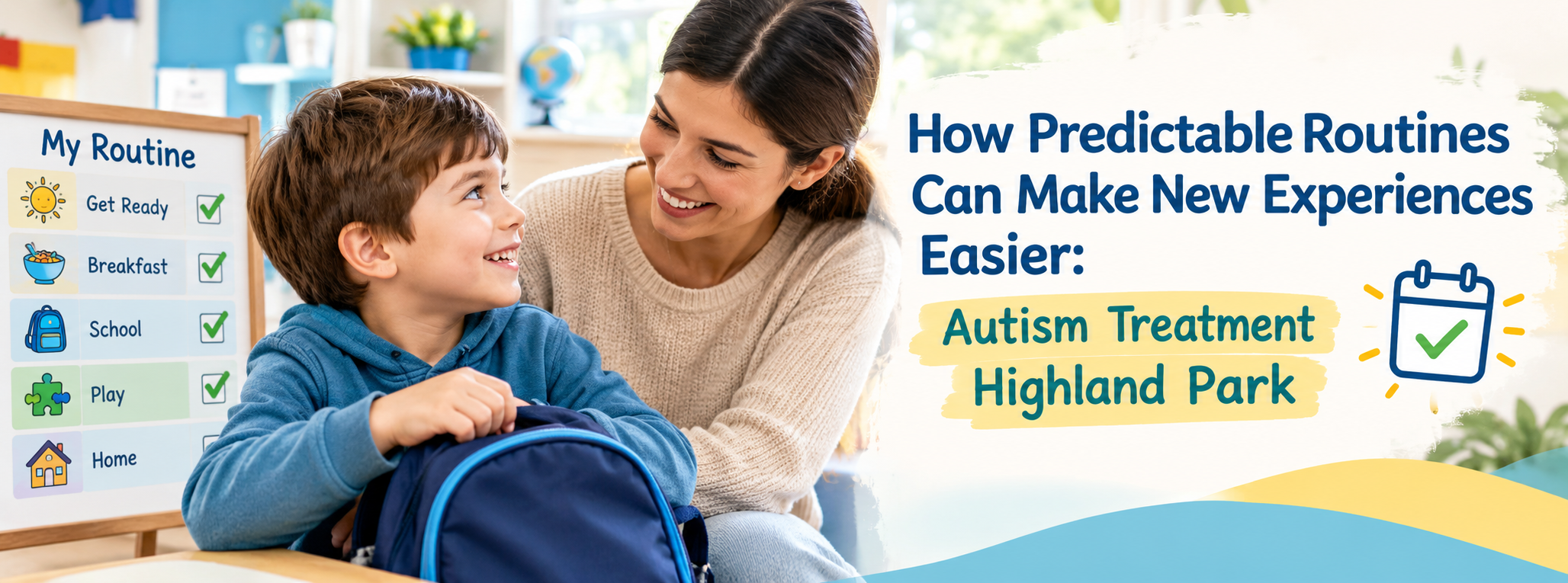
Visual Schedules Can Make the Day Easier to Understand
Some children benefit from seeing what is going to happen instead of relying only on spoken instructions.
A simple visual schedule might show:
Breakfast → Car → New Place → Activity → Snack → Home
The schedule does not need to be complicated.
For some children, photographs may be useful. Others may respond better to drawings, written words, symbols, or a combination.
The important part is that the schedule communicates the sequence of events in a way the child can understand.
Visual schedules can also be useful when a routine changes.
For example, if the normal plan is:
School → Home → Snack → Play
but there is a doctor’s appointment, the schedule could show:
School → Doctor → Home → Snack → Play
The child can see that the familiar activities are still part of the day, even though something new has been added.
Practice Small Changes Before Bigger Ones
Flexibility is a skill that can be practiced gradually.
Rather than changing everything at once, families can introduce small variations to familiar routines.
A child who always uses the same cup might practice using another familiar cup.
A child who always enters through one door might practice using another entrance when appropriate.
A child who follows the same route to the park might occasionally take a slightly different route.
These small experiences can provide opportunities to practice coping with change while the overall environment remains supportive.
This type of gradual practice may be incorporated into individualized behavioral intervention Highland Park TX programs, depending on the child’s needs and goals.
Keep the First Changes Manageable
A change should be challenging enough to provide practice but not so overwhelming that the child has no way to participate.
Parents and professionals can consider factors such as:
- The child’s communication skills
- Sensory preferences
- Current tolerance for change
- Familiarity with the environment
- The size of the change
- Available support
- The child’s motivation to participate
There is no single progression that works for every child.
Individualized planning is one reason families may seek BCBA services Highland Park when they want guidance around specific behavioral and skill-development goals.
Use Predictable Language
The words adults use can also make routines more predictable.
Instead of giving a long explanation, parents can use short, consistent phrases.
For example:
“First shoes, then car.”
“First appointment, then playground.”
“Two more minutes, then cleanup.”
Consistent language can help children recognize familiar patterns.
It can also make transitions easier because the child begins to associate certain phrases with what happens next.
For children receiving ABA therapy services Highland Park, communication strategies can be individualized according to the child’s current skills and needs.
New Places Can Become More Familiar Over Time
Sometimes the best way to make a new environment easier is to introduce it gradually.
Before visiting a new location, a family might:
- Look at pictures of the building.
- Drive past it without going inside.
- Talk about who will be there.
- Watch a short video of the location if one is available.
- Visit briefly before staying for a longer period.
- Bring a familiar item.
- Plan a predictable activity afterward.
The first visit does not have to accomplish everything.
A short, successful introduction can provide useful familiarity for the next visit.
This can be particularly relevant for in-home ABA therapy Highland Park and community-based learning, where children may practice skills in everyday environments rather than only in a therapy setting.
Familiar Objects Can Add Another Layer of Predictability
A familiar object can sometimes serve as a bridge between home and a new environment.
Depending on the child, this might be:
- A favorite small toy
- A familiar book
- Headphones
- A preferred activity
- A familiar bag
- A comfort item
The purpose is not necessarily to make the child dependent on the item forever. Instead, it can provide familiarity while the child learns to navigate a new experience.
Over time, the amount of support may be adjusted as the child’s skills and comfort develop.
Predictable Routines Can Support Communication
New situations can create communication opportunities.
A child might need to ask for:
- Help
- A break
- More time
- A preferred item
- Information about what comes next
- A different option
Families can intentionally build these opportunities into routines.
For example, before leaving home, a parent might ask, “What do we need?”
The child could request a bag, shoes, headphones, or another item.
At a new location, the child might practice asking for help or communicating that they are finished.
These everyday moments can become meaningful practice.
Pediatric ABA therapy Highland Park may address functional communication as part of an individualized treatment plan, helping children build skills that can be used outside of therapy.
What Parents Can Do at Home
Parents do not need elaborate programs to introduce more predictability into everyday life.
A few simple strategies can make routines easier to follow.
1. Explain What Comes Next
Use simple language to preview the next activity.
“After breakfast, we are going to the store.”
2. Keep Important Parts of the Routine Consistent
You do not have to control every detail. Focus on the parts that help the child understand the sequence.
3. Give Warnings Before Transitions
A short warning can help prepare a child for an upcoming change.
“Five more minutes, then cleanup.”
4. Show Rather Than Only Tell
Pictures, written lists, gestures, or visual schedules can provide another way to communicate the plan.
5. Practice Flexibility Gradually
Introduce manageable changes when the child is comfortable and supported.
6. Notice Successful Attempts
If a child handles a small change, recognize the effort.
“You used the new cup today.”
“You came inside even though the playground was closed.”
Specific feedback helps identify what the child successfully accomplished.
Routines Can Also Help During Community Activities
Community activities naturally involve unexpected changes.
A restaurant may have a wait.
A store may be crowded.
A playground may be closed.
A family outing may take longer than expected.
These situations can become opportunities to practice flexibility.
For families looking for autism support services Highland Park, it can be helpful to think beyond isolated skills and consider how those skills function in real-life environments.
A child may know how to follow a schedule at home but need additional practice using those skills at school, a restaurant, a store, or a family gathering.
That is where individualized goals and consistent practice can become especially valuable.
What If the Routine Has to Change?
Even the best routine cannot prevent every unexpected event.
A child may become upset when plans change, and that does not necessarily mean the routine has failed.
Instead, adults can focus on helping the child understand the change and identify what remains predictable.
For example:
“The park is closed. We are going to the library instead. Then we will come home for snack.”
The destination changed, but the child still knows what comes afterward.
Over time, children can practice responding to increasingly unpredictable situations with appropriate support.
This is one area where autism behavior therapy Highland Park may focus on practical skills that support participation in daily life.
Every Child’s Routine Will Look Different
There is no universal routine that every child should follow.
Some children may benefit from detailed visual schedules. Others may only need a simple verbal preview.
Some may need significant preparation before a new environment. Others may adjust after a brief explanation.
Some children may need frequent opportunities to practice flexibility, while others may already handle many changes independently.
The purpose of individualized developmental therapy Highland Park and ABA services is not to make every child behave according to one standard routine. Instead, support should consider the child’s individual strengths, communication style, learning needs, preferences, and goals.
When Families May Consider Professional Support
Parents may seek professional guidance when transitions or unfamiliar experiences consistently interfere with everyday activities.
For example, a family might notice that a child:
- Has significant difficulty leaving familiar environments.
- Becomes distressed when plans change.
- Struggles to participate in community activities.
- Needs extensive support with transitions.
- Has difficulty communicating when something unexpected happens.
- Finds new environments particularly challenging.
A qualified provider can help identify the skills involved and develop an individualized approach.
Families comparing ABA clinics in Highland Park may want to ask how providers approach transitions, flexibility, communication, caregiver involvement, and generalization of skills across everyday settings.
Building Confidence One New Experience at a Time
Predictability is not about keeping children away from new experiences.
It can actually help create a path toward them.
When children know what to expect before, during, and after an activity, they may have more opportunities to focus on learning rather than trying to figure out what is happening around them.
A familiar routine can provide the starting point.
A small change can provide practice.
A new environment can provide an opportunity to generalize a skill.
And repeated experiences can gradually build confidence.
For families exploring Autism Treatment Highland Park, predictable routines can be one practical piece of a larger individualized approach. ABA therapy in Highland Park TX may incorporate strategies that help children develop communication, transition, independence, social, and adaptive skills based on their specific needs.
The goal is not to make life perfectly predictable. Life will always include surprises. Instead, the goal can be to help children develop the skills and confidence they need to navigate those surprises with increasing independence.
Final Thoughts
New experiences do not have to begin with complete uncertainty. A predictable routine can give children a familiar foundation while they learn to handle something unfamiliar.
For families considering Autism Treatment Highland Park, routines, visual supports, preparation, gradual changes, communication strategies, and individualized practice can all play a role in helping children participate more comfortably in everyday experiences.
With the right support, “new” does not always have to mean overwhelming. Sometimes, it can simply mean familiar steps leading to something different.
Contact us at 972–310–4991 or visit https://radiantspectrumtherapy.com/ to learn more.