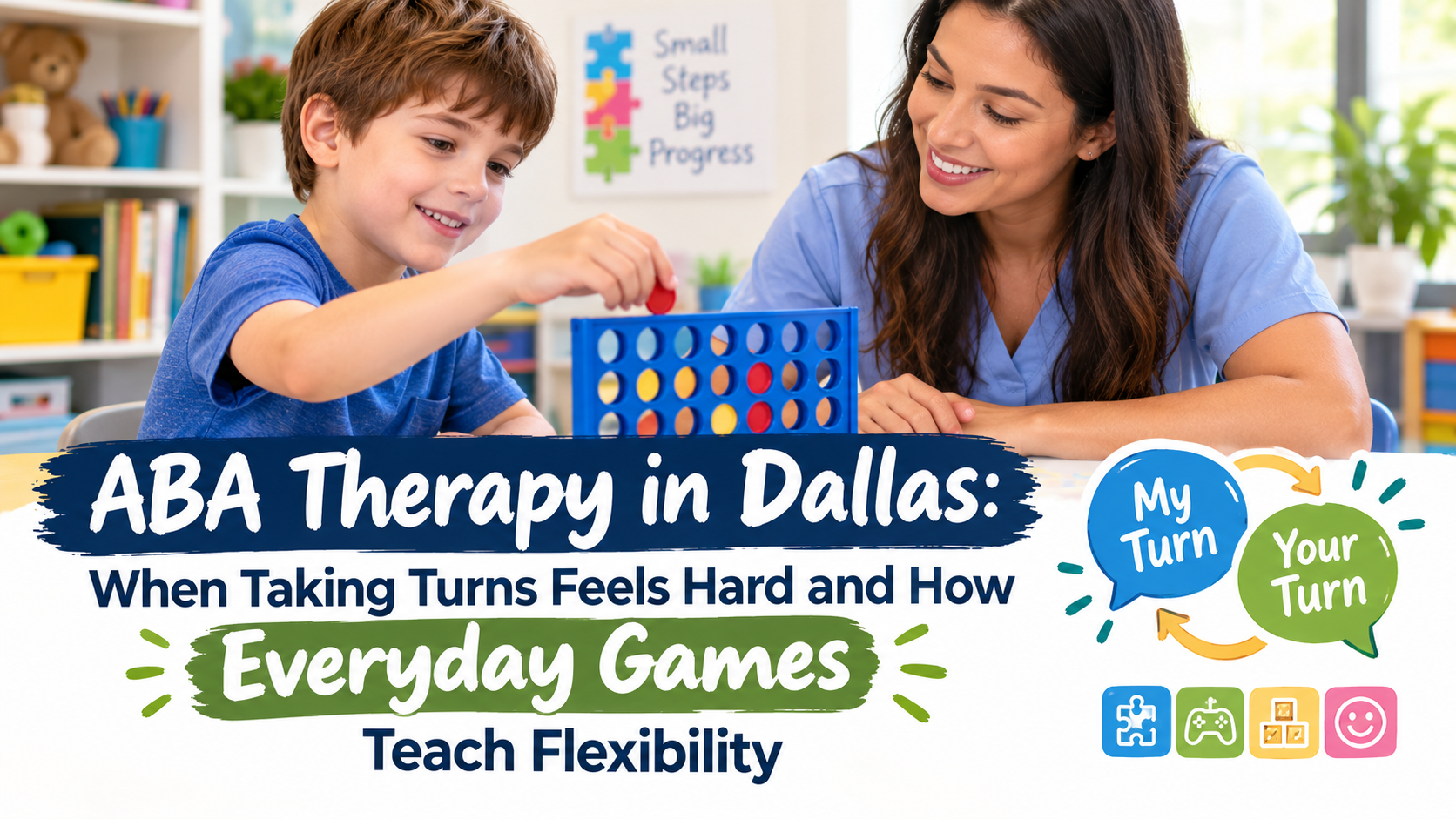

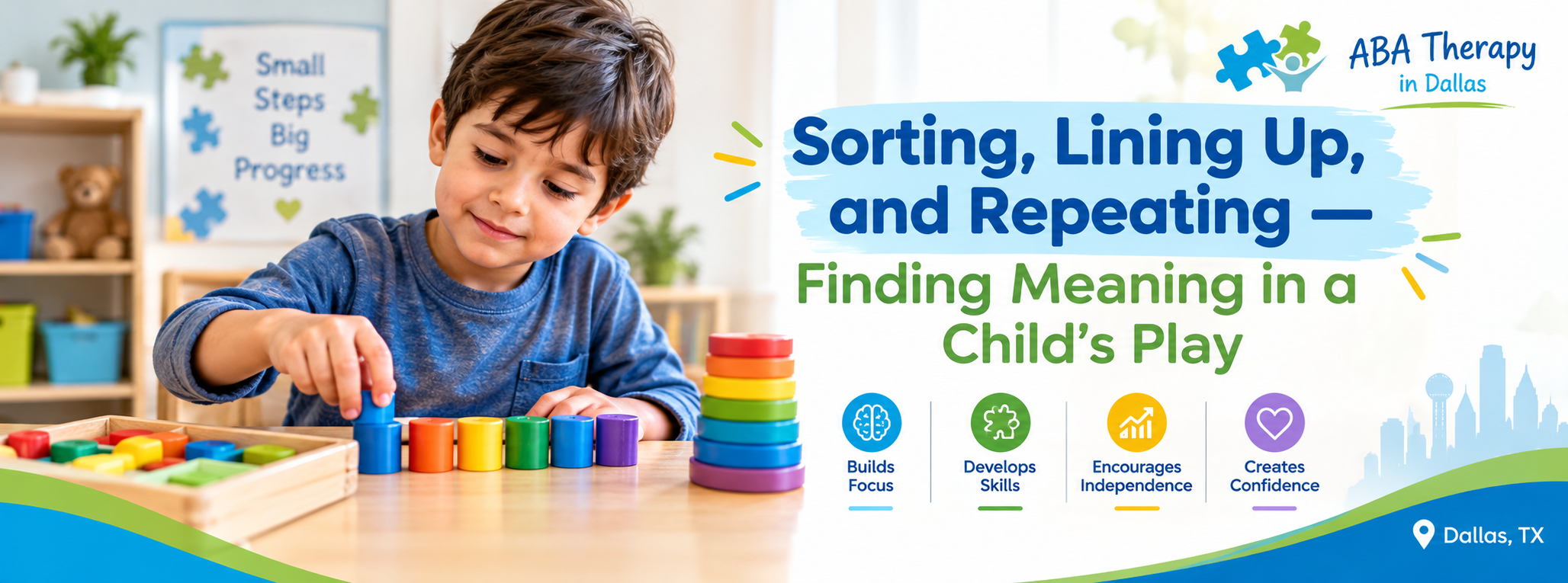
Children play in many different ways. Some enjoy pretending to cook, building towers, or playing games with others, while some prefer sorting toys, lining up cars, or repeating the same activity many times. Through ABA Therapy in Dallas, families can learn to recognize the meaning behind these play patterns and discover ways to build on a child’s existing interests while supporting communication, independence, and development.
For parents exploring ABA therapy Dallas, repetitive play can raise questions. Why does a child want to arrange the same toys in the same order? Why might they prefer sorting objects instead of playing with them in a more conventional way? These behaviors can reflect a child’s preferences, curiosity, sensory experiences, or enjoyment of predictable routines. Repetition is not automatically a problem that needs to be corrected.
Understanding these patterns is an important part of recognizing each child’s individual strengths. Whether families are researching ABA therapy for autism Dallas, autism therapy Dallas TX, or broader developmental resources, it helps to begin with observation rather than assumptions.
At Radiant Spectrum Therapy, a child’s existing interests can provide a starting point for meaningful learning opportunities. By respecting harmless play and understanding what motivates a child, parents and therapy professionals can create opportunities for connection without taking away the activities the child enjoys.
Understanding Repetitive Play Through ABA Therapy in Dallas
Repetitive play involves returning to familiar actions, arranging objects in predictable ways, or enjoying the same activity repeatedly. A child might line up toy animals, organize blocks by color, spin a toy wheel, or repeatedly open and close a container.
These activities can serve different purposes. Some children enjoy visual patterns, while others appreciate the predictability or sensory qualities of an activity. A child might also repeat an action because it is entertaining or because they are exploring what happens each time.
Families considering ABA therapy services Dallas can benefit from learning how individualized approaches examine a child’s environment, preferences, and behavior. Rather than interpreting every repeated action as a concern, professionals can consider the context and whether the activity affects the child’s well-being or everyday participation.
Why Children Enjoy Sorting Objects
Sorting is a common play activity that allows children to explore similarities and differences. A child might separate toy cars from trucks, arrange blocks by color, or group animals according to size.
These activities may provide opportunities to practice:
- Recognizing colors, shapes, sizes, and patterns.
- Exploring relationships between objects.
- Developing visual attention and coordination.
- Making choices and expressing preferences.
- Practicing communication during familiar routines.
Parents do not need to turn every sorting activity into a lesson. Sometimes, allowing a child to enjoy an activity independently is valuable in itself.
When a child welcomes interaction, a caregiver might introduce another block and say, “Where should this one go?” The child can respond verbally, gesture, use an AAC device, or continue playing without responding.
These everyday moments can also help parents understand how ABA therapy works Dallas when therapy incorporates naturally occurring interests into individualized learning opportunities.
What Does Lining Up Toys Mean?
Some children enjoy arranging cars, animals, or blocks in carefully organized rows. They may focus on spacing, color, size, or the order of objects.
For example, a child who lines up toy cars might enjoy seeing all the vehicles together. Another might repeatedly adjust the distance between each car until the arrangement feels right.
Instead of immediately changing the arrangement, adults can observe what captures the child’s attention. Does the child enjoy adding more objects? Do they appear interested in particular colors? Do they invite someone to look at the finished line?
These observations can help caregivers understand individual preferences without assuming that every child engages in repetitive play for the same reason.
Families searching for Applied Behavior Analysis Dallas or behavior therapy Dallas should look for professionals who consider these individual differences when discussing developmental goals.
Why Repetition Can Be Meaningful
Repetition is a natural part of learning. Children often request the same story, practice a favorite movement, or repeat an activity because they enjoy the familiarity.
A child might build the same tower several times, gradually experimenting with its height. Another might arrange toy animals in a familiar order while occasionally introducing a new figure.
For some children, predictable activities provide an enjoyable way to explore their surroundings. Repetition may also help them engage with materials at their own pace.
However, not every repeated activity needs to lead to a new skill. Play can be worthwhile simply because it brings enjoyment, comfort, or a sense of control.
Recognizing Preferences Without Creating Unnecessary Pressure
There is a difference between a child enjoying a repeated activity and a child experiencing significant distress around it.
A child who happily sorts blocks for an extended period may be deeply engaged. Another child might become upset when an arrangement is accidentally moved. These situations require different kinds of understanding and support.
Parents can consider several questions:
- Does the child seem comfortable and interested?
- Can the child communicate when they want help or a break?
- Does the activity interfere with sleep, safety, or important daily routines?
- Does the child have opportunities to explore other activities when they choose?
- Are changes creating distress that requires additional support?
These observations are not intended to label harmless behaviors as problems. They can help families decide whether they need guidance from a qualified professional.
Parents exploring autism behavior therapy Dallas or behavioral intervention Dallas TX can ask providers how they distinguish harmless repetitive play from behaviors that may require individualized support.
The focus should remain on the child’s well-being, communication, autonomy, and meaningful participation rather than simply making their play look different.
Building on a Child’s Interests Through ABA Therapy
A child’s favorite activity can provide a natural starting point for learning. When adults understand what motivates a child, they can create opportunities that are relevant to that child’s interests and needs.
For example, a child who enjoys lining up toy cars might have opportunities to request another car, choose a color, ask for assistance, or communicate when they are finished. A child who sorts animals might practice making choices or sharing an observation during an activity they already enjoy.
These opportunities should be individualized. They should also respect the child’s communication style, sensory needs, and willingness to participate.
For families considering in-home ABA therapy Dallas, familiar toys and everyday routines may offer opportunities to incorporate learning into the home environment. Depending on the child’s needs and the provider’s services, center-based ABA therapy Dallas may offer other opportunities for practicing skills in a structured setting.
Neither setting is automatically the right choice for every child. Families can discuss their preferences, goals, and practical needs with a qualified provider.
Following the Child’s Motivation
Motivation is an important consideration when creating learning opportunities. If a child enjoys organizing toy animals, that activity may provide a natural reason to engage with a caregiver.
An adult might sit nearby, describe the arrangement, or offer another animal when the child indicates interest. If the child communicates a request, the adult can respond meaningfully.
If the child prefers to play independently, that preference should also be respected. An adult does not need to interrupt every activity to create a learning opportunity.
This child-centered approach can be relevant for families exploring early intervention ABA Dallas, particularly when they want to understand how everyday activities may support their young child’s individual developmental goals.
Expanding Play Without Forcing Change
Building on an existing interest does not require replacing the original activity. Small, optional variations can introduce new experiences while keeping the familiar elements a child enjoys.
For example, a child who lines up cars might enjoy:
- Arranging vehicles by color and then by size.
- Choosing which car goes at the beginning of the line.
- Building a longer line with a favorite set of toys.
- Exploring a ramp while keeping preferred cars nearby.
- Inviting a trusted adult to look at the finished arrangement.
The child should have room to accept or decline these possibilities. If they prefer the original activity, that preference provides useful information.
For parents researching pediatric ABA therapy Dallas or ABA therapy for toddlers Dallas, it is worth asking how a provider incorporates children’s interests into treatment instead of expecting every child to engage with toys in the same way.
Supporting Communication During Familiar Activities
Play can provide natural opportunities for communication. Communication may include spoken words, gestures, pointing, pictures, signs, or an augmentative and alternative communication (AAC) device.
Adults can support communication by noticing what a child is expressing and responding in a way that makes sense within the activity.
Use Simple, Relevant Language
While a child sorts blocks, a caregiver might say, “Blue block,” “Another one,” or “All done.” These short comments expose the child to useful language without requiring them to repeat every word.
If a child uses an AAC device to request another toy, the caregiver can acknowledge the request and respond when possible.
It is also helpful to allow enough time for a child to process information and communicate. Asking repeated questions or constantly prompting for a response may make a favorite activity feel demanding.
Families exploring ABA therapy for kids Dallas can ask providers how they support different communication styles and help children express their preferences during everyday activities.
Recognize Different Forms of Participation
A child may show interest by moving closer, handing over an object, smiling, watching an activity, or allowing another person to sit nearby.
These behaviors can provide useful information about engagement, although adults should consider the context rather than assume that every action has the same meaning.
Eye contact and spoken responses are not the only valid ways to participate. Children should have opportunities to communicate and connect in ways that work for them.
This is especially important when comparing developmental therapy Dallas options or exploring special needs therapy Dallas, since different programs may address different developmental goals.
Practical Ways Parents Can Support Play at Home
Parents do not need special equipment or elaborate activities to understand their child’s play. Familiar toys and daily routines can provide plenty of opportunities to observe interests and encourage communication.
Observe Before Joining
Spend a few minutes watching your child play without immediately directing the activity.
Notice which objects they choose, what they repeat, and which details appear to hold their attention. You might discover that your child enjoys a particular color, the sound of an object, or the predictable movement involved in arranging toys.
You do not need to identify the exact reason behind every behavior. Your observations can simply help you understand your child’s preferences.
Join Without Taking Control
If your child seems comfortable with your presence, try sitting nearby or participating in a way that respects their activity.
You might arrange your own group of blocks, comment on a pattern, or hand over an object when requested. Avoid rearranging a child’s toys without permission or turning every moment into a question.
Some children enjoy shared play, while others prefer independent exploration. Both preferences deserve consideration.
Offer Choices and Predictability
When introducing another activity, offer two clear choices when appropriate. For example, your child might choose between sorting blocks and arranging toy animals.
Familiar phrases, visual schedules, or advance notice may also help some children prepare for transitions.
If a transition causes distress, focus on understanding what makes the change difficult and what support may help. Avoid assuming the child is deliberately refusing to cooperate.
Encourage Self-Advocacy
Notice when your child communicates a preference, asks for help, requests a break, or indicates that they want to stop.
Responding to these messages helps show that communication matters. Children should have opportunities to express discomfort, decline activities, and make choices when possible.
Families researching autism support services Dallas can ask providers how their programs support self-advocacy, independence, and the child’s ability to communicate personal preferences.
Finding the Right Professional Support in Dallas
Repeated play alone does not establish that a child has autism or requires therapy. Children have different interests, and their play patterns can change as they develop.
However, parents may benefit from professional guidance if they have concerns about communication, social interaction, developmental progress, emotional regulation, or participation in everyday routines.
Families searching for ABA therapy near Dallas can begin by identifying providers that explain their approach clearly and develop individualized goals. It is also helpful to compare credentials, service settings, parent involvement, and current availability.
A qualified professional can help families determine whether ABA is appropriate for their child’s needs or whether other developmental services may be useful.
Questions to Ask Potential Providers
When comparing programs, consider asking:
- How are a child’s existing interests incorporated into therapy?
- How does the team evaluate whether repetitive play is harmless or needs support?
- How are communication and self-advocacy included in treatment goals?
- How are parents involved in planning and reviewing progress?
- How does the team adapt activities to sensory needs and individual preferences?
These questions can help families evaluate whether a provider’s approach aligns with their priorities.
Parents may encounter BCBA services Dallas when searching for professionals who oversee ABA treatment. A Board Certified Behavior Analyst (BCBA) may assess needs, develop individualized goals, and supervise services, depending on the program and clinical arrangement.
Families can also explore ABA clinics in Dallas to compare available settings and ask about the types of support offered.
Exploring ABA Therapy Options for Your Family
When researching providers, families may search for best ABA therapy providers Dallas, top-rated ABA therapists Dallas, or best ABA therapy in Dallas. Online ratings can help identify potential options, but they cannot determine whether a particular program is the right fit for an individual child.
Practical considerations matter, too. Families might compare affordable ABA therapy Dallas TX, ABA therapy cost Dallas, or private ABA therapy Dallas to understand financial arrangements and service options. Costs, insurance coverage, and availability vary by provider and individual circumstances.
Some parents may explore intensive ABA programs Dallas, while others may prefer a different service intensity. The appropriate approach should depend on the child’s individualized needs, family priorities, clinical recommendations, and the provider’s scope of services.
Searches for ABA therapy near me Dallas, ABA therapy in Dallas TX, and Dallas autism services can help families develop a list of potential providers. Those looking for ABA therapy for autism Dallas should confirm each provider’s qualifications, age range, service area, and treatment approach directly.
Families interested in autism therapy Dallas TX may also want to explore related resources, including developmental therapy Dallas and special needs therapy Dallas, to understand which services best address their child’s needs.
For families seeking support for younger children, early intervention ABA Dallas and ABA therapy for toddlers Dallas may be useful starting points. Parents looking for pediatric ABA therapy Dallas or ABA therapy for kids Dallas can ask how programs adapt to different developmental stages.
Radiant Spectrum Therapy encourages families to learn about their options, ask questions, and seek individualized guidance. Choosing a provider should involve more than comparing search rankings. It should include understanding how the team listens to families, respects children’s preferences, and measures progress toward meaningful goals.
Finding Meaning in the Play Your Child Already Loves
Sorting, lining up, and repeating activities can reveal important information about a child’s interests and ways of exploring the world. These play patterns do not need to be eliminated simply because they are repetitive or unfamiliar to others.
Parents can start with curiosity, observe what captures their child’s attention, and respect activities that bring enjoyment. When a child welcomes interaction, familiar play can create opportunities for communication, choice-making, shared experiences, and independence.
For families considering ABA Therapy in Dallas, the goal should be to find individualized support that builds on a child’s strengths rather than treating differences as something to erase. Whether you are exploring ABA therapy Dallas, ABA therapy services Dallas, or other Dallas autism services, look for a qualified team that values your child’s individuality and works toward goals that improve meaningful aspects of everyday life.
At Radiant Spectrum Therapy, understanding a child’s existing motivation can be an important starting point for supporting development. Every child has their own way of engaging with the world, and meaningful progress begins by recognizing the person behind the play.
Contact us at 972–310–4991 or visit https://radiantspectrumtherapy.com/ to learn more.