
Parents often expect learning to look like answering questions, following instructions, completing activities, or actively participating in a conversation. However, children do not always demonstrate progress in obvious ways. Sometimes, learning begins with watching, listening, observing a familiar routine, or quietly noticing what happens around them. For families exploring ABA Therapy in Dallas, understanding these early signs of engagement can help them recognize meaningful steps in their child’s development, even when active participation has not yet begun.
Every child learns differently, and some children need more time to feel comfortable with unfamiliar people, environments, activities, or expectations. A child who watches a therapist demonstrate a game without joining in may still be processing what they see. Another child may observe how a parent completes a daily routine before attempting the same steps independently. These moments can provide valuable information about how a child learns, responds to their surroundings, and gradually becomes more comfortable engaging with others.
At Radiant Spectrum Therapy, recognizing progress means looking beyond immediate responses and paying attention to the smaller steps that may support future participation. Through individualized support, families and therapists can better understand a child’s learning process while respecting their comfort, communication style, and developmental needs.
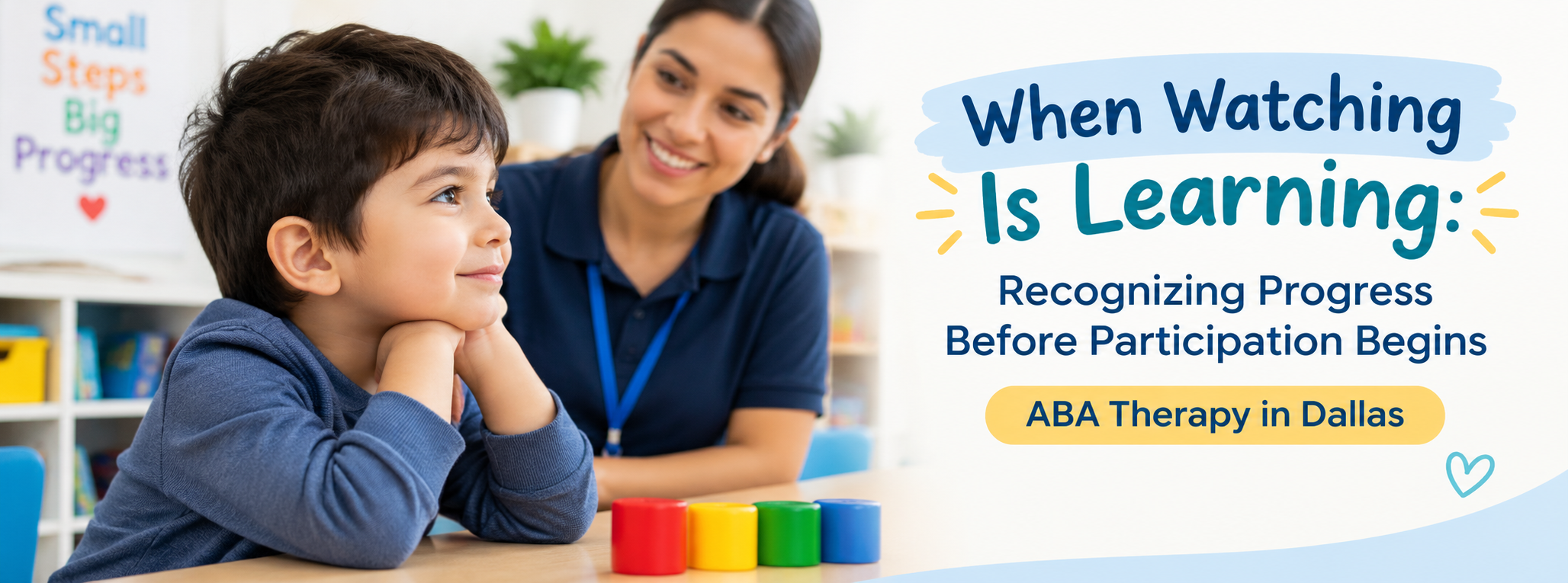
Why Watching Can Be an Important Part of Learning
Observation is a natural way to gather information. Before trying something unfamiliar, many children benefit from seeing how an activity works, what other people do, and what might happen next. Watching can help a child become familiar with a situation before deciding whether or how to participate.
For some children, particularly those who find new environments or social expectations challenging, observation may be an important first step toward engagement. A child may prefer to stand nearby while other children play, watch a therapist introduce a new toy, or remain quiet while a family member demonstrates a task.
These behaviors do not automatically mean that a child is learning, but they can offer useful clues when considered alongside other responses and the child’s individual goals.
Observation Helps Children Gather Information
When children observe an activity, they may notice details that are not immediately apparent to adults. They might watch how a toy works, recognize a familiar sequence, notice another person’s reaction, or learn what happens after a particular action.
For example, a therapist may introduce a matching game with several picture cards. Instead of reaching for a card immediately, a child watches the therapist match two pictures. The child may then look between the cards, follow the therapist’s movements, or remain nearby as the activity continues.
These actions may indicate growing familiarity with the task. The child may eventually attempt a match independently, but that outcome does not need to happen during the first demonstration for the observation to be worthwhile.
Watching Can Reduce Uncertainty
Unfamiliar situations often involve many new details at once. A child may encounter unfamiliar sounds, people, materials, instructions, or expectations. Having an opportunity to observe can make the situation more predictable.
For example, a child beginning center-based ABA therapy in Dallas may initially spend time looking around the treatment room rather than joining an activity. Watching a therapist arrange materials, demonstrate a familiar game, or transition between activities may help the child understand the environment.
Providing time to observe can make it easier to identify what the child is comfortable with and which aspects of the situation may require additional support.
Recognizing Early Signs of Engagement
Participation is not limited to speaking, touching materials, or following instructions. Engagement can take different forms, and its meaning depends on the child, the activity, and the context.
Parents can look for patterns over time rather than relying on a single behavior to determine whether progress is occurring.
Changes in Attention
A child who begins looking toward a familiar activity, follows an object with their eyes, or notices when someone introduces a preferred toy may be showing increased awareness of the experience.
Attention can be brief or inconsistent. A child might watch for several seconds, look away, and then return their attention to the activity. This pattern may be part of how the child explores and processes information.
Adults can support these moments by keeping activities manageable, reducing unnecessary distractions when appropriate, and allowing the child time to observe without immediately asking them to respond.
It is also important to remember that eye contact is not a requirement for learning. Children can attend to information in different ways, and looking directly at a person does not necessarily tell us how much a child understands.
Moving Closer to an Activity
Physical proximity can sometimes offer clues about a child’s growing interest or comfort.
A child who previously remained across the room might begin sitting closer to a therapist during play. Another child might approach a table when familiar materials appear or stay nearby while a sibling builds with blocks.
These changes do not prove that the child is ready to participate, but they can help adults understand which environments and activities may feel more approachable.
Instead of immediately turning this movement into a demand, a parent or therapist can acknowledge the child’s presence and continue offering opportunities to engage naturally.
Anticipating Familiar Routines
Children may begin recognizing patterns before they actively perform each step. For example, a child might look toward the door when it is nearly time to leave, move closer when a favorite song begins, or notice when a familiar activity is about to start.
Recognizing what comes next may indicate that the child is becoming familiar with a routine.
In ABA therapy services in Dallas, therapists may use predictable routines to help children understand what to expect while gradually supporting appropriate communication, independence, and transitions. The specific approach should reflect the child’s abilities, needs, and treatment goals.
Showing Interest Without Touching
A child may show interest in an activity without reaching for materials or joining the group. They might watch a bubble wand, listen to a song, observe a puzzle being completed, or follow the movement of a toy.
Adults sometimes interpret the absence of a direct response as a lack of interest. However, a child may need additional time, a different invitation, or a more comfortable way to participate.
Offering choices and allowing space for the child to approach the activity can help adults discover what encourages engagement without making participation feel overwhelming.
Why Some Children Need More Time Before Participating
Children develop communication, attention, social interaction, and play skills at different rates. A child who watches rather than participates may have several reasons for doing so, and the explanation may differ from one situation to another.
Understanding these possibilities can help parents respond with curiosity instead of assuming the child is being uncooperative.
Processing New Information
Some children benefit from additional time to process spoken instructions, visual information, or changes in their surroundings. When several instructions are delivered quickly, they may need more time to understand what is being asked.
For example, a therapist might say, “Choose a puzzle, sit at the table, and find the matching pieces.” A child may watch the materials and remain still because the instruction includes several steps.
Breaking the activity into smaller parts, demonstrating one step at a time, and allowing pauses can make the task easier to understand.
Families considering pediatric ABA therapy in Dallas can ask how therapists individualize instructions and provide processing time based on each child’s communication and learning needs.
Becoming Comfortable With People and Places
A new therapy room, unfamiliar adult, or different daily schedule can affect how readily a child participates. Some children approach new experiences immediately, while others prefer to watch before getting involved.
A child may participate enthusiastically with a familiar parent but remain quiet during an initial therapy session. This difference does not necessarily mean the child cannot perform the activity. Familiarity, predictability, and the relationship with the person offering the activity may influence the child’s response.
Building trust and offering consistent, low-pressure opportunities can help a child become more comfortable over time.
Communicating in Different Ways
Communication involves more than spoken words. Children may communicate through gestures, movements, facial expressions, picture cards, communication devices, or other individualized methods.
A child who does not verbally answer a question may still be communicating through another response. Likewise, a child may need support to indicate that they want a turn, need a break, or would like an activity to continue.
Applied Behavior Analysis Dallas providers can work with families to identify meaningful communication goals and teach practical ways for children to express preferences, needs, and boundaries.
The goal should be to expand a child’s ability to communicate effectively, not to require one particular communication style.
How ABA Therapy in Dallas Can Support Gradual Engagement
Applied Behavior Analysis (ABA) focuses on understanding behavior in context and using individualized, evidence-informed strategies to support meaningful skills. Depending on the child’s needs and treatment plan, goals may include functional communication, daily living skills, play, social interaction, flexibility, or independence.
Observation can help therapists understand what captures a child’s attention, which activities feel approachable, and what kinds of support may be helpful. However, observation alone does not establish mastery of a skill. Therapists need to consider additional evidence, such as responses across opportunities and settings, when evaluating progress.
Starting With the Child’s Interests
A child’s interests can provide a natural starting point for engagement.
If a child enjoys vehicles, a therapist might introduce a simple car ramp. If the child prefers music, the therapist might begin with a familiar song. If the child enjoys sorting objects, a matching activity could provide an approachable learning opportunity.
Starting with familiar or preferred materials can help make an activity more meaningful. The therapist can then observe how the child responds and determine whether to continue, adjust the activity, or offer another choice.
Following a child’s interests does not mean every activity must remain the same. It means using what motivates the child to create opportunities for learning while gradually introducing appropriate new experiences.
Using Modeling and Demonstration
Modeling allows a child to see how a task or activity works before being expected to attempt it.
For example, a therapist may demonstrate placing a block on a tower, rolling a ball back and forth, or putting a toy into a container. The child can watch the demonstration, explore the materials, or choose to try the action when ready.
Depending on the child’s goals, the therapist may use visual demonstrations, gestures, pictures, or other supports. The amount of assistance can be adjusted as the child becomes more familiar with the activity.
A child does not need to copy every demonstrated action immediately. Therapists can evaluate whether modeling is helpful by observing the child’s responses over time and adjusting their approach accordingly.
Providing Time to Respond
Some children benefit from a pause after an instruction, question, or invitation. Repeating a direction several times or adding more words too quickly may make it harder for the child to process the information.
A therapist might say, “Would you like the blocks or the puzzle?” and then wait while the child considers the choices.
The child might respond by pointing, reaching, using a communication device, speaking, or indicating a preference in another established way.
Providing time does not mean withholding necessary support. It means allowing a reasonable opportunity to respond before deciding whether the instruction needs to be clarified, simplified, or presented differently.
Adjusting the Activity to the Child’s Needs
If a child consistently watches without moving closer, becomes distressed, or turns away when an activity begins, the therapist can consider whether the task is too difficult, the environment is overwhelming, or the child needs a different form of support.
Possible adjustments may include:
- Reducing the number of materials presented at once.
- Using shorter, clearer instructions.
- Offering two meaningful choices.
- Beginning with a familiar activity.
- Reducing unnecessary noise or visual distractions.
- Providing a break when needed.
- Making participation optional when appropriate and respecting the child’s communication.
The purpose of these adjustments is not to force a response. It is to understand barriers to engagement and create more accessible opportunities for learning.
What Parents Can Do at Home
Parents do not need to turn every interaction into a teaching session. Everyday routines already offer many opportunities for children to observe, explore, and gradually become involved.
A supportive environment allows children to approach experiences in different ways while giving adults opportunities to notice what helps.
Demonstrate Before Asking
If your child is learning a new activity, try showing them what it looks like before asking them to do it.
For instance, if you are introducing a simple art activity, you could demonstrate how to place a sticker on paper. Let your child watch, explore the materials, or choose whether to try.
Avoid assuming that a lack of immediate imitation means the demonstration was unsuccessful. You can revisit the activity later or try a different approach.
Create Predictable Opportunities
Familiar routines can make it easier for children to understand what happens next.
You might use the same sequence when preparing for bedtime, getting ready to leave the house, or cleaning up toys. Simple visual supports or brief verbal reminders may help some children follow the routine.
As the child becomes more familiar with the sequence, you can observe whether they begin anticipating steps, communicating preferences, or participating in parts of the activity.
Offer Choices Without Pressure
Choices can give children a meaningful way to engage while supporting autonomy.
For example, ask whether your child would prefer a book or a puzzle, or offer two activities they already enjoy. If the child watches both options without choosing, you can pause, simplify the choices, or provide another accessible way to communicate.
Whenever possible, respect a child’s refusal, request for a break, or indication that they are finished. Learning to communicate these preferences is also valuable.
Notice Small Changes Over Time
Instead of focusing exclusively on whether your child completes a task, consider other changes that may be relevant to their individual goals.
You might notice that your child:
- Stays near an activity for longer than before.
- Returns to a familiar game after taking a break.
- Watches a demonstration and later attempts part of it.
- Shows anticipation during a familiar routine.
- Communicates a preference more clearly.
- Accepts a new material after observing it first.
These examples are not universal milestones, and every behavior does not necessarily indicate progress. Their significance depends on the child’s needs, the circumstances, and whether the change supports a meaningful goal.
Sharing these observations with your child’s therapist can help the team identify patterns and decide whether an approach is working.
How to Recognize Meaningful Progress Without Rushing
It can be difficult to know whether a child is learning when the results are not immediately visible. Parents may compare their child’s participation with that of other children or worry when a new skill takes longer than expected.
A more useful approach is to consider progress in relation to the individual child.
Look at Patterns, Not One Moment
One quiet session does not tell the whole story. A child might observe an activity without joining one day and participate briefly the next. On another day, they might need additional time or prefer a different activity.
Therapists can look at patterns across multiple opportunities to determine whether attention, communication, independence, or other targeted skills are changing.
For families receiving ABA therapy for autism in Dallas, ongoing communication with the treatment team can clarify what progress looks like for their child and how it will be evaluated.
Separate Participation From Compliance
A child sitting still, looking toward an adult, or following a direction does not automatically mean they understand the activity or feel comfortable.
Meaningful engagement includes opportunities for children to communicate, make choices, express discomfort, and participate in ways that are appropriate for their developmental level.
Treatment goals should prioritize useful skills and the child’s quality of life rather than simply making the child appear compliant. Families should feel comfortable asking why a goal matters, how progress is measured, and how the child’s preferences are considered.
Celebrate Progress Without Creating Pressure
It is natural to feel excited when a child begins engaging in a new activity. At the same time, excessive prompting or repeated requests to perform a skill can sometimes make an experience more stressful.
A calm response, an accessible invitation, and enough time to explore can help keep learning opportunities positive.
Parents can celebrate meaningful steps without expecting every observation to lead immediately to participation. Some skills develop through repeated exposure, practice, and adjustments that make the experience more comfortable.
Choosing the Right ABA Therapy Services in Dallas
When exploring ABA therapy services in Dallas, parents may want to understand how a provider evaluates learning, supports communication, and adapts treatment to each child’s needs.
Consider asking potential providers questions such as:
- How do you identify early signs of engagement and learning?
- How are treatment goals selected and reviewed?
- How do you adjust activities when a child needs additional processing time?
- How do you support children who communicate without spoken words?
- How are breaks, preferences, and signs of discomfort respected?
- How do you help families use useful strategies during everyday routines?
- How will you explain progress and share observations with parents?
Families may also compare in-home ABA therapy in Dallas with center-based ABA therapy in Dallas to understand which setting best fits their child’s needs, goals, and daily routines. In-home services may provide opportunities to practice skills in familiar surroundings, while center-based services may offer structured activities in a dedicated learning environment. The most appropriate setting depends on the individual child and the services available.
Parents searching for ABA therapy near Dallas should look for individualized treatment planning, qualified professionals, clear communication, and a collaborative approach that includes family input.
The best fit is not simply a provider that promises fast results. It is a team that can explain its approach, measure meaningful outcomes, and adjust support as the child develops.
Helping Your Child Learn at Their Own Pace With Radiant Spectrum Therapy
Learning does not always begin with an answer, an independent action, or a visible demonstration of a new skill. Sometimes, it begins with a child watching a familiar person, observing how an activity works, or becoming comfortable enough to remain near a new experience.
Recognizing these possibilities can help parents respond with greater patience while remaining attentive to their child’s individual needs. Observation should not automatically be interpreted as proof of learning, but it can be a valuable starting point for understanding what supports engagement and what may need to change.
At Radiant Spectrum Therapy, individualized ABA support can help families explore how their child communicates, responds to new experiences, and develops practical skills. By working collaboratively with families, therapists can identify appropriate next steps and create opportunities for meaningful participation without treating every interaction as a performance.
If you are exploring ABA Therapy in Dallas, consider asking how a provider recognizes early engagement, evaluates progress, and adapts its approach to your child’s strengths and needs. With thoughtful support, families can learn to notice important changes that might otherwise go unrecognized and help children build skills at a pace that respects their individuality.
Every child deserves opportunities to explore, communicate, and grow. Sometimes, the first step is not joining in. It is having the time and support to watch, understand, and become ready for what comes next.
Contact us at 972–310–4991 or visit https://radiantspectrumtherapy.com/ to learn more.