
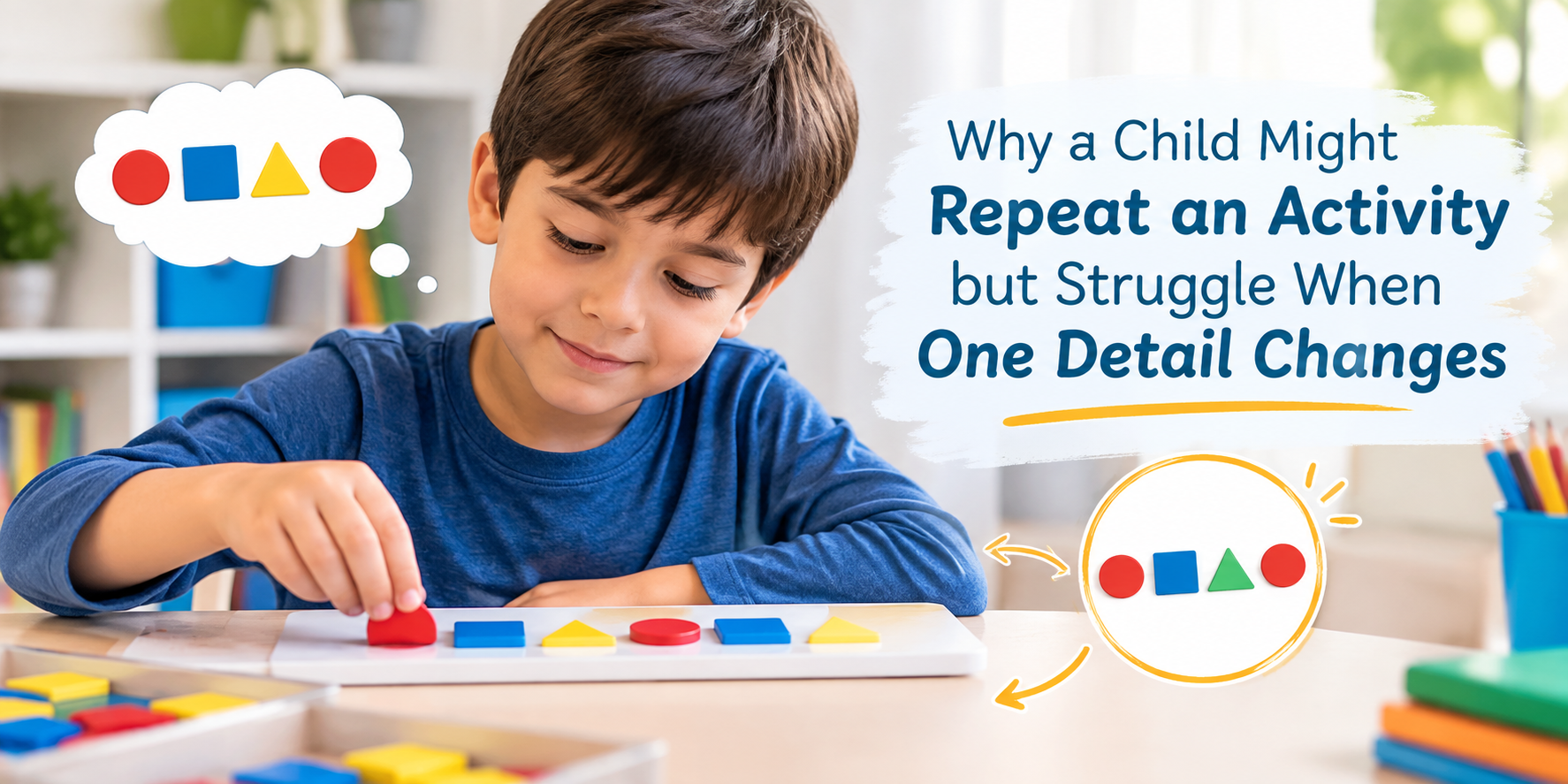
A child may complete the same puzzle, game, routine, or learning activity successfully many times and still become frustrated when just one small detail changes. For families exploring Autism Treatment Highland Park, this can be an important behavior to understand. A child may know exactly what to do when an activity looks familiar, but a slightly different toy, instruction, location, or sequence can suddenly make the task feel much harder.
This does not necessarily mean a child is being stubborn or refusing to learn. Familiar routines can provide predictability, and predictability can make activities easier to understand and complete. When something changes, the child may need to process new information, adjust expectations, and figure out what to do next.
Understanding this difference can help parents, caregivers, and therapists create meaningful opportunities to build flexibility without making a child feel overwhelmed.
Why Familiar Activities Can Feel Easier
Children learn through repetition. Repeating an activity gives them opportunities to practice a skill, remember a sequence, understand expectations, and become more confident.
For some children, repetition also provides a strong sense of predictability.
For example, imagine a child who regularly plays with a set of toy animals. Every time the activity happens, the child lines up the animals, names them, and places them in the same locations. The child becomes very comfortable with this routine.
Then, one day, someone adds a new animal.
To an adult, the change may seem insignificant. To the child, however, several questions may suddenly arise:
- Where should the new animal go?
- Is the activity supposed to be done differently?
- Should the familiar sequence change?
- What happens if the new animal does not fit the usual pattern?
- Is the person asking for something different?
The original activity may have been easy because the child already knew what to expect. The new detail requires flexibility.
This is one reason ABA therapy Highland Park may focus not only on teaching individual skills but also on helping children use those skills when circumstances change.
What Is Flexibility?
Flexibility is the ability to adjust when something does not happen exactly as expected.
It can involve relatively small changes, such as:
- Using a different color of crayon
- Completing a puzzle in a different order
- Playing with a slightly different toy
- Accepting a new snack plate
- Following a changed instruction
- Moving from one activity to another
- Having another person join a familiar game
- Trying an activity in a different location
Flexibility does not mean that a child must be comfortable with every change immediately.
Instead, the goal is to gradually build the ability to notice a change, process it, and continue participating.
For children receiving Applied Behavior Analysis Highland Park, flexibility can be incorporated into everyday learning in ways that are practical and individualized.
Why One Small Change Can Feel So Big
Adults often judge the size of a change based on how different it appears to them.
Children may experience the same change very differently.
A familiar activity can contain many predictable elements. When one of those elements changes, the child may suddenly have to think about something that previously required little effort.
For example, a child may know how to complete a simple matching game. The cards are always placed on the table in the same way, and the child knows what happens next.
If the cards are suddenly turned around or mixed differently, the matching skill itself has not disappeared. However, the context surrounding the skill has changed.
The child may need to:
- Notice the difference.
- Understand that the activity is still the same.
- Identify what remains familiar.
- Determine what needs to be done differently.
- Continue with the activity.
That process can require more attention and problem-solving.
For some children, particularly children who have difficulty with transitions or unexpected changes, this can be challenging.
Repetition Is Not the Problem
It is important not to view repetition as something that should simply be eliminated.
Repetition can be valuable.
Children often use repetition to practice, explore, communicate, regulate themselves, or understand their environment. Repeating an activity can also help a child develop mastery.
The opportunity comes when a child has learned the activity well enough that small, manageable variations can be introduced.
For example, instead of completely changing a favorite activity, an adult might change just one element:
- Same puzzle, different starting piece
- Same blocks, slightly different building goal
- Same story, different place to read it
- Same game, different color piece
- Same snack routine, different cup
- Same drawing activity, different paper
The goal is not to make the activity unpredictable.
The goal is to help the child learn that different does not always mean difficult or wrong.
How Small Changes Can Become Learning Opportunities
Small changes can create natural opportunities to practice flexibility.
Suppose a child enjoys building the same tower every afternoon. Rather than suddenly introducing an entirely new activity, a parent or therapist might make one small adjustment.
Perhaps the child normally uses blue blocks at the bottom. This time, another color is placed nearby.
The adult can encourage the child to continue building while keeping the rest of the routine familiar.
Over time, additional variations may be introduced.
This approach can help a child learn:
“Something changed, but I can still keep going.”
That lesson can become useful far beyond playtime.
Changes in Toys
A familiar toy may be easier to use when it looks and works exactly as expected.
A small difference can sometimes create frustration.
Consider a child who regularly plays with a toy car. One day, the car is a different color. Another day, it has a different shape. Later, a second person begins playing alongside the child.
Each change creates a slightly different situation.
Parents and therapists can use these moments carefully to encourage flexibility while keeping the experience positive.
Possible strategies may include:
Change One Feature at a Time
Rather than changing the entire activity, change one detail.
For example, keep the same game but introduce a different toy.
This makes the change easier to understand.
Use Familiar Elements
If the child is trying something new, keep other parts of the activity familiar.
A familiar setting, person, or routine can provide support while the child practices adjusting to the new element.
Give the Child Time
A child may need additional processing time before responding to a change.
Immediately repeating instructions or adding more demands can sometimes increase frustration.
Allowing a pause gives the child an opportunity to understand what is happening.
Changes in Instructions
Sometimes the activity stays the same, but the instruction changes.
A child may successfully follow:
“Put the red block in the box.”
But then struggle with:
“Put the red block on the table.”
The difference may seem small, but the child has to process new information and adjust the response.
This is where individualized behavioral intervention Highland Park TX can help identify what type of change is difficult and how to teach the skill gradually.
Instructions can be varied carefully once a child demonstrates understanding.
For example, an adult might change:
- The words used
- The order of instructions
- The location of the activity
- The materials involved
- The person giving the instruction
The purpose is to help the child recognize that a skill can still be used even when the situation looks slightly different.
Changes in Familiar Routines
Routines can be especially important for children who depend on predictability.
A routine might include:
Wake up → get dressed → eat breakfast → brush teeth → leave for school.
If one part suddenly changes, the child may struggle to determine what happens next.
This does not necessarily mean the child cannot learn flexibility. It may mean flexibility needs to be taught intentionally.
Parents can begin with small changes that are easier to manage.
For example, if a child always puts on shoes immediately before leaving, an adult might occasionally introduce a short, predictable variation while keeping the overall routine intact.
The child can learn that the sequence may change without the entire routine falling apart.
Flexibility Can Be Built Through Play
Play provides many natural opportunities to practice flexible thinking.
A child who enjoys a particular game may be more motivated to participate when the game remains recognizable.
Parents can introduce simple variations such as:
- Taking turns in a different order
- Changing one game rule
- Using a different piece
- Moving to another part of the room
- Letting someone else choose first
- Adding a new object
- Changing the ending
These changes can be introduced gradually.
The objective is not to “trick” a child into accepting change. Instead, it is to create supportive experiences where the child can practice responding to differences successfully.
What Adults Should Avoid
When a child struggles with a change, it can be tempting to force the situation.
However, making the change much larger than the child can currently tolerate may create unnecessary frustration.
Adults should avoid turning flexibility practice into a battle of wills.
Instead of saying:
“You have to do it this way now.”
It may be more helpful to acknowledge the change and provide support.
For example:
“The blocks are different today. We can still build.”
Simple language can help a child understand that the activity has changed without suggesting that something has gone wrong.
Look for the Reason Behind the Reaction
When a child becomes upset by a small change, the behavior is worth observing rather than immediately labeling it as defiance.
Ask:
- What exactly changed?
- Was the change visual, verbal, physical, or social?
- Did the child know the change was coming?
- Was the child tired or already overwhelmed?
- Was the activity especially important to the child?
- Did the child understand the new expectation?
- Was the change too large for the child’s current skill level?
These questions can help adults identify patterns.
A child may tolerate a different toy but struggle when the order of activities changes. Another child may accept a new instruction but become upset when another person touches a familiar toy.
Flexibility is not one single skill.
Different types of flexibility may need to be taught separately.
The Role of Individualized ABA Therapy
ABA therapy services Highland Park can provide structured opportunities to teach flexibility while considering a child’s communication skills, learning style, interests, and current abilities.
An ABA professional may observe how a child responds to different changes and identify where support is most useful.
Depending on the child’s needs, goals may include:
- Accepting small changes in familiar activities
- Following modified instructions
- Transitioning between activities
- Trying new materials
- Responding to unexpected changes
- Tolerating changes in routines
- Learning alternative ways to complete tasks
- Communicating when help is needed
The specific approach should be individualized rather than based on a one-size-fits-all expectation.
A child may benefit from in-home ABA therapy Highland Park, while another family may prefer center-based ABA therapy Highland Park. The appropriate setting depends on the child’s needs, family circumstances, goals, and treatment plan.
Early Intervention Can Support Flexible Learning
Flexibility is a skill that can be supported throughout development.
For younger children, early intervention ABA Highland Park may incorporate flexibility into play, communication, routines, and everyday learning.
For example, a toddler may practice accepting a different cup, changing the order of a short activity, or playing with a slightly different version of a familiar toy.
These experiences can become building blocks for more complex flexibility later.
As children grow, flexibility may become increasingly important at school, in social situations, during community activities, and within family routines.
Helping Children Learn “Different” Does Not Mean “Wrong”
One of the most important messages adults can communicate is that a change does not automatically mean something is wrong.
A child may initially think:
“That’s not how we do it.”
With practice and support, the child may gradually learn:
“It’s different, but I can still do it.”
That shift can be meaningful.
It can help a child approach unfamiliar situations with greater confidence and reduce the need for everything to happen exactly the same way.
Signs a Child May Need More Support With Flexibility
Every child has preferences, and occasional frustration with change is normal.
Additional support may be worth considering when difficulty with changes consistently interferes with everyday life.
Parents may notice that a child:
- Becomes extremely upset when routines change
- Has difficulty transitioning between activities
- Can complete skills only in one specific setting
- Struggles when instructions are phrased differently
- Refuses familiar activities when one item changes
- Has difficulty accepting alternative materials
- Becomes distressed when another person changes the activity
- Needs activities to happen in a very specific order
These observations can provide useful information for a professional evaluation.
Families looking for autism behavior therapy Highland Park can discuss these concerns with a qualified provider who can help determine whether additional behavioral support may be appropriate.
Building Flexibility Without Taking Away Predictability
The goal is not to remove every routine or make a child’s day unpredictable.
Predictability can be helpful.
Instead, flexibility can be built within predictable routines.
For example:
Familiar routine: Build with blocks.
Small change: Use one new block.
Next opportunity: Build in a different location.
Later opportunity: Let another person choose a block.
Future opportunity: Change one part of the building goal.
Each step can provide another opportunity to practice adjusting.
The pace should depend on the individual child.
Some children may be ready for several variations. Others may benefit from repeating the same small change many times before moving forward.
Supporting Flexibility at Home
Families do not need complicated activities to encourage flexible thinking.
Everyday life naturally provides opportunities.
Parents might:
- Offer two acceptable choices instead of one.
- Occasionally change the order of simple activities.
- Introduce small variations to favorite games.
- Practice using different materials for familiar tasks.
- Model calm responses when plans change.
- Praise attempts to adjust rather than focusing only on perfect responses.
- Give children opportunities to communicate when something feels difficult.
For example, if a favorite cup is unavailable, a parent can acknowledge the disappointment while helping the child choose another option.
This creates a real-life opportunity to practice flexibility.
Finding the Right Level of Challenge
Flexibility practice works best when the challenge is meaningful but manageable.
If a change is too small, the child may not notice it.
If it is too large, the child may become overwhelmed before having a chance to practice the skill.
Professionals providing BCBA services Highland Park can help identify appropriate goals and determine how to gradually increase the level of challenge.
The goal is progress, not perfection.
A child who once could not tolerate a small change may eventually learn to pause, communicate, and continue.
That progress may happen through many small successful experiences.
Why Flexibility Matters Beyond Childhood Activities
Being able to adjust when something changes is useful throughout life.
Children encounter changes at school when a teacher changes an assignment or the classroom schedule shifts.
They encounter changes socially when a friend wants to play a different game.
They encounter changes at home when dinner is different or a planned activity cannot happen.
They encounter changes in the community when a store is closed, a route changes, or an appointment takes place somewhere unfamiliar.
Teaching flexibility through small everyday experiences can help children build skills that apply across many environments.
This is one reason ABA therapy for kids Highland Park may include goals that focus on using learned skills across different people, places, materials, and situations.
A Small Change Can Represent a Big Learning Opportunity
When a child repeats an activity successfully but struggles when one detail changes, the difference may reveal an important learning opportunity.
The child may not simply be refusing to participate. They may be trying to understand what the new situation means.
By slowing down, identifying the specific challenge, and introducing manageable variations, adults can help children develop flexible responses over time.
For families considering Autism Treatment Highland Park, flexibility can be an important area to discuss with a qualified ABA professional. Individualized support can help identify the skills a child already has, the situations that create difficulty, and practical ways to build confidence with change.
The goal is not to make every activity different. It is to help children discover that they can handle small changes and still succeed.
With patient teaching, supportive routines, and opportunities to practice, a familiar activity can become more than something a child repeats. It can become a safe place to learn one of life’s most useful skills: sometimes things change, and I can adjust.
Contact us at 972–310–4991 or visit https://radiantspectrumtherapy.com/our-locations-highland-park/ to learn more.