
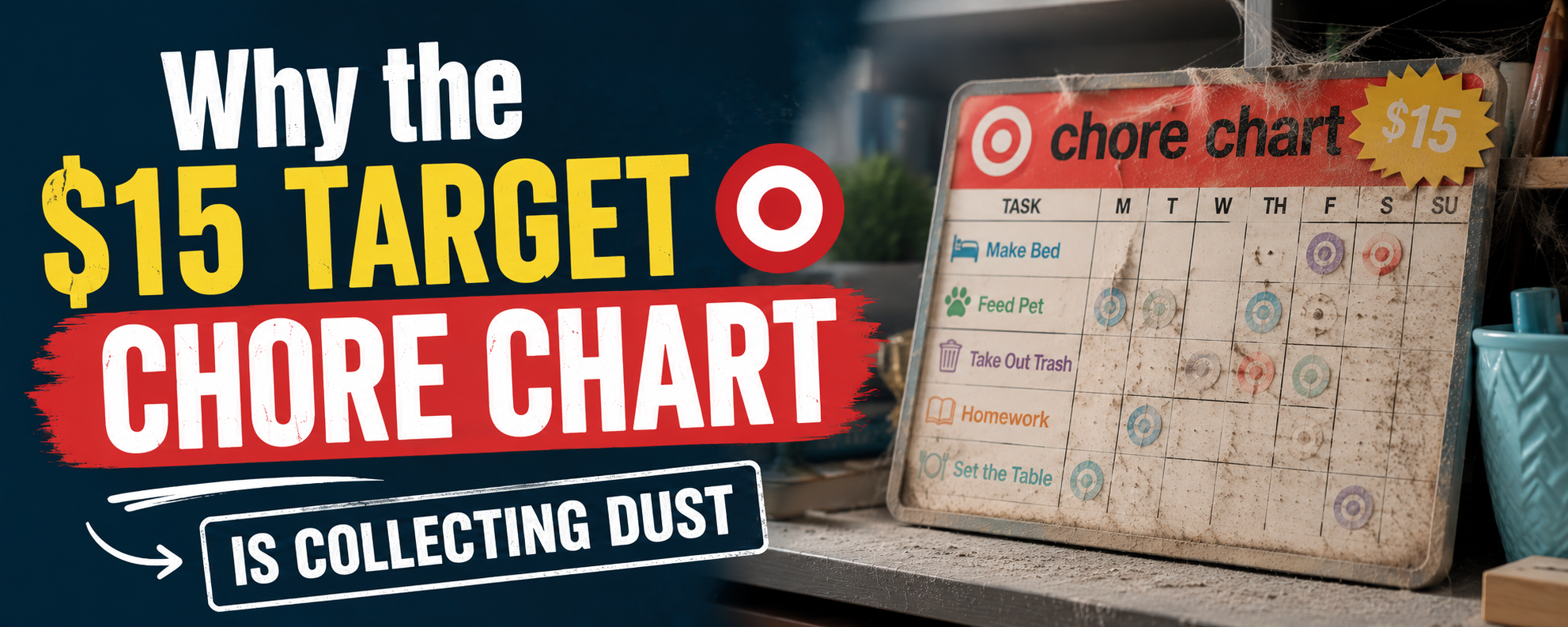
If you’ve ever walked through the aisles at Target, you’ve probably seen those colorful magnetic chore charts promising to transform your child’s daily routine. Maybe you brought one home with the best intentions. For the first few days, everyone was excited. Stickers were placed neatly on the chart, chores were completed, and it seemed like the system was finally working.
Then life happened.
The reminders became constant. The stickers lost their appeal. Your child stopped caring, and before long, the chart ended up buried under school papers on the refrigerator — or tucked away in a drawer, forgotten.
If this sounds familiar, you’re not alone. Many families seeking ABA Parent Training or ABA Therapy in Dallas share this exact experience. The good news is that the problem isn’t your parenting, and it isn’t necessarily your child. More often than not, it’s the system itself.
Behavior science has long shown that sustainable habits require more than colorful charts and occasional praise. Children, especially those who benefit from Center-Based ABA, Home-Based ABA Therapy, or other evidence-based supports, often need a system that’s built around how learning actually happens.
Let’s look at why traditional chore charts usually fail — and what works instead.
Why Traditional Chore Charts Lose Their Effectiveness
Most chore charts are designed with adults in mind. They assume children naturally understand vague expectations and are motivated by collecting stickers.
Unfortunately, that’s rarely the case.
A typical chart might say:
- Clean your room
- Be helpful
- Pick up after yourself
While these instructions seem simple to adults, they’re incredibly broad from a child’s perspective.
What exactly counts as a clean room?
Does putting one toy away count?
Should the bed be made?
Do dirty clothes belong in the hamper?
When expectations aren’t crystal clear, frustration builds on both sides.
Another common problem is delayed reinforcement. A child may earn five stickers before receiving a reward days later. For many children, especially those receiving behavioral therapy North Texas, that delay makes the reward feel disconnected from the behavior.
Eventually, the stickers stop being exciting altogether. In behavior analysis, this is known as satiation — the reinforcer simply loses its value through repeated exposure.
Instead of increasing motivation, the chart becomes another reason for arguments.
Step 1: Replace Vague Chores with Operational Definitions
One of the first concepts taught in ABA therapy Dallas is that behavior must be observable and measurable.
Rather than tracking ideas like “be responsible” or “clean up,” behavior analysts define exactly what success looks like.
This process is called creating an operational definition.
Instead of saying:
Clean your room.
Try defining the task as:
- Toys placed inside the toy bin
- Dirty clothes placed in the hamper
- Books returned to the bookshelf
Now everyone understands the expectation.
There’s no guessing.
No debating.
No confusion.
Children perform better when they know exactly what they’re expected to do.
Think of it this way: if someone asked you to “organize the garage,” you’d probably have questions.
Should you sweep?
Sort tools?
Throw things away?
Label bins?
Children experience that same uncertainty when instructions are too broad.
Families working with autism parent training Dallas often discover that simply making expectations more concrete dramatically reduces resistance.
Step 2: Break Big Jobs into Small Steps Using Task Analysis
Even when expectations are clear, some chores still feel overwhelming.
A request like “empty the dishwasher” sounds like one task to an adult.
To a child, it actually includes dozens of separate actions:
- Open the dishwasher.
- Pull out the bottom rack.
- Pick up one plate.
- Walk to the cabinet.
- Place the plate inside.
- Repeat.
That mental load can trigger avoidance before the chore even begins.
This is where Task Analysis becomes incredibly helpful.
Task Analysis breaks one large activity into manageable steps.
Instead of focusing on the entire job, children learn one piece at a time.
For example, a dishwasher routine could be organized like this:
- Put away all the silverware.
- Put away bowls.
- Put away plates.
- Put away cups.
- Close the dishwasher.
Many professionals providing in-home ABA therapy Dallas teach these routines using forward or backward chaining.
With backward chaining, the parent completes most of the task while the child performs the final step independently.
As confidence grows, the child completes the last two steps.
Then the last three.
Eventually, the entire routine becomes independent.
This gradual teaching process prevents frustration while building genuine success.
Many Dallas ABA centers use similar strategies during daily living skill instruction because they allow children to experience success from the very beginning.
Step 3: Replace Stickers with Functional Reinforcement
Let’s be honest.
A sticker only has value if your child actually wants it.
For some children, that excitement lasts one day.
Others lose interest after the first week.
Instead of assuming stickers are motivating, behavior analysts first identify what actually matters to the child.
This process is often called a preference assessment.
Motivation changes frequently.
Today your child might be excited about:
- Twenty minutes of tablet time
- Riding a scooter outside
- Building with LEGOs
- Staying up fifteen extra minutes
- Baking cookies together
Tomorrow those preferences may look completely different.
The key is matching the reward to the child’s current interests.
One of the easiest systems families can begin using immediately is the First/Then strategy.
For example:
First:
- Toys in the bin
- Clothes in the hamper
- Books on the shelf
Then:
- Twenty minutes of screen time
The reinforcement happens immediately after the completed behavior.
That immediate connection helps children understand exactly why they earned the reward.
Families participating in ABA Parent Training often report that switching from delayed sticker systems to immediate reinforcement creates far fewer daily power struggles.
Step 4: Celebrate Progress Through Shaping
Many parents unintentionally wait until a chore is completed perfectly before offering praise.
That sounds reasonable — but it often backfires.
Imagine you’re learning a new skill at work.
You spend an hour trying your best.
Instead of recognizing your effort, your supervisor only points out what you missed.
Eventually, your motivation drops.
Children respond similarly.
Behavior analysts use a teaching strategy called shaping.
Shaping means reinforcing gradual improvements toward the final goal.
Suppose your child normally leaves every toy on the floor.
Today they pick up five toys.
Instead of saying:
“You still missed ten.”
Try saying:
“I noticed you picked up five toys all by yourself. That’s a great start.”
The child experiences success.
Tomorrow they may pick up seven.
Next week, ten.
Eventually, cleaning the entire room becomes routine.
This approach is commonly incorporated into pediatric behavioral therapy Dallas because confidence grows through repeated success — not repeated criticism.
Why These Strategies Work So Well
Children thrive when expectations are predictable.
They also learn best when success happens often.
Traditional chore charts frequently rely on hope:
“Maybe this sticker will motivate them.”
Behavior-based systems rely on structure:
- Define the behavior.
- Teach each step.
- Reinforce immediately.
- Celebrate improvement.
Those four principles create lasting habits because they focus on learning rather than compliance.
Parents often notice that arguments decrease because everyone understands what success looks like.
Children feel more capable.
Parents spend less time reminding.
Daily routines become calmer.
Whether a family receives services through Center-Based ABA, Home-Based ABA Therapy, or other autism services Dallas TX, these same evidence-based principles can be adapted for home routines.
Every Child Learns Differently
Not every child struggles with chores for the same reason.
Some become overwhelmed by multi-step directions.
Others need stronger motivation.
Some benefit from visual supports.
Others need additional practice before becoming independent.
That’s why individualized strategies matter.
Families working with experienced Dallas autism specialists often discover that small adjustments — rather than major overhauls — can completely change how home routines feel.
Instead of repeating reminders throughout the day, parents gain practical tools for teaching independence one step at a time.
These strategies aren’t about making children perfect.
They’re about making success achievable.
Building Habits That Actually Last
If your Target chore chart has stopped working, don’t view it as a failure.
Instead, think of it as a sign that your child needs a teaching system rather than a tracking system.
Clear expectations.
Small, manageable steps.
Meaningful rewards.
Consistent encouragement.
Those are the ingredients that build lasting habits.
Families exploring DFW ABA therapy often find that the same evidence-based techniques used during therapy sessions can make everyday home routines smoother and far less stressful.
Learning to complete chores independently isn’t simply about having a cleaner house.
It’s about building confidence, responsibility, communication, and lifelong independence — one achievable step at a time.
Frequently Asked Questions
Why do traditional chore charts stop working?
Most chore charts rely on delayed rewards and vague expectations. Children are more likely to stay motivated when expectations are clearly defined and meaningful reinforcement happens immediately after the task is completed.
What is Task Analysis?
Task Analysis is a teaching strategy that breaks a large activity into smaller, manageable steps. This helps children learn complex routines without becoming overwhelmed.
Why is immediate reinforcement important?
Immediate reinforcement helps children connect their completed behavior with the reward. The shorter the delay, the stronger the learning connection.
What is shaping?
Shaping involves reinforcing gradual improvements rather than waiting for perfect performance. This encourages continued effort and builds confidence over time.
How can parents learn these strategies?
Many families benefit from individualized coaching through ABA therapy providers 75201, where practical home strategies can be tailored to a child’s unique learning style while supporting long-term independence.
Contact us at 972–310–4991 or visit https://radiantspectrumtherapy.com/ to learn more.