
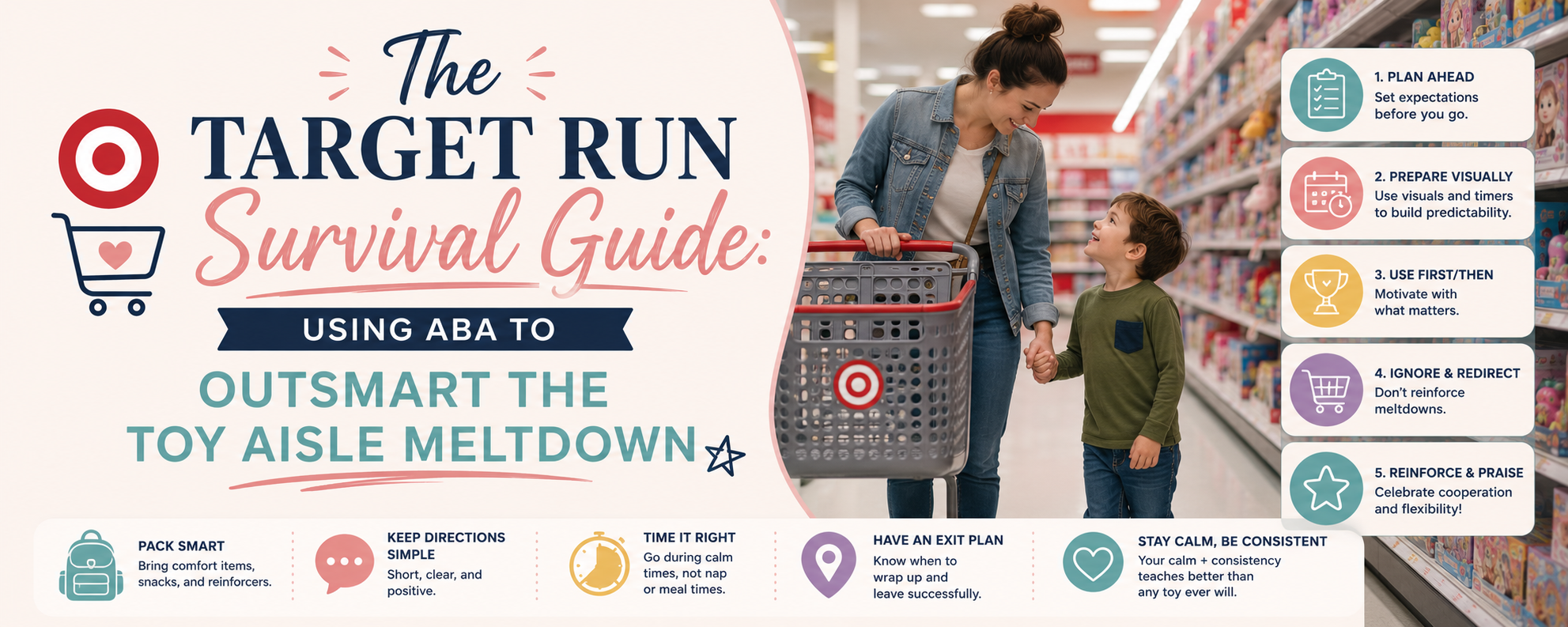
Every parent has been there. You walk into Target with a simple shopping list and a plan to be in and out within 20 minutes. Then you pass the toy aisle.
Suddenly, your child spots a new toy. They want it immediately. You say no. Their disappointment quickly turns into yelling, crying, dropping to the floor, or refusing to move. What began as a routine errand now feels like a public event with an audience of strangers watching from every direction.
For families raising children with autism, these moments can feel especially overwhelming. The sensory stimulation of a busy store, unexpected changes in routine, difficulty waiting, and challenges with communication can all contribute to a meltdown. The good news is that these situations are not hopeless. With the right strategies and consistent support, families can teach skills that make community outings more successful and less stressful.
Applied Behavior Analysis (ABA) focuses on helping children develop practical skills that can be used in everyday life. Shopping trips provide valuable opportunities to practice communication, flexibility, self-regulation, and coping skills. Whether your family receives ABA therapy Highland Park, TX or participates in Home-Based ABA Therapy, the lessons learned during treatment can help transform difficult outings into manageable experiences.
Why the Toy Aisle Can Be So Challenging
To understand how to prevent meltdowns, it helps to understand what may be happening beneath the surface.
For many children, the toy aisle is exciting. For some children with autism, however, it can be intensely stimulating. Bright colors, favorite characters, sounds, and visual displays all compete for attention. When a child sees something they want, they may struggle to understand why they cannot have it immediately.
In addition, children who have difficulty with transitions often find it challenging to move from a preferred activity to a non-preferred one. Leaving the toy aisle without a purchase can feel like a major loss.
This is where structured behavioral support becomes valuable. Families participating in Autism Treatment Highland Park programs often learn that meltdowns are not simply about a toy. They are often related to communication difficulties, emotional regulation challenges, unmet expectations, or a lack of coping strategies.
Start Before You Leave the House
One of the most effective ways to prevent a toy aisle meltdown begins before you even get in the car.
Preparation helps children know what to expect. When expectations are clear, anxiety is often reduced.
Before leaving home, explain:
- Why you are going to the store
- What items you need to buy
- How long the trip will take
- Whether toys will or will not be purchased
Keep the language simple and direct. Avoid vague answers that can create confusion.
For example:
“Today we are buying groceries. We will look at toys, but we are not buying toys today.”
Children benefit when adults provide consistent information. If the expectation changes from trip to trip, it becomes harder for a child to understand the rules.
Many families receiving ABA Parent Training learn how to establish these expectations in ways that are clear, calm, and easy for children to understand.
Use Visual Supports
Visual supports are often powerful tools for children with autism.
A simple shopping list with pictures can help a child stay focused on the purpose of the trip. Visual schedules can show each step of the outing:
- Drive to Target
- Buy groceries
- Pay at checkout
- Go home
When children can see what comes next, they often feel more comfortable and less anxious.
Visual supports are frequently incorporated into both center-based autism services and Home-Based ABA Therapy because they provide consistency across different environments.
Teach the Difference Between Looking and Buying
Many children assume that if they see something they like, they should be able to have it.
One important skill taught through ABA is learning the difference between looking at an item and purchasing an item.
This skill can be practiced gradually.
A child might begin by:
- Looking at a toy
- Talking about the toy
- Holding the toy briefly
- Putting the toy back on the shelf
While this may seem simple, it can be a significant accomplishment for a child who struggles with disappointment.
Behavioral therapists often break large goals into smaller, achievable steps. This approach is common in both center-based autism services and in-home ABA therapy Dallas programs.
Create a Reward Plan
A reward system can help motivate positive behavior during shopping trips.
For example, before entering the store, you might explain:
“If we finish shopping without yelling or dropping to the floor, you can choose a special activity when we get home.”
The reward does not need to be expensive. It simply needs to be meaningful to the child.
Examples include:
- Extra playtime
- A favorite game
- Time with a preferred toy
- Choosing a family activity
The key is consistency. Children learn best when positive behaviors are followed by positive outcomes.
Families working with ABA providers 75205 often develop individualized reinforcement systems that match their child’s interests and goals.
Practice Waiting Skills
Waiting is difficult for many children, especially when they see something they want.
Rather than expecting a child to suddenly wait for long periods, ABA teaches waiting gradually.
Start with a few seconds.
Then increase to:
- 15 seconds
- 30 seconds
- One minute
- Several minutes
Celebrate success at each stage.
When waiting becomes a practiced skill instead of an unexpected demand, children are often more successful during community outings.
Many programs offering ABA therapy Highland Park, TX focus on teaching patience and delayed gratification because these skills affect nearly every aspect of daily life.
Teach Functional Communication
One of the most valuable skills a child can learn is how to communicate disappointment appropriately.
Instead of screaming or crying, a child can learn to say:
- “Can I have that?”
- “Maybe next time?”
- “I’m sad.”
- “I wanted that toy.”
These phrases give children a way to express their feelings without engaging in challenging behaviors.
Communication goals are a major focus of Autism Treatment Highland Park programs because improved communication often leads to fewer behavioral challenges.
When children know how to express themselves effectively, they are less likely to rely on behaviors that create stress for both themselves and their families.
Stay Calm During Difficult Moments
Even with preparation, difficult moments can still happen.
When a child becomes upset, the adult’s response matters.
Try to:
- Speak calmly
- Use short sentences
- Avoid arguing
- Maintain consistent expectations
Children often look to adults for cues about how serious a situation is. If parents become highly emotional, children may become even more distressed.
Families participating in ABA Parent Training frequently practice strategies for remaining calm and supportive during challenging situations.
The goal is not to ignore emotions. The goal is to help children move through those emotions safely and successfully.
Know When to Leave
Sometimes the best decision is to end the shopping trip.
Leaving is not a failure.
If a child becomes overwhelmed by sensory input, exhaustion, illness, or stress, continuing the outing may not be productive.
The important thing is to view the experience as information rather than defeat.
Ask yourself:
- What happened before the meltdown?
- Were expectations clear?
- Was the trip too long?
- Were there warning signs?
Each outing provides valuable insight that can help guide future success.
Professionals providing behavioral therapy Park Cities often help families identify patterns and triggers that contribute to community-based challenges.
Celebrate Small Victories
Progress rarely happens overnight.
A successful shopping trip might begin with something as simple as:
- Walking through the toy aisle without crying
- Looking at a toy and putting it back
- Recovering from disappointment more quickly
- Using words instead of yelling
These milestones matter.
Parents sometimes overlook small improvements because they are focused on larger goals. However, meaningful progress is usually built through many small successes.
Therapists providing pediatric behavioral health Highland Park services often remind families that growth is not measured by perfection. It is measured by steady improvement over time.
Building Real-World Success Through ABA
The ultimate goal of ABA is not simply reducing challenging behaviors. It is helping children develop skills that increase independence, confidence, and participation in everyday life.
A trip to Target may seem ordinary, but it provides countless opportunities to practice:
- Communication
- Flexibility
- Emotional regulation
- Following directions
- Coping with disappointment
- Transitioning between activities
These are skills that extend far beyond the toy aisle.
Whether a child receives support through a local ABA clinic Texas, participates in center-based autism services, or benefits from in-home ABA therapy Dallas, the strategies learned through ABA can help families navigate everyday challenges with greater confidence.
The next time you head to Target, remember that success does not mean a perfect trip. Success means helping your child learn one new skill, manage one difficult moment, or make one positive choice.
Those small victories add up. Over time, they can turn the dreaded toy aisle into just another stop on a successful family outing.
Contact us at 972–310–4991 or visit https://radiantspectrumtherapy.com/ to learn more.